
When most people think about larder beetles, they picture the adult beetle with the pale tan band across its back.
Ironically, that’s usually not the stage doing the most damage.
The real troublemakers are the larvae.
The first time someone finds one, they usually don’t even realize it’s a beetle.
Instead they search Google for things like:
- Brown hairy worm
- Fuzzy bug in my garage
- Hairy caterpillar in my pantry
- Strange brown grub in my basement
I’ve even seen people mistake them for tiny millipedes or caterpillars.
Once you know what to look for, though, larder beetle larvae have several unique features that make them much easier to identify.
Larder Beetle Larvae Don’t Look Anything Like the Adults
One thing that surprises almost everyone is how different the larvae look from the adult beetles.
The adult is an oval-shaped beetle with hard wing covers.
The larva looks more like a fuzzy brown worm.

If you didn’t know they belonged to the same insect, you’d probably never guess they were related.
That’s completely normal.
Like butterflies, larder beetles undergo complete metamorphosis, meaning the larval stage looks entirely different from the adult.



The First Thing I Notice Is the Hair
Whenever I find a suspected larder beetle larva, the first feature I look for is the body covering.
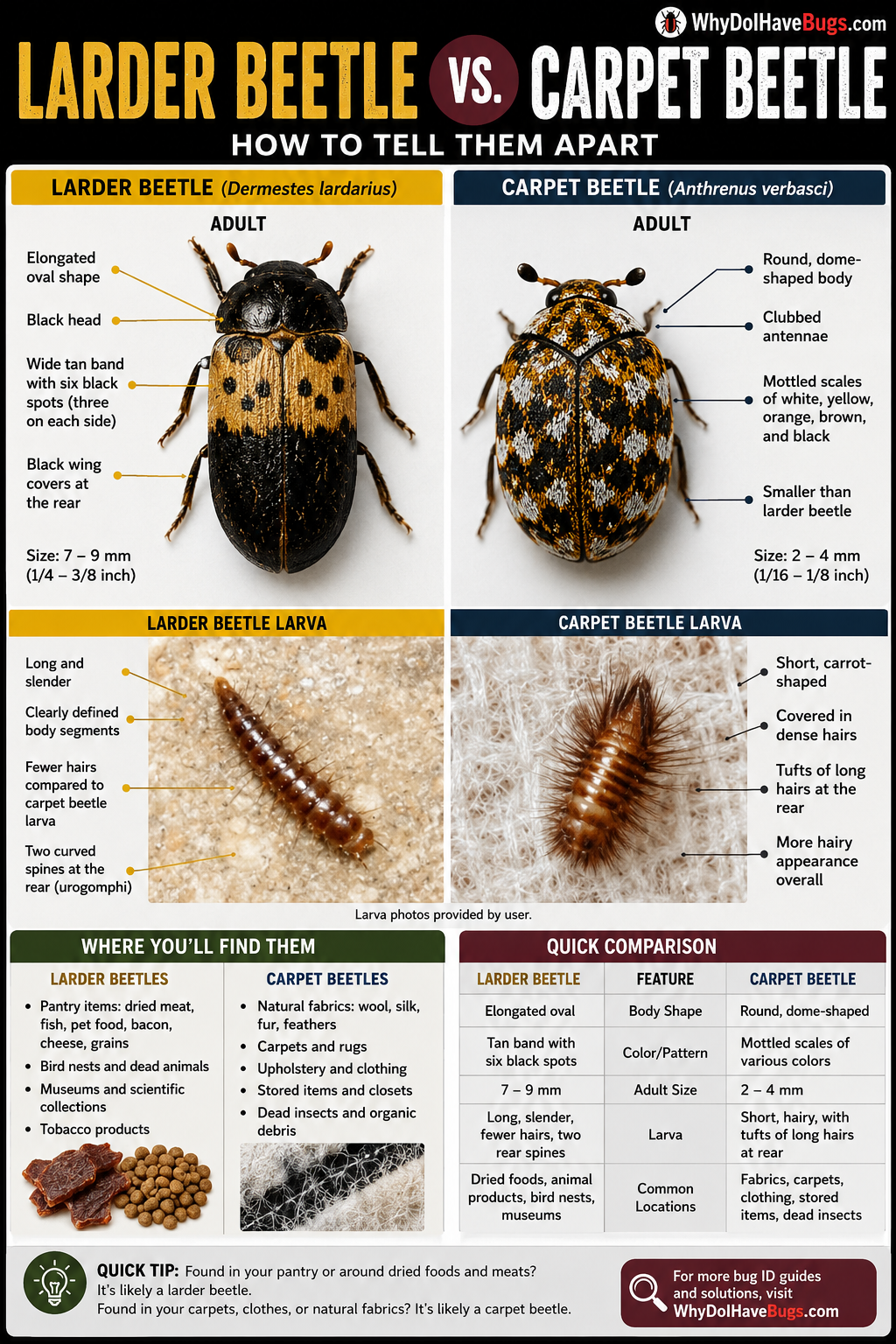
Unlike smooth mealworms or fly larvae, larder beetle larvae are covered with stiff brown hairs.
Those hairs give them a rough, fuzzy appearance that immediately stands out.
The hairs aren’t just near the back.
They’re spread across the entire body, making the larva look almost bristly rather than soft.
That hairy appearance is one of the easiest clues that you’re looking at a dermestid beetle larva rather than another household pest.

Their Bodies Are Long and Segmented
Another feature I always check is the body shape.
Instead of being short and oval like the adult beetle, the larva has a long, segmented body.
Each segment is clearly visible.
The body gradually narrows toward the tail, giving it a slightly tapered appearance.
Unlike caterpillars, they don’t have large fleshy prolegs running underneath the body.
Instead, they have six true legs near the front of the body and crawl with a steady, deliberate movement.
The Two Curved Tail Spines Are the Biggest Clue
If I could pick only one feature to identify a larder beetle larva, this would be it.
At the very end of the body are two curved spines, technically called urogomphi.
They point backward and slightly upward from the tail.
Many homeowners never notice them because they’re small.
But once I learned to look for those tail spines, identifying larder beetle larvae became dramatically easier.
They’re one of the best features for separating them from many other common household larvae.
They Usually Grow Larger Than People Expect
Young larvae are fairly small.
As they continue feeding, however, they become much larger than many homeowners expect.
A mature larva may approach 1/2 inch long, making it noticeably larger than the larvae of many pantry beetles and even larger than most carpet beetle larvae.
That’s another reason people often assume they’ve found some kind of caterpillar instead of a beetle larva.
The size catches them off guard.
Their Color Changes as They Grow
One thing I’ve noticed while looking at photos from extension services is that the color isn’t always identical.
Young larvae often appear lighter brown.
As they mature, they usually become much darker.
Some are reddish brown.
Others are almost black by the time they’re ready to pupate.
Because of that variation, I never rely on color alone when identifying them.
I pay much more attention to the hairs, body shape, and those distinctive tail spines.

Where I Usually Find Larder Beetle Larvae
One of the biggest clues isn’t always what the larva looks like.
It’s where I found it.
Unlike many insects that wander throughout the house, larder beetle larvae usually stay close to whatever they’re feeding on.
The most common places I inspect include:
- Bags of dry dog food.
- Pet treat containers.
- Garages.
- Basements.
- Utility rooms.
- Bird nests.
- Attics.
- Wall voids.
- Dead insects around windows.
- Areas with signs of rodent activity.
If I find a larva crawling across the floor, I don’t assume that’s where it came from.
In many cases it’s actually searching for a place to pupate, which means the food source could be several feet away or even in another part of the room. Mature larvae commonly leave their food source before pupating and may be found wandering across floors or walls.
Mature Larvae Often Leave Their Food Source
This is one of the most interesting parts of the larder beetle life cycle.
Young larvae spend most of their time eating.
Mature larvae behave very differently.
Once they’re fully grown, they stop looking for food and begin looking for a safe place to transform into adults.
That’s why homeowners often find them crawling across:
- Basement floors.
- Garage walls.
- Window ledges.
- Around door frames.
- Along baseboards.
Many people assume the beetles are feeding there.
Usually they’re not.
They’re simply traveling to find a protected place to pupate.



Why They Sometimes Chew Into Wood
This behavior scares a lot of homeowners.
They find small holes in wood and immediately think the larvae are eating the house.
Fortunately, that’s usually not what’s happening.
When larder beetle larvae are ready to become adults, they often chew shallow chambers into materials like:
- Soft wood.
- Cork.
- Cardboard.
- Paper products.
- Foam insulation.
They’re not eating those materials for nutrition.
They’re creating a protected pupal chamber where they can safely complete their transformation into an adult beetle.
In most homes, the damage is minor, but repeated infestations can eventually become noticeable if the same area is used over and over. Extension specialists emphasize that the boring is for pupation rather than feeding.
What Larder Beetle Larvae Are Commonly Mistaken For
I completely understand why people misidentify these larvae.
At first glance they can resemble several other household pests.
The insects I see confused with them most often are:
- Carpet beetle larvae.
- Mealworms.
- Darkling beetle larvae.
- Wireworms.
- Small caterpillars.
- Bristle millipedes.
The two insects people confuse the most are carpet beetle larvae and larder beetle larvae.
They’re both members of the dermestid beetle family and both have hairy bodies.
However, once you know the differences, telling them apart becomes much easier.
I’ll cover those differences in detail in my upcoming guide comparing the two species.


How I Identify One in Less Than a Minute
Whenever I find a suspicious larva, I don’t focus on just one characteristic.
Instead, I quickly work through a mental checklist.
I ask myself:
- Is the body long and clearly segmented?
- Is it covered with stiff brown hairs?
- Does it have six true legs near the front?
- Is it larger than most carpet beetle larvae?
- Can I see the pair of curved spines on the end of the abdomen?
- Was it found near a likely food source?
If the answer to most of those questions is yes, I’m usually looking at a larder beetle larva rather than another household insect.
What I Do After Finding One
Finding a larva tells me something important.
It means there is, or recently was, a food source nearby.
Instead of killing the larva and moving on, I immediately begin inspecting the surrounding area.
I look for:
- Dry pet food.
- Pet treats.
- Dead insects.
- Bird nests.
- Signs of rodents.
- Animal-based materials in storage.

After I’ve removed the source and vacuumed thoroughly, I usually treat cracks, baseboards, and other beetle travel routes with Ortho Home Defense Insect Killer for Indoor & Perimeter² to help eliminate wandering larvae and newly emerged adults before they can spread into other parts of the house.
Frequently Asked Questions
Are larder beetle larvae hairy?
Yes. Larder beetle larvae are covered with stiff brown hairs that give them a fuzzy or bristly appearance. This is one of their easiest identifying features.
How big do larder beetle larvae get?
Fully grown larvae are typically around 1/2 inch long, making them noticeably larger than many other household beetle larvae.
Why are larder beetle larvae crawling across my floor?
They’re often looking for a safe place to pupate. Mature larvae commonly leave their food source and wander before transforming into adults.
Do larder beetle larvae eat wood?
No. Although mature larvae frequently bore into wood, cork, insulation, or cardboard, they’re creating a pupal chamber rather than feeding on the material.
What’s the easiest way to tell them apart from carpet beetle larvae?

The easiest clue is the pair of backward-curving spines at the end of the abdomen. Larder beetle larvae have these distinctive tail spines, while carpet beetle larvae do not.
Can Larder Beetle Larvae Damage Your Home?
One thing that surprises many homeowners is that the larvae can occasionally damage more than just stored products.

Unlike adult larder beetles, which spend much of their time searching for mates and new food sources, the larvae are almost constantly feeding or preparing for the next stage of their life cycle. Comparing the larva with the adult can make identification easier, so see adult larder beetle appearance for the adult beetle's distinguishing features.
Most of the damage they cause comes from feeding on animal-based materials.
However, mature larvae have another habit that catches people off guard.
When they’re ready to transform into adults, they often bore into soft materials to create a protected pupal chamber.
I’ve seen homeowners panic after finding tiny holes in wood, thinking termites or powderpost beetles had invaded their home.
Fortunately, that’s usually not the case.
Larder beetle larvae aren’t eating the wood.
They’re simply tunneling into it for protection while they pupate.
Materials they may bore into include:
- Soft wood.
- Cork.
- Thick cardboard.
- Foam insulation.
- Similar soft materials.
Serious structural damage is uncommon in homes, but repeated infestations over a long period can eventually leave noticeable holes in susceptible materials.
What Time of Year Are You Most Likely to Find the Larvae?
People often assume larvae can appear at any random time.
While that’s true indoors, I tend to notice patterns.
Many homeowners begin finding adult beetles during the spring.

That usually means the larvae developed weeks or months earlier while feeding somewhere inside the home. A guide to where larder beetles enter and develop can help explain why the adults may appear in rooms far from the original food source.
Because homes stay relatively warm year-round, larder beetles aren’t limited to one short season.
If an adequate food source remains available, larvae can continue developing indoors throughout much of the year.
That’s why I don’t dismiss a larva simply because it’s the middle of winter.
If the house provides warmth and food, they can continue their life cycle indoors.
Why You Might Only Find One Larva
This question comes up more often than people realize.
Someone finds one hairy larva crawling across the garage floor and immediately wonders if hundreds more are hiding somewhere.
The honest answer is…
Maybe.
A single wandering larva doesn’t automatically mean your home is heavily infested.
Remember that mature larvae often leave their food source before pupating.
The one you found may have traveled quite a distance from where it was feeding.
That’s why I never assume the room where I discovered the larva is where the infestation actually started.
Instead, I slowly inspect the surrounding rooms for likely food sources.
Sometimes I find one immediately.
Other times, it takes a lot more detective work.
Why These Larvae Are So Often Misidentified
I completely understand why homeowners struggle with identification.
Before I spent time researching them, I probably would’ve called them a “hairy worm.”
The problem is that several household insects have larvae that look somewhat similar.
People commonly mistake larder beetle larvae for:
- Carpet beetle larvae.
- Mealworms.
- Darkling beetle larvae.
- Small caterpillars.
- Bristle millipedes.
The confusion becomes even greater because search engines often show photos of all of these insects together.
That’s one reason I decided to create a separate comparison guide specifically for larder beetle larvae and carpet beetle larvae.
Although they’re closely related, there are several reliable ways to tell them apart once you know what features to examine.
My Best Identification Tips
Whenever I’m trying to identify one of these larvae, I avoid relying on color alone.
Instead, I look at the entire insect.
The features I trust most are:
- A long, clearly segmented body.
- Dense, stiff hairs covering the body.
- Six true legs near the front.
- A gradual taper toward the rear.
- The distinctive pair of backward-curving tail spines.
- A location that’s close to animal-based food sources.
Those characteristics together give me far more confidence than simply matching the color to an online photograph.
My Next Step After Finding a Larva
Whenever I find a larder beetle larva, I actually consider it a more important discovery than finding an adult beetle.
An adult might simply have flown indoors.
A larva usually tells me there’s a food source nearby or that there recently was one.
That’s why I immediately begin inspecting the surrounding area instead of just removing the larva.
After I’ve removed whatever was feeding the larvae, I vacuum thoroughly and then treat cracks, baseboards, and other travel routes with Ortho Home Defense Insect Killer for Indoor & Perimeter² to help eliminate any remaining larvae and newly emerged adults before they spread to other parts of the house.
Final Identification Checklist
Before I confidently identify a larva as a larder beetle, I ask myself these questions:
- Is it about 1/2 inch long when fully grown?
- Is the body long, segmented, and covered with stiff hairs?
- Does it have six legs near the front?
- Can I clearly see the two backward-curving tail spines?
- Was it found near pet food, dead insects, bird nests, garages, basements, or another likely food source?
If I can answer “yes” to most of those questions, I’m usually looking at a larder beetle larva rather than another household pest.
More Frequently Asked Questions
Are larder beetle larvae dangerous?
Not to people.
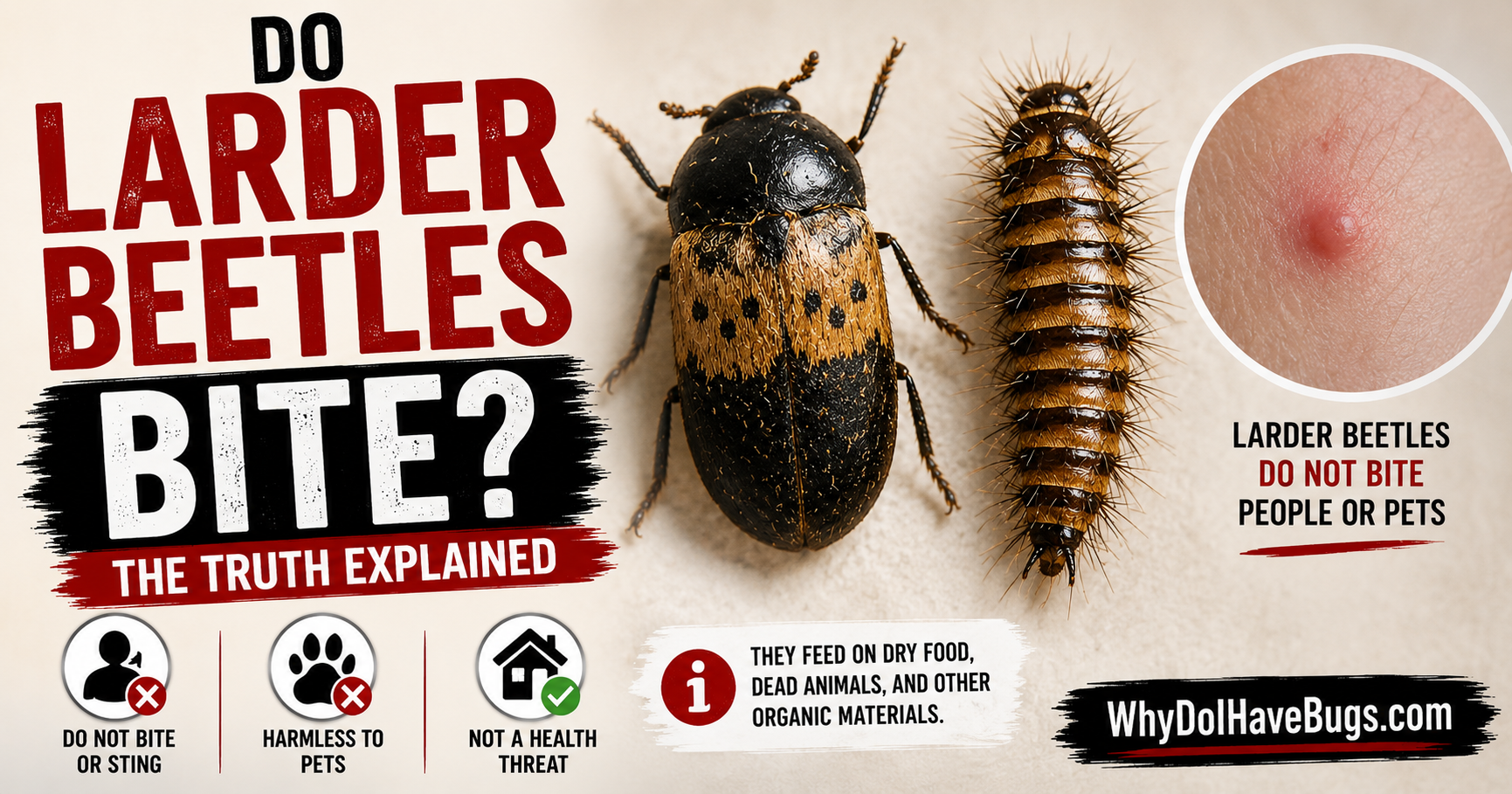
Larder beetle larvae don’t bite, sting, or spread through your home looking for people or pets.
Their primary concern is the damage they can cause to animal-based materials and stored products. If they’re present in your home, they’re almost always feeding on something rather than trying to interact with people.
Do larder beetle larvae bite?
No.
Unlike fleas, bed bugs, or mosquitoes, larder beetle larvae aren’t interested in feeding on humans.
Although their stiff hairs can occasionally irritate sensitive skin if handled, they don’t bite or seek out people as a food source. (extension.umn.edu)
How long do larder beetle larvae stay larvae?
The length of the larval stage depends on temperature, food availability, and environmental conditions.
Under good conditions, larvae spend several weeks feeding before searching for a protected place to pupate.
If food is scarce or temperatures are cooler, development can take considerably longer. (extension.psu.edu)
Why did I find one crawling across my floor?
In many cases, a mature larva has finished feeding and is searching for a safe place to pupate.
That means the place where you found it isn’t necessarily where it developed.
The actual food source could be several feet away or even in another room connected through wall voids or other hidden spaces.
Can I have larvae without seeing adult larder beetles?
Yes.
In fact, it’s fairly common.

Larvae often remain hidden near their food source while adults wander throughout the house after emerging. The adult stage is also capable of flight, as explained in why adult larder beetles wander.
Some homeowners discover larvae first, while others only notice the adults weeks later.
Should I kill every larva I find?
Absolutely.
Any larva you find should be removed immediately.
However, don’t stop there.
Finding even one larva tells me it’s time to begin looking for the food source that’s supporting the infestation.

Simply removing the larva without finding what’s feeding it usually won’t solve the problem. Once you locate the food source, these larder beetle control products can help with the remaining infestation.
The Bottom Line
When I find a larder beetle larva, I don’t just see a single insect.
I see evidence.
That larva tells me there’s a reason it’s in my house.

Instead of chasing wandering adults, I focus on identifying what the larvae have been feeding on because that’s almost always where the real problem begins. Tracing that material can uncover the sources behind larder beetles.
Once the source is removed, I vacuum thoroughly to remove any remaining larvae, shed skins, and food debris. If I continue seeing activity afterward, I treat cracks, baseboards, and other beetle travel routes with Ortho Home Defense Insect Killer for Indoor & Perimeter² to help eliminate any remaining larvae and newly emerged adults while the infestation comes to an end.

The good news is that once you know the features to look for, especially the hairy segmented body and the pair of curved tail spines, identifying larder beetle larvae becomes much easier. That confidence helps you start looking in the right places and greatly increases your chances of solving the infestation permanently. After confirming the identification, use this practical guide to solve a larder beetle infestation.
About the Author
Mark Sullivan has spent years researching household beetles and helping homeowners identify hidden infestations before they become major problems. After initially mistaking the beetles in his own home for carpet beetles, he learned firsthand how important accurate identification is and now shares practical, research-backed guidance to help others confidently identify and eliminate larder beetles.