A while back, I pulled a pair of shoes out of our attic that had been sitting there for quite some time.
As I looked inside one of them, I spotted what looked like a tiny brown insect shell.
At first, I honestly had no idea what it was.
My first thought was a bed bug.
Then I wondered if maybe it came from some kind of roach.
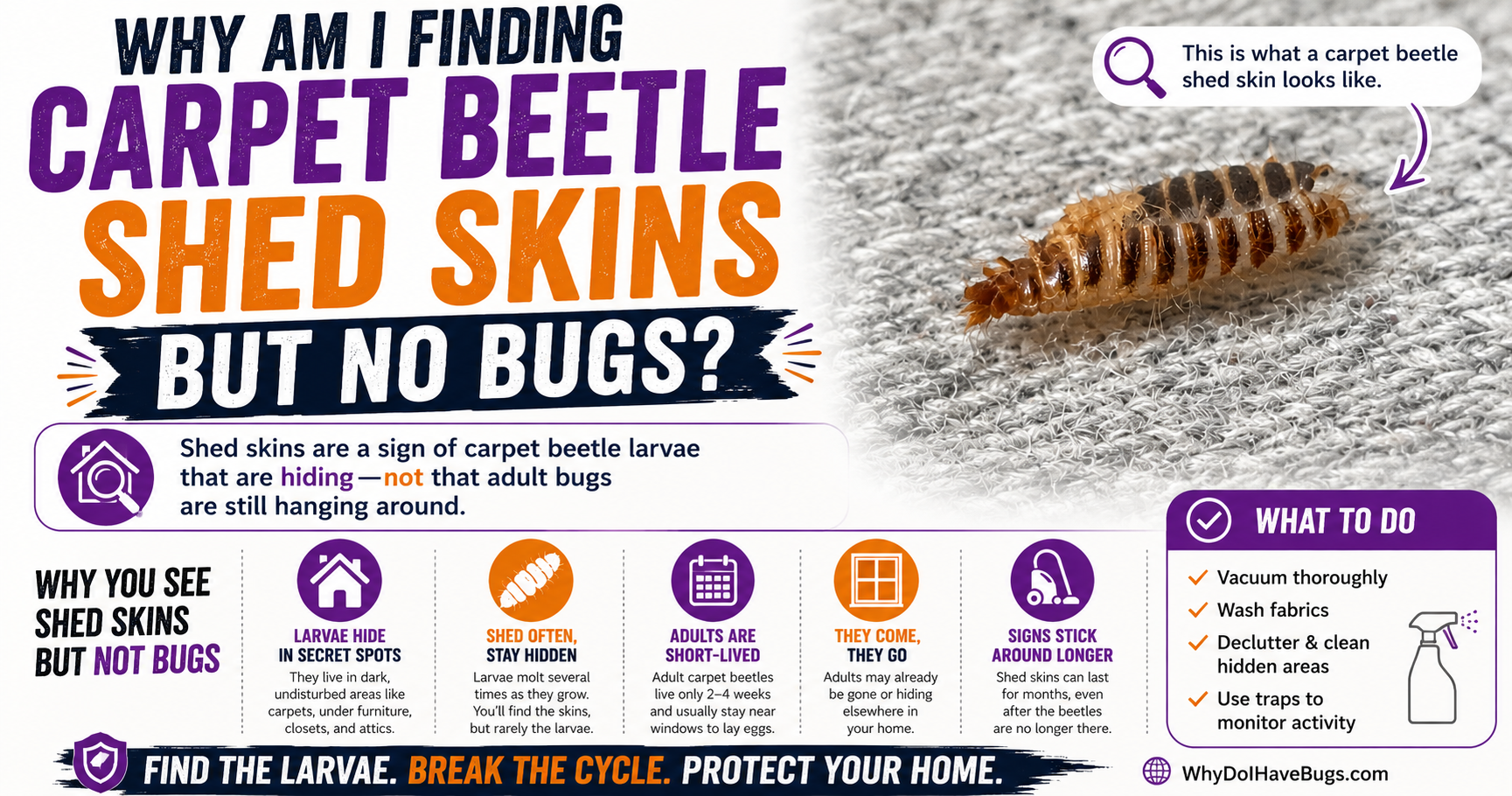
After looking much closer, I realized it was actually a carpet beetle shed skin.
The strange part?
I never found the bug that left it behind.
If you’ve had the same experience, you’re not alone.
It’s actually one of the most common questions people have after discovering evidence of carpet beetles.
The good news is that finding carpet beetle shed skins without seeing any live bugs doesn’t automatically mean you have a massive infestation. Dead adults can provide another clue when you are assessing what those shed skins mean, as explained in Why Do I Keep Finding Dead Carpet Beetles? Here’s What It Usually Means.
The bad news is that it also doesn’t mean the problem is gone.
Understanding why you’re finding shed skins instead of live insects is the first step toward figuring out what’s really happening inside your home. The next step is checking Where Do Carpet Beetle Larvae Hide? Common Hiding Places, since larvae often leave shed skins behind after moving into protected areas.
If you’re still trying to confirm that the object you found is actually a carpet beetle shed skin, I recommend comparing it with my guide showing what a carpet beetle shed skin looks like before assuming you’re dealing with another household pest.
My First Thought When Someone Finds a Shed Skin
Whenever someone tells me they’ve found what looks like a carpet beetle shell but can’t find any bugs, I don’t immediately assume the insects disappeared. The next step is to follow How to Get Rid of Carpet Beetles Fast Step by Step Guide so you can look for the source instead of treating only the evidence you can see.
Instead, I ask myself a completely different question.
Where would a carpet beetle larva want to hide?
That changes the entire investigation.
Most people spend their time looking in open areas.
Carpet beetle larvae spend almost no time there.
They’re built to stay hidden.
Once I start thinking like the insect instead of the homeowner, the hiding places become much more obvious.



The Shed Skin Usually Outlasts the Bug You Were Looking For
One thing that surprises many homeowners is how long a carpet beetle shed skin can remain exactly where it was left.
Unlike the living larva, it doesn’t move.
It doesn’t crawl away.
It simply stays there until someone eventually finds it while cleaning, unpacking storage, or moving furniture.
That means the empty shell you’re holding could have been left behind weeks or even months ago.
Meanwhile, the larva that produced it may have already moved somewhere else or even completed its life cycle.
That’s one reason I never assume the surrounding few inches are the only place worth inspecting.

Learn what spray works to kill them here!
Carpet Beetle Larvae Spend Most of Their Lives Hidden
If you’ve been searching every room and still haven’t found a live larva, don’t get discouraged.
Honestly, that’s pretty normal.
Carpet beetle larvae are incredibly good at avoiding people.
They prefer places that are:
- Dark.
- Quiet.
- Undisturbed.
- Close to food.
They’re far more likely to be tucked beneath stored clothing than crawling across your living room floor.
They’re more comfortable under furniture than on top of it.
That’s why many homeowners find several shed skins before they ever see a living larva.
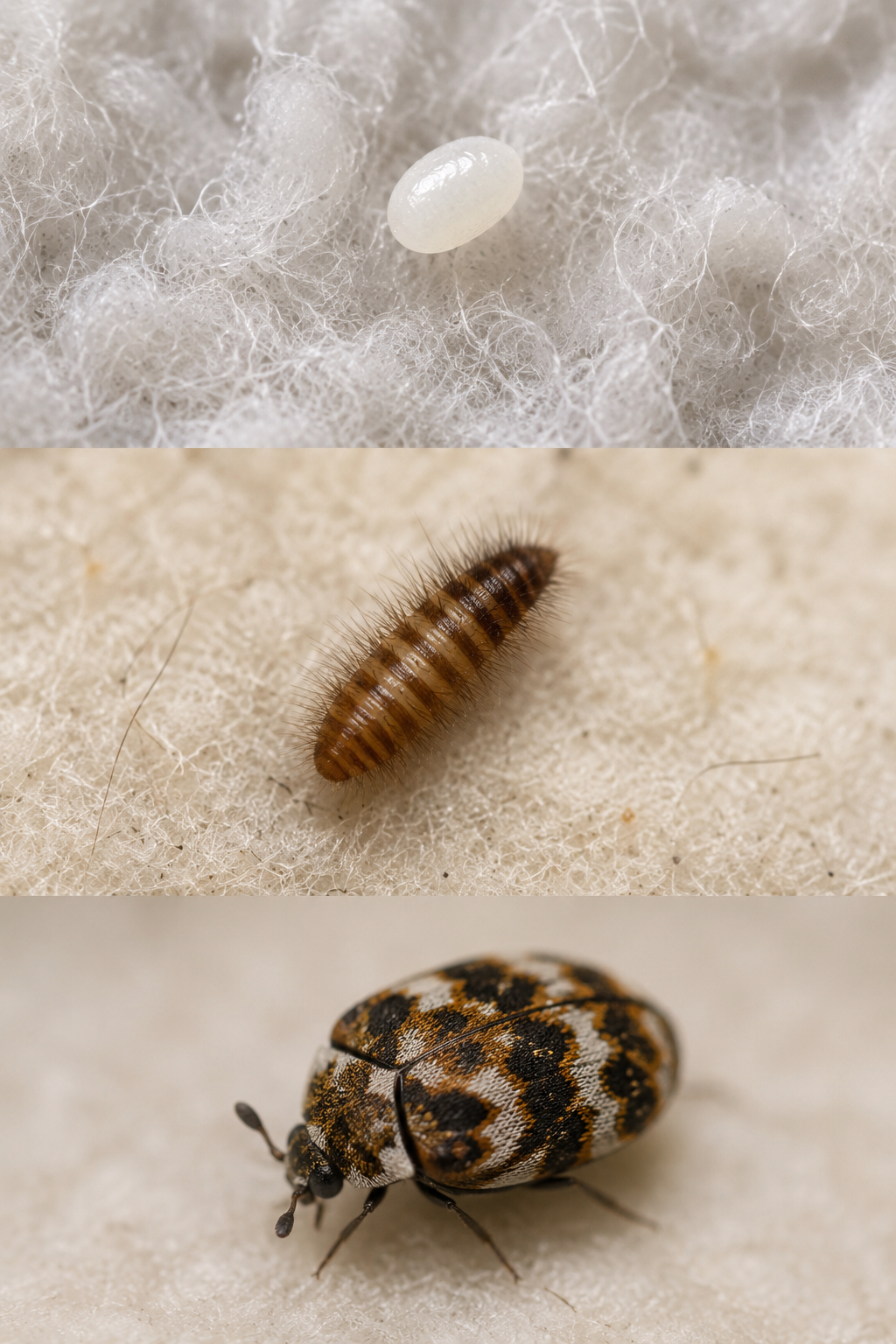
If you’re looking for a broader overview, my Everything You Need to Know About Carpet Beetles guide brings together everything I’ve learned about identifying, preventing, and getting rid of carpet beetles in one place.
One Shed Skin Doesn’t Always Mean Disaster
This is where I try to calm people down a little.
Finding one carpet beetle shed skin doesn’t automatically mean your home has a major infestation.
Sometimes it’s simply evidence that one larva developed nearby.
If I only found one shell, I’d become curious.
If I found five or six scattered throughout the same room, I’d become much more concerned.
The number of shed skins matters almost as much as finding them in the first place.



Why I Don’t Stop Looking After Finding the First One
One thing I’ve learned is that the first shed skin is usually just the beginning of the story.
It tells me I need to slow down and inspect the surrounding area more carefully.
If I had stopped searching after finding the one inside my attic shoe, I never would have understood why it was there.
Instead, I started looking at everything nearby.
Stored clothing.
Blankets.
Boxes.
Other shoes.
Shelves.
That’s the approach I’d recommend to anyone who discovers a carpet beetle shed skin.
Instead of throwing it away, use it as your starting point.
Where I Would Search Next
If this happened in my own house tomorrow, I’d begin expanding my search in every direction.
Not because I expect larvae to be everywhere.
Because I know they usually stay close to food.
I’d carefully inspect nearby closets, storage totes, seasonal decorations, blankets, sweaters, shoes, pet bedding, upholstered furniture, and anything else made from natural fibers.
The goal isn’t simply finding another shed skin.
It’s discovering why that location appealed to the larva in the first place.

One of the biggest reasons homeowners end up with carpet beetles is because their homes unintentionally provide the perfect environment for developing larvae. If you’re wondering what attracted them to begin with, my article explaining why you have carpet beetles in your house covers the most common causes I see.


Stored Items Are Often the Missing Piece
Over the years, one pattern has become obvious to me.
The majority of carpet beetle problems begin in places people rarely disturb.
Think about the areas you might only visit a few times each year.
Attics.
Guest rooms.
Closets.
Holiday decorations.
Boxes stacked on shelves.
Winter blankets.
Stored shoes.
Those quiet locations collect lint, dust, pet hair, and sometimes even dead insects.
To a carpet beetle larva, that’s an ideal place to live.
To us, it looks perfectly harmless.
That’s why carpet beetle infestations often remain hidden until someone starts unpacking seasonal items or doing a deep cleaning.
One Thing I Always Check After Finding a Shed Skin
After finding that carpet beetle shed skin in my attic shoe, I didn’t immediately start looking for another shell.
I started looking for food.
That’s because carpet beetle larvae don’t randomly choose where they live.
They settle where they have something to eat.
If you can identify the food source, you’re often much closer to finding the larvae than if you simply keep searching for bugs.
Around the area where you found the shed skin, ask yourself questions like:
- Is there stored clothing nearby?
- Are there wool blankets or sweaters?
- Has this area collected a lot of dust or lint?
- Are there pet beds or pet hair nearby?
- Are there old boxes that haven’t been opened in months?
Answering those questions often reveals why the larva chose that location.



Don’t Forget to Check Above Eye Level
One thing I think many homeowners overlook is that they only search the floor.
I actually spend just as much time looking above eye level.
I’ve found evidence of carpet beetles in attic rafters, high closet shelves, storage boxes, insulation around attic access doors, and even decorative items that hadn’t been moved for years.
Remember, the adult beetles can fly.
The larvae can’t.
So if an adult female laid eggs inside a box sitting on a high shelf, that’s exactly where the larvae may begin developing.
The Bug You’re Looking For May Not Even Be There Anymore
Here’s something that caught me by surprise when I first started learning more about carpet beetles.
Sometimes the larvae are already gone.
After developing, they eventually transform into adult carpet beetles.
Those adults often crawl toward windows because they’re attracted to light.
Some eventually fly outside.
That’s one reason people often find shed skins but never discover the insect that left them behind.
The evidence remains long after the insect has moved on.



Carpet Beetles Don’t Usually Stay in One Spot
Another misconception I hear is that carpet beetles choose one hiding place and stay there forever.
Not really.
As larvae search for food, they may move through nearby storage areas.
An adult female may also lay eggs in several different locations around your home.
That’s why I recommend inspecting the entire room instead of focusing only on the exact spot where you found the shed skin.
Why I Think Carpet Beetles Fool So Many Homeowners
Honestly, I think carpet beetles are some of the easiest household pests to overlook.
Cockroaches run across the floor.
Ants march across the counter.
Bed bugs leave bites that usually get your attention quickly.
Carpet beetles are different.
Most of the activity happens quietly.
The larvae stay hidden.
The adults are small.
The damage develops slowly.
Then one day you notice a damaged sweater, a strange shell, or a tiny beetle on the windowsill and wonder where it came from.
That’s exactly why I encourage homeowners to investigate early instead of waiting for more evidence.
What I Would Do Before Buying Any Products
If this happened at my house again, I wouldn’t immediately order insecticides online.
I’d spend the first afternoon doing three things.
First, I’d thoroughly vacuum the entire area, paying close attention to baseboards, cracks, closet corners, shelves, and underneath furniture.
Next, I’d inspect every nearby item made from natural fibers, including blankets, wool clothing, leather items, shoes, and pet bedding.
Finally, I’d look for more evidence.
Additional shed skins.
Live larvae.
Adult carpet beetles.
Fabric damage.
Those clues tell me far more than simply finding one empty shell.
Prevention Is Almost Always Easier Than Treatment
One thing I’ve learned over the years is that carpet beetles are much easier to prevent than eliminate.
Regular vacuuming removes many of the things larvae feed on.
Storing seasonal clothing in sealed plastic containers instead of cardboard boxes makes it much harder for adults to lay eggs on fabrics.
Cleaning pet hair from under furniture and along baseboards also removes one of the food sources many homeowners don’t realize they’re providing.
Simple habits often make a much bigger difference than people expect.
If you’re interested in learning more about carpet beetles and other beetles commonly found around the home, be sure to browse our growing Beetles resource center. I’m continually adding new identification guides, prevention tips, and practical solutions based on real experiences and research.
The Biggest Mistake I See
The biggest mistake I see is homeowners treating the shed skin as the problem.
It isn’t.
The shed skin is actually a clue.
It’s evidence that a carpet beetle larva successfully developed nearby.
Instead of asking,
“How do I get rid of this shell?”
Ask,
“Why did the larva choose this location?”
That simple shift in thinking usually leads you much closer to the real source of the infestation.
Frequently Asked Questions
Why am I finding carpet beetle shed skins but no bugs?
This is very common. Shed skins remain behind after a larva molts, while the living larva often moves to another nearby hiding place or eventually becomes an adult beetle.
Can carpet beetle larvae hide where I can’t see them?
Yes. They commonly hide beneath stored clothing, inside closets, under furniture, in attic storage, along baseboards, and in other quiet places with access to natural fibers.
Does finding one carpet beetle shed skin mean I have an infestation?
Not necessarily. One shed skin may be old. However, finding several shed skins, damaged fabrics, or live larvae usually indicates active carpet beetle activity.
Should I throw the shed skin away?
Yes, but before you do, use it as a clue to inspect the surrounding area for additional evidence. The location where you found it is often more important than the shell itself.
What’s the first thing I should do after finding a carpet beetle shed skin?
Inspect nearby natural-fiber materials, vacuum thoroughly, and look for additional signs like more shed skins, larvae, damaged fabrics, or adult carpet beetles.
About the Author
Ryan Mitchell is a home pest researcher who specializes in identifying common household insects through real-world observations and practical home inspections. His goal is to help homeowners understand why pests appear in the first place so they can solve the source of the problem instead of simply treating the symptoms.