
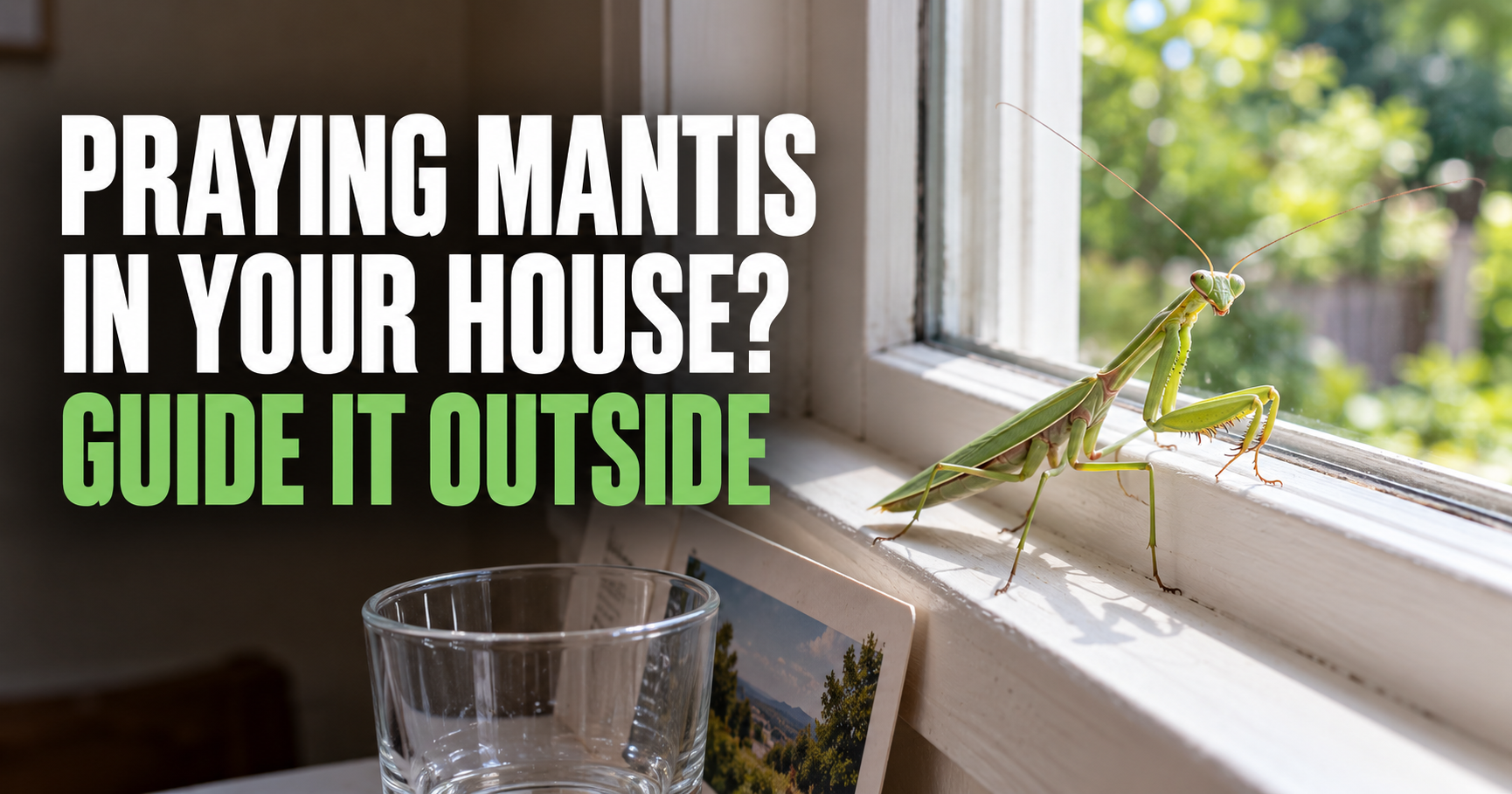
Finding a praying mantis in your house can be startling, especially when it is perched on a curtain, window, or wall looking far bigger than you expected. The good news is that one mantis indoors is usually not an infestation, not a danger, and not a reason to spray your home.
The simplest answer is to gently move it outside. Place a clear container over the mantis, slide a stiff piece of paper or thin cardboard underneath, carry it outdoors, and set it on a shrub, small tree, or other plant. That is safer for you and much better for the mantis than trying to grab it or kill it.
Is a Praying Mantis in the House Dangerous?
No. A praying mantis inside your house is not dangerous to people, dogs, cats, or the home itself.
Mantises do not carry disease around a house, chew wood, infest food, reproduce in kitchen cabinets, or damage clothing. They are outdoor predators that hunt other insects. When one ends up indoors, it is usually there by accident.

A mantis can pinch if somebody squeezes it, traps it against their skin, or tries to handle it roughly. That is a defensive reaction, not an attack. For a closer look at what that means in real life, see whether praying mantises are dangerous.
The main concern is simply that an indoor mantis is in the wrong environment. There is usually little food, low humidity, and no good place for it to live or hunt.



What to Do With a Praying Mantis in the House
The container-and-paper method is the easiest way to get a praying mantis out of the house without hurting it.
You will need a cup, clear plastic container, small bowl, or jar, plus a postcard, junk mail insert, thin cardboard, or another stiff piece of paper.
- Move slowly toward the mantis so it does not jump or start walking farther up the wall.
- Place the container over it, keeping the opening flat against the wall, window, floor, or other surface.
- Slide the paper between the surface and the container until the mantis is standing on it.
- Keep the paper pressed against the container as you carry it outside.
- Set the container against a leafy shrub, tree trunk, tall garden plant, or similar protected outdoor spot.
- Pull the paper away and let the mantis walk out on its own.
You do not need to rush it across the yard. A nearby bush or tree is fine. Choose a place away from a busy door if possible so it does not simply wander back inside.



Do Not Grab or Spray the Mantis
A praying mantis is not a pest that needs an insecticide. Spraying one on a wall, window, or curtain creates an unnecessary mess and exposes people, pets, and indoor surfaces to a product that is not needed for the problem.
It is also better not to pick it up with bare fingers. Mantises have strong front legs designed to hold prey. They may cling tightly or give a small defensive pinch if frightened. That does not make them aggressive, but it does make a cup and paper much easier for everyone involved.
If the mantis is on a lampshade, fragile curtain, or houseplant, put the container close to it and give it a moment to walk inside. You can gently encourage it with the edge of the paper, but avoid poking or flicking it.
How to Get a Praying Mantis Out of a High Window or Ceiling
A mantis on a high wall or ceiling is more awkward, but the same basic approach works.
Do not stand on a chair, countertop, or anything unstable just to reach one insect. If it is safely out of reach, the better move is to wait until it travels down the wall or onto a window.
Mantises are often drawn toward light, so they may eventually settle near a window where they are easier to reach. If it is on a curtain, close the curtain carefully enough to bring it down within reach, then use the container method.
For a mantis on a high window, a long-handled duster or soft broom can sometimes help guide it downward, but do not swat at it. A quick hit can injure the insect or knock it somewhere even harder to reach.
If you need a ladder, do not attempt the removal alone. The fall risk is not worth it. Most single mantises will move eventually, and they are not causing harm while they wait.



Does One Praying Mantis Mean More Are Inside?
Usually, no.
A single praying mantis in your house almost always means one individual wandered in through an open door, a damaged screen, a window gap, or another small opening. It does not mean they are nesting in the walls or breeding indoors.
Mantises are solitary insects. They do not form colonies like ants, termites, or social wasps. They do not build indoor nests. Even if you see one near a window light, it is not a sign that a hidden group is living nearby.
If you find mantises repeatedly, look at the route rather than assuming an infestation. Check whether a screen has a tear, a storm door is not sealing well, or an exterior light is drawing insects close to an entry point.
Why Did a Praying Mantis Come Inside?
Most mantises enter a house accidentally while following prey, shelter, or light. They are commonly found around homes because yards offer shrubs, flowers, trees, garden insects, and places to rest.
At night, an exterior light can attract moths, flies, and other insects. A mantis may follow that food source toward a porch, open door, or window. It can then slip inside when someone comes and goes.
Other common entry routes include:
- Open doors and windows
- Torn window screens
- Gaps around window frames
- Loose weatherstripping under doors
- Attached vegetation brushing against the house
- Potted plants, cut flowers, or outdoor items carried inside
A mantis in the house may also have been hiding on something you brought in. Check potted plants, hanging baskets, firewood, outdoor furniture cushions, or fall decorations before bringing them indoors.

For more on why mantises show up around homes in the first place, see why praying mantises are around your house.
Should You Put a Praying Mantis Back Outside in Cold Weather?
If you find an adult praying mantis inside during mild fall weather, moving it outside to a sheltered shrub or tree is usually the right choice.
If it is very cold outside, there is no perfect indoor long-term solution for an adult mantis. It is still an outdoor insect, and a heated house does not give it the food or conditions it needs. Place it in the most sheltered outdoor area available, such as dense evergreen foliage, a shrub near leaf litter, or another protected plant area.
Avoid keeping it in a jar for days. Adult mantises need live prey and appropriate conditions, and they are not easy to care for indoors without a specific setup.
What if a Child or Pet Finds the Mantis First?
A calm explanation usually works better than panic. Tell children not to squeeze it or put it in their hands, then help them watch it from a short distance while you move it outside.
Dogs and cats are more likely to bat at or eat a mantis than be harmed by one. A mantis may defend itself if cornered, but it is not venomous and does not have a dangerous sting.
If a pet eats one, monitor for ordinary stomach upset, especially if the insect might have been exposed to a pesticide outdoors. In most cases, a single mantis is not a serious pet emergency. Call your veterinarian if your pet seems unwell or if you think it may have eaten an insect recently treated with a chemical product.



Could It Be a Praying Mantis Egg Case?
An adult mantis walking across your wall is not an egg case. Still, people sometimes find a strange tan, foamy-looking mass attached to a branch, outdoor decoration, wreath, or plant that was brought inside.
That mass is called an ootheca. It holds many mantis eggs and can look a little like dried tan foam hardened around a twig.
Do not confuse an egg case with a single adult mantis. An adult indoors does not mean it laid eggs in the house. Female mantises typically attach egg cases outdoors to twigs, stems, fences, garden stakes, and similar surfaces.

If you find a suspected egg case on a live plant or twig that was brought indoors, move that item back outside if you can. A warm house can cause the eggs to hatch at the wrong time, leaving dozens of tiny mantises with no food. This praying mantis egg sac identification guide will help you confirm what you found before removing anything.
How to Keep Praying Mantises From Coming Back Inside
You do not need pest control treatment to keep mantises out. Focus on ordinary exclusion steps that also help prevent other occasional outdoor insects from entering.
- Repair tears in window and door screens.
- Replace worn weatherstripping around exterior doors.
- Check for gaps around window frames, utility lines, and doors.
- Keep doors closed when possible, especially at night with porch lights on.
- Trim branches, vines, and tall plants that touch siding or windows.
- Reduce unnecessary exterior lighting near entry doors, or use lights that are less attractive to insects.
- Check houseplants, cut branches, decorations, and other outdoor items before carrying them inside.
I have seen how easily a large brown mantis can disappear against tree bark around our Missouri property. That same camouflage can make it easy to miss one resting near a screen, porch light, or door frame, so a quick look around entry points is worthwhile before you start sealing gaps.


Should You Keep a Praying Mantis as a Pet?
You can, but a surprise mantis from the house is usually better released outdoors.
Mantises need a ventilated enclosure, places to hang while molting, suitable temperatures, and live insects to eat. They are fascinating to watch, but they are not low-maintenance pets. An adult that wandered indoors is generally better off returned to a protected outdoor plant than kept in a cup or jar.
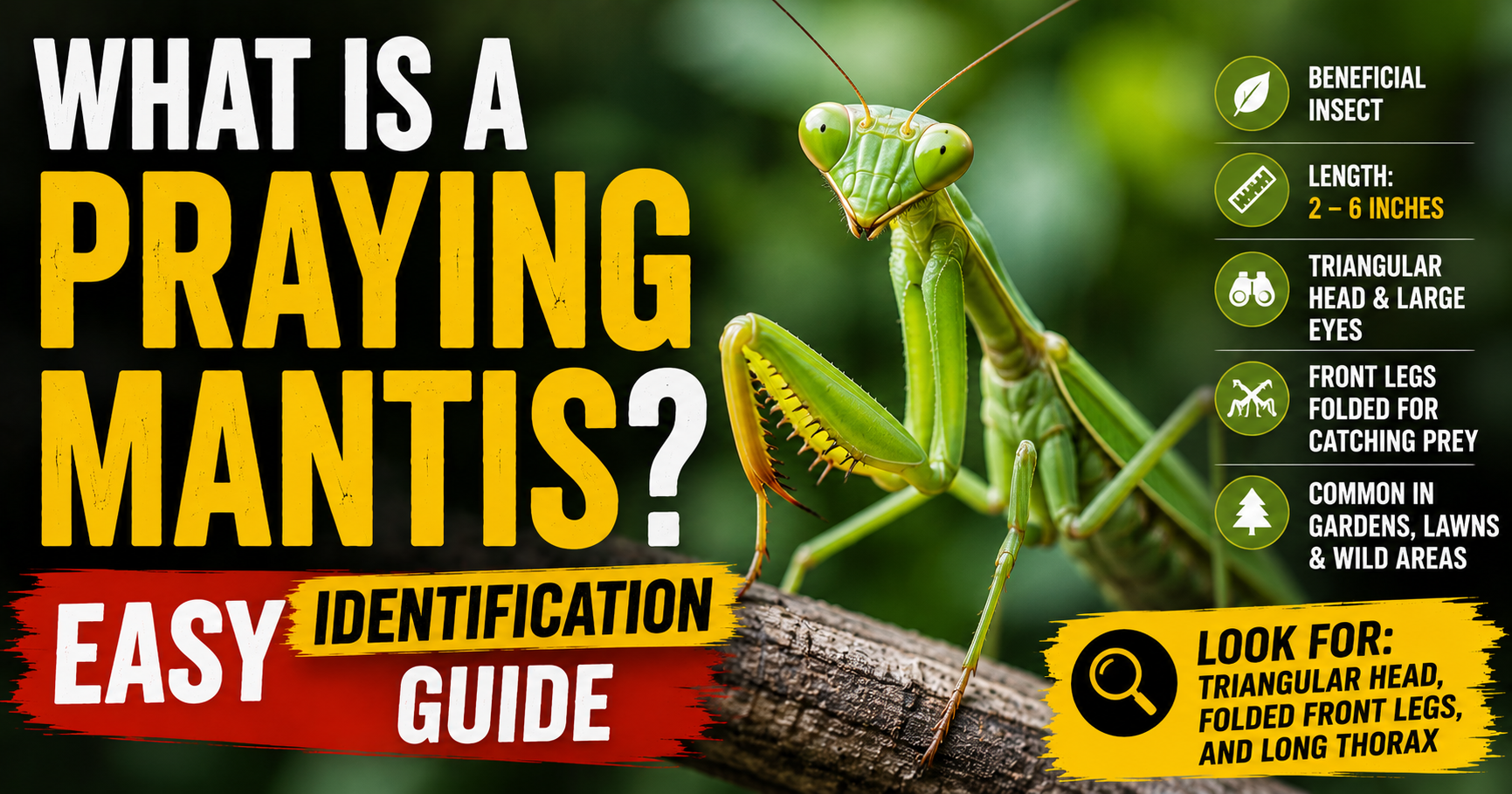
If you do decide to learn more about the mantis before releasing it, compare its body shape, wings, coloring, and front legs with this easy praying mantis identification guide.
When a Praying Mantis Indoors Might Need a Different Response
Most situations are simple: catch it, release it, and check the nearby door or screen. A few situations deserve a closer look.
You Find Many Tiny Mantises Indoors
Dozens of tiny mantises at once may mean an egg case was carried inside on a wreath, branch, houseplant, or seasonal decoration. Look nearby for a tan, foamy egg mass. Move the item outside if weather and conditions allow.
Do not release tiny hatchlings directly onto a bare lawn or sidewalk. Put the egg case or the plant material on a shrub, low branch, or other sheltered outdoor vegetation where the young mantises have a better chance of finding food.
You Keep Finding Other Outdoor Insects Too
A mantis alone is not a building problem. But repeated sightings of mantises, moths, beetles, crickets, and other outdoor insects near the same room can point to a screen, door sweep, or window gap that needs attention.
Start with the easiest fixes. Screen repair and weatherstripping often solve more than one insect issue at a time.
You Are Not Sure It Is a Mantis
Mantises have a long neck-like thorax, triangular head, and bent front legs that look like they are held in prayer. If the insect has a flattened oval body, very long antennae, or fast-running behavior, it may be a different indoor visitor.
Take a clear photo before moving it if you are unsure. Correct identification matters because the right response for a mantis is very different from the right response for a cockroach, cricket, or other household insect.
Frequently Asked Questions
Can I leave a praying mantis in my house?
You can, but it is better to move it outside. A home usually does not provide enough food or the right conditions for an outdoor predator to live well.
Will a praying mantis crawl on me?
It might crawl onto a hand or arm if it is trying to get somewhere, but it is not seeking people out. Use a container instead of your hands if you would rather not have it touch you.
Can praying mantises fly inside a house?
Adult mantises can fly, although females of some species are less active fliers than males. A mantis near a window may fly or flutter when disturbed, which is another reason a container is easier than trying to catch it by hand.
Do praying mantises lay eggs in houses?
It is uncommon. Mantises normally lay egg cases outdoors on plants, twigs, fences, and similar surfaces. An egg case found indoors was more likely brought in on an outdoor item.
Should I vacuum up a praying mantis?
No. A vacuum can injure or kill it. Use a container and paper so you can release it outside instead.
Does finding a mantis mean my house has bugs?
It can mean there are insects around the outside of the house, especially near lights or plants, but one mantis indoors does not prove you have an indoor pest problem.
What should I do if the mantis is dead?
Dispose of it in the trash or compost it if appropriate for your setup. Then check nearby screens, doors, and windows for the likely entry point.
Caleb Warren writes practical pest guides for WhyDoIHaveBugs.com, combining careful identification with straightforward advice homeowners can actually use.