Finding an unfamiliar beetle crawling across your floor is enough to make almost anyone wonder one thing.
Can it bite me?
That was one of my first questions after I discovered larder beetles in my own home.
The adults looked intimidating enough.
Then I started finding the hairy larvae.
At that point, I really wanted to know if either one could bite people or my pets.
Fortunately, the answer is much better than most homeowners expect.
Larder beetles are not insects that feed on people.
They’re scavengers that specialize in animal-based materials, not human skin.
Still, there are a few things you should know because many people mistake skin irritation caused by the larvae for actual insect bites.
The Short Answer
If you’re looking for the quick answer…
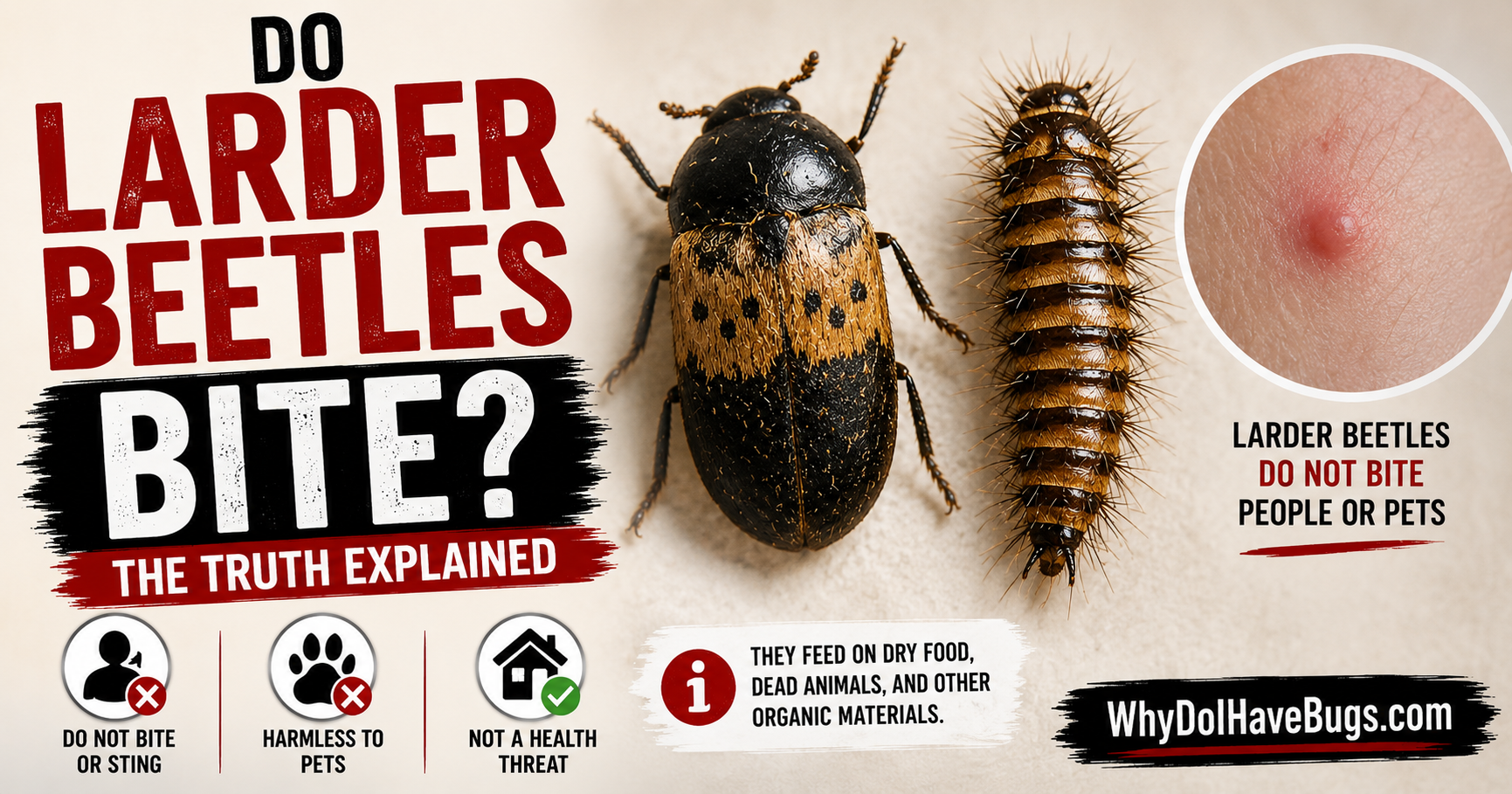
No, larder beetles do not bite people.

Neither the adults nor the larvae feed on human blood.
They don’t seek out sleeping people.
They don’t inject venom.
They don’t bite the way bed bugs, fleas, mosquitoes, ticks, or spiders do.
Their mouthparts are designed for chewing dried animal materials, not piercing skin.


Adult Larder Beetles Don’t Bite Humans
The adult beetle spends its time searching for food, mates, and places to lay eggs.
If one crawls onto your hand, it may feel unsettling.
But it isn’t trying to bite you.
I’ve picked up adult beetles while moving them outside and never had one attempt to bite.
Like many beetles, they may move their legs rapidly as they try to escape, but that’s very different from aggressive behavior.
They’re much more interested in finding dried pet food, dead insects, or another protein-rich food source than interacting with people.



What About the Larvae?
The larvae worry people even more.
They’re larger.
They’re hairy.
They look far more intimidating than the adults.
Fortunately, they don’t bite either.
Their chewing mouthparts are designed for feeding on materials like:
- Dry dog food.
- Dry cat food.
- Dead insects.
- Animal hides.
- Fur.
- Feathers.
- Leather.
- Other protein-rich materials.
Humans simply aren’t on the menu.
Why Some People Think They Were Bitten
This is where much of the confusion comes from.
Although larder beetle larvae don’t bite, their stiff body hairs can sometimes irritate sensitive skin.
Some people develop an itchy rash after handling the larvae or after coming into contact with shed larval skins.
That irritation is an allergic reaction rather than an insect bite.
I’ve seen homeowners swear they were being bitten when the real cause was the tiny hairs left behind by developing larvae.
If you’re seeing itchy bumps but haven’t actually witnessed a beetle biting you, this is one possibility worth considering.



What Happens if One Crawls on You?
Usually…
Nothing.
Most people won’t experience any reaction at all.
If an adult beetle crawls across your arm, it’ll typically continue on its way looking for somewhere to hide.
If it’s a larva, you may notice the prickly hairs brushing against your skin, but simply washing the area is usually enough.
If irritation develops and persists or becomes severe, it’s always a good idea to contact a healthcare professional.
Can Larder Beetles Bite While You’re Sleeping?
No.
This is another common fear.
Unlike bed bugs, larder beetles have no reason to crawl into your bed looking for a blood meal.
If you find one on your mattress, it’s almost certainly there by accident while wandering through the room.

If you’ve recently found a beetle in your bedroom, it’s much more important to determine why it’s in the house than to worry about being bitten. Start by using identify a larder beetle to verify what you found before investigating why it is indoors.
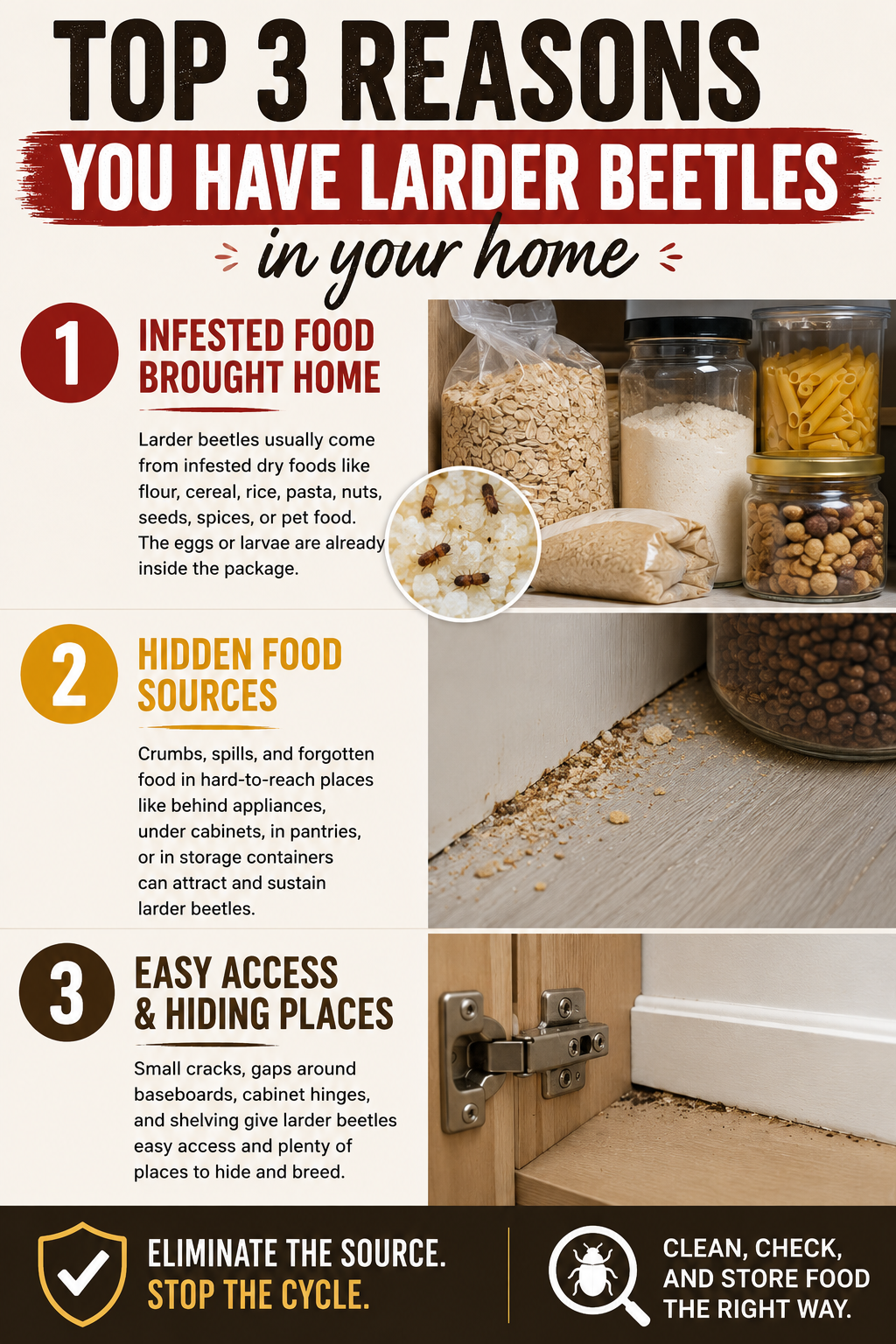
If you’re still trying to figure that out, my guide explaining why you have larder beetles walks through the hidden food sources I always investigate first.
Can Larder Beetles Bite Dogs or Cats?
No.
Larder beetles don’t bite pets any more than they bite people.
They’re not parasites like fleas or ticks, and they don’t feed on blood.

If you find one crawling through your dog’s bed or near your cat’s food bowl, it’s almost certainly searching for food or a place to hide rather than your pet. If your concern is carpet beetles rather than larder beetles, whether carpet beetles live in pet beds explains why pet beds deserve inspection.
The only time I become concerned is if they’ve infested the pet food itself.
In that case, I throw the food away, clean the storage area thoroughly, and inspect nearby shelves before opening a fresh bag.
Why Do People Think Larder Beetles Bite?
I think there are three main reasons.
First, the larvae look intimidating.
They’re covered with stiff hairs and are much larger than many people expect.
Second, some people develop mild skin irritation after handling larvae or coming into contact with their shed skins.

Finally, people often discover larder beetles around the same time they’re dealing with another insect that actually does bite. If that other insect resembles a common house fly, whether house flies can bite helps distinguish harmless fly contact from a true bite.
It’s easy to blame the beetle when the real culprit is something else entirely.


Could They Be Crawling on You at Night?
It’s possible.
But it isn’t because they’re looking for you.
Adult larder beetles sometimes wander while searching for food or places to lay eggs.
A wandering beetle could accidentally crawl across your arm while you’re sleeping, just like a ladybug or another harmless beetle might.
If that happens, it’s simply in the wrong place at the wrong time.
It isn’t trying to bite you.
When Should You Be Concerned?
Although bites aren’t something I worry about, I do pay attention if I start seeing several beetles or larvae around the house.
Multiple beetles usually tell me there’s a food source somewhere nearby.
That could be:
- Dry pet food.
- Dead insects.
- Bird nests.
- A dead rodent.
- Animal-based stored products.

If you’re seeing more than an occasional wandering adult, I recommend reading my guide on how to get rid of larder beetles because finding and removing the food source is the most important step toward eliminating the infestation.


What I Do If I Find One
Whenever I find a larder beetle, I don’t panic.
Instead, I use it as a clue.
First, I inspect the surrounding area for anything the larvae could be feeding on.

Next, I vacuum thoroughly to remove beetles, larvae, shed skins, and food debris. For repeated cleanup, a vacuum for beetles and larvae may be useful when removing insects, shed skins, and debris from nearby surfaces.

Once I’ve cleaned the area and removed the source, I usually apply Ortho Home Defense Insect Killer for Indoor & Perimeter² around baseboards, cracks, and other beetle travel routes to help eliminate any remaining adults before they can establish another breeding site.
Frequently Asked Questions
Can larder beetles bite humans?
No. Adult larder beetles don’t bite people, and they aren’t interested in feeding on human blood or skin. (extension.psu.edu)
Do larder beetle larvae bite?
No. Although the larvae have chewing mouthparts for feeding on animal-based materials, they don’t bite people or pets. (extension.psu.edu)
Why does my skin itch after touching one?
Some people develop irritation from the stiff hairs found on the larvae or from shed larval skins. This is an allergic or mechanical skin irritation rather than an insect bite. (extension.psu.edu)
Can a larder beetle crawl into your bed?
Yes, it’s possible for an adult beetle to wander onto a bed while exploring, but it isn’t there to bite you or feed on you.
Should I worry if one crawls on me?
No. Simply brush it off or remove it. If you handled a larva, washing your hands afterward is a good precaution, especially if you have sensitive skin.
About the Author
Mark Sullivan has spent years researching household beetles and helping homeowners identify hidden infestations before they become major problems. After initially mistaking larder beetles for carpet beetles in his own home, he now shares practical, research-backed guidance that helps readers confidently identify, control, and prevent household beetle infestations.