
Most homeowners only notice larder beetles after the adults begin crawling across the floor or gathering on windowsills.
By then, however, the infestation has usually been developing for quite some time.
What many people don’t realize is that the adult beetle you see today probably spent weeks or even months hidden as an egg, then a larva, before finally emerging as an adult. A similar delayed-emergence pattern helps explain why flies can remain hidden before emerging can seem to appear without warning.
Understanding the larder beetle life cycle completely changed how I approached getting rid of them.
Instead of focusing only on the adult beetles I could see, I started thinking about the stages I couldn’t see.
That shift in thinking made it much easier to locate the real source of the infestation and stop new generations from developing.
The Larder Beetle Has Four Life Stages
Like many beetles, larder beetles undergo complete metamorphosis.

That means they pass through four distinct stages:
- Egg.
- Larva.
- Pupa.
- Adult.
Each stage looks completely different and behaves differently.
Because of that, homeowners often don’t realize the hairy larva and the adult beetle are actually the same insect at different points in its life. Under ideal conditions, the entire life cycle can be completed in roughly 40 to 50 days, although cooler temperatures and limited food can lengthen development considerably.



Stage One Begins With Tiny Eggs
Everything starts when an adult female finds a suitable food source.
She doesn’t lay eggs randomly around the house.
Instead, she places them directly on or very close to materials the larvae can feed on immediately after hatching.
Some of the most common egg-laying locations include:
- Dry dog food.
- Pet treats.
- Dead insects.
- Bird nests.
- Animal remains.
- Leather.
- Fur.
- Taxidermy.
A female may lay well over 100 eggs during her lifetime when conditions are favorable.
Because the eggs are tiny, cream colored, and tucked into food sources or cracks, most homeowners never notice them.


Eggs Hatch Faster Than Most People Expect
Many people imagine the eggs sitting there for months.
In reality, they usually hatch surprisingly quickly.
Under favorable indoor conditions, the incubation period is often less than two weeks, and in warm environments it may be considerably shorter.
That’s one reason infestations seem to appear so suddenly.
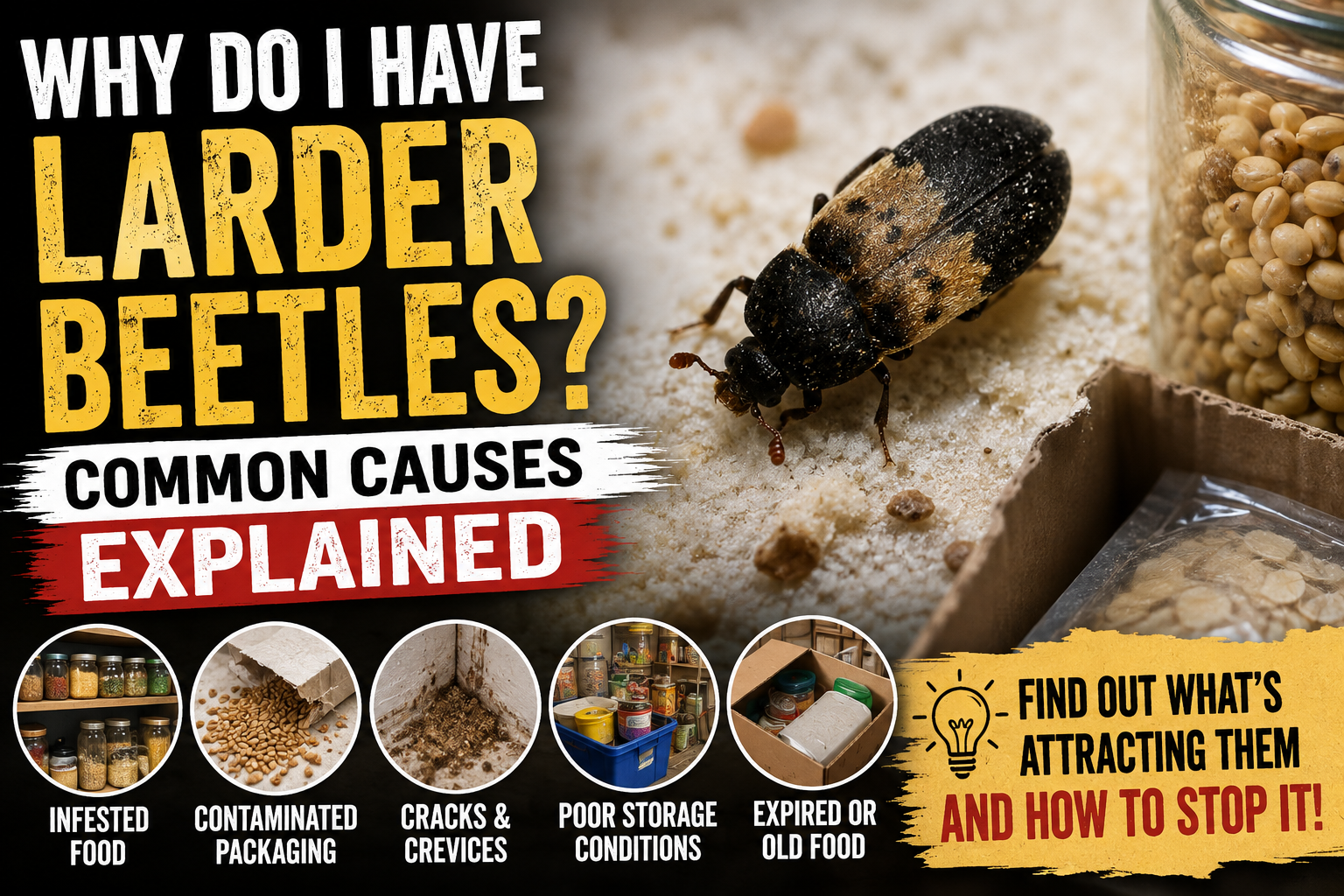
By the time homeowners notice adult beetles, several generations of activity may already have taken place inside a hidden food source. That hidden development is one reason why infestations can remain hidden.
The Larval Stage Is Where Most of the Damage Happens
Once the eggs hatch, the real feeding begins.
The larvae spend the majority of their lives eating.
They’re built for one purpose.
Growing.
Unlike the adults, which spend much of their time searching for mates and new egg-laying locations, larvae remain close to their food source and feed almost continuously.
They’re responsible for nearly all of the damage associated with larder beetle infestations.
They consume materials such as:
- Dry pet food.
- Animal hides.
- Feathers.
- Hair.
- Leather.
- Dried meats.
- Dead insects.
- Animal remains.

If you’ve found one of the fuzzy brown larvae, my guide explaining what larder beetle larvae look like shows the easiest features I use to identify them correctly.
Larvae Molt Several Times Before Becoming Adults
Growing isn’t as simple as getting bigger.
Like other insects with a hard outer covering, larder beetle larvae have to shed their exoskeleton repeatedly.
Each molt allows the larva to continue increasing in size.
As they mature, the larvae become darker, larger, and much more active.
Finding shed larval skins around a food source is often one of the first clues I look for because it tells me the infestation has been present for more than just a few days. Male larvae typically molt about five times, while females often molt six times before pupation.
The Pupal Stage Is Hidden From Most Homeowners
Once the larva has finished feeding, it enters one of the most interesting stages of its life.
Instead of continuing to eat, it begins searching for a safe, protected place where it can transform into an adult beetle.
This is why mature larvae suddenly seem to “disappear.”
They’re no longer interested in food.
They’re looking for shelter.
In many homes they’ll pupate:
- Inside soft wood.
- Under stored boxes.
- Behind baseboards.
- Inside cardboard.
- Beneath insulation.
- In cracks and crevices near their food source.
Unlike the active larva, the pupa doesn’t feed or crawl around.
It remains protected while its body completely reorganizes into an adult beetle.

Why Do Larder Beetle Larvae Bore Into Wood?
This is one of the most misunderstood parts of their life cycle.
When homeowners discover small holes in wood, they often assume the larvae are eating the wood.
Fortunately, that’s usually not what’s happening.
The larvae aren’t using wood as food.
They’re using it as protection.
A mature larva may chew a shallow chamber into soft wood, cork, heavy cardboard, books, or even foam insulation where it can safely pupate.
The chamber protects the vulnerable pupa from predators, including other dermestid beetle larvae that may feed on it.
In most homes, the damage is fairly minor, but repeated infestations over several years can make the holes much more noticeable.
The Adult Finally Emerges
After completing the pupal stage, the adult beetle emerges.
This is usually the point where homeowners finally realize something is wrong.
The adults begin wandering through the home looking for:
- Mates.
- New food sources.
- Places to lay eggs.
This is why people suddenly start finding beetles:
- Crawling across floors.
- Flying through garages.
- Sitting on windowsills.
- Walking along ceilings.
- Appearing in rooms far from where the larvae developed.

If you’ve found adults and aren’t completely sure they’re larder beetles, my guide on what larder beetles look likeexplains the easiest characteristics I use to identify them correctly.
The Life Cycle Can Repeat Several Times
Many people assume killing the adults ends the infestation.
Unfortunately, that’s rarely true.
By the time adults are visible, there may already be:
- Eggs waiting to hatch.
- Young larvae feeding.
- Older larvae preparing to pupate.
- Newly emerging adults.
That’s why successful control depends on breaking the life cycle instead of focusing on just one stage.

Once the food source disappears, the remaining beetles gradually die out because new larvae no longer have anything to eat. Under favorable indoor conditions there may be more than one generation each year, while cooler conditions can slow development significantly. For the remaining cleanup and prevention steps, see how to finish controlling larder beetles.
Which Stage Causes the Most Damage?
Without question, it’s the larval stage.
Adult larder beetles cause very little damage.
They’re primarily responsible for reproducing and finding new places to lay eggs.
The larvae, however, spend weeks feeding almost continuously.
They’re responsible for nearly all of the damage to:
- Dry pet food.
- Animal hides.
- Leather.
- Fur.
- Feathers.
- Dead insects.
- Taxidermy.
- Other animal-based materials.
Understanding that changed the way I approached control.
Instead of chasing adult beetles around the house, I started looking for the larvae and, more importantly, what they were eating.



How Understanding the Life Cycle Helped Me Get Rid of Them
Learning the life cycle completely changed my strategy.
At first, I was focused on every adult beetle I found crawling around.
Now I know those adults are usually the final stage of a problem that started weeks earlier.
Instead of chasing adults, I immediately start looking for the food source that’s supporting the larvae.
Once I locate and remove it, I vacuum thoroughly to remove eggs, larvae, shed skins, and food debris.

Afterward, I treat baseboards, cracks, crevices, and other beetle travel routes with Ortho Home Defense Insect Killer for Indoor & Perimeter² to help eliminate wandering adults while the remaining life cycle comes to an end.
Frequently Asked Questions
How many stages are in a larder beetle’s life cycle?
Larder beetles go through four stages: egg, larva, pupa, and adult. This process is known as complete metamorphosis.
Which stage causes the most damage?
The larval stage causes nearly all of the damage because larvae spend weeks feeding on animal-based materials before pupating.
How long does the entire life cycle take?
Under favorable conditions, a complete generation can develop in roughly 40 to 50 days, although cooler temperatures and limited food can significantly slow development.
Why do mature larvae suddenly crawl across the floor?
Fully grown larvae often leave their food source to search for a protected place where they can pupate. That’s why they’re commonly found wandering before becoming adults.
Do adult larder beetles keep causing damage?
Not very much. Adults mainly search for mates and places to lay eggs. The larvae are responsible for almost all of the feeding and damage associated with an infestation.
About the Author
Mark Sullivan has spent years researching household beetles and helping homeowners trace infestations back to their source. After dealing with larder beetles firsthand, he learned that understanding their life cycle is one of the most effective ways to eliminate them permanently rather than simply treating the adult beetles that happen to be visible.