You’ve got a bug problem and you want answers fast. This page covers the most common questions homeowners ask about household bugs — what they are, why they showed up, and what actually gets rid of them. Find your question, get your answer, and follow the links to the full guides when you need more detail.
General Bug Questions
Why do I suddenly have bugs in my house?
Bugs don’t appear randomly. Something changed — the season, the weather, a food source, a moisture problem, or a new entry point. Most sudden infestations trace back to one of four things: food left accessible, water available somewhere, a gap they’re getting through, or warmer/cooler outdoor temperatures pushing them inside. Figure out which one applies and you’re halfway to fixing it.
Does a clean house mean no bugs?
No — and this surprises a lot of people. Cleanliness reduces risk but doesn’t eliminate it. Bugs need food, water, and shelter. You can have a spotless kitchen and still get ants if there’s a dripping pipe under your sink. You can vacuum daily and still get bed bugs if you brought them home in luggage. Cleanliness helps. It’s not a guarantee.
What bugs are most common in homes?
The most common household bugs in the US are ants, cockroaches, spiders, flies, gnats, fruit flies, silverfish, and bed bugs. Which ones you deal with depends on your region, your home’s age, and the season. Browse our bug categories to identify exactly what you’re dealing with — ants, cockroaches, spiders, flies, and more.
Should I call an exterminator or handle it myself?
For most common household infestations — ants, roaches, gnats, silverfish, spiders — DIY treatment works well if you use the right products correctly. Professional-grade products like Advion roach gel and TERRO ant bait are available to homeowners and get results comparable to what an exterminator applies. Call a professional for termites, large wasp or hornet nests, severe bed bug infestations, or any situation that’s spread through multiple rooms and isn’t responding to treatment.
How do I know if I have an infestation or just a few bugs?
A few bugs occasionally is normal. An infestation has these signs: seeing bugs regularly, seeing them during the day, finding droppings, finding egg cases or shed skins, or noticing damage to food or materials. If you’re seeing roaches in daylight or finding ant trails daily, that’s an infestation. Treat it accordingly. If treatment seems to work briefly but sightings continue, review the Why Do Roaches Keep Coming Back? Common Reasons Explained before assuming the product failed.
Ants
Why do I have ants in my kitchen?
Your kitchen has what ants need — food, water, and warmth. Even tiny crumbs, a sticky spot near the stove, or a dripping pipe under the sink is enough to draw a colony in. They’re not there because your house is dirty. They’re there because they found a resource. Eliminate the resource and seal the entry point and the problem resolves. See our full ant guide for treatment by species.
Why do I keep getting ants even after spraying?
Because spray kills the workers you see — not the colony. A healthy ant colony has thousands of workers and a queen that keeps producing more. Kill a hundred workers with spray and the colony replaces them within days. Bait is the answer. TERRO liquid ant bait works by letting workers carry poison back to the colony, killing it from the inside out. That’s how you actually solve it.
What’s the fastest way to get rid of ants?
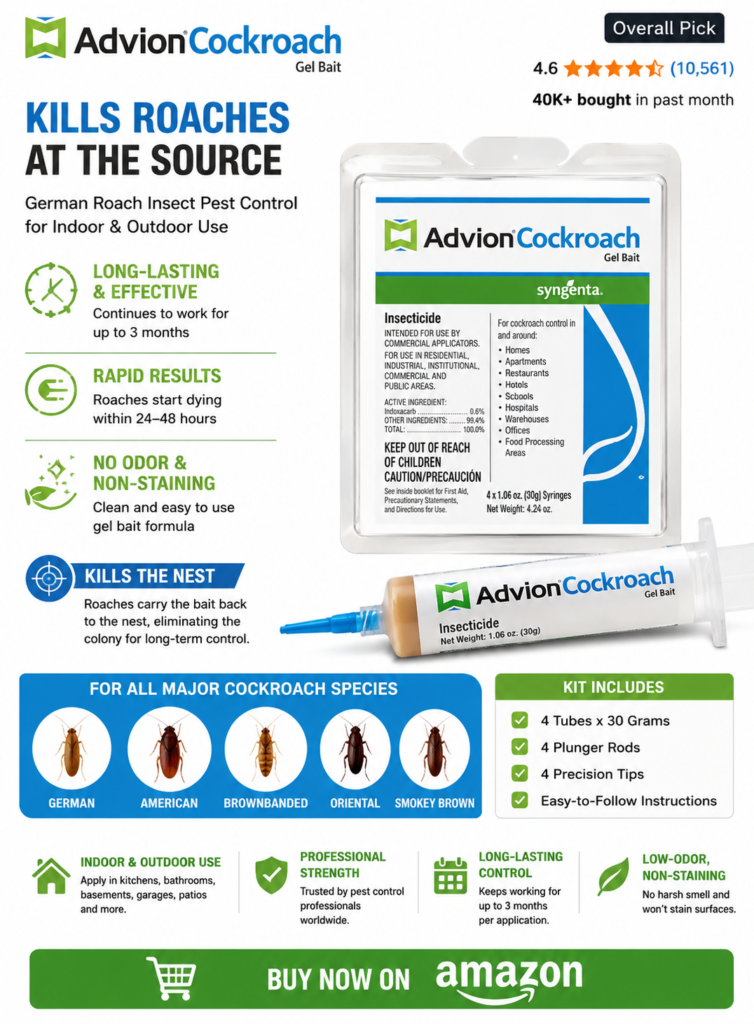
For immediate kill, a contact spray handles visible ants fast. For permanent elimination, bait is the right tool — it reaches the colony. Use both strategically: spray at entry points, bait in harborage areas, keep them separated so the spray doesn’t repel ants from the bait. For roach problems that call for bait rather than a contact spray, targeted roach bait is a relevant option to evaluate according to its label.
Cockroaches
Why do I have roaches if my house is clean?
Roaches come in through gaps around pipes, cracks in walls, and spaces under doors — not because your house is dirty. German roaches especially spread through apartment buildings via shared plumbing and walls. A clean house can absolutely have roaches. The fix is sealing entry points, eliminating moisture, and using the right treatment. See our full cockroach guide.
What’s the best way to get rid of roaches?
Gel bait is the most effective DIY method — specifically for German roaches, which are the hardest to kill and the most common indoor species. Advion cockroach gel bait is what pest control professionals use and it’s available to homeowners. Apply small dots in roach travel zones, leave it alone, and give it two weeks. The cascade kill wipes out the colony including roaches you never see.
Why do I only see roaches at night?
Roaches are nocturnal — seeing them only at night is actually normal behavior. If you’re seeing roaches during the day, that’s a sign of a heavy infestation where competition for resources is pushing them out of hiding outside their normal hours. Daytime roaches mean treat immediately and treat aggressively.
Do roaches mean my house is dirty?
No. Roaches need food, water, and warmth — and even the cleanest home provides those. Older homes especially have gaps around pipes and in walls that give roaches easy access. That said, eliminating crumbs, fixing leaks, and sealing gaps removes the conditions that keep them there. Check our cockroach category for the full breakdown.
Bed Bugs
How did I get bed bugs?
Bed bugs are hitchhikers. They don’t come in from outside through gaps like most bugs — they come in on luggage, used furniture, clothing, and bags. A hotel stay, a thrift store find, a guest who visited, a piece of furniture picked up secondhand — any of those is a common source. They have nothing to do with cleanliness. See our bed bug guide for identification and treatment.
How do I know if I have bed bugs?
Look for: small reddish-brown bugs about the size of an apple seed, tiny dark fecal spots on your mattress seams and bedding, shed skins near the bed frame, and small blood spots on your sheets. Bites alone aren’t reliable — not everyone reacts to bed bug bites and other bugs bite too. Physical evidence on the mattress and bed frame is what confirms it.
Can I get rid of bed bugs myself?
Mild infestations caught early can be treated DIY with a combination of heat treatment, mattress encasements, and diatomaceous earth. Diatomaceous earth is one of the most effective non-chemical options for bed bugs specifically because bed bugs have developed resistance to many common pesticides — and DE bypasses resistance entirely. Severe infestations usually require professional heat treatment.
Flies, Gnats, and Fruit Flies
Why do I have gnats in my house?
Most indoor gnats are either fungus gnats coming from overwatered houseplants or fruit flies coming from overripe produce, a dirty drain, or an open trash can. They need a breeding site to sustain themselves — eliminate the breeding site and the population collapses within a week. See our gnat and fruit fly guide for the full breakdown.
Why do I have flies in my house?
Flies need two things: a food source and a way in. Common sources are trash cans, pet waste, compost, and open food. Entry points are gaps around doors and windows. House flies don’t breed indoors — they come in from outside. Eliminate the attractant and seal the entry. See our fly guide for more.
Spiders, Silverfish, and Less Common Bugs
Why do I have so many spiders?
Spiders go where their food is — and their food is other bugs. A lot of spiders in your home usually means a lot of smaller insects are present for them to hunt. Solve the underlying bug problem and the spider population typically drops on its own. See our spider guide for more.
What are silverfish and why do I have them?
Silverfish are small, fast, silvery insects that feed on starchy materials — paper, cardboard, book bindings, wallpaper, and certain fabrics. They thrive in humid environments and tend to show up in bathrooms, basements, and closets. Reducing humidity and eliminating paper clutter are the two most effective prevention steps. Diatomaceous earth applied in the dry hidden spots they travel through is one of the best treatment options. See our full silverfish guide.
Why do I have earwigs in my house?
Earwigs come in from outside seeking moisture. They’re particularly common after heavy rain or during dry spells when they’re searching for water. They’re mostly harmless but unpleasant. Reducing exterior moisture, clearing debris from around your foundation, and sealing gaps at entry points handles most earwig problems. See our earwig guide for treatment options.
Why do I have centipedes in my house?
Same answer as spiders — centipedes eat other bugs. If you have centipedes, you have a food source for them somewhere. They also need moisture, so they tend to show up in basements, bathrooms, and laundry rooms. Fix the moisture and address the underlying bug population and centipedes follow. See our centipede and millipede guide.
Why do I have moths in my house?
There are two common types of indoor moths — pantry moths that infest dry food storage, and clothes moths that damage wool, silk, and natural fiber fabrics. Both are brought in rather than invading from outside — pantry moths usually hitchhike in on infested dry goods, clothes moths on secondhand clothing or untreated wool items. See our moth guide for identification and treatment.
Outdoor Bugs Coming In
Why do I have mosquitoes near my house?
Mosquitoes breed in standing water — any container, puddle, clogged gutter, or low spot in your yard that holds water for more than a few days is a breeding site. Eliminating standing water is the single most effective mosquito control step. See our mosquito guide for yard treatment options.
Why do I have wasps or hornets near my house?
Wasps and hornets build nests in protected spots — under eaves, in wall voids, in shrubs, under decks. They’re most active in late summer when colonies are at peak size. Never approach or disturb a nest without treatment. See our wasp and hornet guide for safe removal options.
Do I have termites or just ants?
Easy to confuse during swarming season. Key differences: termites have straight antennae, equal-length wings, and a thick waist. Ants have elbowed antennae, unequal wings, and a pinched waist. Termites are also much lighter in color — creamy white to tan. If you’re seeing swarmers inside your home, treat it as urgent — see our termite guide immediately. Termite damage is expensive and gets worse the longer it goes untreated.
Products and Treatment
What’s the difference between bait and spray for bugs?
Spray kills on contact — fast, visible results, no colony impact. Bait kills slowly on purpose, spreads through the colony via feeding and contact, and eliminates the source. Spray manages. Bait eliminates. For recurring problems, bait is almost always the right answer. Products like Advion for roaches and TERRO for ants use this principle and consistently outperform sprays for established infestations.
Is diatomaceous earth safe to use around kids and pets?
Food grade diatomaceous earth is one of the safest pest control options available. It kills bugs physically rather than chemically and has very low toxicity to mammals. The main precaution is avoiding inhalation during application — it’s a fine dust. Once applied and settled in place it poses minimal risk during normal household activity. See our full diatomaceous earth review for how and where to use it correctly.
Can I use spray and bait at the same time?
Yes — but keep them in separate zones. Pyrethroid sprays repel insects. If you spray near your bait placements, you create a barrier that stops bugs from reaching the bait and the treatment fails. Use spray at entry points and exterior perimeters. Use bait in harborage areas and travel zones. Keep them well separated.
How long does it take to get rid of bugs?

Depends on the bug and the method. Contact spray works in seconds. Bait typically shows results in 24–48 hours and resolves a moderate infestation in 1–2 weeks. Diatomaceous earth kills in 24–72 hours per bug but works as a long-term barrier rather than a fast knockdown. Give any treatment a full two weeks before deciding it isn’t working. Switching products too early is one of the most common reasons treatments fail. For the diatomaceous-earth approach described here, readers can review home-safe diatomaceous earth before choosing a product.
Still can’t find your answer? Visit our contact page and ask — or browse the full bug library from our homepage to find the specific guide for whatever you’re dealing with.