
The first time I found a mayfly, I honestly wasn’t sure what I was looking at.
At first glance, it almost looked like a strange mosquito with a long tail. When an insect resembles a mosquito but has unusual proportions, mosquito-like insects can help narrow down the possibilities.
Then I noticed the delicate upright wings, the incredibly long tail filaments, and its soft, fragile body.
After spending some time learning about them, I realized mayflies are among the most fascinating insects you’ll ever find around your home.
Despite their unusual appearance, they’re completely harmless.
In fact, they’re often a sign that you live near relatively clean water because their immature stages spend most of their lives developing underwater.
If you’ve found one around your house or noticed large swarms near lights, this guide will explain everything you need to know about these unique insects. The reasons behind those house-side swarms are explained in why mayflies gather around houses.
What Is a Mayfly?
A mayfly is a delicate flying insect belonging to the order Ephemeroptera, a group that has existed for more than 300 million years.
There are over 600 species of mayflies in North America alone, and while they vary somewhat in size and color, they all share several distinctive features.
Unlike many insects that spend most of their lives as adults, mayflies spend the overwhelming majority of their lives underwater as aquatic nymphs.
The adult stage is incredibly short.
For many species, adulthood lasts only a few hours to a couple of days, and the adult’s primary purpose is reproduction. Adult mayflies have vestigial mouthparts and most species cannot eat once they emerge.
How to Identify a Mayfly

Once you’ve seen a few mayflies, they’re actually fairly easy to recognize. If you are comparing a mayfly with other insects around the house, this household fly identification guide can help distinguish the common possibilities.
The features I always notice first include:
- Large transparent wings held upright when resting.
- Very short antennae.
- Large compound eyes.
- A soft, slender body.
- Two or three long thread-like tails extending from the end of the abdomen.
- Front legs that are often noticeably longer than the others.

Those upright wings are one of the easiest ways to separate mayflies from many other insects. Wing position becomes especially useful when comparing mayflies with stoneflies, as shown in mayfly and stonefly wing differences.
Unlike flies, mosquitoes, and most other winged insects, mayflies hold their wings vertically over their backs when they’re resting.

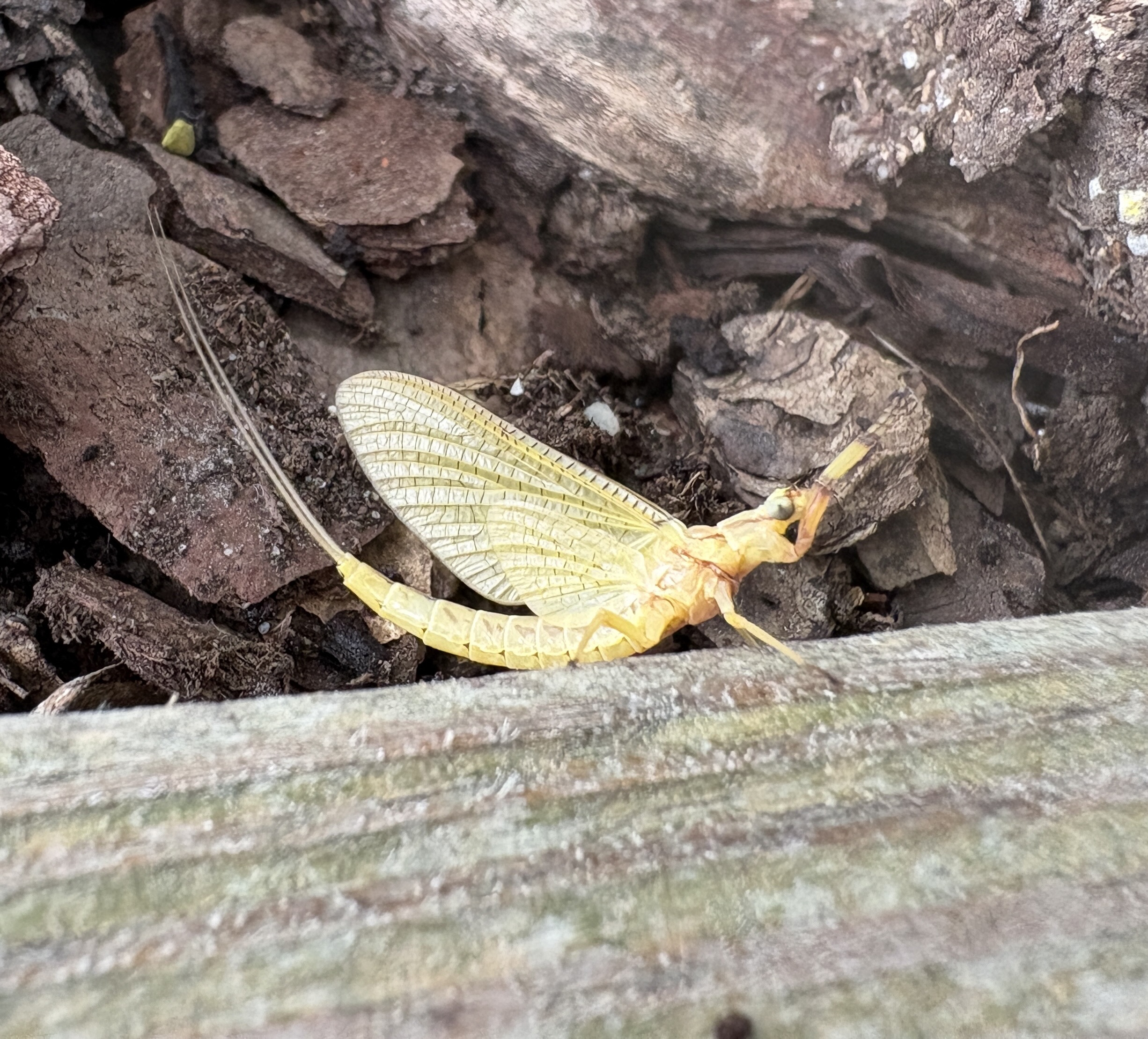
The Photo Above Is a Great Example
The mayfly in my photograph shows several of the classic identification features.
Its wings are folded straight upward instead of lying flat over the body.
You can also clearly see the long tail filaments extending from the end of its abdomen.
The pale yellow color suggests it had probably emerged fairly recently, since freshly emerged adults often appear lighter before their colors fully develop.
Finding one resting on bark, mulch, fences, or outdoor walls during the daytime is completely normal.
Why Are They Called Mayflies?
Their name actually causes quite a bit of confusion.
People often assume they only appear during May.
That’s not true.
Different species emerge at different times depending on where you live.
Some appear in late spring.
Others emerge throughout the summer.
Some species don’t emerge until early fall.
The name comes from the fact that many European species were first noticed emerging around the month of May.
Today, the common name has simply stuck even though emergence varies greatly by location and species.


Where Do Mayflies Live?
One thing every mayfly has in common is water.
Although adults spend their brief lives flying, nearly their entire development takes place underwater.
The immature nymphs live in:
- Rivers.
- Streams.
- Lakes.
- Ponds.
- Creeks.
- Wetlands.
Many species require clean, well-oxygenated water to survive.
Because of that, healthy mayfly populations are often considered indicators of good water quality.
Why Do They Suddenly Appear in Huge Numbers?
One of the most remarkable things about mayflies is how synchronized they are.
Instead of emerging one at a time over several months, many species emerge in enormous numbers over a very short period.
To homeowners, it can seem like they appeared overnight.
In reality, thousands or even millions of aquatic nymphs have been developing underwater for months or years before emerging almost simultaneously.
This mass emergence increases the chances of successful mating while overwhelming predators with sheer numbers. Large synchronized hatches are common enough that they can even appear on weather radar in some regions.


How Long Do Mayflies Live?
This is one of the biggest surprises about mayflies.
Despite their name and reputation, mayflies don’t actually live for only one day.
At least, not if you count their entire life.
Most mayflies spend months or even one to two years living underwater as aquatic nymphs.
The part that lasts only a short time is the winged adult stage.
Depending on the species, adults may survive for just a few hours, a day, or occasionally a couple of days before mating and dying.
In other words, over 99% of a mayfly’s life is spent underwater, not flying around your porch.
Mayflies Are One of the Most Important Insects in Freshwater Ecosystems
Although they’re often viewed as nuisance insects when they emerge in huge numbers, mayflies actually play an incredibly important role in nature.
Their aquatic nymphs feed on algae, decaying plant material, and other organic debris.
In doing so, they help recycle nutrients and keep freshwater ecosystems functioning properly.
They’re also one of the primary food sources for:
- Trout.
- Bass.
- Bluegill.
- Perch.
- Frogs.
- Salamanders.
- Birds.
- Dragonflies.
Many artificial fishing flies are specifically designed to imitate mayflies because so many freshwater fish depend on them as food.


Do Mayflies Bite or Sting?
Fortunately…
No.
Adult mayflies don’t bite.
They don’t sting.
They aren’t poisonous.
They don’t spread diseases.
In fact, most adult mayflies don’t even have functional mouthparts.
Once they become winged adults, their only job is to find a mate, reproduce, and complete their life cycle.
Since they aren’t feeding anymore, they have absolutely no reason to bite people or pets.
Why Are Mayflies Attracted to Lights?
If you’ve ever lived near a lake or river, you’ve probably noticed dozens or even hundreds of mayflies gathering around porch lights.
Sometimes there are thousands.
Artificial lights confuse flying adults, especially during their evening mating flights.
Bright white lights, security lights, parking lot lights, and illuminated buildings can attract enormous swarms.
This is one reason waterfront homes often experience much larger mayfly hatches than homes farther away from water.
Should You Worry if You Find Mayflies Around Your House?
Generally speaking…
No.
Finding mayflies is usually more of an inconvenience than a pest problem.
Unlike termites, ants, or beetles, they aren’t trying to move into your home.
They’re simply attracted to nearby lights or resting on walls, fences, plants, and outdoor furniture after emerging.
Most adults die naturally within a day or two.
Because of that, infestations inside homes are extremely uncommon.
How to Reduce Mayflies Around Your Home
If large numbers are becoming annoying, there are a few simple things I recommend.
- Turn off unnecessary outdoor lights during major hatches.
- Switch bright white bulbs to warm-colored LED bulbs that are generally less attractive to insects.
- Keep doors closed at night when lights are on indoors.
- Repair damaged window screens.
- Sweep or rinse away dead mayflies after large swarms.
Unlike many household insects, spraying insecticides is rarely worthwhile.
The hatch is temporary, and new insects are constantly emerging from nearby water.
Most homeowners find that simply waiting a few days is far more effective than trying to spray every insect they see.
Fascinating Facts About Mayflies
The more I learned about mayflies, the more fascinating they became.
Here are a few facts that surprised me the most.
- They have existed for more than 300 million years, making them one of the oldest groups of winged insects alive today.
- They are the only insects that molt after already developing functional wings, passing through a unique stage called the subimago before becoming fully mature adults.
- Some species emerge in such enormous numbers that weather radar has mistaken their swarms for rainstorms.
- Healthy mayfly populations are often considered a sign of good water quality because many species are sensitive to pollution.
Frequently Asked Questions
Are mayflies harmful?

No. Mayflies are harmless to people and pets. They don’t bite, sting, spread diseases, or damage homes.
Why do I suddenly have hundreds of mayflies?
Mayflies often emerge in synchronized hatches. Thousands of nymphs that have been developing underwater for months or years may become adults over the course of a day or two, making it seem like they appeared overnight.
Do mayflies come inside houses?

Occasionally. They’re usually attracted to lights shining through windows or open doors, but they don’t infest homes or reproduce indoors. For another common reason flies end up at indoor glass, why flies head toward windows offers a practical explanation.
How long do adult mayflies live?
Most adult mayflies live only a few hours to a couple of days. Their primary purpose is to mate and lay eggs before dying naturally.
Is it good to have mayflies around?
In many ways, yes. Mayflies are an important part of freshwater ecosystems and are often considered indicators of healthy water because their aquatic young are sensitive to pollution.
About the Author
Mark Sullivan has spent years researching household insects and helping homeowners correctly identify the bugs they find around their homes. By combining firsthand observations with trusted university extension resources, he creates practical identification guides that explain not only what an insect is, but why it’s there and whether you actually need to worry about it.