
At first glance, mayflies and stoneflies look remarkably similar.
Both are slender insects.
Both have long tail filaments.
Both are commonly found near rivers and streams.
Both are excellent fliers.
It’s no surprise they’re confused with one another all the time.
In fact, even biologists compare these two groups because they share many of the same habitats during the early stages of life.
Fortunately, once you know which features to examine, telling them apart becomes much easier.
After learning what to look for, I can usually identify one in just a few seconds.
Why People Confuse Them
There are several reasons these insects are mixed up so often.
For starters, both spend most of their lives as aquatic nymphs before emerging as winged adults.
They also appear around the same time of year in many parts of North America and are commonly found near clean streams, rivers, and lakes. Both groups are considered important indicators of healthy freshwater ecosystems because they thrive in well-oxygenated water.

If someone only notices the long tails and transparent wings, it’s easy to assume they’re the same insect. For another identification challenge involving flies around homes, see this guide to compare common fly species.
They’re actually members of completely different insect orders.
Mayflies belong to Ephemeroptera.
Stoneflies belong to Plecoptera.
The Wings Tell Me Almost Everything
When I’m looking at an adult insect, the wings are usually the first thing I study.

A resting mayfly almost always holds its wings straight up over its back, almost like a tiny sailboat or butterfly. For more identifying details beyond wing position, use this complete guide to mayflies.
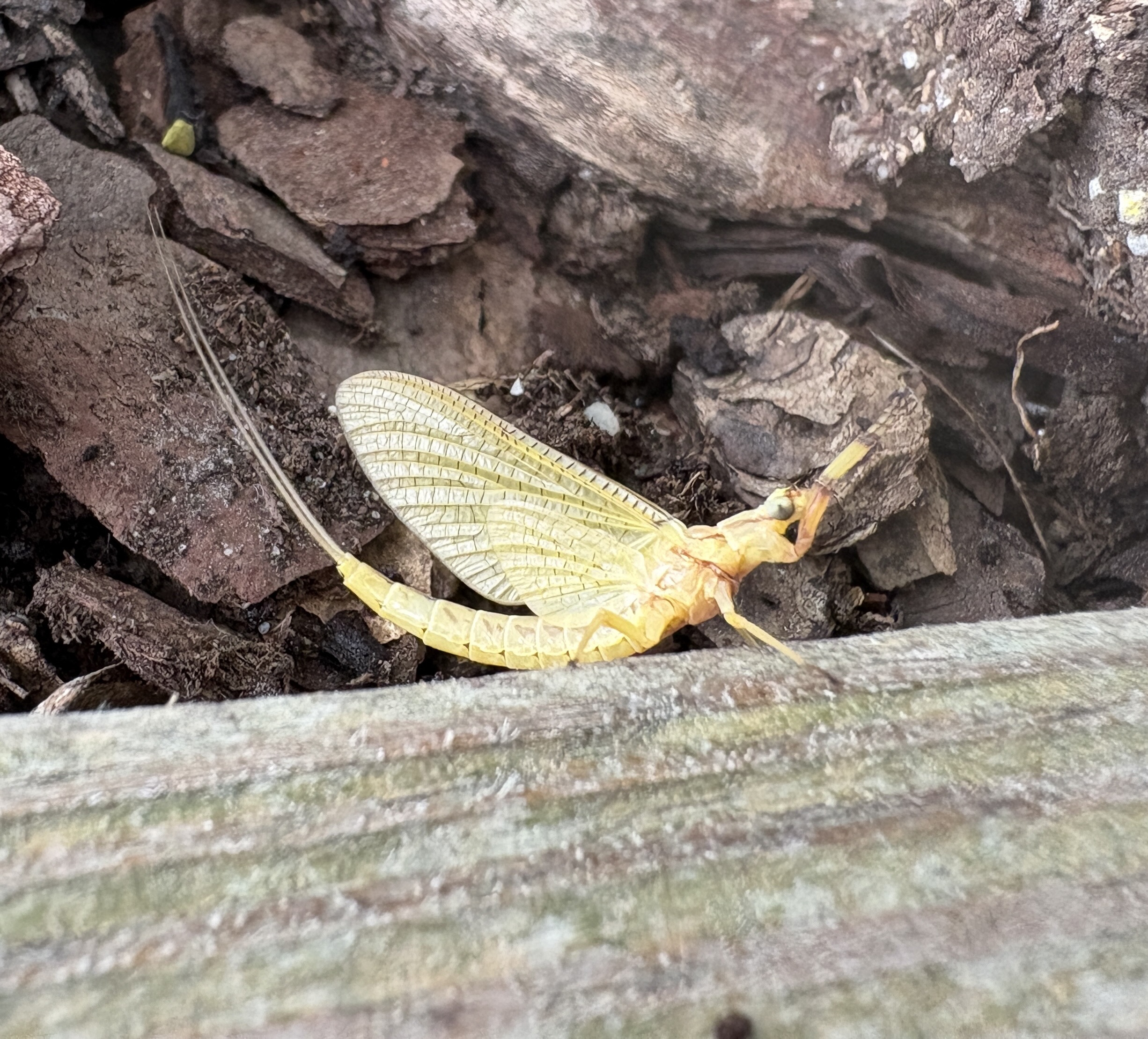
It’s one of the easiest characteristics to recognize once you’ve seen it a few times.
Stoneflies do the opposite.
When they’re resting, their wings lie flat over the back of the body, neatly folded one on top of the other.
If I can clearly see how the wings are positioned, I often know which insect I’m looking at before I even examine anything else.


Look at the Antennae
The next feature I compare is the antennae.
Mayflies have surprisingly short antennae.
They’re often so short that many people barely notice them at all.
Stoneflies have long, thread-like antennae that project well in front of the head.

Sometimes they’re nearly as long as the insect’s body.
Once I started paying attention to the antennae, I found identification became much easier.
Count the Tail Filaments Carefully
People often hear that mayflies have three tails while stoneflies have two.
That’s a useful rule, but it isn’t perfect.
Most adult mayflies have two long tail filaments, although the nymphs of many species have three. Some adult species may also appear to have only two because the middle filament is reduced or absent.
Adult stoneflies consistently have two tail filaments.
Because of this overlap, I never rely on tail count alone.
Instead, I combine it with the wing position and antenna length for a much more reliable identification.
Their Bodies Have Different Shapes
Mayflies generally have a softer, more delicate appearance.
Their bodies are slender, and their long front legs often stick out while they’re resting.
Stoneflies usually look a bit sturdier.
Their bodies are flatter, their legs appear stronger, and they have a more robust overall build.
It’s a subtle difference, but after you’ve seen both insects side by side, it’s surprisingly easy to notice.
Where You’ll Usually Find Each Insect
Location is another clue I use when trying to identify these insects.
Both mayflies and stoneflies spend their immature stages underwater, so neither one is going to be found far from freshwater for very long.
However, there are some differences.
You’re more likely to find mayflies:
- Around lakes.
- Along slow-moving rivers.
- Near ponds.
- Around bridges crossing water.
- Covering buildings during large hatches.
- Swarming around porch lights.
You’re more likely to find stoneflies:
- Along cold, fast-moving streams.
- On rocks beside creeks.
- Near mountain rivers.
- Resting on streamside vegetation.
- In shaded woodland areas close to water.
Stoneflies are generally more dependent on cool, highly oxygenated flowing water, while some mayfly species tolerate slower rivers and even well-oxygenated lakes.



Which One Is More Likely to Swarm?
If you’ve ever seen millions of insects covering bridges, vehicles, or buildings near a river, there’s a very good chance you were looking at mayflies.
Large synchronized hatches are one of the defining characteristics of many mayfly species.
Thousands, sometimes millions, of adults emerge within a very short period to mate before dying.
Stoneflies don’t usually produce those massive, highly visible swarms.
Instead, adults are more commonly seen individually or in much smaller numbers resting on vegetation or rocks near streams.
Which One Lives Longer?
This is another area where these insects differ.
Adult mayflies have famously short lives.
Many survive only a day or two, and some species live for only a few hours after becoming adults.

Their entire purpose is to mate and lay eggs before dying. Adult mayflies generally don’t feed because their mouthparts are greatly reduced.
Stoneflies also spend most of their lives underwater, but adult stoneflies generally live longer than adult mayflies, often surviving for several weeks depending on the species and environmental conditions. For the mayfly side of that comparison, see the detailed explanation of its adult mayfly lifespan.



Are Either of Them Dangerous?
Fortunately, neither insect is something I worry about around my family.
Both mayflies and stoneflies are considered harmless.
They don’t:
- Bite people.
- Sting.
- Damage homes.
- Destroy furniture.
- Reproduce indoors.
If I find one inside the house, I simply catch it and release it outdoors.
They’re accidental visitors, not household pests.
My Fastest Identification Method
When someone sends me a photo, I don’t immediately count tails.
Instead, I go through the same checklist every time.
If I see:
- Wings held straight up.
- Very short antennae.
- Large eyes.
- A delicate, slender body.
…I almost always identify it as a mayfly.
If I see:
- Wings folded flat over the back.
- Long thread-like antennae.
- A stockier body.
- Two obvious tail filaments.
…I’m usually looking at a stonefly.
After a while, these differences become surprisingly easy to spot.



Which Insect Did I Find?
If you’re still unsure, ask yourself these questions:
- Were the wings folded upright like a butterfly or flat over the back?
- Were the antennae short or long?
- Was it near a lake or beside a fast-flowing creek?
- Did you find hundreds of them or just one or two?
- Did it appear delicate or more robust?
Answering those questions correctly will identify most adult mayflies and stoneflies without needing special equipment.
If your insect holds its wings upright while resting, has very short antennae, and resembles the mayfly in the photo at the top of my Everything You Need to Know About Mayflies guide, you’re almost certainly looking at a mayfly rather than a stonefly.
Frequently Asked Questions
What’s the easiest way to tell a mayfly from a stonefly?
The easiest clue is the wings. Mayflies hold their wings upright over their backs while resting, while stoneflies fold their wings flat against the body.
Do both insects have long tails?
Yes. Both have long thread-like tail filaments, which is one reason they’re so often confused. However, tail count alone isn’t always reliable because some adult mayflies have only two visible tails.
Which one is more common around houses?
Mayflies are much more likely to be noticed around homes because they often emerge in huge numbers and are strongly attracted to lights during mass hatches.
Are mayflies and stoneflies good for the environment?
Yes. Both are considered excellent indicators of clean freshwater habitats because their aquatic young are sensitive to pollution and low oxygen levels.
Can either insect infest a house?
No. Neither mayflies nor stoneflies establish indoor infestations. If you find one inside, it most likely wandered in accidentally or was attracted to lights at night.
About the Author
Dr. Emily Carter is a freshwater ecologist who specializes in aquatic insects and stream ecosystems. She has spent years studying mayflies, stoneflies, and other aquatic invertebrates, helping homeowners and outdoor enthusiasts correctly identify the insects they encounter while explaining the important role these species play in healthy rivers and streams.