Seeing one ant in your kitchen is one thing.
Seeing dozens of ants with wings flying around your windows is something else entirely.
I’ve had homeowners tell me they thought termites had invaded their house, while others believed the ants had suddenly “mutated” and started flying overnight.
Fortunately, that’s not what’s happening.
In most cases, flying ants are simply part of an ant colony’s natural life cycle. The different roles and lifespans involved are described in How Long Do Ants Live? The Surprising Answer.
The bad news is that seeing them indoors can sometimes mean there’s a mature colony nearby or, in some cases, inside your home.
Knowing the difference is the key to deciding what to do next.
Michael’s First Impression
Whenever someone tells me they’ve found flying ants indoors, I don’t immediately assume they have a serious infestation.
My first goal is figuring out why they’re there.
I usually ask a few simple questions.
Did they all appear on the same day?
Are they gathering around windows or light fixtures?
Have you been seeing regular worker ants in your home over the past few weeks?
The answers help me determine whether I’m looking at a normal seasonal swarm from an outdoor colony or a mature colony that’s much closer to the living space. That distinction changes how I’d approach the problem and whether I’d start looking for a nest inside the home.
What Are Flying Ants?
Flying ants aren’t a separate species.
They’re ordinary ants that have developed wings for one specific purpose.
Reproduction.
These winged ants, often called reproductive ants or swarmers, leave the colony during certain times of the year to mate and establish new colonies.
After mating, males die, while fertilized queens lose their wings and begin searching for a suitable nesting location.
That’s why you may suddenly see dozens or even hundreds of flying ants over the course of just a day or two.



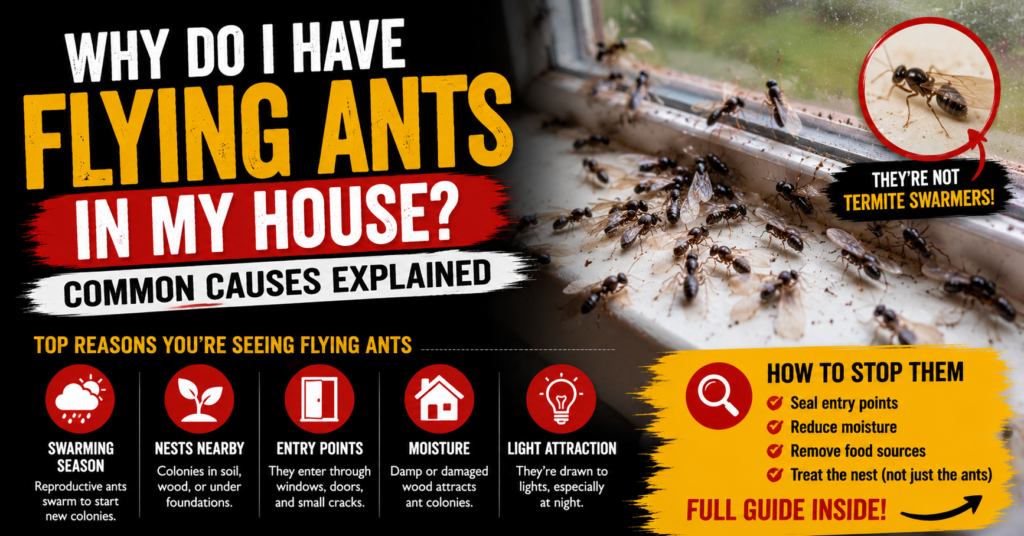
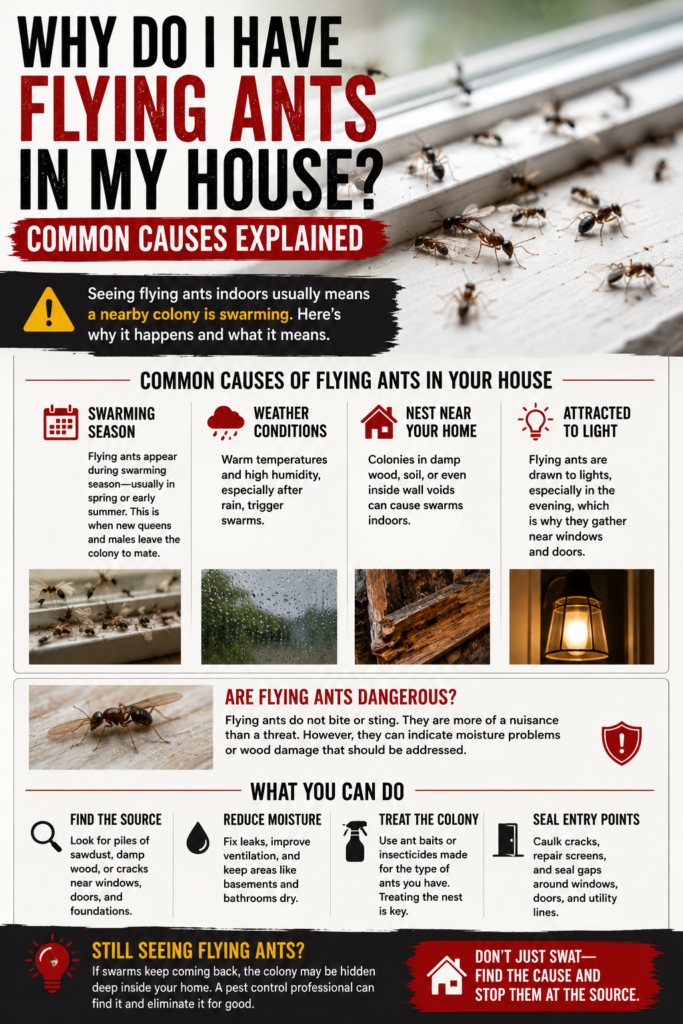
Why Are Flying Ants Suddenly in My House?
There are several common reasons.
A Nearby Colony Is Swarming
This is probably the most common explanation.
During warm, humid weather, mature colonies release winged ants in large numbers.
Some may accidentally fly indoors through:
- Open doors
- Windows
- Garage doors
- Damaged window screens
- Small gaps around the home
Sometimes they’re simply attracted to indoor lighting.
There’s a Colony Inside the House
If you’re seeing large numbers of flying ants indoors, especially over multiple days, I become more concerned that the colony may actually be inside the structure.
That doesn’t automatically mean serious damage.
But it does mean I’d start looking more carefully.
Are Flying Ants the Same as Termites?
No.
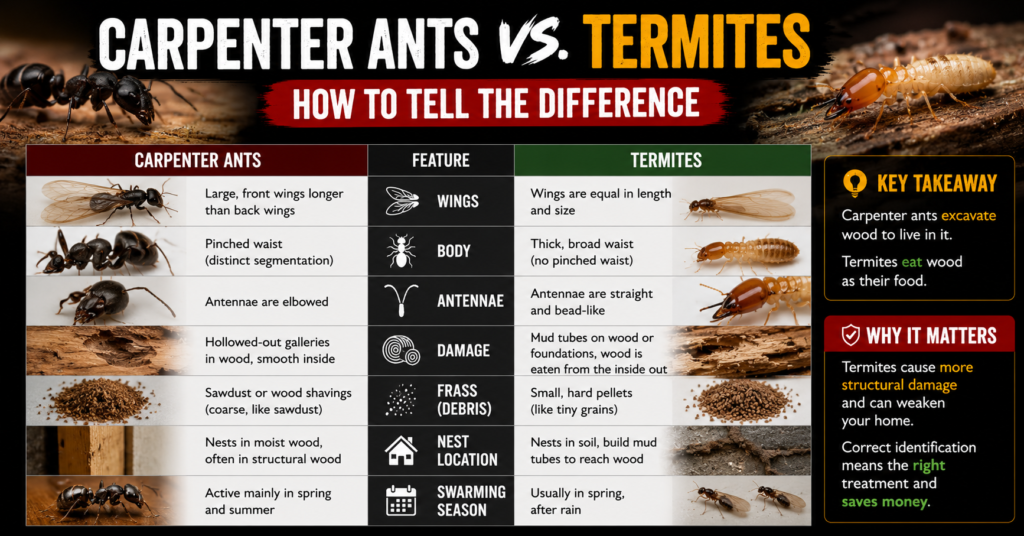
This is one of the biggest misconceptions I hear. The visual clues explained in Carpenter Ants vs Termites: How to Tell the Difference can help you tell flying ants from termites before assuming you have an infestation.
People often confuse flying ants with winged termites because both insects swarm around the same time of year.
However, there are several differences.
Flying ants generally have:
- Bent antennae
- A narrow, pinched waist
- Front wings that are longer than the back wings
Winged termites typically have:
- Straight antennae
- A broad waist
- Four wings that are nearly equal in length
I’ll cover this comparison in much more detail in an upcoming guide on carpenter ants versus termites.


Where I Would Inspect First

If this were my house, I wouldn’t immediately spray every flying insect I saw. A safe catch-and-release bug catcher can help you examine an individual insect without immediately spraying it.
I’d start looking for where they’re coming from.
I’d inspect:
- Window sills.
- Door frames.
- Attic spaces.
- Basement windows.
- Crawl spaces.
- Around plumbing penetrations.
- Exterior foundation.
Finding where they’re entering often tells me far more than catching individual ants.
Why Are They Around My Windows?
This is another question I hear often.
Flying ants are naturally attracted to light.
That’s why homeowners frequently discover them gathered around:
- Windows
- Glass doors
- Skylights
- Ceiling lights
It doesn’t necessarily mean the colony is inside the window.
It simply means the ants are moving toward light after swarming.

Could They Be Coming From Outside?
Absolutely.
Many indoor sightings begin outside.
Colonies living in:
- Soil
- Mulch
- Landscaping
- Tree stumps
- Firewood
can produce swarmers that accidentally make their way indoors.
That’s why I always inspect both inside and outside the home before assuming there’s an indoor nest.
What If You’ve Been Seeing Regular Ants Too?
This is where things get more interesting.
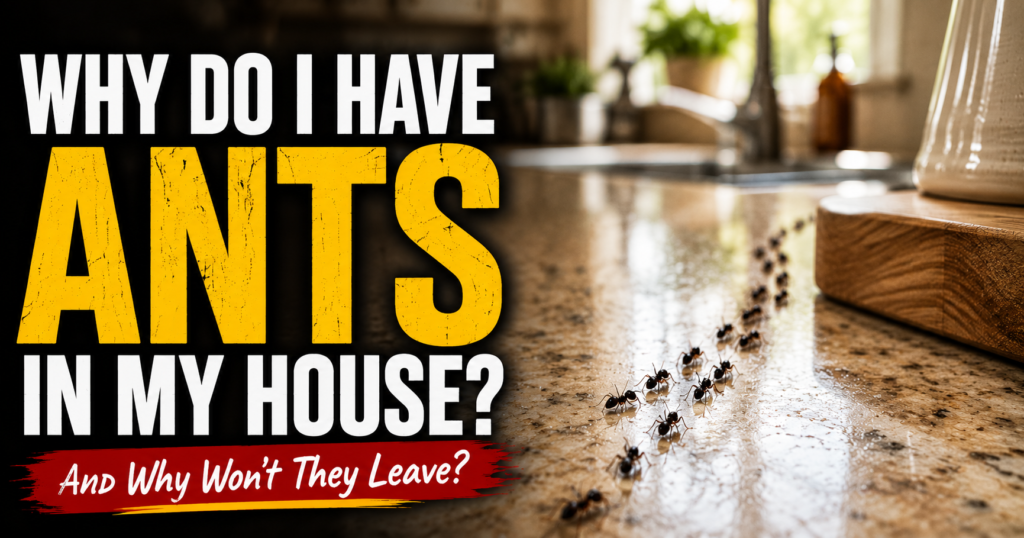
If you’ve already been dealing with worker ants in your kitchen or bathroom and suddenly start seeing flying ants, I become much more suspicious that a mature colony is nearby.
Our article on Why Are Ants Suddenly in My House? explains why established colonies often become much more noticeable once conditions are right.
If they’re primarily showing up around food preparation areas, our guide on Why Are Ants Coming Into My Kitchen?walks through the most common reasons.

What I Would Do If This Were My House
If I found flying ants today, I’d avoid panicking.
Instead, I’d spend time gathering information.
I’d determine:
- How many there are.
- Whether they’re appearing in one room or throughout the house.
- Whether worker ants have been present recently.
- Whether I could locate where they’re entering.
Only then would I decide whether treatment was necessary.
Products That Can Help
If you’re dealing with an active ant problem, eliminating the colony is much more effective than simply spraying the flying ants you see.

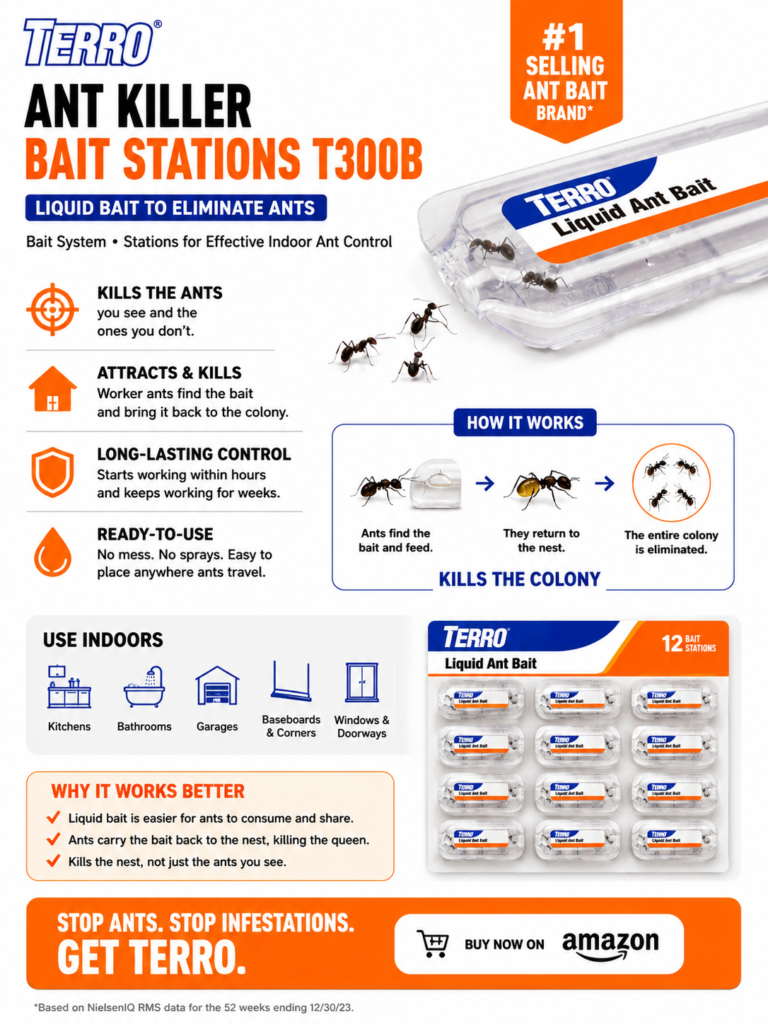
One product I’ve had good success with is TERRO Liquid Ant Bait Stations because worker ants carry the bait back to the colony instead of simply dying where you find them. If you’re considering using them, read my full review of TERRO Liquid Ant Bait Stations to learn when they work best and where to place them.


For larger infestations, Ecoxall Boric Acid Fine Powder can also be part of an ant control strategy when used correctly. I explain the advantages, limitations, and proper expectations in my review of Boric Acid for Roaches and Ants.

If you’ve already tried treating the ants but they continue showing up, my guide on Getting Rid of Ants Fast walks through the complete process I would follow.
The Biggest Mistake I See
The biggest mistake I see is homeowners focusing entirely on the flying ants.
The flying ants aren’t usually the real problem.
They’re simply a sign that a mature colony is reproducing.
Finding and eliminating the colony is almost always far more important than killing the winged ants you happen to see.
Frequently Asked Questions
Are flying ants dangerous?
Most flying ants are more of a nuisance than a danger. However, identifying the species is important because some ants, such as carpenter ants, can become structural pests.
Why do flying ants suddenly appear overnight?
Ant colonies often release winged reproductive ants during warm, humid weather, making it seem like they appeared all at once.
Do flying ants mean I have an infestation?
Not always. They may have entered from an outdoor colony, but repeated indoor swarms can indicate a nearby or indoor nest.
Should I kill the flying ants?
Removing the flying ants may reduce the immediate nuisance, but it won’t eliminate the colony that’s producing them.
When should I worry about flying ants?
If you repeatedly find large numbers indoors, especially in the same area, it’s worth inspecting your home for signs of an established colony.
About the Author
Michael Carter researches household ants, seasonal insect behavior, and practical pest control strategies. He specializes in helping homeowners identify ant species, understand why infestations begin, and choose effective solutions that target the colony instead of just the ants they see.