Most people simply call every large flying insect around the house a “fly.”
From a distance, that’s understandable.
But if you’re trying to figure out why flies suddenly appeared in your home, identifying the species can tell you a lot.
One of the comparisons I make most often is between house flies and blow flies.
While they belong to the same general group of insects, they behave very differently and are often attracted to completely different things.
Knowing which one you’re seeing can help you find the real source of the problem much faster.

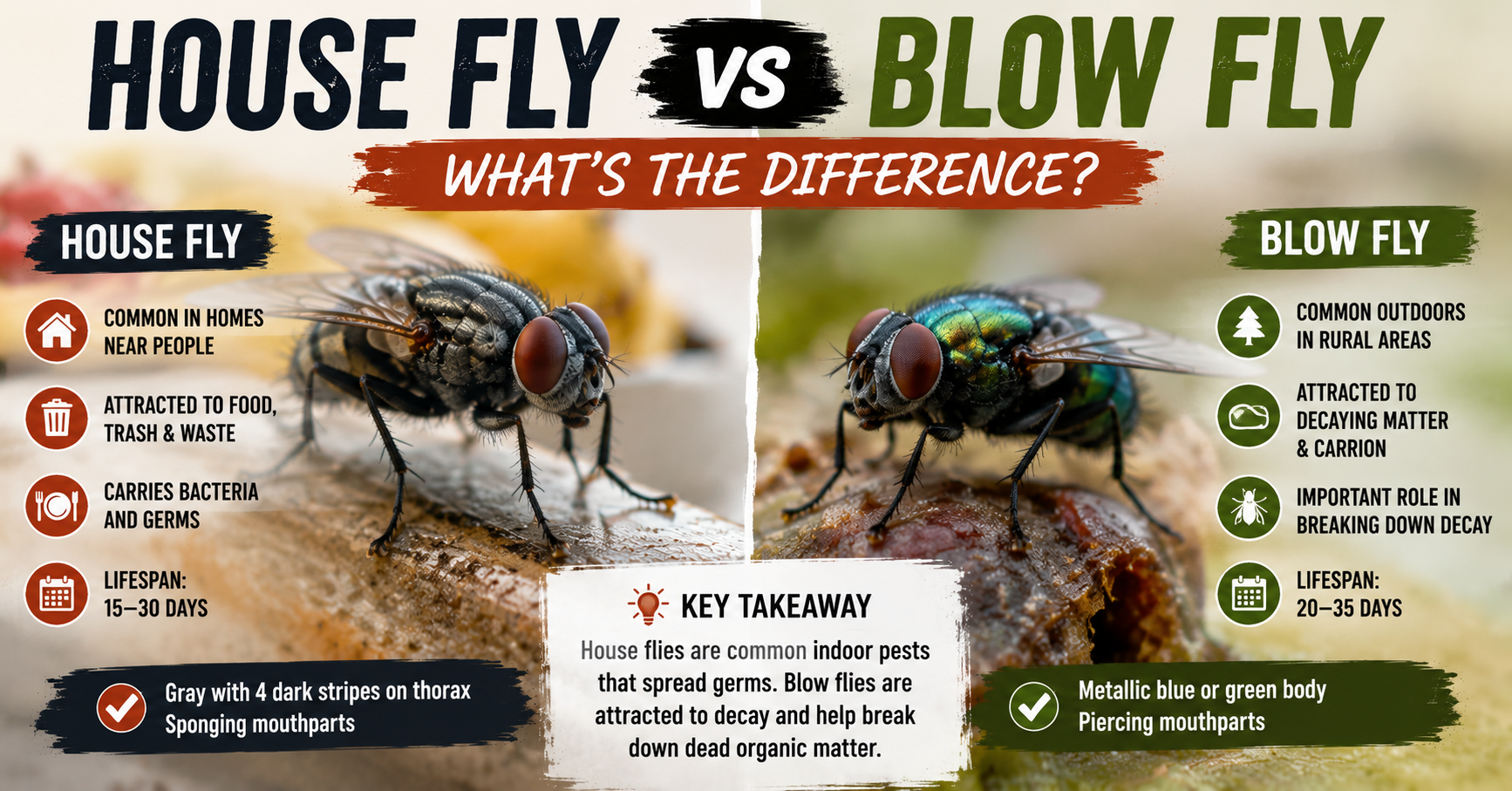
House Flies Usually Look Plain Gray
When I think of a typical house fly, I picture the common gray fly buzzing around kitchens, garages, and trash cans.
House flies usually have:
- A dull gray body.
- Four dark stripes running lengthwise on the thorax.
- Bright red eyes.
- A body about 1/4 inch long.
- A slightly fuzzy appearance when viewed closely.
They’re the flies most homeowners encounter every summer.

If you’re unsure whether that’s what you’re seeing, my What Do House Flies Look Like? Easy Identification Guidewalks through the identifying features in much greater detail.
Blow Flies Are Much More Colorful
Blow flies stand out almost immediately because of their color.
Instead of being dull gray, they’re often:
- Metallic blue.
- Metallic green.
- Bronze.
- Shiny black with an iridescent sheen.
Their bodies look smooth and glossy, especially in sunlight.
Whenever I notice that metallic shine, blow fly becomes my first guess.
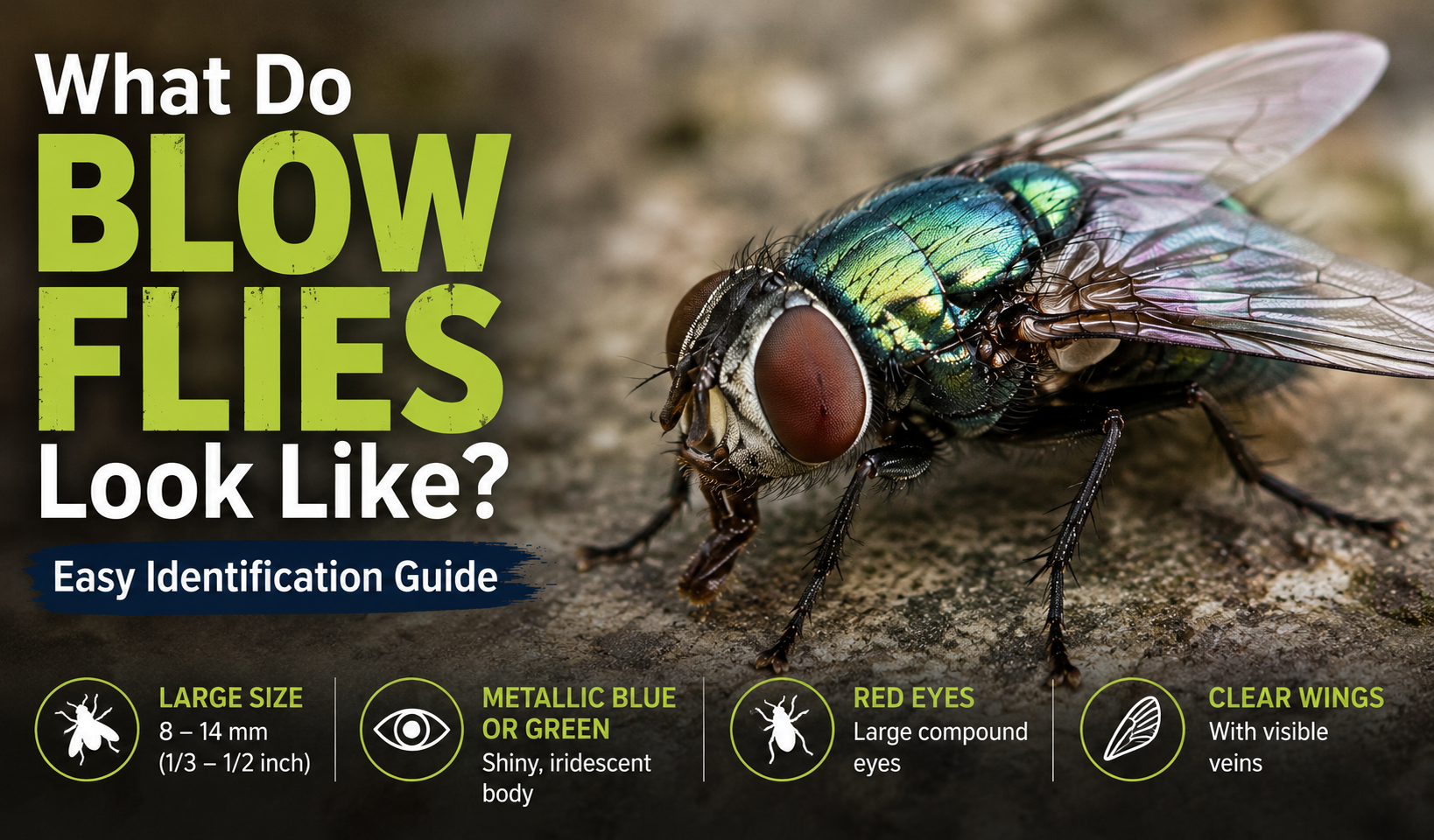
You can compare close-up photos and identifying features in What Do Blow Flies Look Like? Easy Identification Guide.
Blow Flies Are Usually Slightly Larger
Although the difference isn’t dramatic, blow flies are generally a little larger and heavier than ordinary house flies.
They also make a deeper, louder buzzing sound when flying around windows.
Size alone isn’t enough for identification, but when it’s combined with the metallic body color, it becomes much easier to tell the two species apart.
They Usually Come From Different Sources
This is probably the biggest difference.
House flies commonly develop in:
- Garbage.
- Pet waste.
- Compost.
- Rotting food.
- Manure.
- Organic debris.
Blow flies often have a very different source.
I immediately begin thinking about:
- Dead rodents.
- Dead birds.
- Dead squirrels.
- Animal carcasses.
- Decaying meat.
That’s why identifying the fly correctly is so important.
The source of the infestation may be completely different depending on the species.
Where I Start Looking
If I’m dealing with ordinary house flies, I usually inspect garbage cans, compost piles, pet waste, and food sources first.
If I’m seeing metallic blue or green blow flies, my investigation changes completely.
Instead of focusing on garbage, I begin checking:
- Attics.
- Crawl spaces.
- Chimneys.
- Wall voids.
- Dead animals around the property.
- Areas where rodents may have died.
The type of fly completely changes where I begin my inspection.
Blow Flies Usually Mean I Investigate More Carefully
One of the reasons I take blow flies more seriously is because they often point to something I don’t want to ignore.
A handful of house flies around the trash can usually means I need to improve sanitation or remove a breeding source.
A sudden explosion of metallic blue or green blow flies makes me immediately wonder whether an animal has died somewhere around the property.
Over the years, I’ve found dead mice inside wall voids, birds trapped in chimneys, squirrels in attics, and even rabbits beneath decks that homeowners never knew were there.
The flies were the first clue.
That’s why I always pay attention to the species before deciding where to start looking.

House Flies and Blow Flies Don’t Always Stay Near the Source
One mistake I see homeowners make is assuming the flies must be coming from the room where they’re seeing them.
That’s not always true.
A dead mouse in an attic may result in blow flies gathering on second-floor windows.
A garbage can in the garage may produce house flies that eventually end up in the kitchen.
Adult flies move throughout the home once they emerge.
That’s why I don’t simply inspect the room where they’re most noticeable.
I work backward to figure out where they likely developed.
Can You Have Both at the Same Time?
Absolutely.
I’ve inspected plenty of homes where house flies and blow flies were present together.
For example, a property might have outdoor garbage attracting house flies while a dead rodent inside a crawl space is producing blow flies.
Because both species can be flying around the same windows, it’s easy to assume they’re all the same insect.
Whenever I notice flies with different colors or sizes, I start looking much more closely instead of assuming they’re part of one problem.
Which Fly Is More Likely to Be Inside a Home?
House flies are generally the species I expect to see most often inside occupied homes.
They’re well adapted to living around people and are attracted to everyday things like food scraps, garbage, pet food, and waste.
Blow flies certainly enter homes too, but when I find large numbers indoors, I usually suspect there’s a nearby carcass or other decaying animal material that needs to be located.
That’s one of the biggest reasons I never treat every fly problem the same way.
Correct identification changes the entire investigation.
How I Tell Them Apart in Just a Few Seconds
If I only have a moment to look at a fly before it disappears, these are the things I notice first.
A dull gray fly with red eyes immediately makes me think of a house fly.
A shiny metallic blue or green fly immediately makes me think of a blow fly.
Next, I consider where I found it and whether I’ve seen more than one.
Those simple observations usually give me enough information to know where I should begin searching for the source.

My Approach to Getting Rid of Either Species
Whether I’m dealing with house flies or blow flies, my first priority is always the same.
Find the source.
Once I know what’s attracting or producing the flies, controlling the adults becomes much easier.
After removing the source, I often use traps to reduce the remaining adult population.

For general outdoor fly pressure around garbage cans, compost piles, pet areas, and similar locations, I’ve had excellent results with the Rescue! Outdoor Disposable Fly Trap.
If flies have already made their way inside and are gathering on sunny windows, I often recommend the methods discussed in Window Fly Traps That Actually Work because they continue working quietly while I’m solving the underlying problem.

If you’re still deciding which option fits your situation best, my Best Fly Traps That Actually Work for Every Situation compares the different styles I use and explains when each one makes the most sense.
The Fly’s Appearance Usually Tells Me Where to Look
One thing I’ve learned over the years is that the fly itself is often my biggest clue.
A plain gray house fly usually sends me toward garbage, food waste, pet waste, or compost.
A metallic blow fly sends me looking for something completely different.
Taking just a few seconds to identify the species often saves me hours of searching because it tells me where the investigation should begin.
Instead of guessing, I let the insect point me toward the most likely source.
Frequently Asked Questions
Which is bigger, a house fly or a blow fly?
Blow flies are usually slightly larger and heavier than house flies, although the difference isn’t always dramatic. Their metallic blue or green color is often the easiest way to tell them apart.
Why are blow flies shiny?
Blow flies have an iridescent outer body that reflects light, giving them their distinctive metallic blue, green, or bronze appearance.
Do house flies and blow flies breed in the same places?
Not usually. House flies commonly breed in garbage, manure, pet waste, and decaying organic material. Blow flies are much more strongly associated with dead animals and decaying meat.
Which fly should concern me more?
Neither should be ignored, but a sudden appearance of many blow flies often makes me investigate for a hidden dead animal because that’s one of the most common reasons they suddenly show up indoors.
What’s the easiest way to identify them?
I start with color. If the fly is dull gray with red eyes, it’s likely a house fly. If it’s metallic blue, green, or bronze with a shiny body, it’s much more likely to be a blow fly.
About the Author
Mark Sullivan has spent years helping homeowners identify household pests and trace infestations back to their source. He believes learning to distinguish between common fly species is one of the fastest ways to uncover why they’re showing up and choose the most effective long-term solution.