

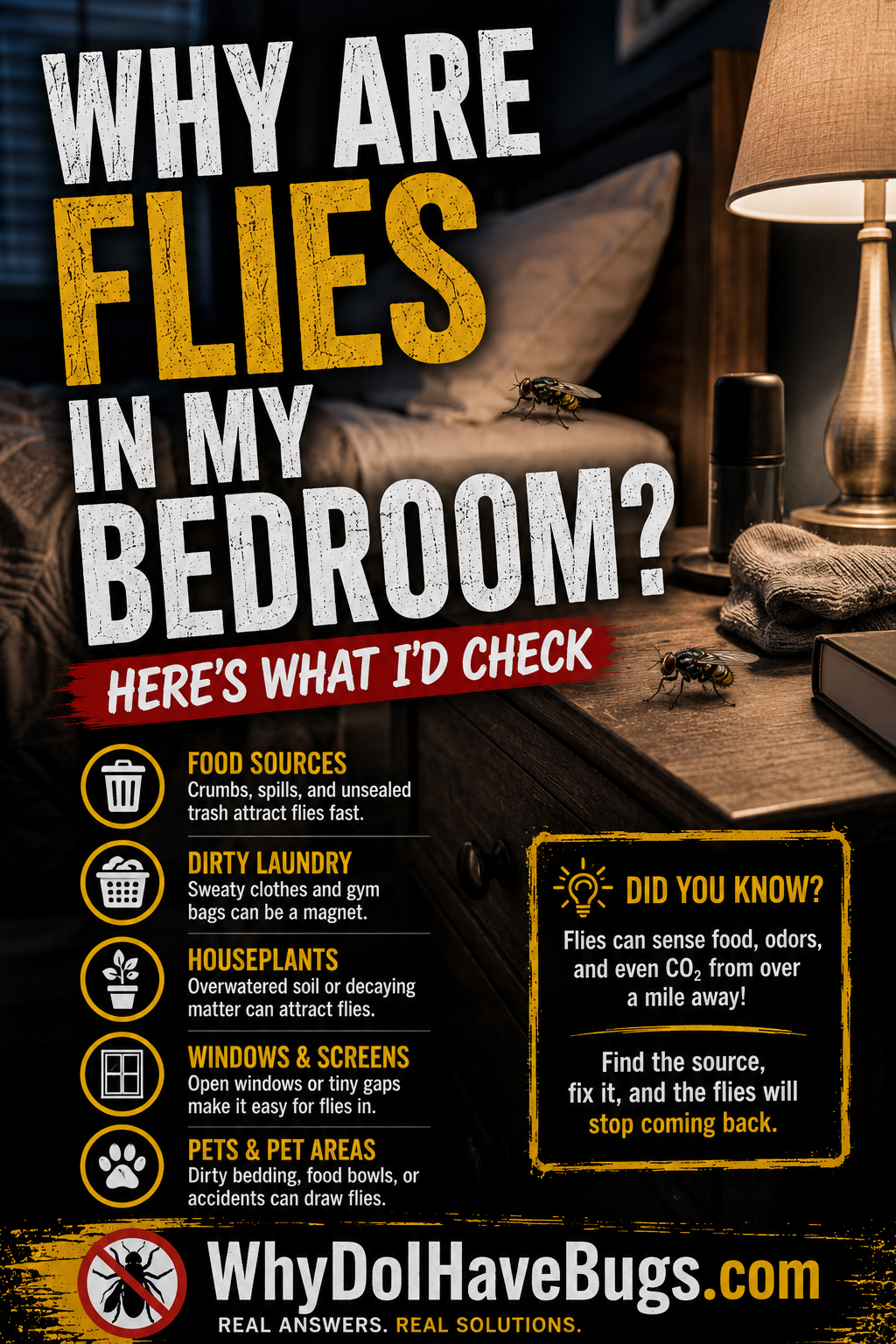
Finding flies in your bedroom feels different than finding them almost anywhere else.
You expect to see one near a garbage can or maybe around the kitchen sink.
Your bedroom?
Not so much.
That’s why whenever I hear someone say they’re finding flies in the bedroom every day, I don’t immediately assume the bedroom is the problem.
In fact, most of the time it isn’t.
Over the years, I’ve learned that bedrooms often act more like a stopping point than the actual source of a fly problem. Flies end up there because they’re following light, warmth, or simply wandering after entering another part of the house.
Instead of asking, “Why are there flies in my bedroom?”
I usually ask,
“Why did they choose this room?”
That question almost always leads me in the right direction.
I Watch the Flies Before I Do Anything Else
One habit that’s helped me solve a lot of fly problems is simply slowing down.
Instead of immediately grabbing a fly swatter, I spend a few minutes watching where the flies go.
That tells me much more than killing them ever will.
For example:
- Are they flying against the bedroom window?
- Do they keep returning to the same corner?
- Are they staying near a closet?
- Are they landing on the ceiling?
- Do they disappear under furniture?
Those patterns usually point toward the next thing I should inspect.



Bedroom Windows Tell Me a Lot
If nearly every fly is gathered around the bedroom window, I don’t blame the window.
I take it as a clue.
Flies naturally move toward the brightest light they can find after becoming trapped indoors.
That’s why windows become gathering spots throughout the house.
One bedroom window may attract far more flies than another simply because it receives more sunlight during the day.

If that’s exactly what you’re seeing, I’d also read Why Are Flies on My Windows? Here’s What It Means because understanding that behavior often helps narrow down where the flies actually came from.


Don’t Forget About the Closet
Closets aren’t usually the first place people inspect.
They’re one of mine.
Bedrooms often have closets that stay closed for days at a time.
If something unusual is happening inside, you may not notice right away.
I’d check for:
- Damp shoes.
- Dirty laundry.
- Forgotten food wrappers.
- Water damage.
- Rodent activity.
- Dead insects collecting around windows.
Most closets are perfectly clean.
But every now and then, they surprise you.
Check Under the Bed
It’s amazing what can end up underneath a bed.
Dust bunnies.
Pet toys.
Dropped snacks.
Even pet food if animals like to hide treats.
I’m not saying flies are living under the bed.
But if something organic has been sitting there for weeks, it’s worth removing it from the equation.
Whenever I inspect a bedroom, I like starting with a completely clean floor because it eliminates one more possible attraction before I move on to bigger possibilities.

Bedrooms Can Reveal Where Flies Enter the House
One thing I’ve noticed over the years is that bedrooms often expose entry points people don’t think about.
Unlike the kitchen or garage, bedrooms usually stay quiet for long periods.
That makes it easier to notice patterns.
If flies always seem to appear in the same bedroom, I start checking everything around that room instead of assuming the entire house has a fly problem.
I’d inspect:
- Window screens.
- Window locks that don’t seal tightly.
- Gaps around the window frame.
- Exterior doors if the bedroom has one.
- HVAC vents nearby.
Sometimes the answer is surprisingly simple.
A damaged screen that’s been there for months.
Dirty Laundry Usually Isn’t the Problem… But It Can Be
People often ask me if dirty laundry attracts flies.
Normally, no.
A pile of clothes by itself usually isn’t enough to create a fly problem.
But there are exceptions.
Workout clothes.
Food spilled on clothing.
Baby clothes with formula.
Pet blankets.
Anything with organic residue can become more attractive than ordinary laundry.
I wouldn’t panic because of a laundry basket, but I also wouldn’t ignore it if everything else checks out.



Pets Can Accidentally Bring Flies Into the Bedroom
If your dog or cat sleeps in your bedroom, I also look at the areas where they spend time.
Pet beds.
Food bowls.
Favorite hiding spots.
Treat containers.
Even toys that have been carried outside and brought back in.
Most people don’t think of those things during a fly inspection, but I’ve found they’re worth checking.
One Fly Isn’t the Same as Twenty
Context matters.
Finding one fly in the bedroom once in a while isn’t unusual.
It may have simply wandered into the room while following light.
But if you’re seeing several flies every day in the same bedroom, that’s a different situation.
Recurring activity tells me there’s probably an underlying reason.
At that point, I stop treating it like a random visitor and start looking for patterns.


What I Pay Attention To
Whenever I’m trying to solve a bedroom fly problem, I ask myself questions like these.
Are they only active during the afternoon?
Do they disappear at night?
Are they always on the same window?
Do they seem larger than ordinary house flies?
Did the problem begin suddenly or gradually?
The answers help narrow down the possibilities much faster than randomly trying sprays or traps.
The Best Trap Depends on Their Behavior
I don’t automatically recommend the same trap for every bedroom.

If flies spend all day crawling across the window, I’d probably start with window fly traps because they work with the flies’ natural instinct to move toward light.
If they’re flying around the room instead, I prefer a quiet plug-in trap that can work continuously without becoming an eyesore.

That’s one reason I put together Best Fly Traps That Actually Work for Every Situation. Choosing the right trap is much easier once you know how the flies are behaving.



Here’s Exactly How I’d Inspect a Bedroom
If I walked into my bedroom tonight and found several flies, I wouldn’t immediately start spraying insecticide.
I’d spend five or ten minutes looking for clues.
First, I’d watch where the flies gather.
Next, I’d inspect the window, screen, and nearby walls.
Then I’d check inside the closet, under the bed, and behind furniture.
After that, I’d look around the rest of the house to see if the bedroom is actually the only room with flies.
More often than not, the bedroom isn’t where the problem started.
It’s simply where the evidence became obvious.
Think Bigger Than the Bedroom
One thing I’ve learned is that bedrooms rarely create fly problems on their own.
They’re usually revealing a larger issue somewhere else in the home.
That’s why I always zoom out before jumping to conclusions.

If you’re also finding flies in your kitchen, garage, basement, or other rooms, I’d recommend reading Why Do Flies Keep Coming Back? Common Reasons Explained because recurring fly problems almost always point to an overlooked source or entry point.
You can also browse our growing Flies category for more fly identification guides, product reviews, and practical advice to help you solve the problem for good.
Frequently Asked Questions
Why do flies keep showing up in my bedroom?
Most of the time, flies aren’t attracted to the bedroom itself. They’re often following light, entering through a nearby opening, or wandering in from another room after getting trapped inside the house.
Can flies breed in a bedroom?
It’s uncommon for ordinary house flies to breed in a clean bedroom. If flies keep appearing, the source is usually somewhere else in the home or just outside it.
Why are flies always on my bedroom window?
Flies naturally move toward the brightest light available after becoming trapped indoors. That’s why bedroom windows often become gathering spots, especially if they receive plenty of sunlight.
Should I use a fly trap in my bedroom?

If flies keep returning, a trap can certainly help. The best choice depends on where the flies spend their time. Window traps work well for flies gathering on glass, while enclosed indoor traps are often a better fit for flies moving throughout the room. For flies gathering on bedroom glass, fly traps for windows may be the most targeted option to consider.
When should I be concerned about flies in my bedroom?
If you’re suddenly seeing large numbers of flies every day, especially after never having a problem before, it’s worth inspecting your home carefully for hidden food sources, entry points, moisture issues, or other underlying causes.
About the Author
Mark Sullivan has spent years maintaining homes and rural properties while solving everyday pest problems. He enjoys helping homeowners think like inspectors by tracking down the real cause of recurring pest problems instead of simply treating what they can see.