
If you’ve ever heard someone say a mayfly only lives for one day, you’re not alone.
It’s one of the most common facts people know about these unusual insects.
The interesting part is that it’s only partially true.
While many adult mayflies live for just a few hours to a couple of days, that’s only the final chapter of a much longer life. House flies have a notably longer adult stage, with typical lifespans explained in this guide to house flies' longer adult lifespan.
In reality, mayflies spend the overwhelming majority of their lives hidden beneath the surface of lakes, rivers, streams, and ponds. Because both insects develop in freshwater, aquatic mayflies and stoneflies explains how to distinguish them in and around these habitats.
By the time you see one resting on your porch or flying around your outdoor lights, it may already be months or even years old.
Understanding their complete lifespan helps explain why mayflies suddenly appear in huge numbers and why those swarms disappear almost as quickly as they arrived.
The Short Answer
If you’re looking for the quick answer, here it is.
A mayfly’s total lifespan usually ranges from several months to two years, depending on the species and environmental conditions.
However, the winged adult stage often lasts only:
- A few hours.
- One day.
- Two days.
- Occasionally a little longer for some species.

Most of a mayfly’s life is spent underwater as an aquatic nymph, not flying around your home. For a broader introduction to their appearance and behavior, see mayfly identification and behavior.



Most of Their Life Happens Underwater
This was probably the biggest surprise to me.
When people see a mayfly, they assume they’re looking at an insect that has only existed for a day or two.
Actually, they’re seeing the end of its life.
After hatching from an egg, a young mayfly spends months developing beneath the water’s surface.
During this stage it feeds, grows, molts repeatedly, and avoids predators like fish, salamanders, and aquatic insects.
Depending on the species, this underwater stage may last:
- A few months.
- One full year.
- Nearly two years.
Cold water generally slows development, while warmer temperatures can speed it up.


It All Starts With Tiny Eggs
Every mayfly begins life as an egg.
After mating, the female returns to the water and deposits her eggs on or just below the surface.
Different species use slightly different strategies.
Some drop their eggs while flying.
Others briefly touch the water before releasing them.
The eggs eventually sink to the bottom where they settle among rocks, gravel, plants, or sediment.
Depending on water temperature and species, they may hatch within days or remain dormant for much longer before tiny aquatic nymphs emerge.
The Nymph Stage Is Where All the Growing Happens
Once the eggs hatch, the mayfly enters the nymph stage.
This is by far the longest part of its life.
Unlike the adults, nymphs are active feeders.
Most spend their days grazing on:
- Algae.
- Microscopic plants.
- Decaying leaves.
- Organic debris.
- Biofilm growing on submerged rocks.
Some species are also predators that feed on tiny aquatic animals, although this is less common.
During this stage they molt dozens of times as they gradually grow larger.
Every molt allows the nymph to develop stronger legs, larger wing pads, and more advanced gills.


Water Quality Can Change Their Lifespan
One reason it’s difficult to give a single lifespan for every mayfly is because environmental conditions matter.
Development is affected by factors such as:
- Water temperature.
- Oxygen levels.
- Food availability.
- Water pollution.
- Stream flow.
- Species.
Some species mature in less than a year.
Others require two growing seasons before finally emerging as adults.
That’s one reason scientists often study mayflies when evaluating stream health.
Healthy mayfly populations usually indicate clean, oxygen-rich water capable of supporting long-term development.
The Most Unusual Stage Happens Just Before Adulthood
One of the things I find most fascinating about mayflies is that they do something almost no other insect can do.
Before becoming fully mature adults, they pass through a unique winged stage called the subimago.
At this point, they already have wings and can fly.
But they’re not finished developing.
After a short period, they molt one final time into the fully mature adult.
Mayflies are the only living insects known to molt after developing functional wings, making this one of the most unusual life cycles in the insect world.

Adult Mayflies Live Remarkably Short Lives
Once a mayfly reaches adulthood, the clock starts ticking.
Unlike the nymph stage that can last months or years, the adult stage is incredibly brief.
For many species, adulthood lasts only:
- A few hours.
- One day.
- Two days.
Some species survive slightly longer, but very few adult mayflies live more than a couple of days. Their only objectives are to find a mate, reproduce, and ensure the next generation begins. Because adults generally don’t feed, they rely entirely on the energy stored during their long underwater development. (mdc.mo.gov)
That short lifespan explains why massive swarms often disappear almost as quickly as they arrive.
Why Don’t Adult Mayflies Live Longer?
When I first learned about mayflies, I wondered why nature would create an insect that spends years growing only to live for a day or two as an adult.
The answer comes down to specialization.
The nymph stage handles almost everything required for survival.
During that time, mayflies:
- Eat.
- Grow.
- Store energy.
- Develop wings.
- Escape predators.
- Prepare for adulthood.
Once they emerge, there’s only one job left.
Reproduction.
Since they don’t need to search for food anymore, natural selection favored adults that reproduce quickly instead of living longer. That strategy allows enormous numbers of eggs to be laid over a very short period. (mdc.mo.gov)

Why Do Millions Emerge at the Same Time?
One of the most incredible things about mayflies is that many species don’t emerge randomly.
Instead, entire populations emerge together.
This synchronized hatch provides a huge survival advantage.
Imagine if only ten mayflies emerged.
Fish, birds, bats, dragonflies, and spiders could easily eat all of them.
Now imagine millions emerging over the course of a few hours.
Predators become overwhelmed.
Even though countless mayflies are eaten, enough survive to reproduce and lay the next generation of eggs.
Scientists call this predator satiation, and it’s one of the main reasons mayflies have survived for hundreds of millions of years. (arboretum.wisc.edu)
Weather Can Affect How Long Adults Survive
Not every adult mayfly lives exactly the same amount of time.
Several environmental factors can influence survival, including:
- Heavy rain.
- Strong winds.
- Cool temperatures.
- Extremely hot weather.
- Predator activity.
A violent storm shortly after emergence can dramatically reduce the number of adults that survive long enough to reproduce.
Likewise, large flocks of birds or heavy fish feeding during a hatch may consume enormous numbers of adults.
Fortunately for the species, synchronized hatches usually ensure that enough survive despite these losses.
How Long Can Mayflies Live Inside Your House?
If a mayfly accidentally flies indoors, it usually doesn’t survive very long.

Most adults continue flying toward windows because they’re trying to return outside.
Since they don’t feed, they eventually die naturally whether they’re indoors or outdoors.
If I find one inside, I simply capture it with a cup and release it outside.
There’s no need for insecticides because the insect isn’t capable of infesting the home.
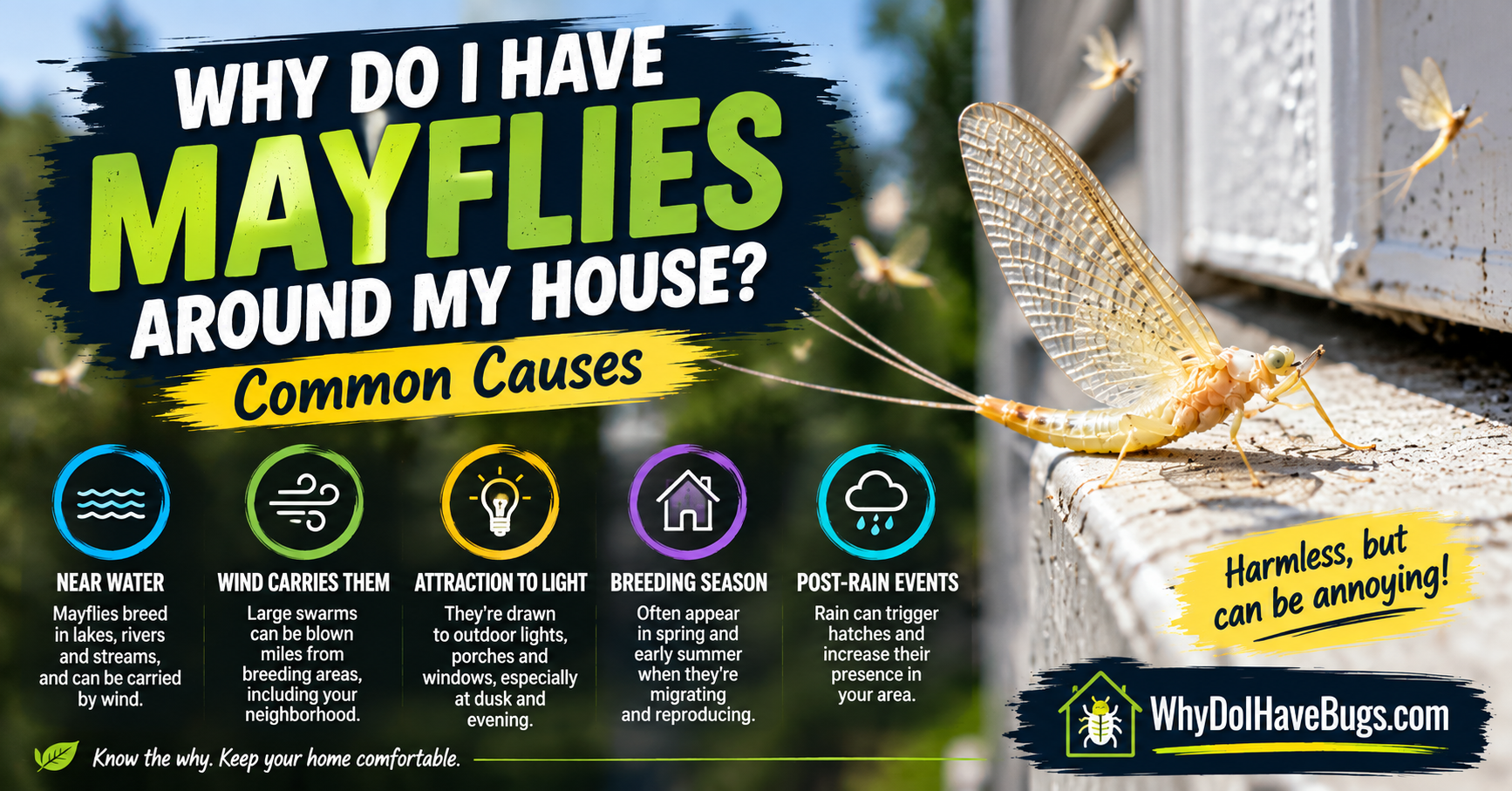
If you’re finding large numbers around your house, my guide explaining why you have mayflies around your houseexplains the most common reasons they gather near homes and what you can do to reduce them.
Mayflies Spend More Time Growing Than Almost Any Homeowner Realizes
When people hear “one-day lifespan,” they often assume the insect’s entire life lasted only twenty-four hours.
The reality is almost the opposite.
A mayfly that lived as a nymph for eighteen months and as an adult for one day spent well over 99% of its life underwater.

That long development period allows it to grow, molt dozens of times, and store enough energy to complete its brief adult stage without ever needing another meal.
Looking at it that way completely changes the way I think about mayflies.
The insect you see flying around your porch isn’t just a one-day-old bug.
It’s the final stage of a life that may have begun years earlier beneath the surface of a nearby stream or lake.
Frequently Asked Questions
Do mayflies really live only one day?
Not exactly. While many adult mayflies live only a day or two, their total lifespan is often several months to two years because they spend most of their lives underwater as nymphs. (mdc.mo.gov)
Why do adult mayflies die so quickly?
Adult mayflies are specialized for reproduction rather than feeding. Most have nonfunctional mouthparts, so they rely on energy stored during the nymph stage and live only long enough to mate and lay eggs. (mdc.mo.gov)
Which stage lasts the longest?
The aquatic nymph stage is by far the longest, often lasting months or even years depending on the species and environmental conditions. (texasinsects.tamu.edu)
Can weather shorten a mayfly’s lifespan?
Yes. Heavy rain, strong winds, extreme temperatures, and predators can all reduce how long adult mayflies survive after emerging.
Why do mayflies emerge all at once?
Many species synchronize their emergence so predators can’t eat them all. This strategy, known as predator satiation, greatly increases the odds that enough adults survive to reproduce. (arboretum.wisc.edu)
About the Author
Dr. Emily Carter is a freshwater ecologist specializing in aquatic insects and stream ecology. She has spent years studying mayflies and other aquatic invertebrates, helping explain their fascinating life cycles, ecological importance, and the science behind the spectacular seasonal hatches that occur across North America.