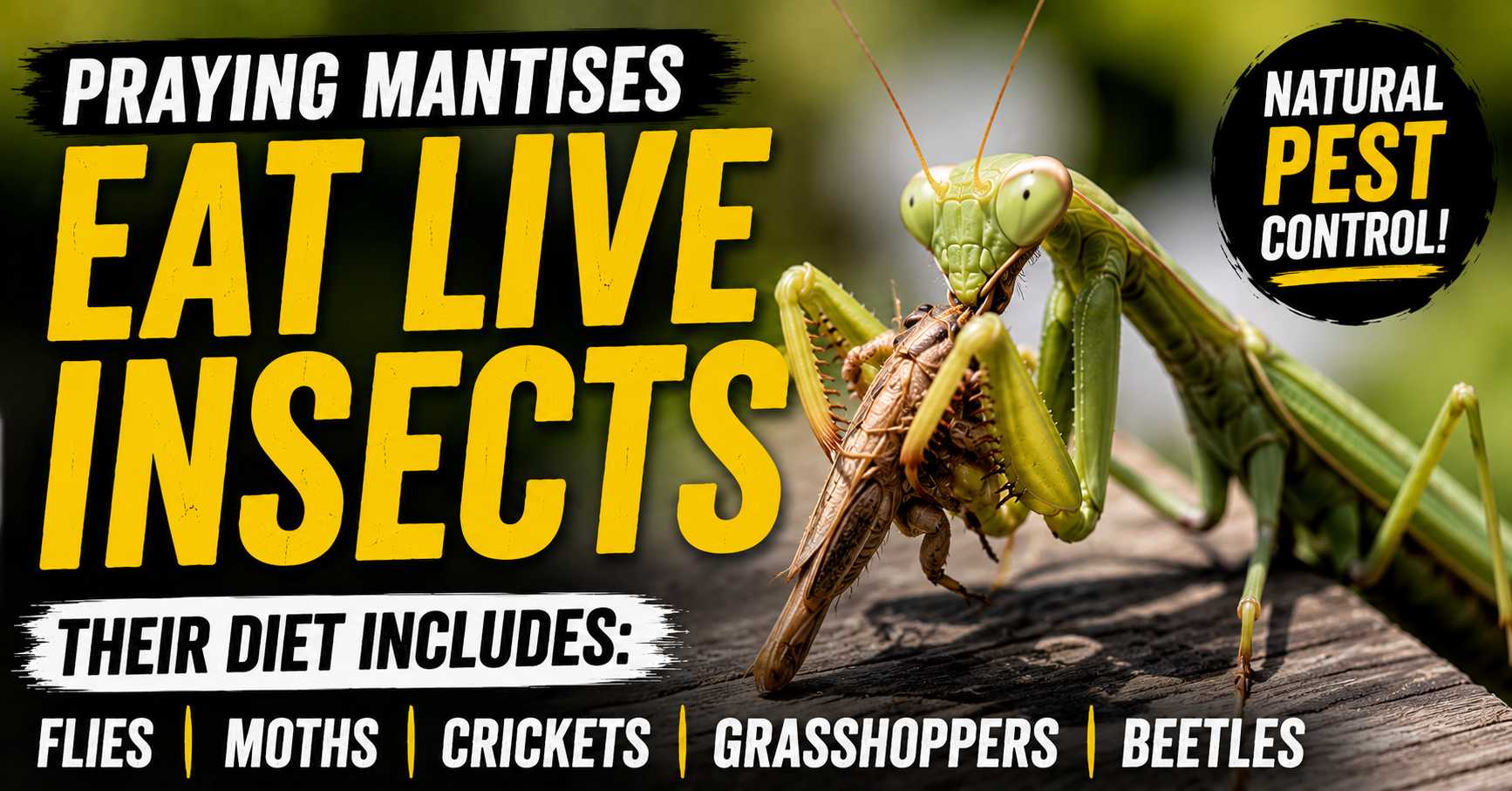
Praying mantises eat live insects, spiders, and almost any other small animal they can overpower. Their usual diet includes flies, moths, crickets, grasshoppers, beetles, caterpillars, roaches, bees, and even other praying mantises.
They are not plant eaters and do not chew leaves, flowers, roots, or vegetables. When you find a mantis sitting on a garden plant, it is normally using the plant as a hunting perch rather than eating it.
The exact diet depends heavily on the mantis’s size. A newly hatched mantis begins with tiny insects such as aphids and fruit flies, while a large adult may capture prey nearly as big as itself.
What Praying Mantises Eat Most Often
Praying mantises are generalist predators, meaning they do not rely on one particular type of prey. They usually eat whichever manageable animal moves close enough to grab.
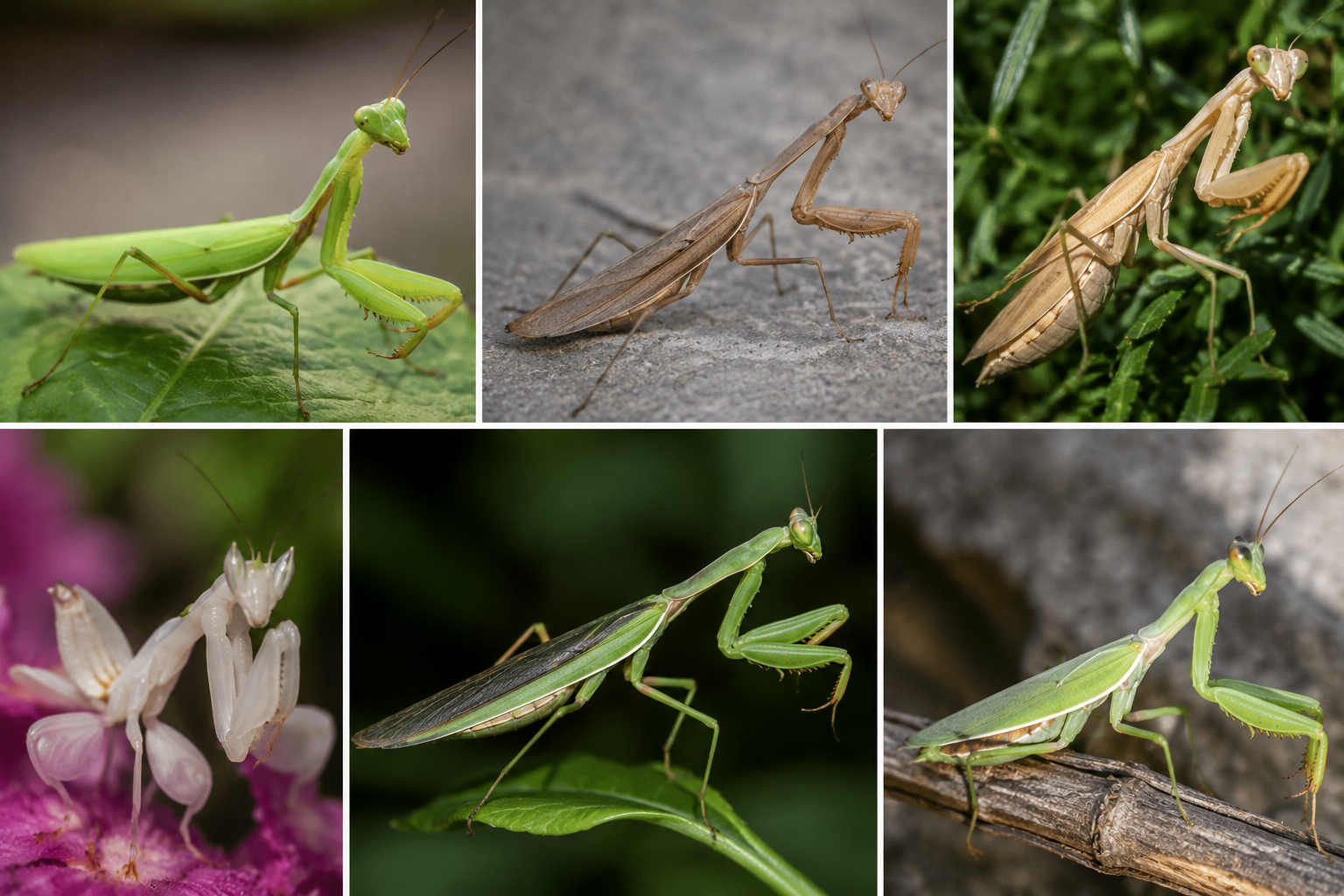
Common prey includes:
- Flies
- Moths
- Crickets
- Grasshoppers
- Beetles
- Caterpillars
- Roaches
- Aphids
- Leafhoppers
- Mosquitoes
- Bees
- Wasps
- Butterflies
- Spiders
- Other mantises
A mantis does not understand which insects people consider pests. It may capture a destructive caterpillar and later eat a pollinating bee from the same plant.
That lack of selectivity is important when deciding whether praying mantises are truly beneficial for a particular garden.


Praying Mantises Are Carnivores
Praying mantises are carnivores that obtain their energy from other animals. They are not known for switching between insects and plant material like many omnivorous bugs.
Their bodies are specifically adapted for hunting. The large compound eyes detect motion, the movable head tracks prey, and the folded front legs form a powerful grabbing trap.
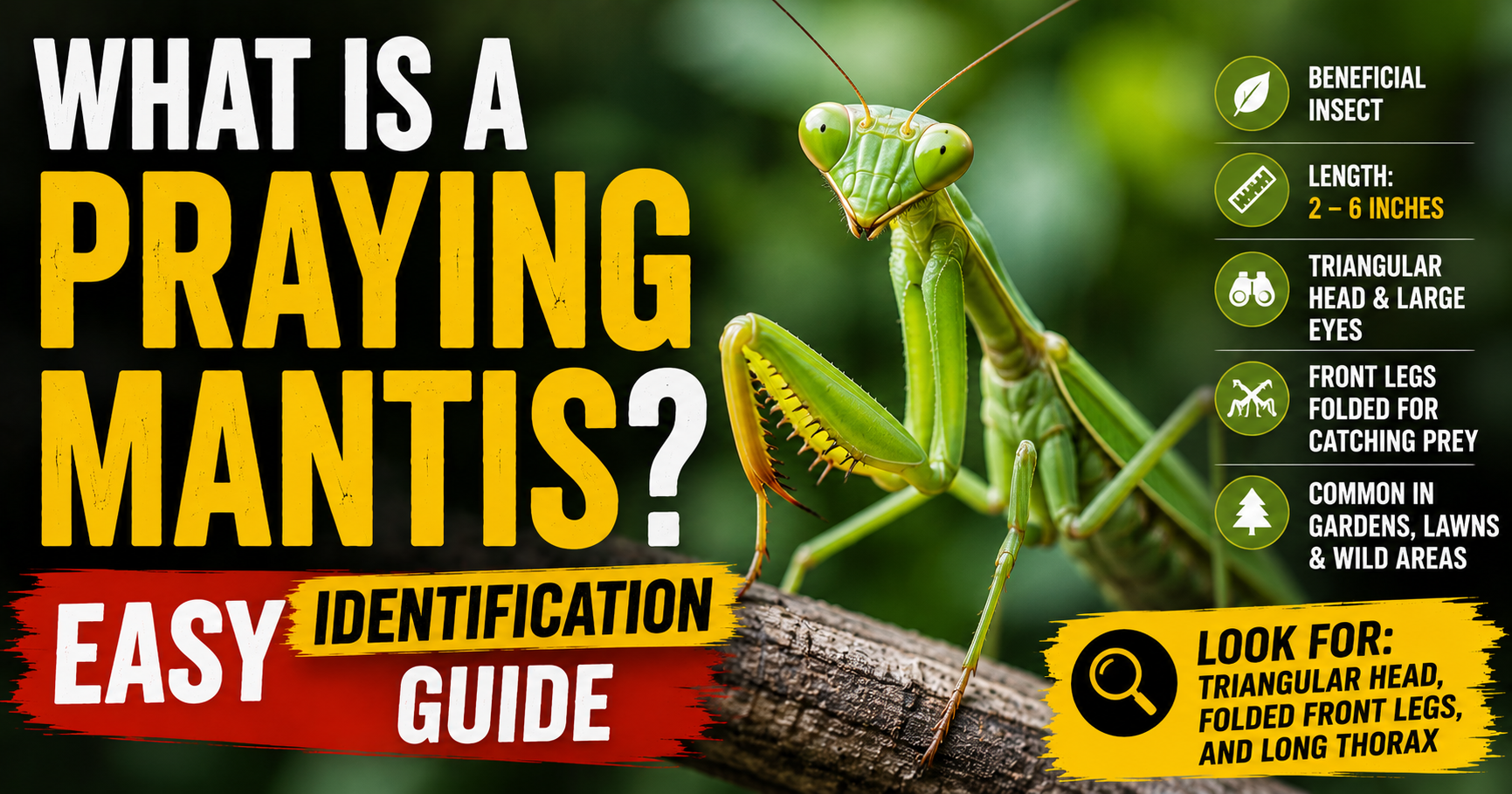
Those recognizable hunting features can help identify an unfamiliar insect. My guide explaining what a praying mantis looks like covers the triangular head, spiny front legs, long body, wings, and colors in greater detail.
How a Praying Mantis Catches Its Food
A praying mantis normally waits for food rather than chasing it over a long distance.
It chooses a location where insects are likely to pass, such as:
- A flower
- A leafy shrub
- A vegetable plant
- Tall grass
- A tree branch
- A porch light
- A window screen
- An exterior wall
- A woodland edge
- An overgrown fence row
The mantis remains motionless and relies on camouflage. When an insect comes within range, it extends its front legs in a rapid strike.
Rows of spines close around the prey and prevent it from escaping. The mantis then holds the captured animal near its mouth and begins eating with its mandibles.
It may begin eating immediately rather than killing the prey first. Although this seems harsh, it is normal predator behavior within the insect world.
Do Praying Mantises Eat Flies?
Praying mantises commonly eat flies. Flies are active, abundant, and often move within reach of a mantis waiting on vegetation or a structure.
A mantis may capture:
- House flies
- Blow flies
- Horse flies
- Fruit flies
- Crane flies
- Hover flies
- Other small flying insects
Adult mantises can catch larger flies, while newly hatched nymphs may be able to eat tiny fruit flies.
A praying mantis around a porch or window may be taking advantage of flies gathering near lights, screens, garbage areas, pet waste, or other food sources.
However, one mantis will not eliminate a serious fly problem. It captures individual insects that come within reach and does not seek out breeding material.
Do Praying Mantises Eat Mosquitoes?
Praying mantises can eat mosquitoes, but they are not dependable mosquito control.
A mosquito that flies close to a waiting mantis may be captured. The problem is that mosquitoes are small, highly mobile, and often active in places where a large mantis is not positioned to catch them.
A mantis does not actively search the entire yard for mosquitoes. It waits in one area and takes advantage of prey that approaches.
Even several mantises would be unlikely to reduce a mosquito population noticeably. Removing standing water and addressing breeding areas will do far more than relying on predators.
Do Praying Mantises Eat Roaches?
A praying mantis can eat roaches that are small enough to overpower.
Roaches are fast, mostly nocturnal, and frequently hide in cracks or beneath objects. Those habits limit how often an outdoor mantis encounters them.
A mantis may catch a roach traveling through vegetation, mulch, a porch, or another exposed area. It will not enter wall voids, cabinets, or appliances to hunt an indoor infestation.
Finding a praying mantis near the house should not be interpreted as natural roach treatment. The mantis may eat an occasional exposed roach, but established indoor roaches require targeted inspection and control.


Do Praying Mantises Eat Crickets?
Crickets are common praying mantis prey. Their size, movement, and outdoor activity make them suitable targets for medium and large mantises.
A mantis may capture crickets in:
- Tall grass
- Gardens
- Flower beds
- Shrubs
- Around exterior lights
- Along foundations
- Near sheds and garages
The mantis must still be large enough to control the cricket. A small nymph may avoid a large adult cricket that could kick, bite, or injure it.
Do Praying Mantises Eat Grasshoppers?
Large praying mantises eat grasshoppers. Both insects frequently live in gardens, fields, tall grass, and other open areas.
Grasshoppers have powerful jumping legs and can be difficult prey. The mantis depends on a quick strike that traps the grasshopper before it can leap away.
Smaller mantises may target grasshopper nymphs, while a large adult can attempt to overpower a mature grasshopper.
This is one reason mantises are sometimes welcomed in gardens. Grasshoppers can damage plants, and a mantis may remove individual grasshoppers from the area.


Do Praying Mantises Eat Caterpillars?
Praying mantises eat many kinds of caterpillars.
Caterpillars are soft-bodied and frequently move along the same stems and leaves where mantises hunt. They may be easier to capture than fast-flying insects.
A mantis could eat caterpillars that damage vegetable plants, flowers, shrubs, or trees. However, it may also eat caterpillars that would have become harmless or beneficial butterflies and moths.
The mantis does not recognize the difference between a tomato hornworm, a monarch caterpillar, or another species people may want to protect.
Do Praying Mantises Eat Beetles?
Praying mantises eat beetles they can grasp and chew.
Beetles vary tremendously in size, speed, shape, and defensive ability. A soft-bodied or moderately sized beetle may be suitable prey, while a heavily armored beetle can be difficult to consume.
The mantis may capture beetles that fly to exterior lights or crawl across plants. Beetle larvae may also be eaten when they are exposed.
A mantis will not dig through soil, wood, or stored products to find hidden beetle larvae.


Do Praying Mantises Eat Aphids?
Baby and small praying mantises may eat aphids.
Aphids are tiny, slow-moving, and often concentrated on tender plant growth. These qualities make them manageable prey for young mantises that are not yet strong enough to capture larger insects.
Adult mantises may ignore individual aphids because the small meal provides little energy compared with a moth, cricket, or grasshopper.
Other predators, such as lady beetle larvae and lacewing larvae, are usually better suited to controlling large aphid colonies.
Do Praying Mantises Eat Spiders?
Praying mantises eat spiders when they can catch them, but spiders can also eat mantises.
The outcome depends on:
- The species involved
- Their relative size
- Which animal attacks first
- Whether a web is involved
- The available escape routes
A mantis may grab a spider walking across vegetation. A web-building spider may trap a young mantis in its web, while a large hunting spider could overpower a small mantis.
Neither predator always wins. Backyard food webs are filled with animals that may switch between being hunter and prey.
Do Praying Mantises Eat Bees?
Praying mantises eat bees, including pollinating species visiting flowers.
A mantis may position itself on or beside a flower because the location attracts a steady supply of insects. It does not avoid bees simply because they are beneficial pollinators.
The mantis’s front legs can hold the bee away from its body while it begins feeding. This reduces the bee’s ability to sting the mantis effectively.
Seeing a mantis eat one bee does not mean it will destroy the entire local bee population. However, a mantis consistently hunting on a heavily visited flower can capture multiple pollinators.
This is one reason I would not describe praying mantises as perfect garden helpers.
Do Praying Mantises Eat Wasps?
Large praying mantises can eat wasps, but attacking one carries some risk.
A mantis must control the wasp quickly and keep the stinger away from vulnerable parts of its body. Its spiny front legs provide the grip needed to restrain struggling prey.
The size and species of the wasp matter. A small solitary wasp is a more manageable target than a large hornet or an entire social-wasp colony.
A mantis cannot control a nest or protect a property from aggressive wasps. It may only capture individual wasps that move within striking range.
Do Praying Mantises Eat Butterflies?
Praying mantises eat butterflies.
Flowers attract butterflies, which makes those same flowers useful hunting locations for mantises. A well-camouflaged mantis can remain hidden until a butterfly lands close enough to grab.
Large mantises may capture surprisingly large butterflies. The mantis holds the body or wings with its front legs and begins feeding.
This behavior is natural, but it can be upsetting to gardeners who planted flowers specifically to support butterflies.
If a mantis repeatedly hunts on a favorite pollinator plant, you can move it to vegetation elsewhere on the property.
Do Praying Mantises Eat Moths?
Moths are one of the most common types of prey available to adult praying mantises.
Many moths are active after dark and gather around porch lights, security lights, garages, and illuminated windows. Mantises may wait nearby to capture them.
A mantis found on siding or a window screen at night may be using the house as a hunting platform rather than trying to enter.
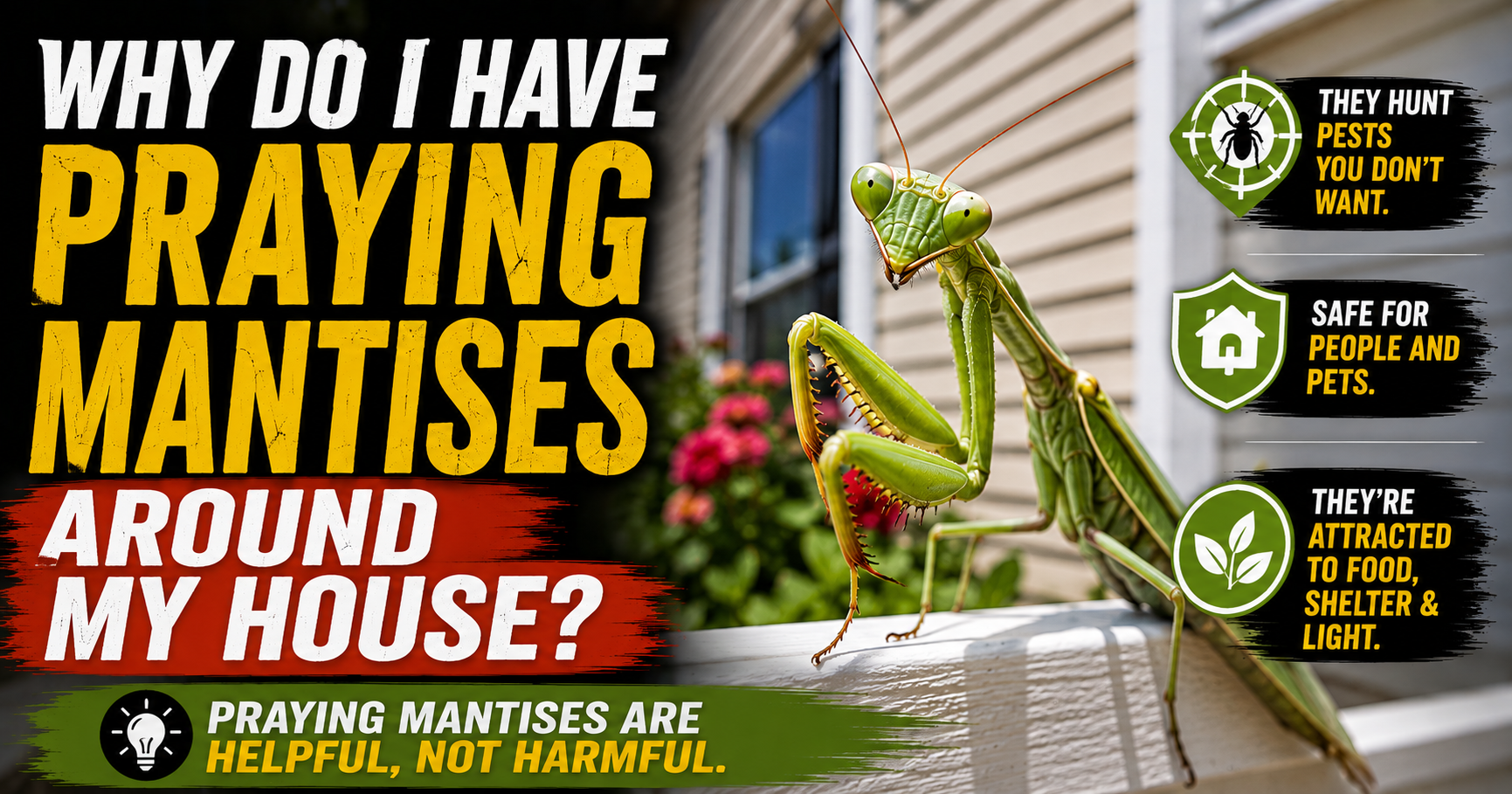
The combination of prey insects, vegetation, and lighting is explained further in my guide covering why praying mantises come around houses.
Do Praying Mantises Eat Ants?
Small praying mantises may eat individual ants, but ants are not always desirable prey.
Ants can bite, sting, release defensive chemicals, and recruit other ants. Their small size also means one ant provides relatively little food to a large mantis.
A young mantis might capture a small ant walking alone. An adult is more likely to focus on larger prey that provides more energy.
Mantises do not enter ant nests or provide meaningful ant-colony control.
Do Praying Mantises Eat Termites?
A praying mantis may eat winged termites during a swarm if the insects fly within reach.
Termite swarmers leave their colony in large numbers and can attract many predators. Birds, spiders, frogs, and other insects may all take advantage of the temporary food source.
A mantis cannot reach termites living inside wood, soil, or a structure. Seeing it eat a swarmer does not protect the house from termite damage.
Do Praying Mantises Eat Bed Bugs?
Praying mantises are not bed bug predators in any practical sense.
Bed bugs hide indoors in mattress seams, bed frames, furniture joints, baseboards, and small cracks. A praying mantis lives primarily outdoors and cannot search those protected hiding places.
Even if a mantis happened to encounter a bed bug, releasing it inside would not control an infestation.
Praying mantises should never be brought into bedrooms or used as a substitute for a proper bed bug inspection and treatment plan.
Do Praying Mantises Eat Ticks?
A praying mantis might eat an exposed tick, but ticks are not a major or dependable part of its diet.
Ticks spend much of their time low in vegetation, leaf litter, or attached to hosts. A mantis is unlikely to encounter enough of them to affect the local population.
Reducing tick habitat, checking people and pets, and using appropriate prevention provide far more protection.
Do Praying Mantises Eat Other Praying Mantises?
Praying mantises commonly eat other mantises.
Cannibalism can happen when:
- Young mantises hatch close together
- Food is scarce
- A larger mantis encounters a smaller one
- Several mantises are confined together
- A female encounters a male during mating
- One mantis molts near another
Newly hatched nymphs need to disperse quickly. If they remain crowded around the egg case, stronger individuals may begin eating their siblings.
Adult mantises are normally solitary. They do not form family groups or cooperate while hunting.
Why Does a Female Mantis Eat the Male?
A female praying mantis may eat a male during or after mating, but this does not occur every time.
The female is generally larger and requires substantial nutrition to produce eggs. A smaller male moving within reach may trigger the same predatory response as any other prey animal.
Sexual cannibalism has been observed frequently in confined conditions, where the male has fewer opportunities to approach carefully or escape. It also happens in nature, but it is not guaranteed.
The male’s body provides protein and nutrients that may contribute to the female’s egg production.
Do Praying Mantises Eat Hummingbirds?
Very large praying mantises have occasionally captured and eaten hummingbirds. These events are real, but they are rare and mostly involve large adult mantises waiting on or near hummingbird feeders.
A mantis positioned on a feeder has an unusual opportunity. The hummingbird repeatedly approaches the same small opening and may not detect the camouflaged predator until it is close.
This does not mean praying mantises routinely hunt birds throughout the yard.
If you find a large mantis sitting directly on a hummingbird feeder, move it to vegetation a considerable distance away. Continue checking the feeder during late summer and early fall when mantises reach their largest adult size.
Do Praying Mantises Eat Lizards and Frogs?
Large praying mantises have occasionally captured small lizards, frogs, and other vertebrates.
These animals are not the main part of a mantis’s diet. Most mantises spend their lives eating insects and spiders.
A vertebrate must be small enough for the mantis to grab, restrain, and begin eating without being injured itself. Such opportunities are much less common than encounters with moths, flies, or crickets.
The possibility demonstrates how powerful a large mantis can be for its size, but it does not make the insect dangerous to people.
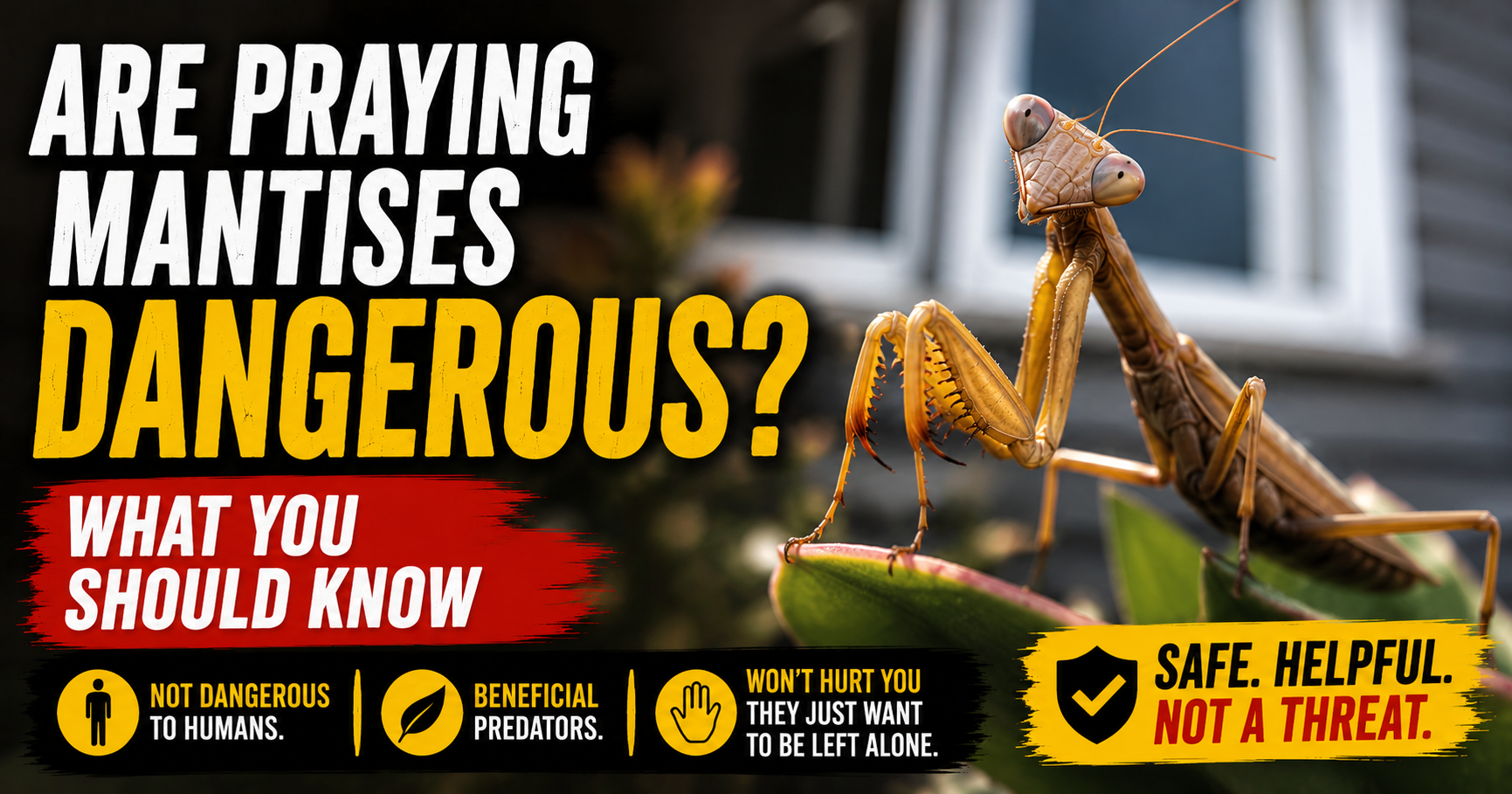
My complete safety guide answers whether praying mantises are dangerous to people and pets without exaggerating these unusual events.
What Do Baby Praying Mantises Eat?
Baby praying mantises, called nymphs, begin eating live prey soon after hatching.
Their first foods may include:
- Aphids
- Fruit flies
- Fungus gnats
- Tiny leafhoppers
- Springtails
- Small flies
- Mites
- Mosquitoes
- Newly hatched insects
- Other mantis nymphs
A newly hatched mantis cannot overpower the large crickets, grasshoppers, and moths eaten by adults. Its prey must be small enough to hold with its developing front legs.
As the nymph molts and grows, it gradually begins capturing larger food.
What Do Adult Praying Mantises Eat?
Adult praying mantises focus on larger prey that provides enough energy to support survival and reproduction.
An adult may eat:
- Large flies
- Moths
- Crickets
- Grasshoppers
- Beetles
- Caterpillars
- Roaches
- Bees
- Wasps
- Spiders
- Other mantises
Large females may consume more food as they prepare to produce egg cases. They are also capable of overpowering larger animals than smaller males or young nymphs.
Do Praying Mantises Eat Every Day?
A praying mantis does not necessarily eat every day.
How often it feeds depends on:
- Body size
- Age
- Temperature
- Prey availability
- The size of its previous meal
- Whether it is preparing to molt
- Whether a female is producing eggs
A large meal may sustain a mantis for several days. Cooler temperatures can slow its activity and reduce the need for food.
A mantis may also refuse food shortly before molting. During this vulnerable period, it needs a secure place to hang and shed its old exoskeleton.
How Much Does a Praying Mantis Eat?
The amount varies by species, age, and prey size.
A young nymph may eat several tiny insects, while an adult may consume one larger moth or cricket and remain satisfied for a while.
Praying mantises are relatively inactive hunters. They spend much of their time waiting, which helps conserve energy between meals.
One mantis may eat numerous insects during its lifetime, but it does not consume enough to control every pest across an entire garden or property.
Do Praying Mantises Eat Dead Bugs?
Praying mantises strongly prefer moving live prey.
Movement helps trigger their hunting response. A motionless dead insect may not be recognized as food, even when it would otherwise be an appropriate size.
A very hungry mantis may investigate freshly killed prey, particularly if it is moved, but scavenging is not its normal feeding strategy.
This is why wild mantises cannot survive on crumbs, dry pet food, or dead bugs collected from a windowsill.
Do Praying Mantises Eat Plants?
Praying mantises do not eat leaves, flowers, fruit, vegetables, grass, or tree bark.
They may sit on a damaged plant, but another insect is responsible for the chewing.
When you see holes or missing leaf edges near a mantis, look for:
- Caterpillars
- Beetles
- Grasshoppers
- Slugs
- Snails
- Earwigs
- Leaf-feeding larvae
The mantis may have been attracted to the plant because those animals provide food.
Do Praying Mantises Drink Water?
Praying mantises need moisture, but they do not usually drink from deep pools of standing water.
Wild mantises may obtain water from:
- Rain droplets
- Dew
- Moist plant surfaces
- Their prey
- High environmental humidity
A mantis may drink small droplets from a leaf or another surface.
Deep water containers can be dangerous to insects. A mantis that falls into smooth-sided water may be unable to climb out.
What Do Praying Mantises Eat Inside a House?
A praying mantis trapped inside may capture flies, gnats, moths, spiders, or other small live insects. Most homes do not provide enough accessible prey or moisture for it to survive long-term.
It will not eat:
- Pantry food
- Clothing
- Carpet
- Furniture
- Wood
- Paper
- Pet food
- Household crumbs
The mantis did not enter because it wanted to live indoors. It probably slipped through an open door, came through a damaged screen, or was carried inside on a plant or decoration.
Capture it with a container and release it onto vegetation outdoors.
What Do Praying Mantises Eat During Winter?
In areas with freezing winters, adult praying mantises usually die when cold weather arrives. They do not spend the winter actively hunting for food.
The next generation survives as eggs inside a protective case called an ootheca. The eggs remain dormant through winter and hatch when warmer conditions return.
This is why homeowners may find egg cases on branches and plant stems even when no adult mantises are visible.
A mantis found indoors during winter may have been brought in accidentally or kept alive temporarily by the warm indoor temperature.
Can You Feed a Wild Praying Mantis?
A wild praying mantis is usually better left outdoors where it can select its own prey.
If you need to hold one briefly for observation, it requires live food of an appropriate size. The prey should be smaller than the mantis and unable to seriously injure it.
Potential food depends on the mantis’s size:
- Fruit flies for tiny nymphs
- Small flies for larger nymphs
- Appropriately sized crickets for adults
- Small moths
- Other soft-bodied insects
Never leave large or aggressive prey trapped with a mantis. A cricket can bite a resting or molting mantis.
Avoid insects collected from areas treated with pesticides. Chemical residue on the prey can poison the mantis.
Should You Feed a Praying Mantis You Find Outside?
There is normally no reason to feed a wild praying mantis.
If it is healthy enough to sit, climb, and hunt, it can find its own food. Placing prey directly in front of it may interfere with natural behavior or expose it to contaminated insects.
The most helpful approach is to avoid spraying broad-spectrum pesticides where mantises and other wildlife are active.
You can observe the mantis from a distance and allow it to move when prey becomes scarce.
Can a Praying Mantis Bite While Eating?
A praying mantis focused on prey may defend its meal if someone tries to touch or remove it.
Do not place a finger between a mantis and captured food. Its hunting response is already active, and sudden movement close to its mouth may trigger a grab or bite.

A mantis bite is not venomous, but it can feel like a sharp pinch. My detailed guide explaining when praying mantises bitecovers what a bite feels like, basic wound care, and safe handling.
Allow the mantis to finish eating without disturbing it.
Are Praying Mantises Good Natural Pest Control?
Praying mantises eat many insects that people consider pests, but they are unreliable as targeted pest control.
They do not:
- Search specifically for harmful insects
- Enter hidden pest nesting areas
- Eliminate entire colonies
- Protect every plant in a garden
- Avoid bees and butterflies
- Reproduce according to the homeowner’s needs
A mantis may eat a caterpillar, grasshopper, fly, or roach. It may just as easily eat a pollinator or another useful predator.
Their role is best understood as part of the natural food web rather than a replacement for identifying and addressing a specific pest problem.
What a Praying Mantis Diet Tells You About Your Yard
Finding a praying mantis means the surrounding habitat offers at least some live prey and suitable places to hunt.
This does not automatically mean your yard has too many bugs. Every healthy outdoor environment contains insects, spiders, and other small animals.
Flowers, vegetable plants, shrubs, tall grass, and exterior lights can concentrate prey in predictable locations. The mantis takes advantage of those opportunities.
Unless you are seeing clear evidence of a separate infestation, one mantis is simply an outdoor predator using the resources already present around your home.
Frequently Asked Questions
What is a praying mantis’s favorite food?
Praying mantises do not have one universal favorite food. They usually capture live prey that is appropriately sized and moves within reach.
Do praying mantises eat mosquitoes?
They can catch mosquitoes, but they do not eat enough to provide dependable mosquito control.
Do praying mantises eat roaches?
Yes, a mantis may eat an exposed roach that is small enough to overpower. It cannot control roaches hiding inside a house.
Do praying mantises eat spiders?
Yes. Mantises eat spiders, although larger spiders can also prey on young or small mantises.
Do praying mantises eat bees and butterflies?
Yes. Mantises are general predators and do not avoid beneficial pollinators.
Do praying mantises eat hummingbirds?
Large mantises have occasionally captured hummingbirds near feeders, but these incidents are uncommon.
Do praying mantises eat their mates?
Females sometimes eat males during or after mating, but it does not happen during every mating encounter.
What do baby praying mantises eat?
Baby mantises eat tiny live prey such as aphids, fruit flies, gnats, mites, and other newly hatched insects.
Do praying mantises eat plants?
No. Praying mantises are carnivores and do not feed on leaves, flowers, vegetables, or other plant material.
Will a praying mantis eat a dead insect?
Mantises strongly prefer live moving prey. A motionless dead insect may not trigger their hunting response.
How often does a praying mantis eat?
A mantis may eat daily when prey is small and plentiful or go several days after consuming a large meal.
Caleb Warren is a longtime gardener and backyard insect researcher who writes practical identification guides for WhyDoIHaveBugs.com, helping homeowners understand the insects they find before deciding whether any action is needed.