
Seeing one fly every now and then isn’t unusual.
Walking into your kitchen and seeing ten, twenty, or even fifty flies is something completely different.
Whenever I hear someone say their house is suddenly full of flies, I stop thinking about random insects wandering inside.
Instead, I start thinking about what changed.
Large numbers of flies almost always point to a specific cause.
It could be something as simple as a trash can that needs cleaning.
It could be an outdoor breeding area close to the house.
Or it could be something hidden that most homeowners never think to inspect.
One thing I’ve learned is that the number of flies matters.
Finding one fly doesn’t tell me much.
Finding dozens tells me the flies are getting what they need somewhere nearby.
The trick is figuring out where.

My First Question Is Always the Same
Whenever I’m helping someone figure out why they suddenly have so many flies, I don’t ask where they bought bug spray.
I ask this.
“When did you first notice the increase?”
That answer often tells me more than anything else.
Did it happen overnight?
Did it slowly get worse over several weeks?
Did it begin after coming home from vacation?
Did it start after the weather turned hot?
Those details help narrow the list of possibilities before I ever start inspecting the house.



I Don’t Count Flies. I Watch Them.
One mistake I think people make is focusing only on how many flies they see.
I pay much more attention to what they’re doing.
For example:
- Are they all on one window?
- Are they staying in one room?
- Are they flying throughout the house?
- Are they gathering near a door?
- Are they mostly upstairs or downstairs?
Those patterns almost always tell me where to begin looking.
If every fly is gathered around one sunny window, that’s a completely different situation than flies appearing equally in every room.


Start With the Room That Has the Most Flies
I never inspect an entire house at once.
I start where the flies seem happiest.
If that’s the kitchen, I stay there until I either find the cause or rule it out.
If it’s the garage, I inspect the garage first.
If it’s the basement, that’s where I begin.
Trying to inspect everything at once usually leads to missed clues.
Working room by room is much more effective.
If your flies seem concentrated in one area, these guides may help narrow things down even faster:
- Why Are Flies in My Kitchen? Common Causes Explained
- Flies in Your Garage? Here’s Why They Keep Showing Up
- Why Are Flies in My Basement? What They’re Telling You
- Why Are Flies in My Bedroom? Here’s What I’d Check
A Sudden Explosion Usually Means Something Changed
Flies don’t randomly decide to invade your house.
Something almost always changes first.
Some of the biggest changes I see include:
- A forgotten bag of garbage.
- Pet waste building up outside.
- A damaged window screen.
- A garage door left open more often.
- Warmer weather speeding up fly reproduction.
- A hidden dead animal.
- Food left out during a family gathering.
- Compost becoming more active.
Instead of asking why the flies are there, I ask what changed recently.
That question usually leads me straight to the answer.


One Hidden Source Can Produce Hundreds of Flies
This is where many homeowners get frustrated.
They’ll kill flies every day for a week and wonder why the problem never improves.
The reason is simple.
If one hidden source is producing new flies, killing the adults won’t solve anything.
That’s why I spend far more time looking behind, underneath, inside, and outside than I do chasing flies around the house.
A few extra minutes inspecting often saves days of frustration later.
Don’t Assume the Problem Is Inside the House
One thing I’ve learned after dealing with fly problems is that the source isn’t always indoors.
In fact, I spend almost as much time outside as I do inside.
If your house suddenly has dozens of flies, take a slow walk around your property.
I’d check:
- Garbage cans.
- Recycling bins.
- Compost piles.
- Pet waste.
- Animal pens.
- Bird feeders with spilled seed underneath.
- Rotting vegetation.
- Dead wildlife.
I’ve seen people spend weeks trying to solve an indoor fly problem that was actually starting fifteen feet from their back door.

Check Every Window and Exterior Door
If flies keep appearing but you can’t figure out where they’re coming from, I always inspect the obvious entry points.
Walk around the house and look closely at:
- Window screens.
- Screen doors.
- Weather stripping.
- Door sweeps.
- Basement windows.
- Garage doors.
I’m not looking for huge openings.
A surprisingly small gap is often enough for flies to enter.
Sometimes one damaged screen is responsible for weeks of frustration.
Don’t Overlook Your Trash Cans
People usually remember to take the garbage out.
What they forget is the garbage can itself.
Even after the trash bag is gone, food residue often remains on the bottom, around the lid, and inside the hinges.
That smell is enough to keep attracting flies.
Whenever I clean my outdoor garbage cans, I scrub the entire container instead of just replacing the liner.
It’s one of the easiest things you can do that often has an immediate impact.

Watch What the Flies Are Trying to Tell You
This is probably the biggest piece of advice I can give.
Flies leave clues.

If they’re all gathered on a window, they’re usually trying to get outside. For activity concentrated on glass, all gathered on a window can help monitor or reduce flies at that specific location.
If they’re concentrated in one room, that’s where I begin inspecting.
If they’re mostly around the garage, I shift my attention there.
Instead of fighting the flies immediately, spend five minutes watching them.
Their behavior often tells you exactly where to start looking.
Don’t Buy Every Product You See
When people become frustrated, they often buy three or four different fly products hoping one of them works.
I’ve done enough testing to know that’s usually not the best approach.
Different situations call for different products.

If flies are covering your windows, I’d lean toward window fly traps because that’s where the insects already want to be.
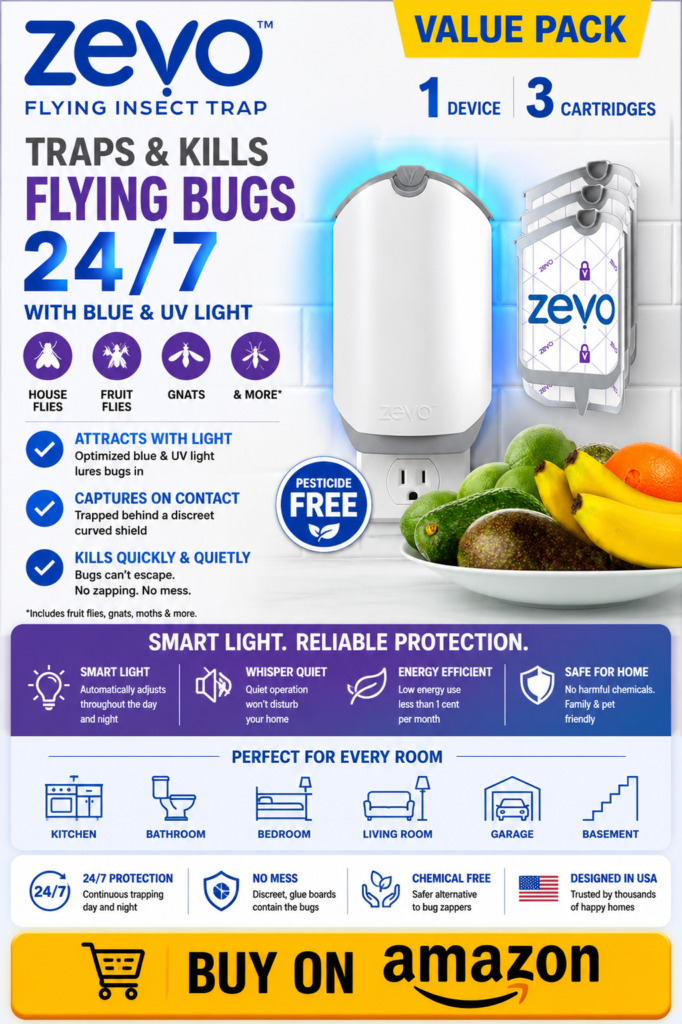
If they’re throughout the kitchen or living room, I usually recommend an enclosed indoor trap instead.
For garages and workshops, sticky fly strips are still one of my favorite budget options.
And when the real problem is outdoors around garbage cans or animal areas, I’d rather stop flies before they ever reach the house.

That’s exactly why I put together Best Fly Traps That Actually Work for Every Situation. It compares the strengths of each type so you can choose the right one instead of wasting money on the wrong one.



Here’s Exactly What I’d Do
If I opened my front door tonight and suddenly found flies throughout the house, this would be my plan.
First, I’d figure out which room has the highest number of flies.
Then I’d spend several minutes simply watching where they’re landing and how they’re moving.
Next, I’d inspect trash cans, recycling bins, pet food, produce, and nearby windows.
After that, I’d check every exterior screen, garage door, and entry point.
Finally, I’d walk around the outside of the house looking for anything that could be producing or attracting flies.
Only after doing all of that would I decide which trap belonged where.
Taking that approach almost always gets me to the real problem much faster than spraying random areas of the house.
The Goal Isn’t Just Fewer Flies
Anyone can kill the flies they see.
That’s the easy part.
The goal is making sure you don’t have another wave of flies tomorrow.
Once you remove what’s attracting them, eliminate breeding areas, repair entry points, and place the right traps where they’re most effective, the problem usually starts getting better instead of repeating itself week after week.

If your fly problem seems to come and go throughout the season, I’d also recommend reading Why Do Flies Keep Coming Back? Common Reasons Explained. It’s one of the best places to start if you’ve been dealing with the same issue over and over.
For more practical fly control guides, product reviews, and identification help, visit our growing Flies category.
Frequently Asked Questions
Why do I suddenly have so many flies in my house?
A sudden increase usually means something has changed. It could be warmer weather, a new food source, damaged window screens, outdoor breeding areas, or even a hidden dead animal.
Why are there dozens of flies in one room?
When flies gather in one room, they’re often responding to something nearby, such as food, moisture, light from a window, or an easy entry point.
Can one dead animal really cause that many flies?
Yes. A dead mouse, bird, or squirrel hidden in a wall, attic, or crawl space can produce a surprisingly large number of flies over a short period.
Should I worry if I suddenly have a house full of flies?
It’s definitely worth investigating. While some causes are simple, a large number of flies usually means there’s an underlying issue that needs to be found instead of simply treating the symptoms.
What’s the fastest way to reduce a large fly infestation?
Start by identifying where the flies are concentrated, inspect for food sources and entry points, eliminate whatever is attracting them, and then use traps that fit the specific areas where the flies are most active.
About the Author
Mark Sullivan has spent years maintaining homes, garages, barns, and rural properties while tracking down everyday pest problems. He believes the fastest way to solve a fly problem is to understand why it’s happening first, then choose practical solutions that address the source instead of just the symptoms.