
One question I hear quite a bit is whether house flies only live for a day or two.
It’s a common myth.
In reality, house flies usually live much longer than most people think.
While an individual fly doesn’t have an especially long lifespan, it has plenty of time to reproduce and start the next generation before it dies.
That’s one reason a small fly problem can quickly become a much larger one if the breeding source isn’t removed.
Understanding how long house flies live also helps explain why simply swatting a few adults rarely solves the problem.
If you’re not completely sure the insects you’re see are actually house flies, start with What Do House Flies Look Like? Easy Identification Guide before comparing lifespans.
Most Adult House Flies Live About Two to Four Weeks
Under normal conditions, most adult house flies live around 15 to 30 days.
Some die sooner because of predators, weather, or lack of food.
Others may survive a little longer if conditions are ideal.
Although that may not sound like a long time, an adult fly can accomplish a lot in just a few weeks.
Females can lay several batches of eggs during their lives, allowing one generation to quickly produce the next.
That’s why the overall fly population can continue growing even though individual flies don’t live very long.

Temperature Makes a Big Difference
One of the biggest factors affecting a house fly’s lifespan is temperature.
Warm weather speeds up nearly everything.
Flies become more active.
They feed more often.
They reproduce faster.
Eggs develop more quickly.
Cold temperatures usually have the opposite effect.
Development slows, adult activity decreases, and reproduction becomes much less efficient.
That’s one reason fly problems are far more common during late spring, summer, and early fall.
Food and Water Help Them Live Longer
Adult house flies don’t survive very long without access to food and moisture.
They’re constantly searching for places where they can feed.
Some of the things that attract them include:
- Food spills.
- Garbage.
- Pet food.
- Compost.
- Animal waste.
- Sugary liquids.
- Rotting fruits and vegetables.
The easier it is for flies to find food and water, the longer they’re likely to survive and continue reproducing.
The Adult Stage Is Only Part of Their Life
When people ask how long house flies live, they’re usually talking about the flying adults.
But that’s only one stage of the insect’s life.
Before becoming adults, house flies spend time as eggs, larvae, and pupae.
Taken together, the complete life cycle can be surprisingly fast during warm weather.
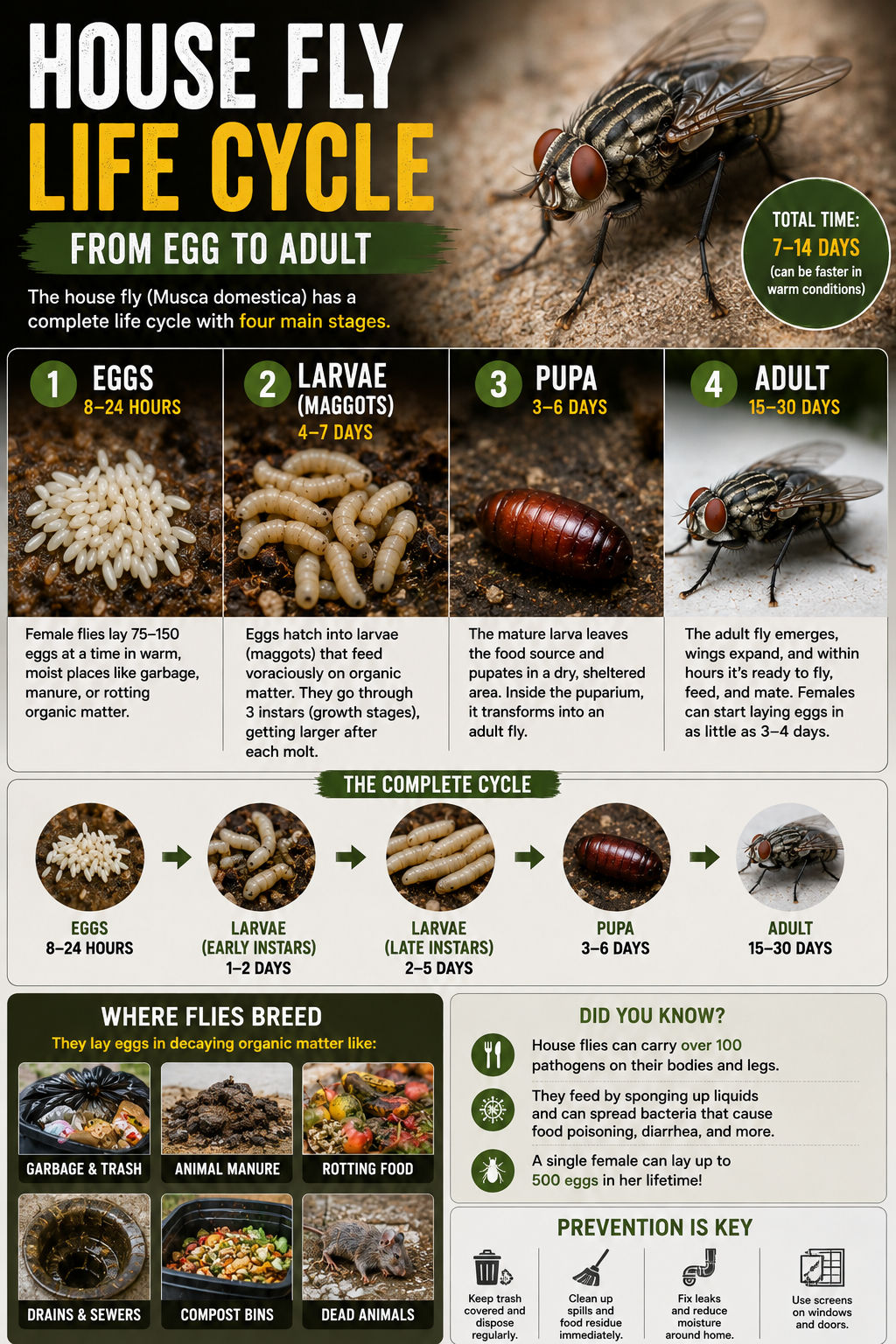
If you’d like a complete breakdown of every stage, my House Fly Life Cycle Explained From Egg to Adult walks through the entire process in detail.
Why It Seems Like the Same Fly Lives Forever
I’ve heard plenty of people joke that they’ve been chasing the same fly around the house for weeks.
Sometimes that may actually be true.
More often, though, what’s happening is that one fly dies while another newly emerged adult takes its place.
If flies are continuously breeding nearby, the population is constantly replacing itself.
That creates the impression that the same insects never go away, even though individual flies have relatively short lives.
Whenever I notice this happening, I stop focusing on the adults and start looking for where they’re coming from.

That’s exactly what I explain in Where Do House Flies Come From? Common Sources Explained because eliminating the breeding source is the only reliable long-term solution.
Female House Flies Spend Much of Their Adult Life Reproducing
One reason house fly populations grow so quickly is that females don’t waste much time after becoming adults.
Once they’ve mated, they begin searching for suitable places to lay eggs.
Instead of depositing eggs just anywhere, they’re looking for moist organic material that will provide food for the larvae after they hatch.
That means a single female can produce hundreds of offspring during her relatively short lifetime if conditions are favorable.
Whenever I see flies returning over and over again, I know it’s usually because new generations are continuing to develop nearby.
If you’re wondering where females prefer to reproduce, my guide Where Do House Flies Lay Eggs? Hidden Places to Check explains the locations I inspect first.



Why Some House Flies Die So Quickly
Not every house fly reaches its full lifespan.
Many die long before they would naturally.
Some common reasons include:
- Lack of food or water.
- Being trapped indoors.
- Predators like spiders.
- Extreme heat or cold.
- Fly traps.
- Swatting or other control methods.
Even so, if breeding sites remain active, new adults often replace the ones that die, making it seem like the problem never improves.
Why Fly Problems Can Last for Weeks
One thing I’ve noticed is that homeowners often expect flies to disappear within a day or two after cleaning.
Sometimes they do.
Often they don’t.
That’s because several generations may already be developing.
While you’re seeing adult flies today, there may also be eggs, larvae, and pupae hidden nearby that haven’t emerged yet.
Over the next several days, those immature flies continue becoming adults.
That’s why I don’t judge success based only on what I see today.
I think about what’s still developing out of sight.
Understanding the full House Fly Life Cycle Explained From Egg to Adult makes this much easier to understand.


How I Shorten the Lifespan of a Fly Problem
I can’t change how long an individual fly naturally lives.
What I can do is make the environment much less favorable.
Whenever I’m trying to eliminate house flies, I focus on:
- Removing breeding material.
- Cleaning garbage containers.
- Picking up pet waste.
- Repairing damaged window screens.
- Keeping doors closed whenever possible.
- Reducing food sources.
- Using traps where adult flies gather.
When those changes are combined, the overall fly population usually begins shrinking because fewer new flies are replacing the adults that die.
Why I Still Recommend Fly Traps
Even after removing the source, adult flies already inside your home may continue living for days or even weeks.
That’s why I usually add traps to speed up the process.

For outdoor fly activity around garbage cans, dog kennels, compost piles, or barns, I’ve had excellent results with the Rescue! Outdoor Disposable Fly Trap. It helps reduce the breeding adults before they have another opportunity to lay eggs.

Inside the house, flies naturally move toward windows and light sources. That’s where I often place the methods I discuss in Window Fly Traps That Actually Work to quietly reduce the remaining adults.

If you’re trying to decide which type of trap makes the most sense for your situation, my guide Best Fly Traps That Actually Work for Every Situation compares the options I recommend most often.


A Fly’s Lifespan Doesn’t Tell the Whole Story
One mistake I see people make is focusing only on how long a single fly lives.
The real question is how long the population will continue replacing itself.
As long as eggs are being laid and larvae have food to develop, new adults will continue emerging.
That’s why a fly problem can seem endless even though each individual fly only lives for a few weeks.
The moment the breeding source is removed, the clock starts running out on the remaining adults because no new generation is there to replace them.
Frequently Asked Questions
How long does an adult house fly usually live?
Most adult house flies live about 15 to 30 days, although temperature, food availability, and environmental conditions can shorten or extend that lifespan.
Do house flies live longer indoors?
Sometimes. Indoor flies may avoid predators and harsh weather, but they still need access to food and moisture to survive for long.
Can house flies survive through the winter?
In colder climates, adult house flies usually don’t survive prolonged freezing temperatures outdoors. However, they may survive longer inside heated buildings where food and shelter are available.
Why do house flies seem to live forever?
It’s usually because new adults keep emerging from hidden breeding sites. One fly dies while another takes its place, making it appear as though the same flies never disappear.
What’s the fastest way to end a house fly problem?
The quickest long-term solution is removing the breeding source. Once eggs and larvae no longer have suitable places to develop, the remaining adult flies eventually die off without being replaced.
About the Author
Mark Sullivan has spent years helping homeowners identify the source of persistent fly problems. He believes understanding how long house flies live is valuable, but knowing what keeps producing new generations is the real key to eliminating them for good.