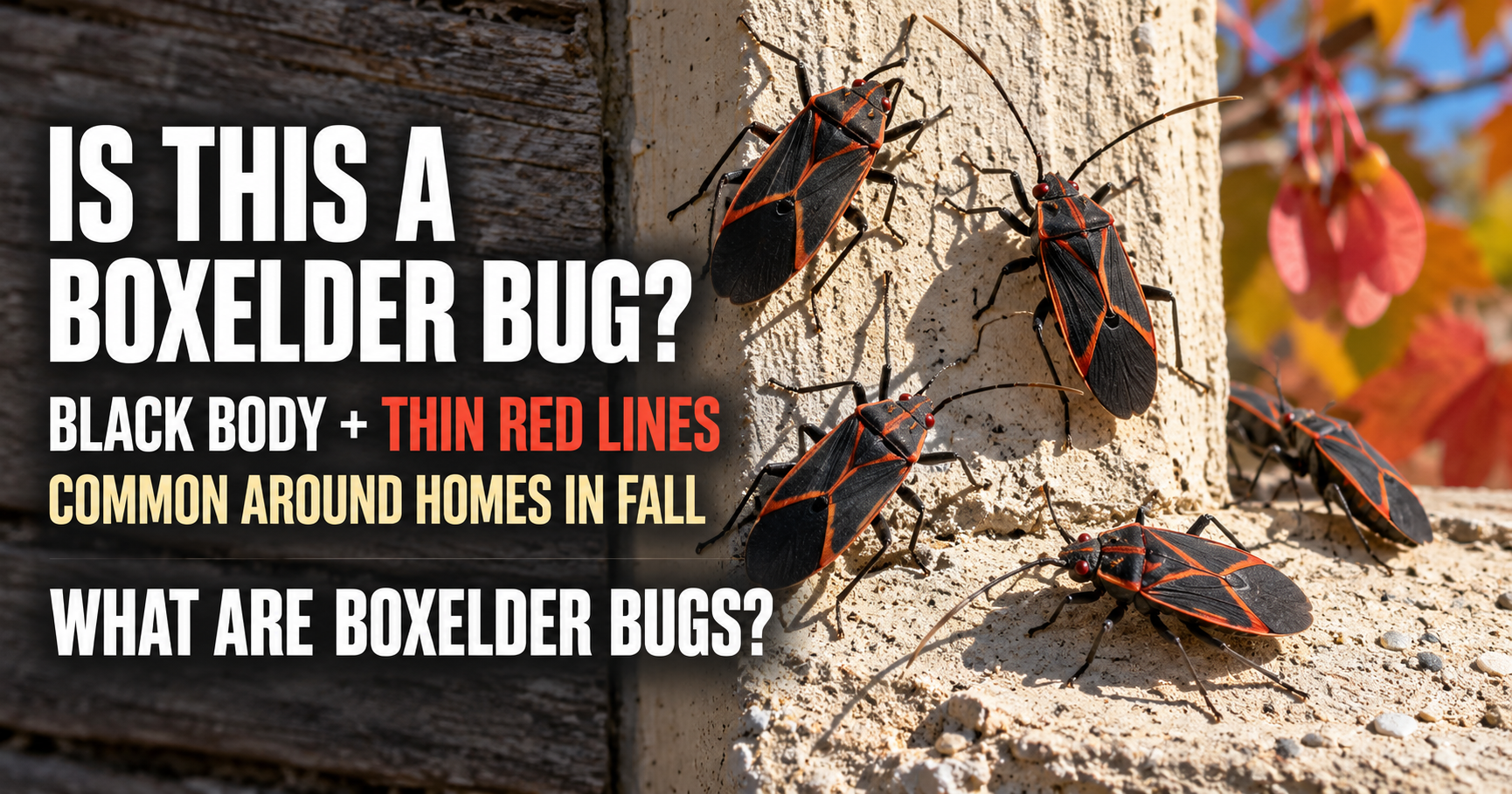
Boxelder bugs are slender black insects with bright red or orange-red lines along their backs and wings. You may see a few at a time on a tree, but the moment most people notice them is when dozens or hundreds gather on a warm, sunny wall in late summer or fall.
They can look alarming in a crowd, especially when they start working their way around windows, siding, and doors. The good news is that boxelder bugs are mainly a nuisance. They do not damage the structure of a house, do not eat clothing or stored food, and are not dangerous to people or pets.
The easiest way to identify one is to look for a narrow black body, long black legs and antennae, and clear red lines that create an X-shaped pattern across the folded wings.
What Are Boxelder Bugs?
Boxelder bugs are true bugs in the species Boisea trivittata. Despite the name, they are not beetles.
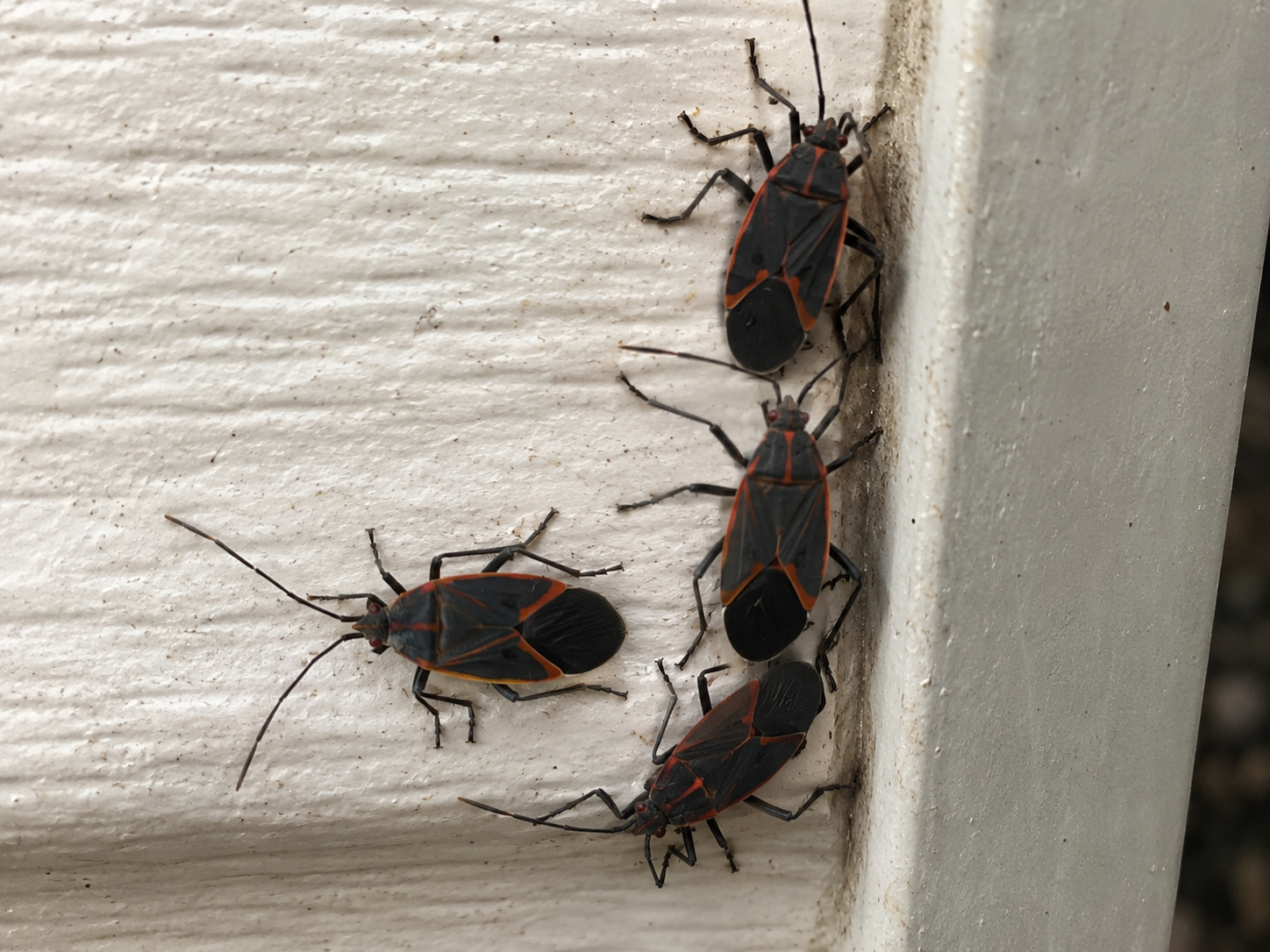
They spend most of the warm season outdoors feeding on boxelder trees and other members of the maple family. They are especially associated with seed-bearing female boxelder trees, but they can also be found around silver maples, ash trees, and other plants nearby.
Their behavior changes when fall arrives. As days shorten and temperatures cool, adult boxelder bugs gather on sunny tree trunks, rocks, and buildings while looking for protected spots to spend winter. A house with warm siding and small gaps can become an appealing shelter.



What Do Adult Boxelder Bugs Look Like?
Adult boxelder bugs are about one-half inch long. They have an elongated, somewhat flattened body instead of the broad shield shape people associate with stink bugs.
Their main color is dark grayish black or black. The red or orange-red markings are the giveaway.
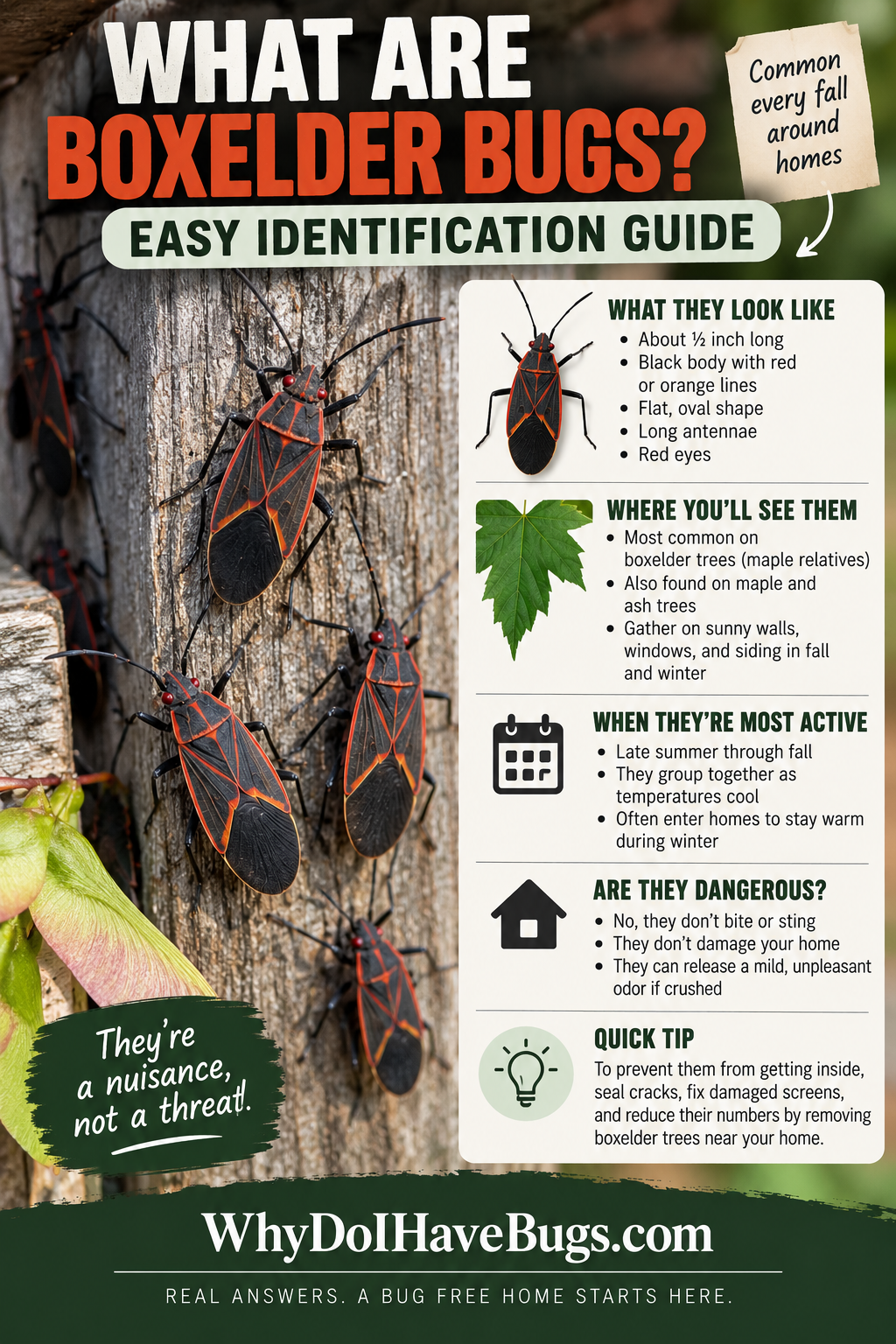
Look for these details:
- Three red lines just behind the head.
- A thin red line along each outer side of the body.
- Diagonal red lines crossing the wings.
- Wings that lie flat and overlap into a noticeable X shape.
- Long black legs and antennae.
The markings can look orange instead of bright red depending on the light, the age of the insect, and how recently it has molted. The overall black-and-red pattern is more useful than trying to match one exact shade.


What Do Baby Boxelder Bugs Look Like?
Baby boxelder bugs are called nymphs. They look much different from adults at first, which is why they are often mistaken for another kind of insect.
Freshly hatched nymphs are tiny and bright red. They have black legs, black antennae, and dark coloring around the head and upper body, but they do not have full wings. As they grow through several stages, they become darker red and black and develop visible wing pads.
A group of small red-and-black bugs gathered on a boxelder tree, maple tree, seed pods, or sunny wall during summer is often a group of boxelder bug nymphs.
The bright red young bugs can worry people because they resemble other insects at a glance. Their location helps a lot. If they are on or near a boxelder or maple tree and grow into narrow black adults with red lines, boxelder bugs are the likely answer.
What Do Boxelder Bug Eggs Look Like?
Boxelder bug eggs are small and usually laid in groups. They begin pale yellow or straw yellow, then become darker red as development continues.
You are most likely to find them outdoors on boxelder leaves, bark cracks, branches, or nearby protected surfaces. They are not typically an indoor egg-laying pest. If adult boxelder bugs enter a home in fall, they are looking for winter shelter, not trying to start a colony in your walls.
Seeing boxelder bugs indoors can be frustrating, but it does not mean they are breeding in the house.


Why Are Boxelder Bugs Black and Red?
The red-and-black coloring helps make boxelder bugs recognizable, though it does not make them dangerous.
Many insects use bold colors as a warning or as camouflage against bark, seeds, leaves, and shadows. With boxelder bugs, the colors are most useful to homeowners because they make adults and nymphs easier to identify once you know what to look for.
The red pattern is not a sign of blood, venom, a bite, or a disease risk. It is simply part of the insect’s normal coloring.
Where Do Boxelder Bugs Live?
Boxelder bugs live outdoors most of the year. They are often found on boxelder trees, especially female trees that produce the winged seed clusters many people recognize.
They can also use silver maples, ash trees, and nearby vegetation. Their numbers may be much higher one year than another depending on weather, available host trees, and local conditions.
During late summer and fall, they move away from trees and gather in sunny, protected places. This is when they become a homeowner problem.
Common places to find them include:
- Sunny south-facing and west-facing walls.
- Window frames and door trim.
- Cracks behind siding.
- Around soffits, vents, and utility openings.
- Attics, wall voids, garages, and crawl spaces.
- Boxelder trees, maples, ash trees, and seed-bearing plants nearby.
If you are seeing them around the house every fall, it is usually because the building offers sheltered cracks and sunny surfaces, not because the inside of the house is dirty.
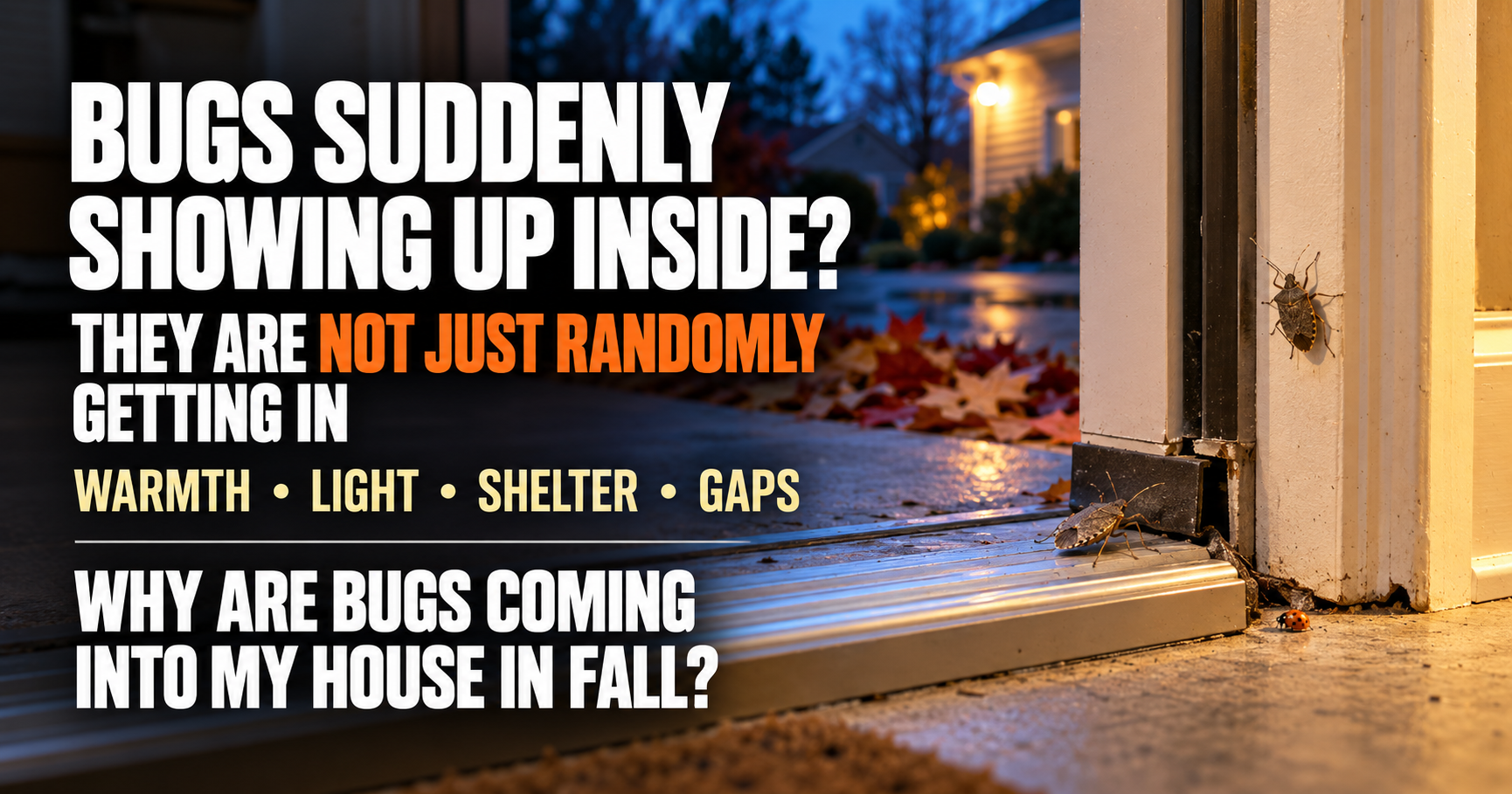
For the bigger seasonal pattern behind this, see why bugs come inside during fall.
Why Do Boxelder Bugs Gather on Houses?
Boxelder bugs gather on houses because they are looking for a place to overwinter.
Warm sunlight on siding attracts them during cool fall days. Once they land on a house, they search around windows, trim, rooflines, vents, and gaps in siding for a protected space. Some stay outside in sheltered spots. Others squeeze into cracks and end up inside walls, attics, or living areas.
They can remain dormant through much of winter, then wake up during sunny warm spells. That is why homeowners sometimes see them at windows in January, February, or early spring even though they have not opened a door recently.
A boxelder bug at an indoor window probably did not come in that day. It may have entered the structure months earlier and followed warmth or light toward the living space.
Are Boxelder Bugs the Same as Stink Bugs?
No. Boxelder bugs and stink bugs are different insects, though both can gather on homes in fall.
Stink bugs have a wider, shield-shaped body. Boxelder bugs are narrower and longer, with obvious red lines and a more elongated outline.
Stink bugs are usually mottled brown or green, depending on the species. Boxelder bugs are black with red or orange-red markings.
Stink bugs can release a noticeable odor when crushed. Boxelder bugs do not have the same strong smell, though they can leave stains if crushed on light surfaces.
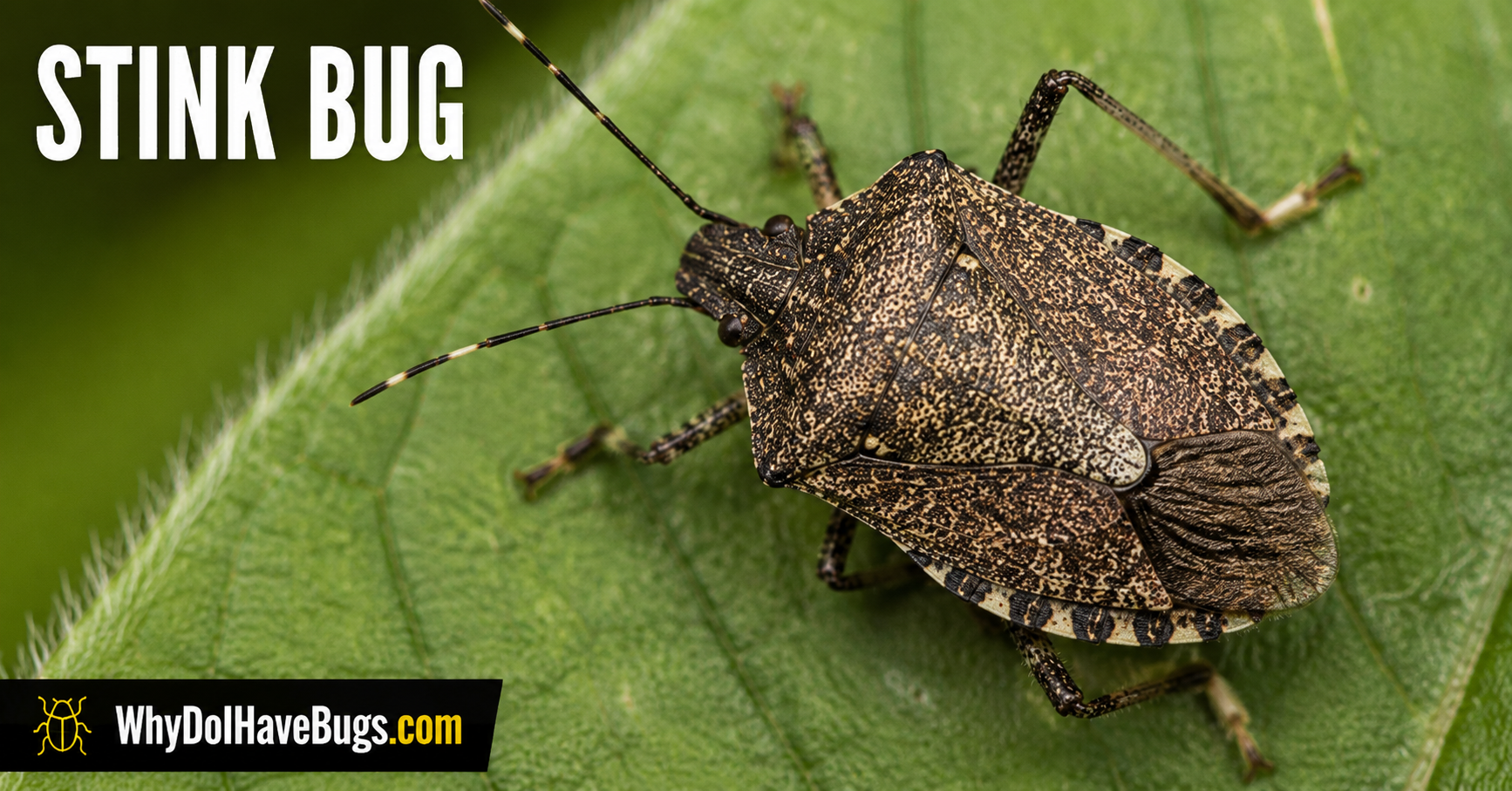
If the insect in your house is brown and shield-shaped instead of black and red, use this easy stink bug identification guidebefore treating it as a boxelder bug problem.
Boxelder Bugs vs. Spotted Lanternfly Nymphs
Young boxelder bugs are sometimes confused with spotted lanternfly nymphs because both can show red and black coloring.
The difference is in the pattern. Boxelder bug nymphs are mostly red with black legs, a black head, and dark developing wing pads. They do not have the sharply defined white spots that spotted lanternfly nymphs have.
Older spotted lanternfly nymphs are red, black, and covered with clear white spots. They also tend to have a chunkier, more rounded body than a boxelder bug nymph.
If you think you may have seen a spotted lanternfly, do not rely on color alone. Take a clear photo and check your state agriculture department’s current reporting guidance.
Boxelder Bugs vs. Milkweed Bugs
Large milkweed bugs are another black-and-orange or black-and-red insect people may confuse with boxelder bugs.
Milkweed bugs usually have bolder orange-red blocks or a broad orange-red X pattern on their backs. Boxelder bugs have thinner red lines and a more understated pattern.
Location can help. Milkweed bugs are often found on milkweed plants and seed pods. Boxelder bugs are more likely around boxelder trees, maples, sunny buildings, and fall entry points around a home.


Boxelder Bugs vs. Kissing Bugs
People sometimes worry that a black-and-red bug could be a kissing bug. That concern is understandable because kissing bugs can be a medical issue in some areas.
Boxelder bugs are smaller, usually about one-half inch long, and have smooth red lines along the back and wings. Their body shape is narrow and fairly even from front to back.
Kissing bugs are usually larger and have alternating colored markings along the outer edge of the abdomen instead of the thin red lines seen on boxelder bugs. They also have a more cone-shaped head.
If you find a bug you think may be a kissing bug, avoid handling it with bare hands. Take a clear photo from above and contact your local extension office or state health department for identification help.
Do Boxelder Bugs Bite?
Boxelder bugs do not bite people. They feed on plant material, especially seeds and parts of boxelder and maple-family trees.
They do not have the kind of mouthparts used to bite skin, feed on blood, or sting. They are not a medical pest and are not known for harming dogs or cats.
They can be annoying in large numbers, and crushing them can leave reddish stains on walls, curtains, siding, or fabrics. That is why vacuuming or gently sweeping them up is usually better than smashing them.
Do Boxelder Bugs Damage Trees or Homes?
Boxelder bugs can feed on leaves, flowers, seeds, and fallen fruit, but they normally cause only minor damage to established trees. Their numbers look much worse than the harm they cause.
Inside the home, they do not chew wood, eat insulation, damage wiring, infest food, or destroy fabric. They are nuisance insects, not a structural pest.
The real issue is the seasonal invasion. Large groups can be unpleasant around doors and windows, and adults hidden in wall spaces may appear indoors later.
Are Boxelder Bugs Dangerous to Pets?
No. Boxelder bugs are not considered dangerous to dogs or cats.
A curious pet may paw at one or eat one. That can occasionally lead to mild stomach upset, especially if the pet eats several insects, but boxelder bugs are not venomous and do not sting.
The bigger concern is pesticide exposure. If you use an outdoor treatment around your home, keep pets away until the product label says the area is safe again.
When Are Boxelder Bugs Most Common?
Boxelder bugs are most noticeable from late summer through fall, especially on warm sunny days after cooler weather begins.
Nymphs are usually seen during summer around host trees. Adults become more noticeable later as they gather on buildings and search for winter shelter.
You may also see them again in spring when they leave overwintering spots. A warm spell can bring them out around windows, attics, and sunny exterior walls before they head back outdoors.
Do Boxelder Bugs Fly?
Yes. Adult boxelder bugs can fly, which is how they move from trees to buildings and find overwintering sites.
They are capable of traveling farther than people expect, so removing one tree from a yard does not guarantee they will disappear. Bugs can come from neighboring properties, nearby tree lines, or other host trees in the area.
Their ability to fly is also why sealing entry points matters more than trying to kill every bug you see outside.
What Should You Do if You Find Boxelder Bugs in Your House?
First, confirm the identification. A narrow black bug with red lines is likely a boxelder bug, while a broad brown shield-shaped bug is more likely a stink bug.
For a few bugs indoors, vacuum them, sweep them into a container, or use a sticky trap in an out-of-the-way location. Avoid crushing them on painted walls, curtains, or carpet.
Then inspect the outside of your home for likely gaps. Check weatherstripping, door sweeps, window screens, siding seams, utility openings, and attic or crawl-space vents. The aim is to reduce the next wave of bugs before they settle into hidden winter spaces.
Once the adults are already inside walls, spray alone rarely fixes the whole issue. Exclusion is what makes the biggest difference from one season to the next.
Frequently Asked Questions
Are boxelder bugs beetles?
No. They are true bugs, not beetles. Their narrow body, long antennae, and overlapping wings form a different shape from most beetles.
Why are there so many red and black bugs on my house?
They are likely boxelder bugs gathering on a warm wall before winter. Sunny siding, nearby host trees, and gaps around the exterior can all make one house especially attractive.
Can boxelder bugs live in walls?
They can hide in wall voids, attic spaces, window casings, and other protected gaps during winter. They do not typically breed or build nests there.
What tree attracts boxelder bugs?
Female boxelder trees are their best-known host because of the seeds they produce. Boxelder bugs can also be found around silver maples, ash trees, and other nearby vegetation.
Why are baby boxelder bugs bright red?
Young boxelder bugs are naturally bright red with black legs and darker head markings. They become darker and develop wing pads as they grow.
Do boxelder bugs smell when crushed?
They do not produce the strong odor associated with stink bugs. However, crushing them can leave reddish stains on walls, fabrics, or siding.
Should I kill boxelder bugs in my yard?
A few boxelder bugs outdoors usually do not need treatment. Focus on keeping them from entering the home if they gather in large numbers near doors, windows, or siding.
Caleb Warren writes practical pest guides for WhyDoIHaveBugs.com, helping homeowners identify outdoor invaders accurately before choosing a treatment.