
If you’ve recently discovered a strange beetle crawling across your garage floor, sitting on a windowsill, or wandering through your basement, there’s a good chance you’re here because you want one simple answer.
What is this beetle, and how do I get rid of it?
That’s exactly where I found myself.
At first, I was convinced I had carpet beetles.
The larvae looked similar.
The adults belonged to the same beetle family.
The more I investigated, though, the more I realized I was dealing with something entirely different.
Larder beetles.
Since then, I’ve spent countless hours researching these insects, photographing them in my own home, learning their behavior, and figuring out what actually works to eliminate them.
This guide brings everything I’ve learned together in one place.
Whether you’ve found a single adult beetle or you’re dealing with a full infestation, I’ll walk you through what they are, why they’re in your home, where they’re hiding, and how to get rid of them permanently.
What Is a Larder Beetle?
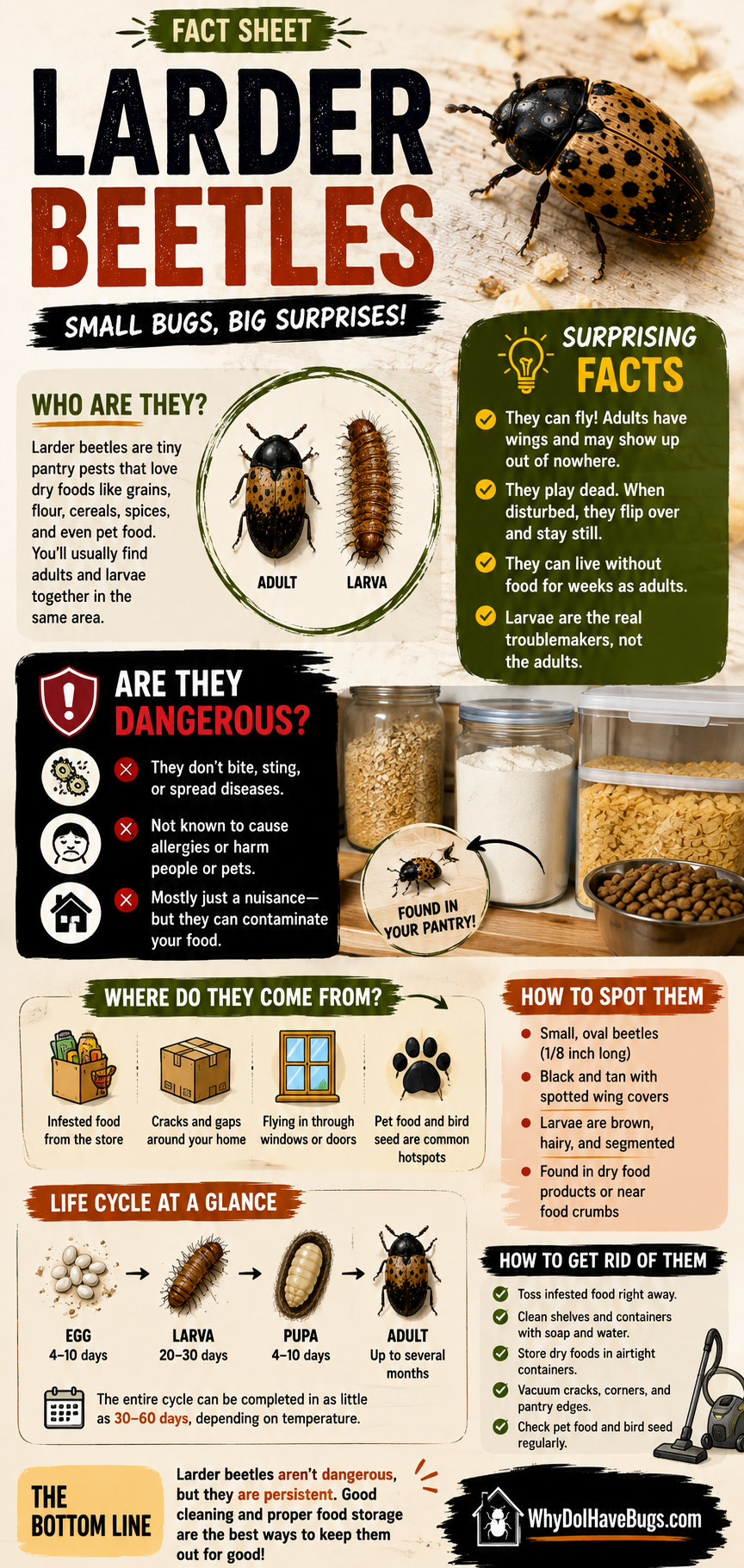
The larder beetle (Dermestes lardarius) is a member of the dermestid beetle family, which also includes carpet beetles.
For hundreds of years these beetles were commonly found in food storage rooms, or “larders,” where cured meats were stored before refrigeration became common.
That’s where their unusual name comes from.
Today, they’re much more likely to be found around:
- Dry dog food.
- Dry cat food.
- Pet treats.
- Bird nests.
- Dead insects.
- Animal remains.
- Taxidermy.
- Leather and hides.
Although they occasionally become pantry pests, modern infestations are often traced to pet food or accumulations of dead insects in attics and wall voids rather than cured meats.



How to Identify a Larder Beetle
Adult larder beetles are easy to recognize once you know what to look for.
The features I always check first are:
- A dark brown to black body.
- An oval shape.
- A broad pale yellow or tan band across the front half of the wing covers.
- Six small dark spots within that band.
- A body length of about one-third of an inch.
That light-colored band is what separates them from many other household beetles.

If you’re trying to identify an adult you’ve found, my complete guide to what larder beetles look like walks through every identifying feature with photos and comparisons.
What Do the Larvae Look Like?
The larvae look nothing like the adults.
Instead of being oval beetles, they’re long, brown, hairy larvae that many people mistake for caterpillars or carpet beetle larvae.
Some of the easiest features I look for include:
- A long segmented body.
- Dense brown hairs.
- Six true legs near the front.
- Two distinctive curved tail spines.
- A body that can approach one-half inch long when fully grown.

If you’re trying to identify one you’ve found, my guide on what larder beetle larvae look like covers every identifying feature in detail.
Why Are Larder Beetles in Your House?
One of the biggest mistakes I made was assuming the beetles randomly wandered indoors.
They didn’t.
They came because something inside my home attracted them.
The most common reasons include:
- Dry pet food.
- Pet treats.
- Dead insects in attics or wall voids.
- Bird nests attached to the home.
- Dead rodents.
- Taxidermy.
- Animal hides and leather.
- Other protein-rich materials.

Once I stopped chasing beetles and started looking for their food source, everything became much easier. Dead overwintering insects in wall voids and attics are one of the most overlooked causes of home infestations.

What Do Larder Beetles Eat?
Unlike many pantry pests that primarily attack grains, larder beetles strongly prefer foods rich in animal protein.
That includes everything from dried pet food to feathers and dead insects.
Understanding what they’re eating is often the fastest way to locate the infestation.

My complete guide to what larder beetles eat explains every common food source and where I recommend looking first.
Where Do Larder Beetles Come From?
One of the biggest misconceptions I had was assuming larder beetles simply “appeared.”
In reality, they almost always have a reason for being there.
Sometimes an adult beetle flies into a home from outdoors.
Other times, the entire infestation develops indoors after a female lays eggs near a suitable food source.
The most common places they originate include:
- Bags of dry dog food.
- Dry cat food.
- Pet treats.
- Bird nests attached to homes.
- Dead rodents inside walls.
- Dead overwintering insects in attics.
- Animal hides and leather.
- Taxidermy.
- Stored animal products.
One thing that surprised me was learning how often dead insects are responsible.
Every fall, insects like cluster flies, boxelder bugs, and lady beetles move into attics and wall voids to overwinter.
Many die there.
Those dead insects become an ideal food source for larder beetles, which explains why homeowners sometimes find beetles even when they don’t have pet food or stored meat nearby.

If you want to investigate your own home more thoroughly, I explain every common source in my guide on where larder beetles come from.
How Do Larder Beetles Get Into Houses?
This is another question that completely changed the way I approached the problem.
At first, I assumed every beetle had flown in through an open door.
Sometimes that’s exactly what happens.
Adult larder beetles are capable of flying and may enter through:
- Open garage doors.
- Torn window screens.
- Attic vents.
- Utility openings.
- Gaps beneath exterior doors.
However, that’s only part of the story.
Many homeowners never realize the beetles they’re seeing may have developed entirely inside the home.
By the time the adults begin crawling across floors or collecting on windows, the larvae may have already spent weeks feeding somewhere hidden.
That’s why I don’t immediately start caulking every crack I can find.
Instead, I first look for the breeding source.

If you’re trying to determine where they’re entering, my complete guide on how larder beetles get into houses walks through every place I inspect.
What Do Larder Beetles Eat?
Understanding their diet is probably the single most important step toward eliminating an infestation.
Unlike pantry pests that prefer grains and flour, larder beetles are attracted to foods rich in animal protein.
Some of their favorite foods include:
- Dry dog food.
- Dry cat food.
- Pet treats.
- Dead insects.
- Bird nests.
- Dead rodents.
- Fur.
- Leather.
- Feathers.
- Animal hides.
- Taxidermy.
- Dried meats.
- Fish products.
That’s one reason garages, basements, utility rooms, and attics are common places to find them.
Those locations often contain one or more of these food sources without homeowners realizing it.
If you’d like a complete breakdown, including the foods homeowners overlook most often, my article on what larder beetles eat goes into much greater detail.

Are Larder Beetles Dangerous?
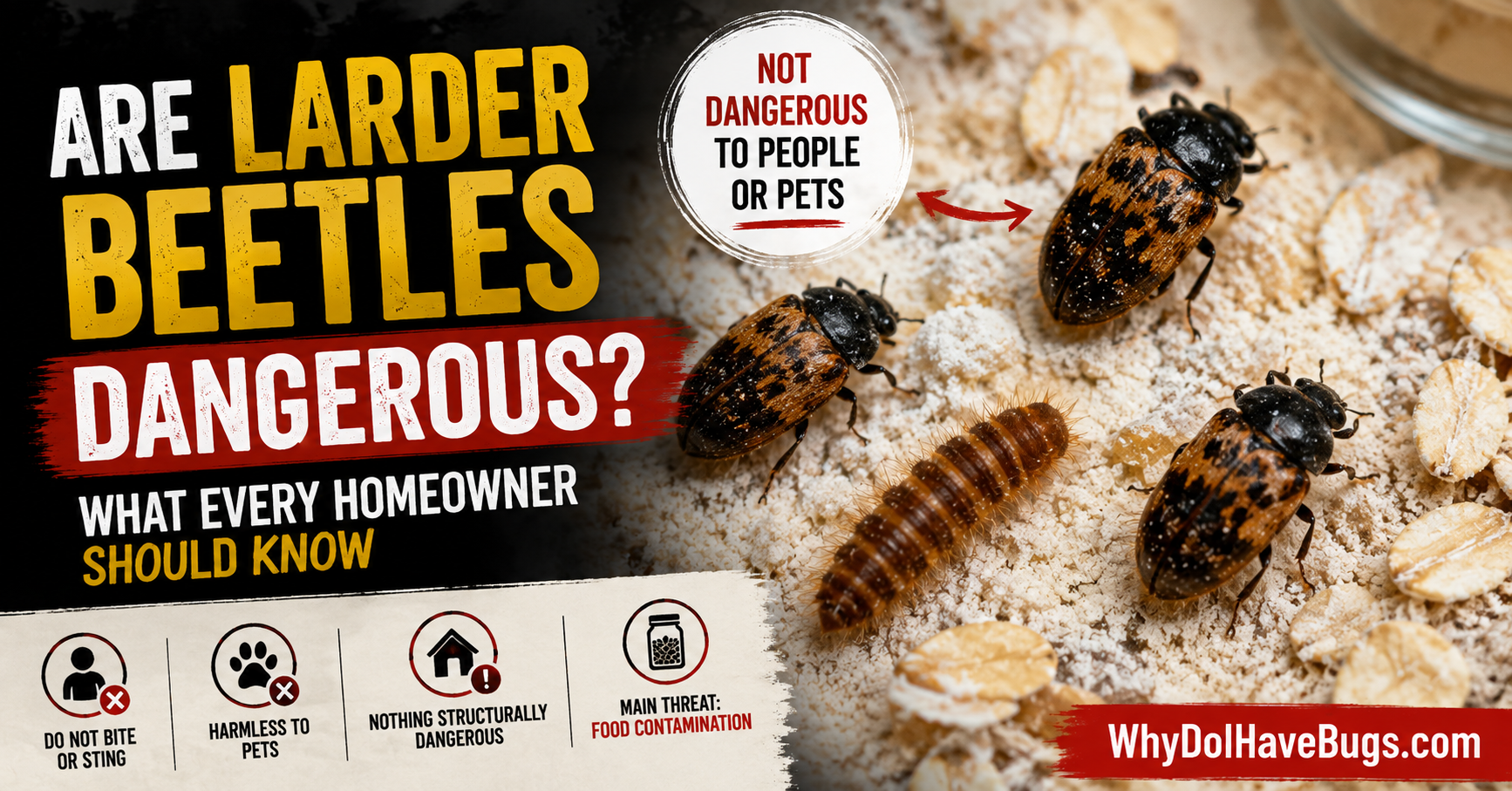
Fortunately, they’re far less threatening than many people assume.
They don’t:
- Bite people.
- Sting.
- Feed on blood.
- Attack pets.
- Spread through your home looking for humans.
However, I still don’t ignore them.
They can contaminate stored products, damage valuable animal-based materials, and indicate that another hidden issue, such as a dead rodent or an accumulation of dead insects, exists somewhere in the home.
The larvae can also irritate sensitive skin if handled because of their stiff body hairs, although this isn’t the same thing as being bitten.
If you have concerns about health risks, my guide on whether larder beetles are dangerous covers those questions in depth.
How Do You Get Rid of Larder Beetles?
This is where many homeowners waste the most time.
They focus on the beetles.
I focus on the reason the beetles are there.
Over the years, I’ve found the most successful approach is always the same.
- Identify the food source.
- Remove and discard anything that’s heavily infested.
- Vacuum thoroughly, including cracks, corners, shelving, and baseboards.
- Inspect nearby areas for additional food sources.
- Store pet food and similar products in airtight containers.
- Monitor the area for several weeks.

Once the source has been removed and the area is clean, I usually apply Ortho Home Defense Insect Killer for Indoor & Perimeter² around baseboards, cracks, shelving, and other beetle travel routes to help eliminate any remaining adults while the infestation dies out naturally.
One thing I’ve learned is that patience matters.
You may continue seeing adults for a short time after removing the source because they’re emerging from larvae that developed before the cleanup began.
That doesn’t necessarily mean the treatment failed.
Often, it simply means you’re seeing the last generation complete its life cycle.


Common Mistakes I See Homeowners Make
After researching larder beetles and talking with other homeowners dealing with them, I’ve noticed the same mistakes happen over and over.
Avoiding these can save you a tremendous amount of time and frustration.
Mistake #1: Only Killing the Adults
This is probably the biggest mistake of all.
It’s easy to focus on the beetles you can actually see.
Unfortunately, those adults are only a small part of the infestation.
By the time they’re crawling across your floor or flying around your garage, there may already be eggs, larvae, and pupae hidden nearby.
That’s why simply spraying every adult you see rarely solves the problem.
Mistake #2: Never Looking for the Food Source
I’ve learned that larder beetles almost always have a reason for staying.
If they’re reproducing inside your house, something is feeding the larvae.
Until that food source is removed, new adults can continue appearing.
Whenever I investigate an infestation, I start with places like:
- Dry pet food.
- Pet treats.
- Bird nests.
- Dead insects.
- Rodent activity.
- Animal-based materials in storage.
Finding the food source is almost always the turning point. Extension specialists consistently recommend locating and eliminating the breeding source before relying on insecticides.
Mistake #3: Assuming Every Beetle Came From Outside
This one surprised me the most.
Many homeowners believe every beetle flew into the house through an open door or damaged screen.
Sometimes that’s true.
But if you’re repeatedly finding adults, there’s a good chance they actually developed somewhere inside your home.
The adults you’re seeing today may have spent weeks hidden as larvae before finally emerging.
Mistake #4: Ignoring the Garage
Garages are one of the most common places I would inspect.
Why?
Because they often contain everything larder beetles need.
- Pet food.
- Bird seed.
- Hunting equipment.
- Leather gloves.
- Dead insects.
- Rodent activity.
A quick inspection of the garage has solved countless infestations for homeowners because it’s often where the primary food source is hiding.
When Should You Call a Professional?
Most larder beetle infestations can be handled without hiring a pest control company.
However, I would seriously consider professional help if:
- You continue finding larvae after removing every obvious food source.
- You suspect a dead animal inside a wall or ceiling.
- The infestation has spread throughout multiple rooms.
- You’re unable to reach an attic, crawl space, or wall void where the beetles may be breeding.
- Large numbers of adults continue appearing for several months.
Professionals often have tools for inspecting wall voids and other hidden spaces that simply aren’t practical for most homeowners.
My Overall Strategy for Eliminating Larder Beetles
After everything I’ve learned, my approach has become surprisingly simple.
Instead of reacting to every beetle I see, I work through the infestation step by step.
- Confirm the insect is actually a larder beetle.
- Locate the food source.
- Remove and discard heavily infested materials.
- Vacuum thoroughly, paying close attention to cracks and hidden areas.
- Store pet food and similar products in airtight containers.
- Treat beetle travel routes with Ortho Home Defense Insect Killer for Indoor & Perimeter² after the source has been removed.
- Continue monitoring for several weeks while the remaining life stages finish developing.
I’ve found this method to be much more effective than simply spraying every beetle that appears.
Frequently Asked Questions
Are larder beetles common?
They’re much more common than most people realize. While they aren’t as well known as ants or carpet beetles, extension offices regularly receive questions about them, especially from homeowners storing pet food or dealing with dead insects in attics and wall voids.
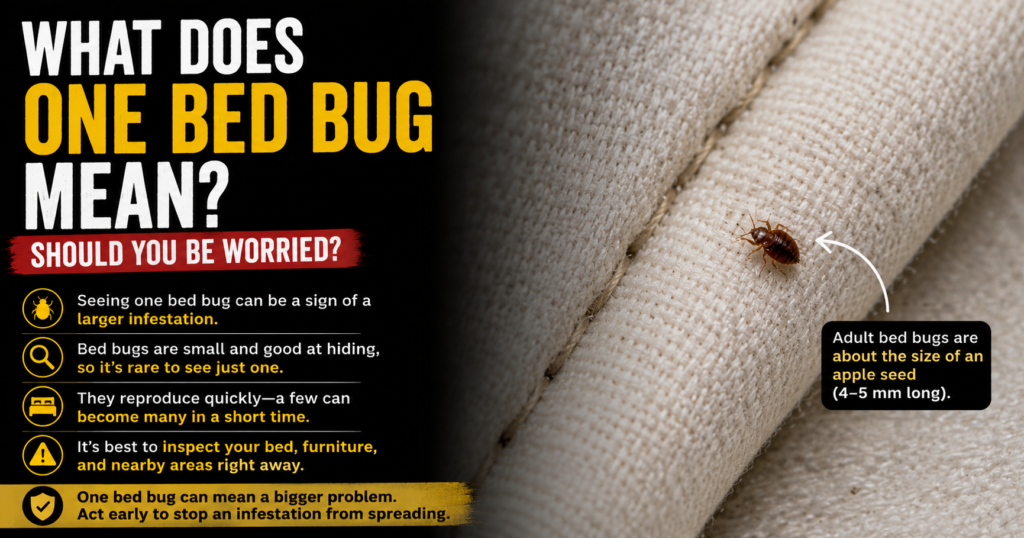
Should I worry if I only find one larder beetle?
Not necessarily.
A single adult may have wandered indoors from outside.
However, if you begin finding multiple adults, larvae, or shed larval skins, it’s time to investigate because those signs often indicate an active breeding source.
Can larder beetles come back?
Yes.
If the original food source isn’t completely removed, or another suitable food source becomes available later, a new infestation can develop.
That’s why long-term prevention is just as important as eliminating the current population.
What’s the fastest way to get rid of larder beetles?
The fastest long-term solution is to locate and remove whatever the larvae are feeding on.
Once that source is gone, thoroughly clean the area, vacuum surrounding cracks and crevices, and treat beetle travel routes if needed.
Are larder beetles harder to eliminate than carpet beetles?
In my experience, not really.
Both insects become much easier to control once you locate the breeding source.
The biggest difference is usually where you need to look.
Carpet beetles are often associated with wool, clothing, and natural fabrics, while larder beetles are much more closely tied to animal protein sources such as pet food, dead insects, and animal remains.
About the Author
Mark Sullivan has spent years researching household beetles and helping homeowners identify hidden infestations before they become expensive problems. After initially mistaking the insects in his own home for carpet beetles, he traced the infestation to larder beetles and has since focused on creating practical, research-backed guides that help homeowners confidently identify, prevent, and eliminate them using real-world experience alongside university extension recommendations.