
If you’ve noticed tiny flying insects buzzing around your kitchen, the first question you should ask isn’t how to get rid of them.
It’s whether they’re actually fruit flies.
I’ve found that homeowners call almost every tiny flying insect a fruit fly, even when they’re looking at fungus gnats, drain flies, or another small insect entirely. When the insect may be a drain fly instead, how to identify drain flies can help you compare the features before treating the problem.
That matters because each one comes from a different source and usually requires a different solution.
Before spending money on traps or treatments, I always recommend taking a minute to identify what you’re actually seeing.
That one step can save you a lot of time and frustration.

Fruit Flies Are Much Smaller Than House Flies
The first thing I notice is the size.
Fruit flies are tiny.
Most people are surprised the first time they compare one to an ordinary house fly.

An adult fruit fly is usually only about 1/8 inch long, making it just a fraction of the size of the flies that buzz around garbage cans or windows. Comparing those differences with house fly size and appearance can help you determine which type of fly is actually indoors.
Because they’re so small, you’ll often notice several hovering together instead of seeing one large fly moving across the room.
If the insects you’re seeing are closer to the size of a house fly, you’re probably dealing with something else.

Most Fruit Flies Are Light Brown or Tan
Color is another helpful clue.
Most fruit flies have:
- Light tan bodies.
- Brown or yellowish coloring.
- Transparent wings.
- Rounded bodies.
They’re usually much lighter in color than house flies, which often appear dark gray or black.
Lighting can make them look slightly different, but they’re rarely solid black.


Their Eyes Are Surprisingly Noticeable
One feature that stands out when you look closely is the eyes.
Many common fruit flies have bright reddish eyes.
You probably won’t notice this from across the room, but if one lands on a counter or gets caught in a trap, the eye color becomes much easier to see.
I don’t rely on eye color alone for identification, but it can help confirm you’re looking at a fruit fly rather than another tiny insect.

Fruit Flies Don’t Fly Like House Flies
One thing I’ve noticed over the years is that fruit flies have a completely different flying pattern.
House flies usually fly quickly from place to place before landing.
Fruit flies tend to hover.
They often stay within a small area, making short flights around fruit bowls, recycling bins, sinks, or trash cans.
Instead of racing across the room, they seem to drift in little circles around whatever attracted them.
Watching how an insect flies can tell you almost as much as looking at its appearance.

They Usually Stay Close to Food
This is another clue I use.
Fruit flies don’t usually wander all over the house the way house flies do.
Instead, they stay surprisingly close to whatever attracted them in the first place.
I’ve found them hovering around:
- Fruit bowls.
- Bananas sitting on the counter.
- Tomatoes.
- Recycling bins.
- Wine bottles.
- Beer cans.
- Coffee grounds.
- Compost containers.
- Kitchen sinks.
- Garbage disposals.
If the insects are spending almost all of their time in one of those places, there’s a good chance you’re looking at fruit flies.
If they’re all over your house instead, you’re probably dealing with a different type of fly.
Fruit Flies Are Curious but Not Aggressive
One thing people often ask me is whether fruit flies bite.
They don’t.
They’re not interested in people.
They’re interested in sugars and fermenting organic material.
You’ll usually notice them hovering around food instead of buzzing around your face.
That’s another easy way to separate them from some other flying insects.

Where I Usually Find Fruit Flies
When I’m trying to identify fruit flies, I don’t just look at the insect.
I also look at where it’s spending its time.
The location often confirms what I’m seeing.
The most common places I find fruit flies include:
- Kitchen counters.
- Produce bowls.
- Pantry shelves.
- Trash cans.
- Recycling bins.
- Garbage disposals.
- Compost containers.
- Near empty soda or wine bottles.
If they’re consistently staying in those areas, fruit flies move much higher on my list of suspects.
Fruit Flies vs. House Flies
This is probably the easiest comparison.
House flies are much larger.
They’re darker gray or black.
They move much faster around a room.
Fruit flies are tiny by comparison.
They hover more than they dart.
And instead of exploring the whole house, they usually stay close to food that’s beginning to ferment.

If you’re finding larger flies throughout your home instead of tiny flies around the kitchen, I’d start with my guide on Why Do I Have Flies in My House? because you’re probably dealing with a different problem.


Fruit Flies vs. Fungus Gnats
This is where homeowners get fooled all the time.
I’ve had people tell me they had fruit flies, only to discover every insect was actually a fungus gnat living in the potting soil of a houseplant.
The biggest differences I look for are:
Fruit flies:
- Usually tan or light brown.
- Stay around food.
- Hover near fruit and trash.
- Rounded body.
Fungus gnats:
- Usually darker, almost black.
- Stay around houseplants.
- Hover over potting soil.
- Slender body with long legs.
If every insect seems to be flying around your plants instead of your kitchen, I’d start investigating fungus gnats instead.
Fruit Flies vs. Drain Flies
Drain flies confuse people for a different reason.
They’re also tiny, but they look much fuzzier than fruit flies.
Their wings almost resemble a tiny moth.
They’re usually found resting on bathroom walls, shower areas, utility sinks, or near drains instead of hovering around fruit.
If the insects seem to appear almost exclusively around plumbing fixtures, they’re much less likely to be fruit flies.

Don’t Rely on One Characteristic
One mistake I see quite a bit is someone reading that fruit flies have red eyes and deciding every tiny insect with dark eyes must be something else.
Identification works better when you look at several characteristics together.
I pay attention to:
- Size.
- Color.
- Body shape.
- Flight pattern.
- Where they’re gathering.
- What they’re seem attracted to.
When all those clues point in the same direction, I’m much more confident about the identification.
Here’s How I Identify Them
If I walked into my kitchen and saw tiny flying insects tomorrow, I wouldn’t immediately assume they were fruit flies.
I’d watch them for a minute.
I’d see where they landed.
I’d look at their size compared to a house fly.
I’d inspect the fruit bowl, recycling bin, sink, and trash can.
Then I’d compare what I found with the insects’ appearance and behavior.
That takes a little longer than guessing, but it almost always leads me to the right answer.
Once I know what I’m dealing with, choosing the right solution becomes much easier.
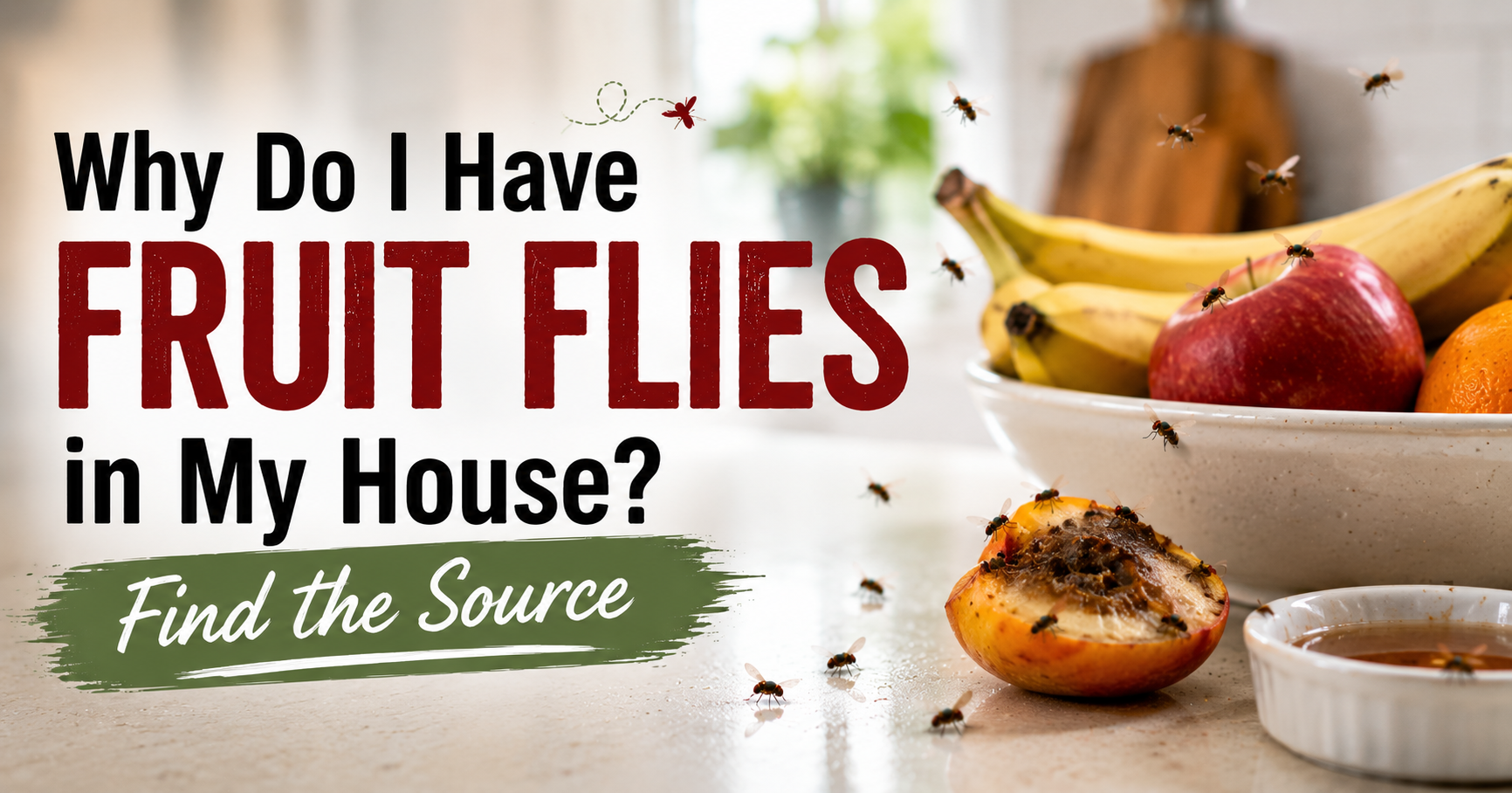
If you determine they are fruit flies, my guide on Why Do I Have Fruit Flies in My House? Find the Source walks through the most common causes I investigate and the places I’d inspect first.
For more identification guides and practical pest control advice, you can also browse our growing Flies category.
Frequently Asked Questions
How big are fruit flies?
Adult fruit flies are usually about 1/8 inch long, making them much smaller than ordinary house flies.
Are fruit flies brown or black?
Most fruit flies are light tan, yellowish-brown, or light brown. They usually aren’t solid black like many people expect.
Do all fruit flies have red eyes?
Many of the most common fruit flies do have noticeable reddish eyes, although they can be difficult to see without looking closely.
How can I tell if I have fruit flies or fungus gnats?
The easiest clue is where you find them. Fruit flies usually stay around food, fruit, trash, and recycling, while fungus gnats spend most of their time around damp potting soil and houseplants.
Do fruit flies ever bite people?
No. Fruit flies don’t bite people or pets. They’re attracted to fermenting fruits, sugary liquids, and other organic materials instead of blood.
About the Author
Mark Sullivan has spent years solving everyday pest problems around homes, garages, and rural properties. He believes proper identification is the first step to solving any insect problem because treating the wrong pest almost always leads to wasted time, wasted money, and more frustration.