The first time I noticed a blow fly, I honestly thought it was just an unusually shiny house fly.
From a distance, they’re similar in size.
But once you get a closer look, the differences become pretty obvious.
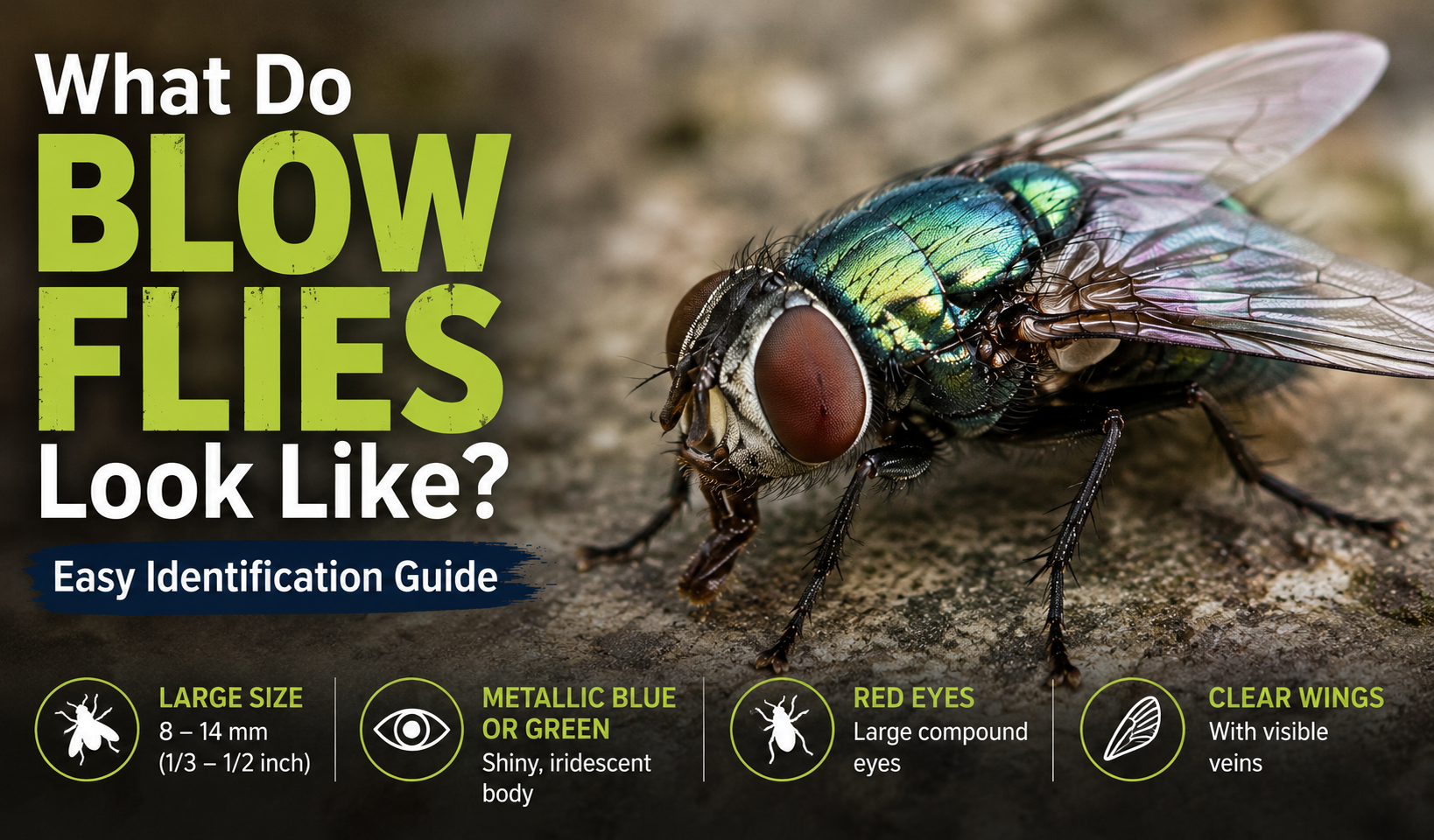
Blow flies are some of the easiest flies to recognize because many of them have brilliant metallic coloring that almost looks painted on.
If you’ve found a large blue, green, or bronze-colored fly buzzing around your home, there’s a good chance you’re looking at a blow fly instead of an ordinary house fly. If the insect lacks that metallic coloring, you can compare blow flies with cluster flies to narrow down the identification.
Before trying to get rid of it, I always recommend making sure you’ve identified it correctly.
Different flies usually point to different problems.

The Metallic Color Is the Biggest Clue
Whenever I’m trying to identify a blow fly, color is the first thing I notice.
Unlike ordinary house flies, blow flies often have bodies that appear:
- Metallic blue.
- Metallic green.
- Bronze.
- Bluish-green.
When sunlight hits them, they almost sparkle.
That’s something I never see with common house flies.
If the fly looks dull gray instead of shiny, I immediately start considering other possibilities.

Blow Flies Are Usually Larger Than House Flies
Size isn’t always perfect for identification, but it definitely helps.
Most blow flies are slightly larger and stockier than the average house fly.
Their bodies also look heavier.
When one lands on a window or countertop, it usually appears much more substantial than a fruit fly or house fly.
If you’re dealing with a tiny insect hovering around bananas, you’re almost certainly looking at something else.
Their Eyes Stand Out
Like many other flies, blow flies have large compound eyes.
When viewed up close, those eyes usually appear reddish-brown and take up a large portion of the head.
Combined with the metallic body, they give blow flies a very distinctive appearance that’s difficult to mistake once you’ve seen one a few times.
They Sound Different Too
One thing I’ve noticed over the years is that blow flies often sound different than house flies.
Their buzzing tends to be deeper and louder.
It’s not something I’d rely on by itself for identification, but after hearing both species enough times, it’s another clue that catches my attention.
Sometimes I’ll hear the buzzing before I even see the insect.


Where I Usually Find Blow Flies
Location often helps confirm my identification.
I’ve found blow flies around:
- Windows.
- Garages.
- Trash cans.
- Dead animals.
- Compost piles.
- Outdoor garbage bins.
- Animal buildings.
- Basements after a rodent dies.
If a metallic blue fly suddenly appears in large numbers inside a house, I immediately begin wondering if something nearby is attracting them rather than assuming they’re ordinary house flies.
Blow Flies vs. House Flies
This is the comparison I make most often because the two are confused all the time.
From across the room, they can look similar.
Once you get a closer look, the differences are much easier to spot.
House flies are usually:
- Dull gray.
- Slightly smaller.
- Four dark stripes behind the head.
- Not shiny.
Blow flies are usually:
- Metallic blue, green, or bronze.
- Slightly larger and heavier.
- Smooth-looking bodies.
- Bright, reflective coloring.
If the fly almost looks like polished metal when the light hits it, I immediately start thinking blow fly instead of house fly.

If you’re still unsure, my guide on What Do House Flies Look Like? Easy Identification Guide compares the features I use to identify ordinary house flies.
Blow Flies Don’t Usually Hover Around Fruit
This is another clue I pay attention to.
Fruit flies stay close to whatever they’re feeding on.
They hover around bananas, tomatoes, recycling bins, and other sugary foods.
Blow flies behave very differently.
They’re much stronger fliers.
Instead of hovering in one small area, they move throughout the room and often head straight for windows after becoming trapped indoors.
Watching their behavior helps me narrow down the possibilities before I ever get close enough to inspect them.
One Blow Fly Isn’t the Same as Twenty
Context matters just as much as appearance.
Finding one metallic fly in your garage isn’t necessarily unusual.
Finding twenty of them inside your house definitely gets my attention.
When I see multiple blow flies appearing over a short period, I start asking myself what changed.
Did an animal die in the attic?
Is there a dead mouse inside a wall?
Is an outdoor garbage container attracting them?
Did something recently get trapped in the chimney?
Blow flies are excellent at finding decaying organic material, which means a sudden increase often points to a source that needs to be investigated.


Their Behavior Gives Away a Lot
Before I ever grab a fly swatter, I usually spend a minute watching the insect.
Blow flies tend to be:
- Fast fliers.
- Loud buzzers.
- Strong enough to repeatedly hit windows.
- Constantly exploring large areas.
They’re much less likely to stay hovering around a fruit bowl or potted plant.
Instead, they move from surface to surface while searching for a way back outside or another food source.
Don’t Rely on Color Alone
I’ve seen metallic flies look almost black in a dim garage.
I’ve also seen ordinary house flies appear darker than they really are because of shadows.
That’s why I never identify a fly using only one characteristic.
Instead, I combine several clues.
I look at:
- Body size.
- Color.
- Body shape.
- Flight behavior.
- Where I found it.
- Whether it’s alone or part of a larger group.
Putting all of those observations together almost always leads to a much more accurate identification.



Here’s How I Identify Blow Flies
If I found a large fly buzzing around my kitchen tomorrow, I wouldn’t automatically assume it was a house fly.
I’d wait until it landed.
I’d look for that metallic shine.
I’d estimate its size.
I’d watch how it moved around the room.
Then I’d think about where I found it and whether I’d seen more than one.
Those few minutes usually tell me far more than trying to identify it from a blurry photo online.
Once I know it’s a blow fly, my next goal isn’t killing it.
It’s figuring out why it’s there.
If you’ve confirmed you’re dealing with blow flies, the next article I’d read is Why Do I Have Blow Flies in My House?because the source is often more important than the fly itself.
You can also browse our growing Flies category for more identification guides, product reviews, and practical advice covering the most common flies homeowners encounter.
Frequently Asked Questions
Are blow flies bigger than house flies?
Usually, yes. Blow flies are generally a little larger and have a stockier body than common house flies.
Why are blow flies shiny?

Many blow fly species have metallic blue, green, or bronze bodies that reflect light. That’s one of the easiest ways to tell them apart from ordinary house flies. If you're comparing a metallic fly with an ordinary gray one, house fly and blow fly differences can help clarify the identification.
Are metallic green flies blow flies?
Many are. Metallic green flies are often green bottle flies, which belong to the blow fly family.
Do blow flies bite people?

No. Blow flies don’t bite people or pets. While they can certainly be a nuisance indoors, they aren’t blood-feeding insects like horse flies. If you need to distinguish a blood-feeding horse fly from a nonbiting blow fly, horse fly identification guide explains the features to compare.
Why is identifying a blow fly important?
Blow flies are often associated with decaying organic material, so correctly identifying them can help point you toward the underlying source of the problem instead of treating them like ordinary house flies.
About the Author
Mark Sullivan has spent years solving pest problems around homes, garages, barns, and rural properties. He believes careful identification is the first step to solving any fly problem because different flies almost always point to different underlying causes.