
One of the biggest reasons house flies become such a frustrating pest is how quickly they reproduce.
I’ve seen homes go from seeing just a few flies to dozens in what feels like no time at all.
The reason is their life cycle.
Under the right conditions, house flies can develop from tiny eggs into fully grown adults in surprisingly little time. If the breeding site isn’t removed, that process simply repeats over and over again.
That’s why I don’t just focus on getting rid of the adult flies flying around my house.
I want to understand where they are in their life cycle because that usually tells me where to look for the source of the problem.
If you’re still trying to determine whether you’re actually dealing with house flies, start with What Do House Flies Look Like? Easy Identification Guide before reading further.
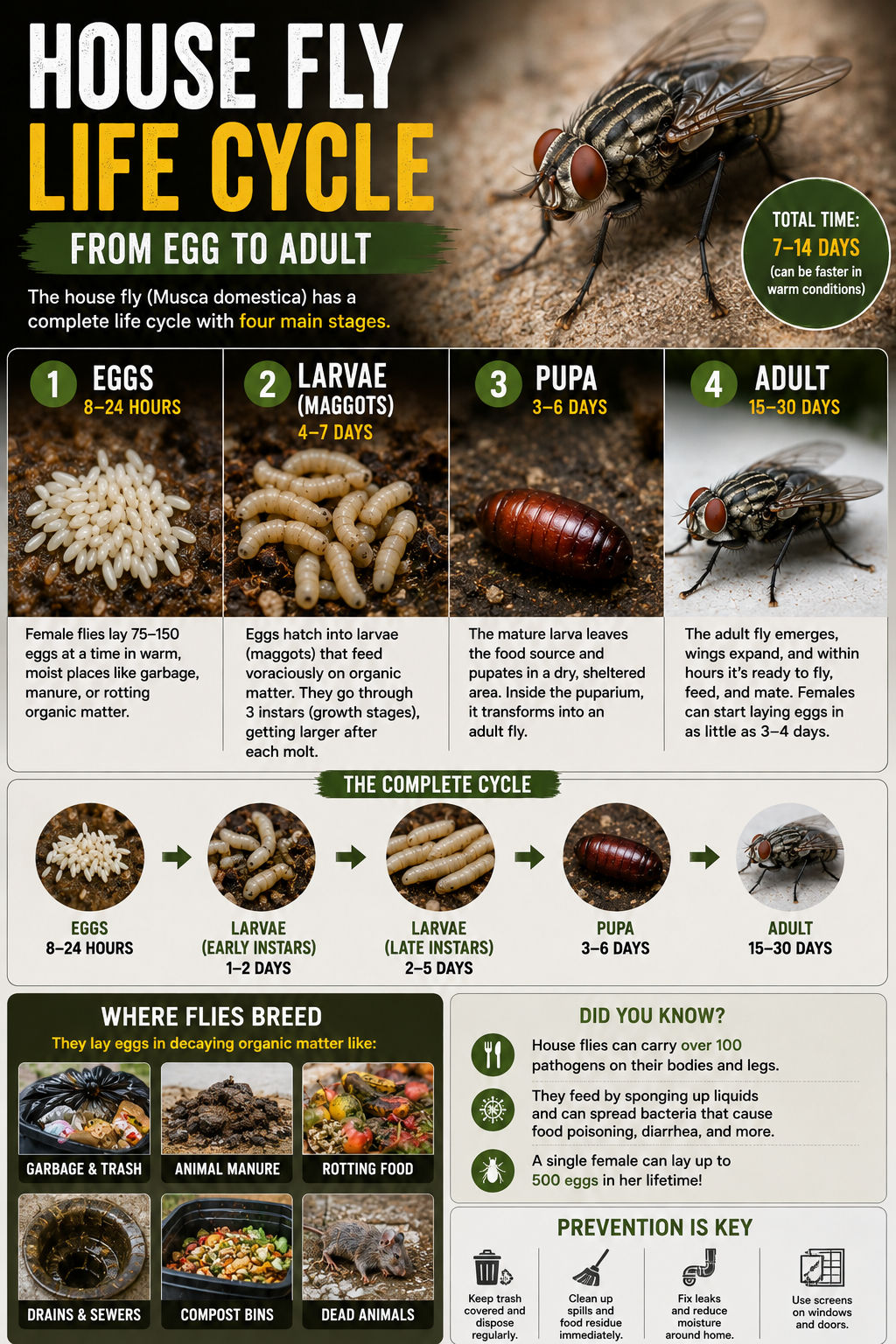
The Four Stages of the House Fly Life Cycle
Like many insects, house flies go through complete metamorphosis.
That means they pass through four completely different stages before becoming adults.
Those stages are:
- Egg
- Larva (maggot)
- Pupa
- Adult
Each stage serves a different purpose, and understanding them helps explain why house fly populations can grow so quickly.
Stage One… Eggs
The life cycle begins when an adult female finds the perfect place to lay her eggs.
She’s looking for one thing.
A location where her young will immediately have food after they hatch.
That’s why I almost always inspect moist organic material whenever I’m tracking down a fly problem.
Some of the most common egg-laying locations include:
- Garbage cans.
- Rotting food.
- Compost piles.
- Pet waste.
- Livestock manure.
- Dead animals.
- Organic debris.
A single female can lay 75 to 150 eggs at one time, and she’ll often lay several batches during her lifetime.
Those eggs are tiny, white, and usually hidden deep inside the breeding material.
Most homeowners never actually see them.
If you’d like to learn more about where females choose to lay eggs, I cover that in much greater detail in Where Do House Flies Lay Eggs? Hidden Places to Check.


Stage Two… Larvae (Maggots)
Once the eggs hatch, the larvae emerge.
Most people know them simply as maggots.
This is the feeding stage.
The larvae don’t have legs.
They don’t have wings.
Their entire purpose is to eat and grow as quickly as possible.
They’re usually buried inside the same decaying organic material where the eggs were laid.
That’s why people often don’t realize they’re there until they disturb the breeding site.
When I find maggots, I know I’ve found the real source of the fly problem.
Removing that material usually has a much bigger impact than killing adult flies buzzing around the house.
Stage Three… Pupae
After feeding long enough, the larvae stop eating and enter the pupal stage.
This is where one of the most amazing transformations in nature takes place.
Inside the protective pupal case, the maggot gradually changes into an adult fly.
From the outside, it may not look like much is happening.
Inside, nearly every part of the insect is being reorganized.
This stage usually takes several days, although temperature has a major influence on how quickly development occurs.

Stage Four… Adult House Flies
When development is complete, the adult fly emerges from the pupal case.
At first, it’s soft and lighter in color.
Within a short time, its body hardens, its wings fully expand, and it’s ready to fly.
From that point on, the adult’s main goals are fairly simple.
Find food.
Find moisture.
Find a mate.
Then start the entire life cycle over again.
That’s why finding just a handful of adult flies often means more are developing somewhere nearby.
Warm Weather Speeds Up the Entire Process
Temperature plays a huge role in how quickly house flies develop.
During warm summer weather, every stage of the life cycle happens faster.
Eggs hatch sooner.
Larvae grow more quickly.
Pupae develop faster.
Adults begin reproducing earlier.
That’s one reason fly problems seem to explode during late spring and throughout the summer.
A breeding site that produces only a few flies during cooler weather can suddenly produce many more once temperatures rise.
Why House Fly Populations Grow So Fast
People often ask me why house fly problems seem to appear almost overnight.
The answer usually comes down to two things.
Fast development.
And lots of eggs.
When multiple females are laying dozens of eggs every few days, it doesn’t take long before new adults begin emerging.
If the breeding material remains available, each new generation continues the cycle.
That’s why simply killing adult flies rarely solves the problem.
You have to eliminate the breeding site or the cycle simply starts again.
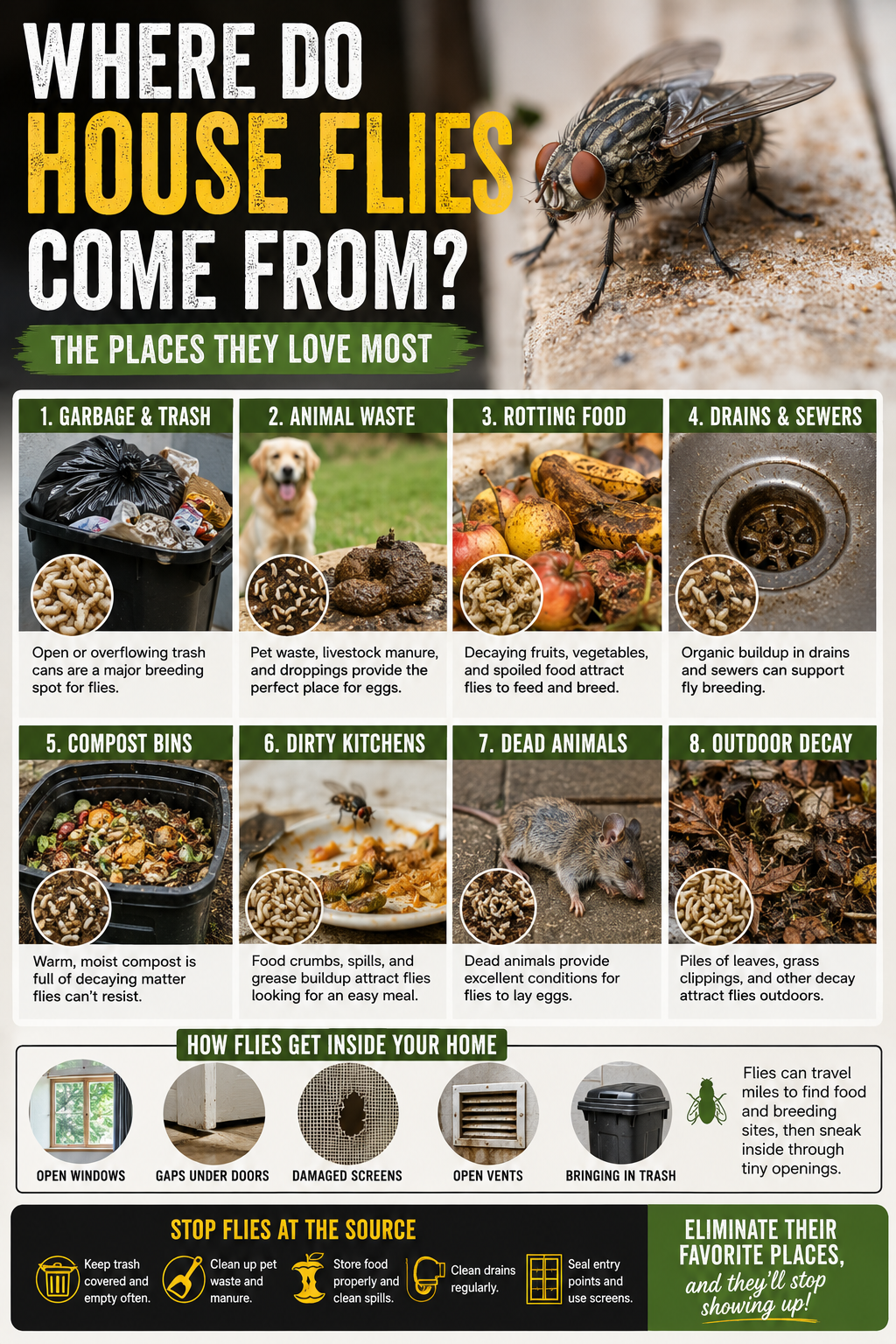
The article Where Do House Flies Come From? Common Sources Explained explains the places I inspect first whenever I’m trying to locate that source.
Every Stage Gives Me Different Clues
One thing I’ve learned after dealing with house flies for years is that every stage of their life cycle leaves different clues behind.
If I see adult flies gathering on windows, I know they’re already looking for light and trying to move around the house.
If I find maggots inside a trash can or compost pile, I’ve located the breeding site.
If I’m only seeing a handful of adults every few days, I start looking for a smaller, hidden source that may be producing new flies slowly.
Understanding which stage I’m dealing with helps me narrow down my search much faster.
Instead of randomly spraying insecticides, I can focus on eliminating the part of the life cycle that’s actually keeping the problem going.

Breaking the Life Cycle Is the Real Solution
People often ask me what the fastest way is to get rid of house flies.
My answer is almost always the same.
Break the life cycle.
If adult flies continue finding places to lay eggs, new flies will keep replacing the ones you kill.
That’s why I focus on removing breeding material before anything else.
Some of the first things I eliminate are:
- Food waste.
- Dirty garbage cans.
- Pet waste.
- Rotting produce.
- Compost that’s attracting flies.
- Dead animals.
- Damp organic debris.
Once those breeding sites disappear, the life cycle is interrupted and the fly population usually begins shrinking instead of growing.
Why Fly Traps Still Have an Important Job
Even after I’ve eliminated the breeding source, I usually don’t expect every adult fly to disappear overnight.
Some have already completed development and are now flying around the property.

That’s where fly traps become extremely useful.

For outdoor fly problems around trash cans, dog kennels, compost piles, or barns, I’ve had excellent success using the Rescue! Outdoor Disposable Fly Trap while the remaining adults are dying off.

Inside the home, flies naturally gather around windows after entering, so I often recommend Window Fly Traps That Actually Work to quietly reduce the adults that have already made it indoors.

If you’re unsure which type of trap fits your situation, my guide Best Fly Traps That Actually Work for Every Situation compares the options I use most often and explains where each one performs best.



Why House Fly Problems Seem to Explode Overnight
One thing homeowners tell me all the time is that they only noticed two or three flies one day, then suddenly dozens a few days later.
In reality, the problem didn’t develop overnight.
The breeding site had probably been active for days or even weeks before the first adults became noticeable.
Once multiple flies begin emerging at roughly the same time, it feels like they appeared all at once.
That’s another reason I never ignore even a small number of house flies.
Finding the source early is much easier than waiting until the next generation has already emerged.
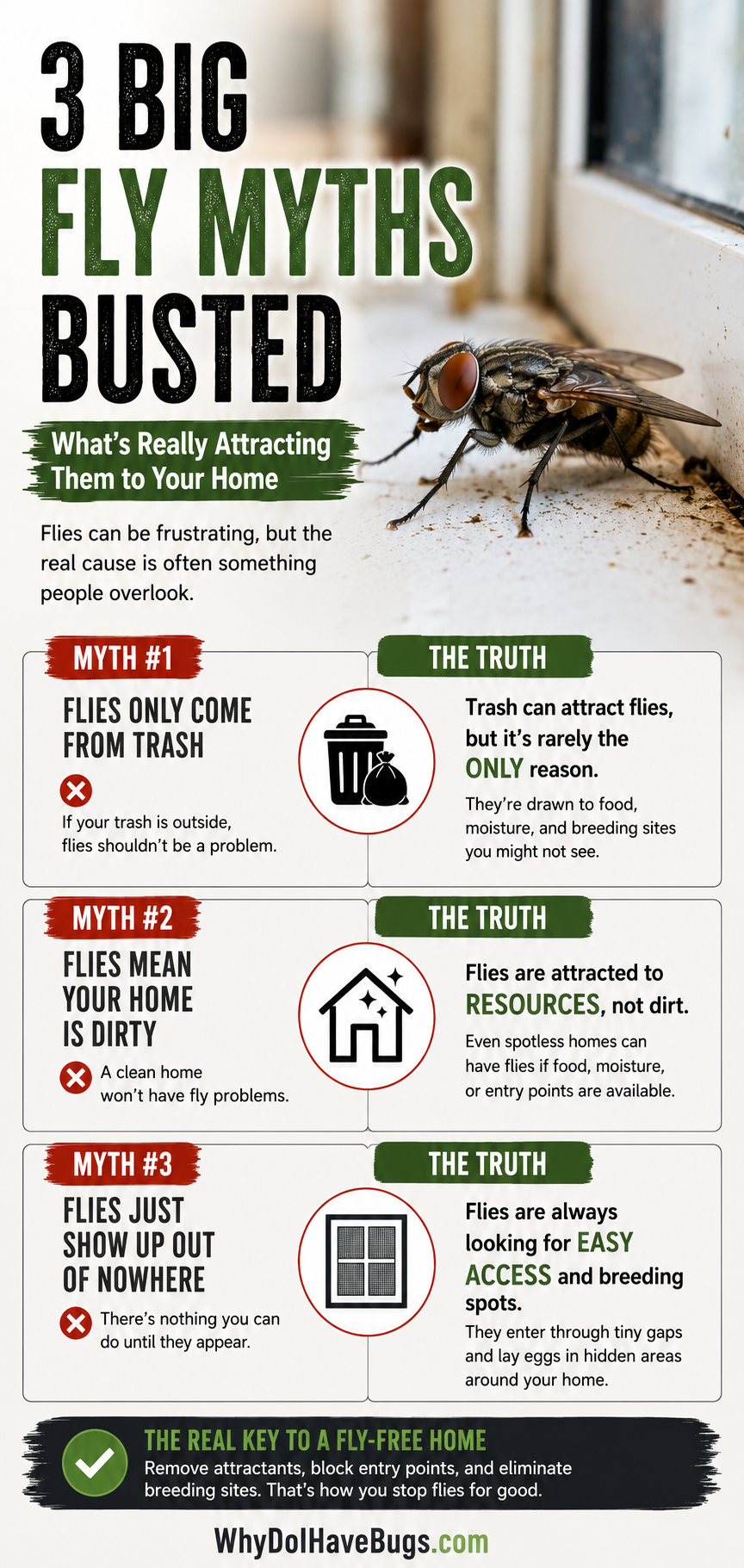
If you’re wondering why the numbers keep increasing, you may also want to read Why Do I Have House Flies? Common Causes Explained because many of the same conditions that attract adult flies also support their entire life cycle.
My Approach to Stopping the Cycle
Whenever I’m dealing with house flies, I remind myself that the adults I can see are only one part of the population.
Some are still eggs.
Others are feeding as larvae.
Others are hidden inside their pupal cases.
That means simply killing the adults rarely solves the entire problem.
Instead, I work backward through the life cycle.
I locate where the eggs are being laid.
I remove the material feeding the larvae.
I clean the area thoroughly so it no longer attracts new flies.
Then I use traps to catch the remaining adults while the population naturally declines.
Approaching the problem this way consistently produces better long-term results than trying to eliminate only the flies that are already flying around the house.
Frequently Asked Questions
How long does the house fly life cycle take?
Under warm conditions, the complete life cycle from egg to adult can take as little as 7 to 10 days, although cooler temperatures often slow the process considerably.
What are the four stages of a house fly?
House flies develop through four stages: egg, larva (maggot), pupa, and adult.
Why do house flies reproduce so quickly?
Female house flies lay multiple batches of eggs during their lifetime, and warm weather allows those eggs to develop rapidly. When breeding sites remain available, populations can increase very quickly.
What stage causes the most damage?
The larvae don’t usually damage your home, but they indicate that decaying organic material is present. The adult flies are the stage most homeowners notice because they’re the ones flying through the house and contaminating surfaces.
How do I stop the house fly life cycle?
The most effective approach is removing the breeding material before new generations can develop. Cleaning up garbage, pet waste, compost, rotting food, or other decaying organic matter interrupts the life cycle and prevents future flies from emerging.
About the Author
Mark Sullivan has spent years helping homeowners identify and solve fly problems by tracing them back to their source. He believes understanding the complete house fly life cycle is one of the best ways to eliminate infestations because it explains not just where flies come from, but why they keep coming back if the breeding site isn’t removed.