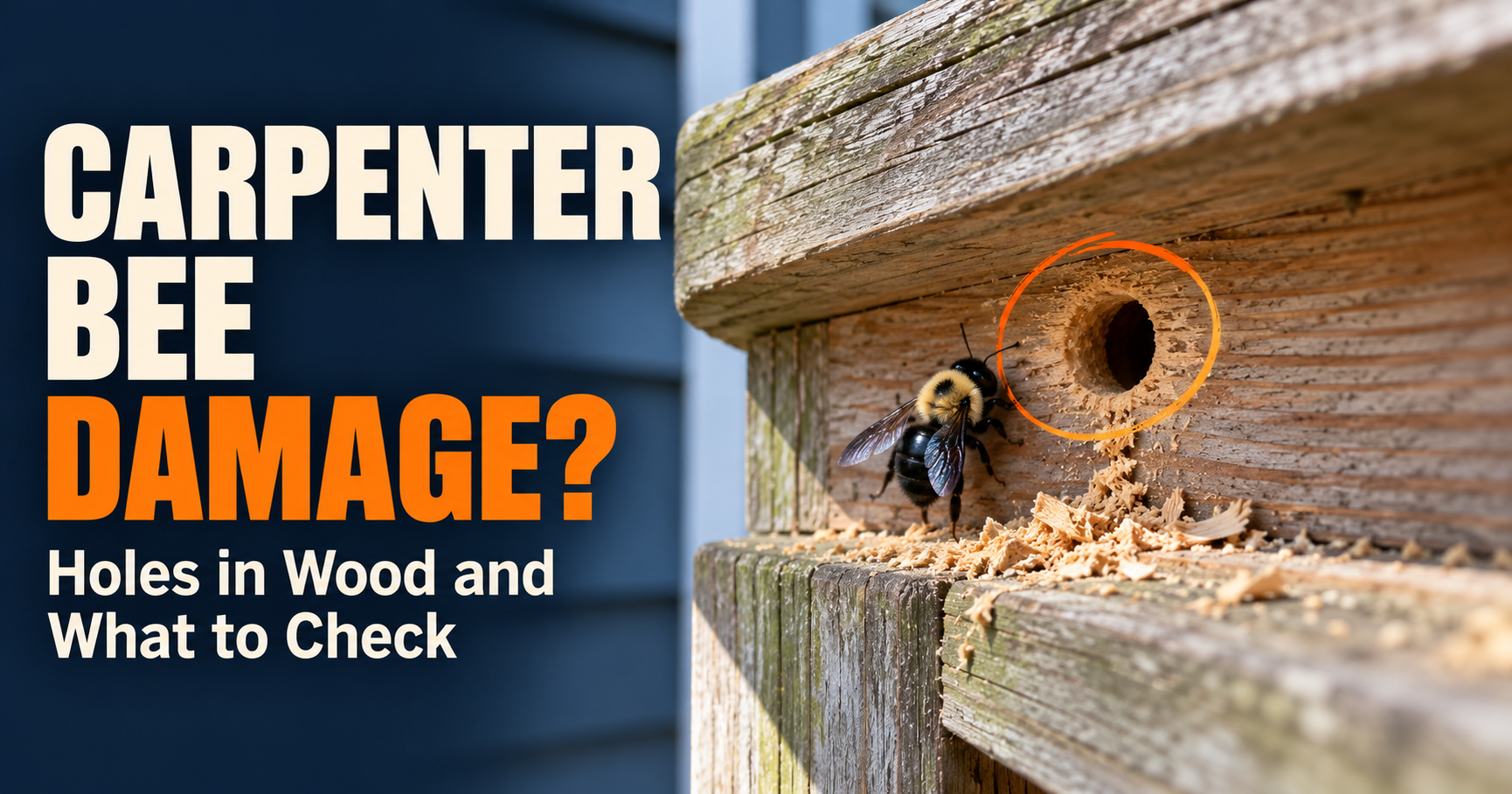
You notice a perfectly round hole underneath your porch railing. It looks so clean that you almost wonder if somebody drilled it. Then you spot a little pile of sawdust on the deck below, and suddenly that big black-and-yellow bee hovering around the porch starts making a lot more sense. If the hovering bee also makes you wonder about sting risk, that big black-and-yellow bee hovering around the porch explains what its behavior usually means.
You may have found a carpenter bee nesting hole.
These bees are surprisingly good at woodworking. They can chew their way into solid lumber and create tunnels that aren’t always visible from the outside. What looks like one little hole may actually lead to several inches of nesting space inside the board.
Carpenter bee holes are usually nearly perfect circles about 1/2 inch wide, often accompanied by fresh sawdust or yellowish staining. They’re commonly found underneath porch railings, deck boards, exposed rafters, and other sheltered wooden surfaces.
The good news is that one carpenter bee hole doesn’t automatically mean your porch is falling apart. These insects are valuable pollinators, and limited nesting damage may be more of a cosmetic problem than a structural emergency.
But repeated tunneling can become serious, especially when several generations use the same wooden structure.
Here’s how to recognize their holes, tell whether the damage is fresh, and figure out what actually needs attention.
What Do Carpenter Bee Holes Look Like?
The most recognizable feature is the shape.
A typical large carpenter bee entrance hole is nearly circular, with a diameter around 3/8 to 1/2 inch.
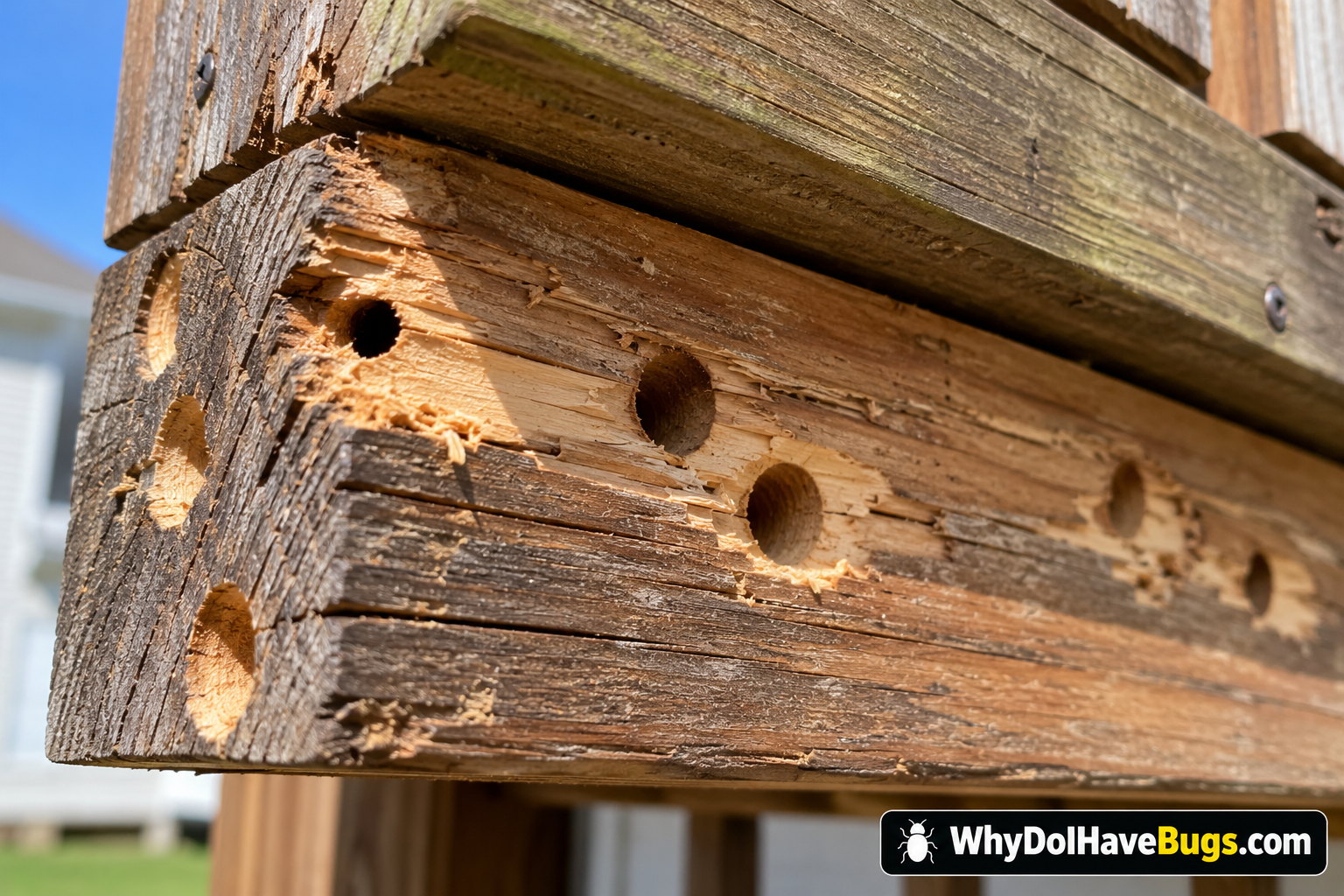
The edges often look smooth and clean, almost as though someone used a drill bit.
Unlike termites, carpenter bees don’t eat wood. Female carpenter bees chew through it to create nesting galleries where they lay eggs and raise their young.
As they excavate, they push out small particles of wood.
That’s why a fresh carpenter bee hole may have sawdust scattered underneath it.
The Hole May Look Smaller Than the Damage Inside
Here’s something that surprises homeowners.
The round opening isn’t necessarily the entire tunnel.
A female carpenter bee typically chews inward for a short distance before turning and continuing along the wood grain.
That hidden gallery may extend several inches beyond the opening.
As nests are reused and expanded, galleries can become substantially longer.
So even when you see just one entrance, there may be more tunneling inside than you’d expect.


What Size Holes Do Carpenter Bees Make?
For the large carpenter bees commonly encountered around American homes, entrance holes are generally about half an inch wide.
That’s roughly the diameter of a standard wooden pencil, although pencil sizes vary.
Smaller carpenter bee species may make smaller openings, so the exact diameter isn’t universal.
Are Carpenter Bee Holes Always Perfectly Round?
They’re usually very round, but not every opening will look exactly the same.
Wood condition, weathering, previous damage, and repeated use can alter the appearance.
An older entrance may have rougher or darker edges.
Woodpeckers can also enlarge the opening dramatically while searching for bee larvae.
If you’re finding irregularly torn-up wood instead of a neat circular hole, investigate whether another animal or insect has contributed to the damage.

Where Do Carpenter Bees Usually Drill Holes?
Carpenter bees often choose dry, exposed wooden surfaces.
They tend to prefer bare, weathered, or unfinished softwood.
Pine, cedar, fir, and similar lumber are common targets.
Their nesting holes often appear on sheltered undersides where rain and direct sunlight are less intense.
Porch Railings
This is one of the first places I’d inspect.
Look underneath horizontal rails and around exposed wooden posts.
The underside may be unfinished even when the visible surface has been painted.
Deck Framing
Check accessible joists, beams, and other wooden components beneath the deck.
Look for circular openings, sawdust, and areas where bees repeatedly enter and leave.
Don’t crawl beneath unstable structures or disturb electrical equipment to investigate.
Fascia and Trim Boards
Carpenter bees may excavate holes along roof trim, fascia boards, and other exposed exterior wood.
These locations can be difficult to inspect without a ladder.
If the holes are high above the ground, use binoculars or a camera with zoom rather than taking unnecessary risks.
Wooden Siding
Homes with exposed wooden siding may occasionally develop carpenter bee nesting holes.
Pay particular attention to weathered sections and exposed edges.
Sheds and Outdoor Furniture
Sheds, pergolas, fences, and wooden outdoor furniture can also attract carpenter bees.
An old unfinished picnic table may be more appealing than a freshly painted porch railing.
Finding a nest in something you don’t need to protect structurally may provide an opportunity to simply leave the bees alone.
How to Tell if a Carpenter Bee Hole Is Active
A round hole tells you that something may have excavated the wood.
But it doesn’t automatically prove that bees are currently living inside.
Carpenter bee galleries can remain in wood for years.
Some are reused, while others may be abandoned.
Here are several clues that suggest recent activity.
Fresh Sawdust Beneath the Opening
Newly produced sawdust is one of the stronger signs of excavation.
If you clean the area and find another little pile of wood particles later, something may still be working inside.
You can photograph the area and compare it over time.
Don’t insert objects into the hole to provoke a response.
Bees Entering and Leaving
Seeing a female carpenter bee repeatedly entering and exiting the same opening strongly suggests that the gallery is being used.
However, activity may vary with the weather, temperature, and season.
An occupied nest won’t necessarily have visible bees at the entrance every time you inspect it.
Fresh, Light-Colored Wood
Recently excavated openings sometimes expose lighter wood beneath the weathered surface.
Older holes may have darker edges.
Color alone isn’t a dependable age test, though, especially on treated or painted lumber.
Yellowish or Brownish Staining
Carpenter bee nesting sites may develop staining around entrances.
Some staining comes from bee waste.
It can appear yellowish, brownish, or fan-shaped on the wood below an opening.
Staining is a useful clue, but not every carpenter bee hole will have it.


Do Carpenter Bees Make Holes in the Ground?
The large carpenter bees most homeowners recognize generally excavate nests in wood rather than soil.
If you see bees flying into round holes in your lawn, you may be observing ground-nesting bees or another type of insect.
Mining bees, certain solitary bees, and some wasps use underground nesting sites.
Don’t assume they’re carpenter bees simply because they’re large or black and yellow.
Accurate identification matters because many ground-nesting bees are beneficial and relatively docile.
Carpenter Bee Holes vs. Termite Damage
Carpenter bees and termites can both affect wooden structures, but the damage usually looks quite different.
Carpenter bees create visible, relatively clean circular entrance holes that lead to nesting galleries.
Termites typically damage wood internally while feeding on cellulose.
Subterranean termites may also build mud tubes along foundations or other surfaces.
Drywood termites can leave small fecal pellets that resemble coarse sand or sawdust.
Does Sawdust Always Mean Carpenter Bees?
No.
Different wood-boring insects produce different forms of sawdust or frass.
Woodworking activity, carpenter ants, and certain beetles may also leave material near damaged wood.
A nearly circular half-inch opening with fresh sawdust and carpenter bee activity provides much stronger evidence than sawdust alone.
If you notice galleries, moisture-damaged wood, or insects that don’t resemble carpenter bees, don’t assume you’re dealing with the same problem.
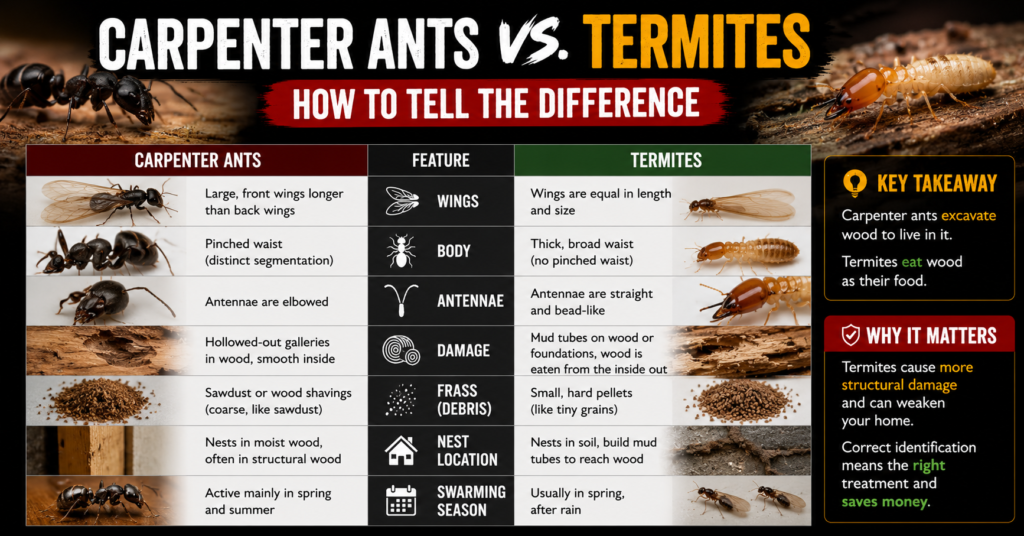
Our carpenter ants versus termites guide explains two other important types of insects associated with wood damage.
Carpenter Bee Holes vs. Woodpecker Damage
This is an important distinction because the two problems can be connected.
Carpenter bees create relatively neat, round entrances.
Woodpeckers may enlarge those holes while searching for carpenter bee larvae developing inside.
The result can look much worse.
Instead of a circular opening, you may find long, irregular gouges or sections of wood torn open along the grain.
A woodpecker can expose the nesting galleries that were previously hidden inside the board.
If you’re finding both round entrance holes and larger torn openings nearby, carpenter bees and woodpeckers may both be involved.
This is one reason it’s worth inspecting recurring carpenter bee activity before damage accumulates.
Can One Carpenter Bee Hole Cause Serious Damage?
Usually, one ordinary nesting gallery doesn’t create a structural emergency.
The amount of damage depends on the size and condition of the wood, the gallery’s location, and how much excavation has occurred.
A small hole in thick, sound lumber may have little immediate effect.
But repeated nesting in a narrow rail, thin trim board, or other vulnerable component can be more concerning.
When the Damage Becomes a Problem
I’d be more concerned if you notice several entrance holes in one board, extensive internal galleries, visible splitting, or movement in a railing that should be solid.
Woodpecker damage can further weaken affected sections.
If a load-bearing or safety-related wooden component is involved, have a qualified professional inspect it.
Don’t rely on exterior wood filler to restore structural strength.

Should You Plug Carpenter Bee Holes Right Away?
No, not until you know whether the gallery is occupied.
Carpenter bees can reuse tunnels, and some adults overwinter inside them.
An entrance may appear inactive even when living bees or developing young are present.
If you seal an occupied tunnel, you could trap the insects inside.
Adults may also try to excavate another exit, potentially creating additional damage.
When Is It Safe to Repair Carpenter Bee Holes?
The best time is when you’ve confirmed that the gallery is unoccupied.
In many areas, late summer after the emergence of new adults or early spring before nesting activity may offer opportunities for inspection and repair.
However, carpenter bees can use galleries for overwintering, so the calendar alone doesn’t guarantee that a hole is vacant.
A pest-management professional familiar with carpenter bees can help when occupancy is uncertain.
What Can You Use to Fill an Empty Hole?
For suitable unoccupied galleries, a wooden dowel secured with exterior-grade wood glue may be appropriate.
Exterior wood filler can also help with cosmetic repairs.
The right material depends on the location and condition of the wood.
If the gallery has caused substantial internal damage, replacing the affected board may be necessary.
Once repaired, properly finish the exposed wood to discourage future nesting.
How Do You Stop Carpenter Bees From Drilling New Holes?
The best long-term approach is to reduce the attractiveness of vulnerable wooden surfaces.
Carpenter bees generally prefer bare or weathered wood over well-maintained painted surfaces.
That makes painting and protecting exposed lumber useful preventive measures.
Paint or Properly Finish Exposed Wood
Pay particular attention to undersides, exposed board ends, and sheltered wooden edges.
These locations can remain unfinished even when the visible side looks good.
A properly maintained paint finish is generally a stronger deterrent than leaving wood bare.
Consider a Preventive Carpenter Bee Repellent
For appropriate outdoor wooden surfaces, you can also consider a purpose-made carpenter bee repellent.

One option is Best Bee Brothers Citrus Carpenter Bee Repellent Spray on Amazon , which contains lemongrass and citronella oils and is marketed for discouraging nesting.
This product is a supplemental deterrent rather than a guaranteed solution. I haven’t verified independent testing demonstrating how well this specific formula prevents nesting.
Follow the product’s current directions and don’t spray bees or active nests.
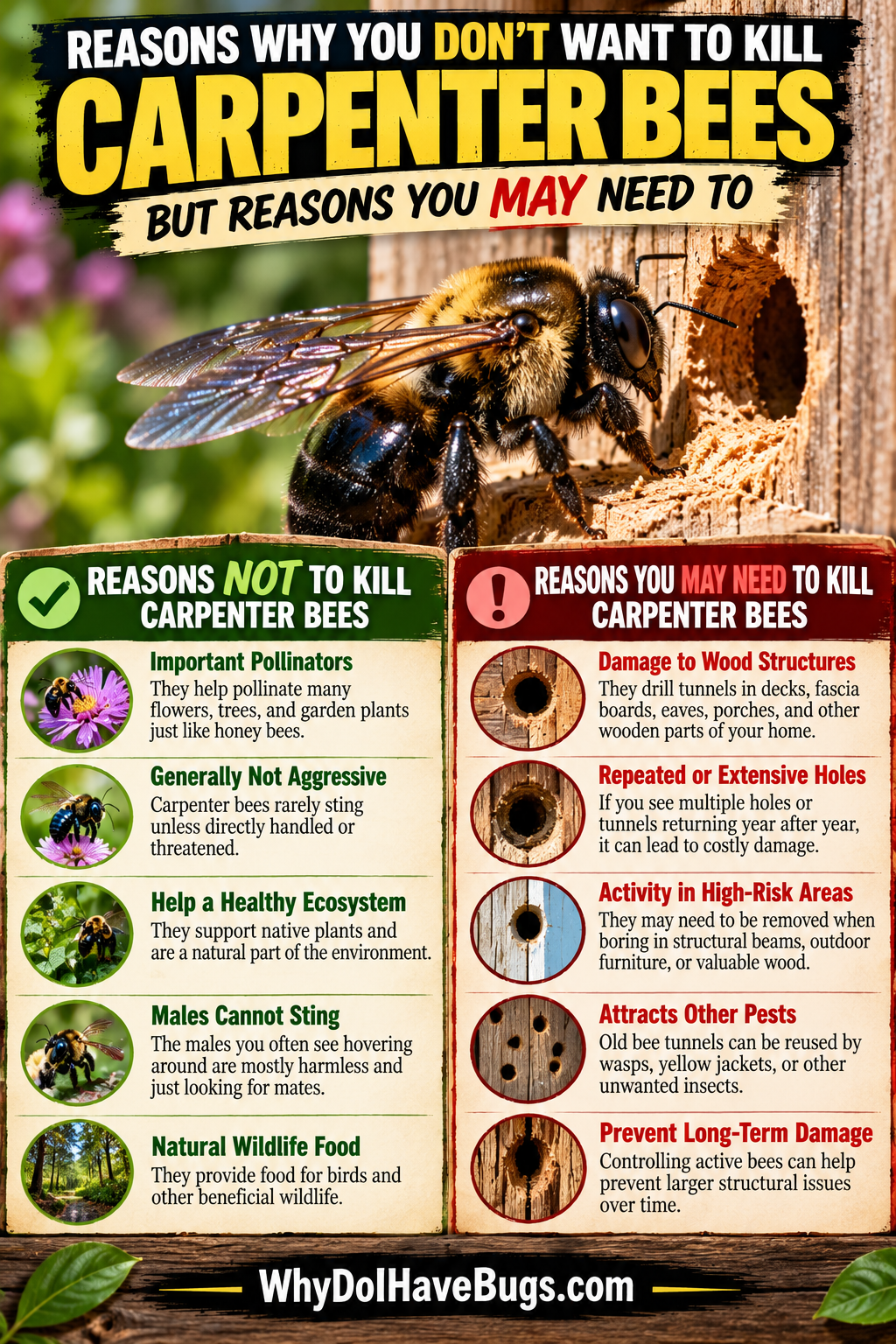
For the complete prevention approach, including the benefits of leaving harmless carpenter bees alone, see our guide to getting rid of carpenter bees without killing them.
Replace Repeatedly Damaged Wood
If the same board develops new holes year after year, consider whether a different material would be more appropriate.
Composite materials, metal coverings, and other suitable non-wood surfaces can eliminate the opportunity for carpenter bees to excavate the covered area.
That’s especially useful for trim and other components that don’t require exposed natural wood.



Should You Leave Carpenter Bee Holes Alone?
Sometimes, yes.
Carpenter bees are important native pollinators.
They visit many flowering plants and contribute to pollination, including through buzz pollination.
If they’re nesting in a dead log or an old stump away from buildings, the damage may not matter.
In that situation, leaving the bees undisturbed is often a reasonable choice.
However, a nest inside an important porch railing or supporting board deserves closer attention.
The goal isn’t to remove every carpenter bee from your property.
It’s to protect the wooden structures you rely on while allowing these beneficial insects to thrive where they aren’t causing problems.
Frequently Asked Questions
How big are carpenter bee holes?
Large carpenter bees typically create nearly circular entrance holes about 3/8 to 1/2 inch in diameter.
Do carpenter bee holes look like drill holes?
Yes. They’re often smooth and nearly perfectly round, making them resemble holes made with a drill bit.
Why is there sawdust underneath a carpenter bee hole?
Female carpenter bees chew wood to excavate nesting galleries. They push wood particles out of the entrance as they work.
How deep do carpenter bee holes go?
The entrance extends into the wood before turning along the grain. Galleries commonly run several inches and may become longer when reused or expanded.
Do carpenter bees make multiple holes?
Yes. Multiple bees may establish nearby galleries, and an individual entrance can connect to branching or extended nesting tunnels.
Do carpenter bees return to the same holes?
They can. Existing galleries may be reused, and some adults overwinter in old tunnels.
Can carpenter bee holes weaken a deck?
Yes, particularly when multiple tunnels affect the same wooden component or woodpeckers enlarge the damaged area. Structural concerns should be evaluated by a qualified professional.
What happens if you leave carpenter bee holes open?
Some holes may remain unused, while others may be reused or expanded in future nesting seasons. The risk depends on the location and condition of the wood.
Can you fill carpenter bee holes with spray foam?
Spray foam isn’t a substitute for structural wood repair, and you shouldn’t use it to seal an occupied gallery. Choose repair materials suitable for the wood and confirm the hole is unoccupied first.
Are carpenter bee holes a sign of termites?
Not usually. Carpenter bee holes are typically clean and circular, while termite damage involves a different feeding and tunneling pattern. If you’re uncertain, have the damage and any insects identified.
Should I be worried about one carpenter bee hole?
One hole generally isn’t an emergency, but it’s worth inspecting. Check for fresh activity, assess the wood’s condition, and monitor for additional damage.
About the Author: The team at Why Do I Have Bugs helps homeowners identify insects, understand the damage they can cause, and find practical ways to protect their property while respecting beneficial species whenever possible.