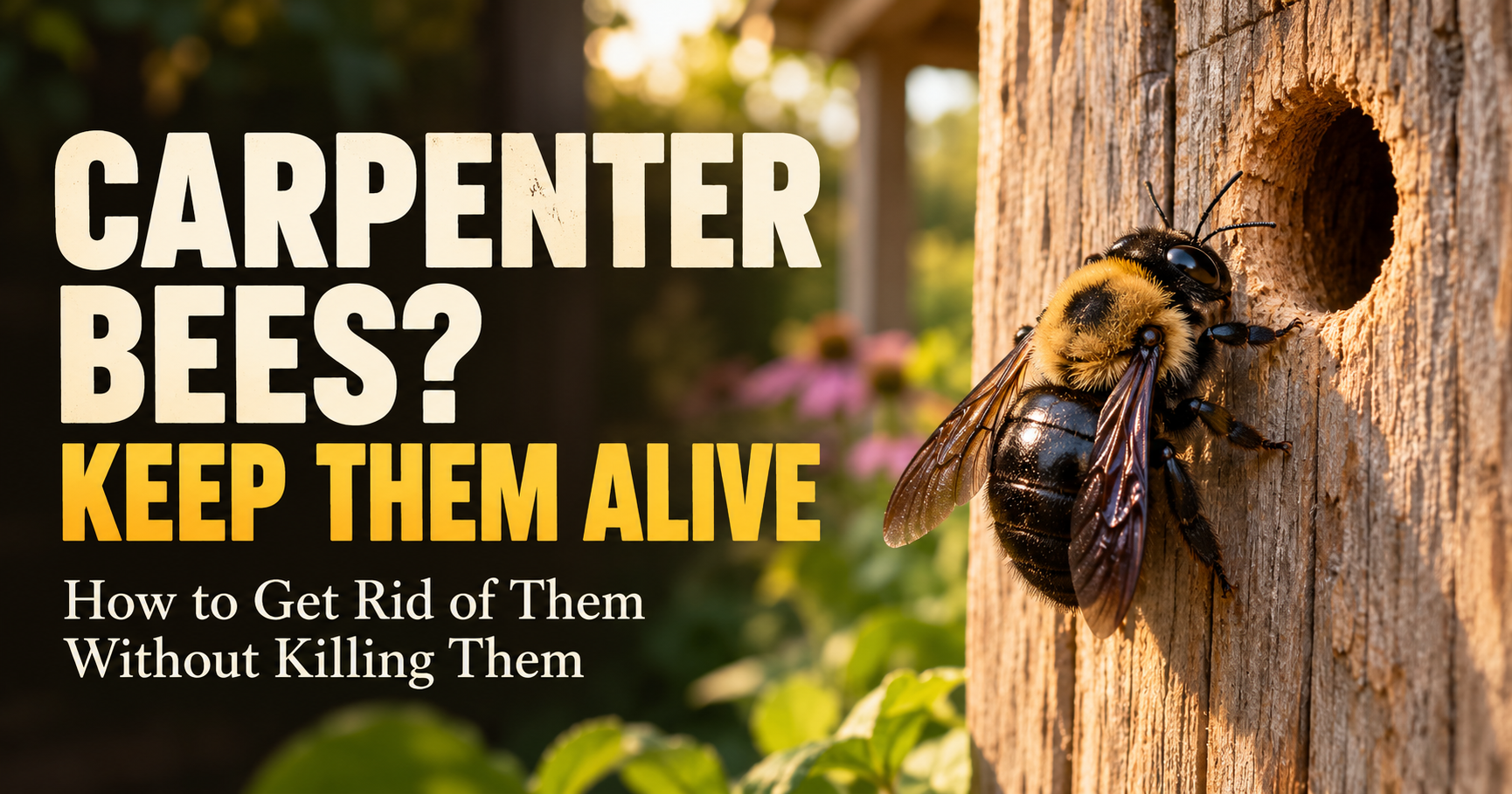
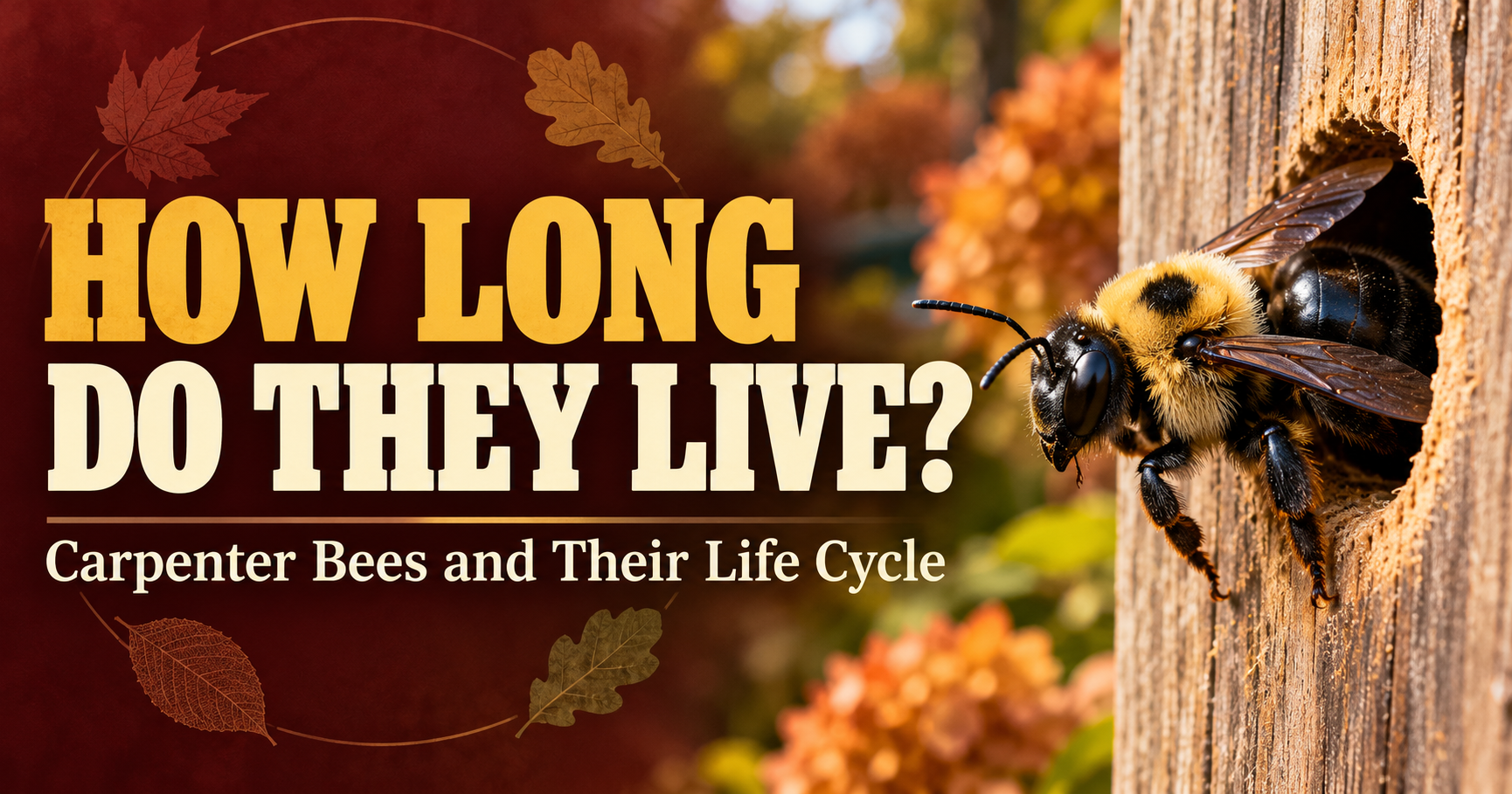
There’s something frustrating about stepping onto your porch and finding a perfectly round hole drilled into the wood. A little sawdust is scattered underneath it, and a big black-and-yellow bee keeps hovering nearby like it owns the place.
Chances are, you’ve discovered carpenter bees.
I understand why homeowners want them gone. Nobody wants their deck, porch railing, shed, or siding filled with holes. And when carpenter bees return to the same wooden structures year after year, the damage can become more serious than one little opening in a board.
But before reaching for a can of insecticide, there’s something worth knowing.
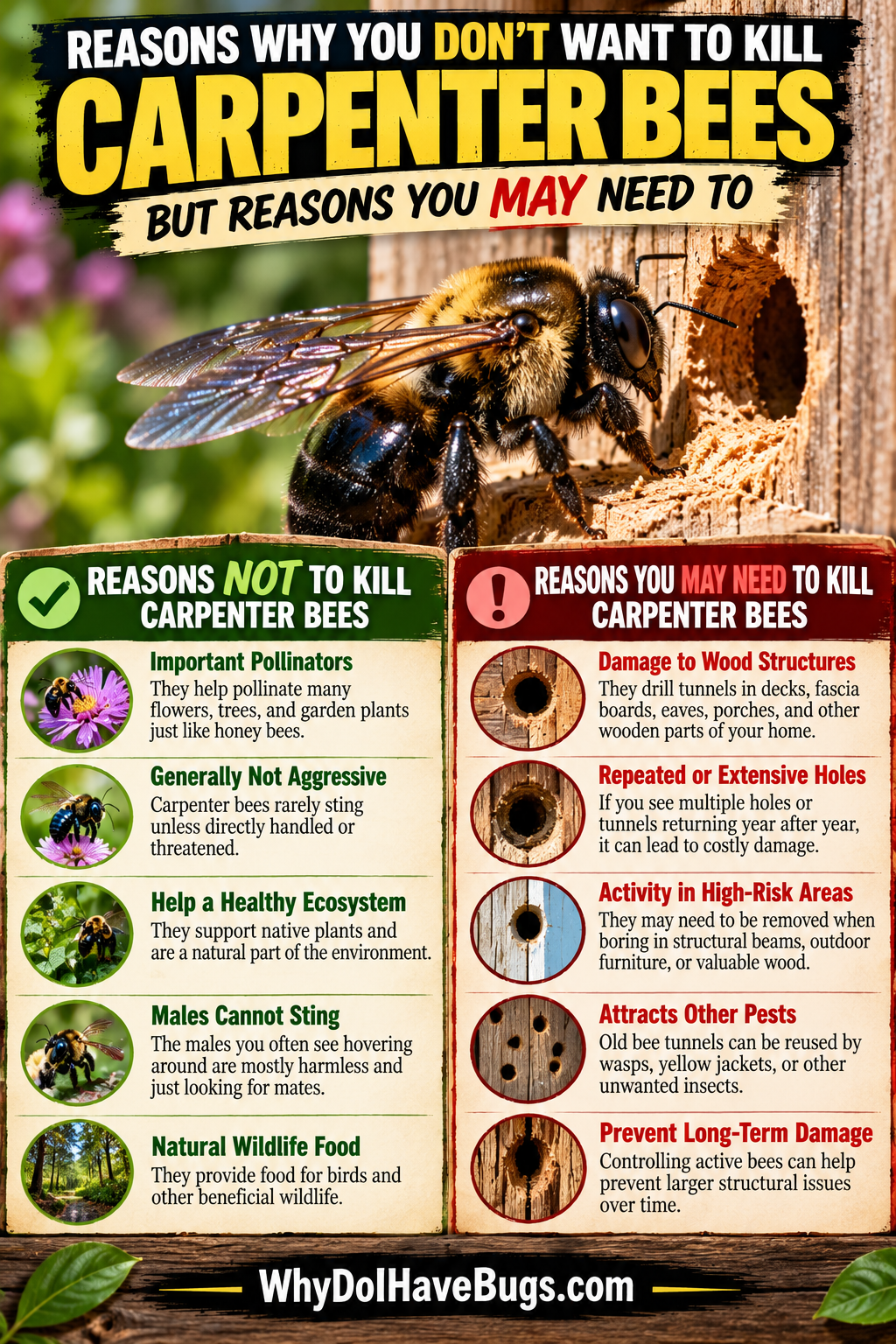
Carpenter bees are important native pollinators, and you can often discourage them from nesting in your home without killing them. They help pollinate flowers, vegetables, and other plants. Most aren’t particularly aggressive toward people, either.
The trick is finding a balance between protecting your property and protecting insects that actually do some good.
Here’s how I’d approach the problem, including a purpose-made citrus repellent, protecting exposed wood, repairing old nesting holes, and deciding when professional help makes sense.
How to Get Rid of Carpenter Bees Without Killing Them
The best approach is to make wooden structures less appealing to carpenter bees before they begin excavating new nesting tunnels.
If you already have bees nesting inside the wood, you’ll need to handle those occupied tunnels differently.
Here are the methods I’d consider first.
- Paint exposed wooden surfaces. Carpenter bees generally prefer bare or weathered wood, so keeping your porch, deck, and trim properly finished can discourage new nesting.
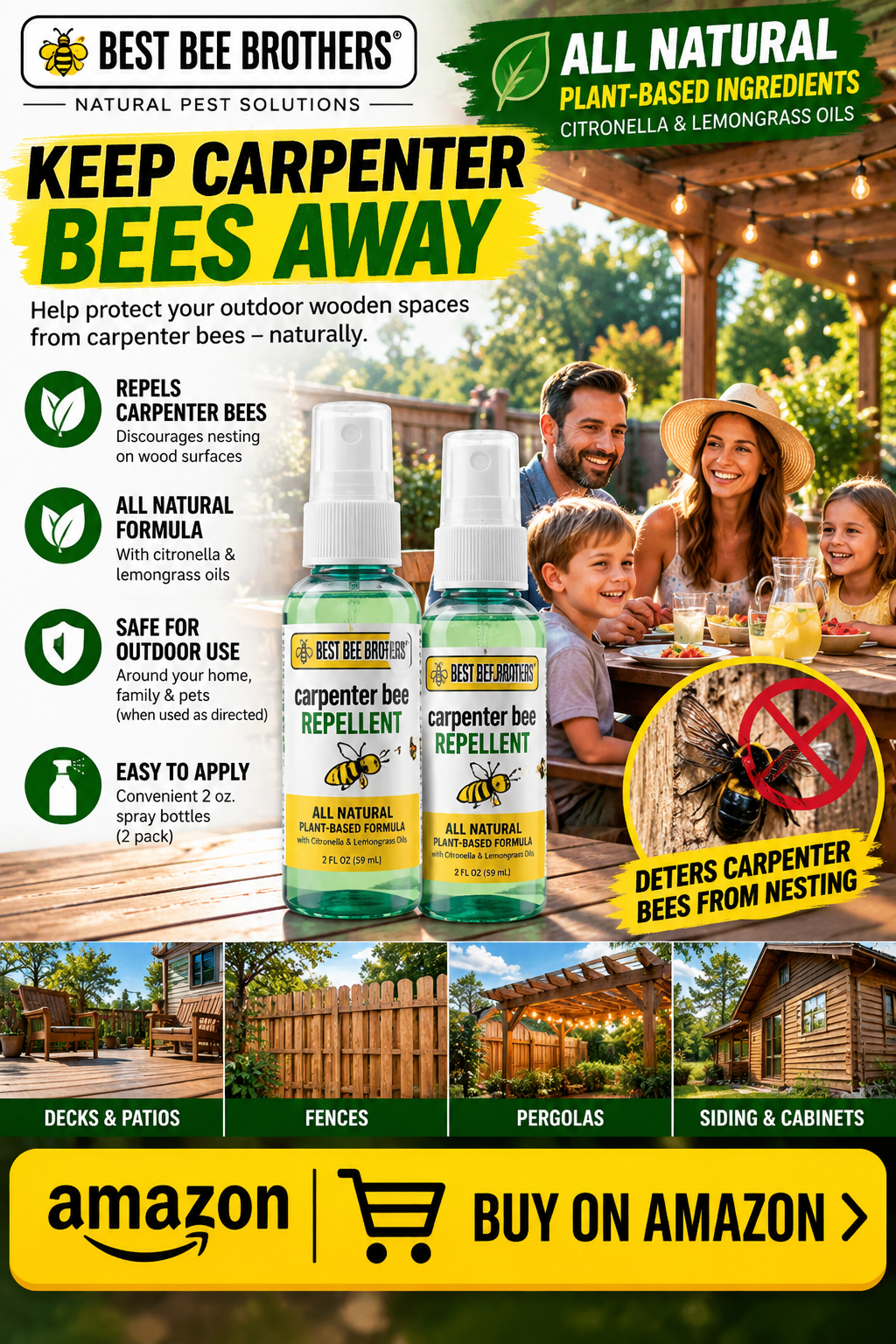
- Try a purpose-made carpenter bee repellent. Best Bee Brothers Citrus Carpenter Bee Repellent Spray on Amazon contains lemongrass and citronella oils and is marketed for discouraging carpenter bees from nesting on outdoor wooden surfaces. Its effectiveness on your particular structure isn’t guaranteed.
- Repair old nesting holes once they’re unoccupied. Existing tunnels may attract returning bees, but you shouldn’t simply seal an occupied nest.
- Replace badly damaged or repeatedly attacked wood. Composite materials, metal coverings, and properly protected boards can help prevent future nesting opportunities.
- Consider alternative nesting habitat. Suitable untreated wood away from your house may give carpenter bees another place to nest, although it won’t guarantee they’ll leave your porch alone.
- Leave harmless nests undisturbed. A carpenter bee nesting in an old stump away from buildings generally doesn’t require intervention.
These methods are about prevention, not immediately eliminating every carpenter bee in your yard.
That’s an important distinction because carpenter bees are a natural part of our environment, and most only become a problem when they excavate wood we need to protect.

Why Carpenter Bees Are Worth Protecting
Carpenter bees have a reputation for causing damage, but they also provide something valuable.
They’re native pollinators that visit flowers to collect nectar and pollen.
The eastern carpenter bee, Xylocopa virginica, is commonly found throughout much of the eastern United States, including Missouri.
These large bees visit a variety of flowering plants and contribute to pollination.
Carpenter Bees Help Pollinate Garden Plants
One of their interesting abilities is something called buzz pollination.
Certain flowers hold their pollen inside structures that don’t release it easily.
Carpenter bees can vibrate their flight muscles to shake pollen loose, helping pollinate plants such as tomatoes and eggplants.
They also visit many wildflowers and other flowering plants.
If you’ve got a vegetable garden, flower beds, or native plants around your property, carpenter bees can be helpful visitors.
Should You Leave Carpenter Bees Alone?
When possible, yes.
If a carpenter bee is visiting flowers, flying around the garden, or nesting in a dead log away from anything important, I wouldn’t consider it a pest that needs to be eliminated.
But if females are repeatedly drilling into porch railings, structural wood, or expensive trim, there’s a legitimate reason to intervene.
Protecting carpenter bees and protecting your home don’t have to be opposing goals.
The most responsible approach is to prevent nesting where it could cause damage while allowing the bees to continue living and pollinating elsewhere.
What Does Carpenter Bee Damage Look Like?
Carpenter bees don’t eat wood like termites.
Female carpenter bees chew into wood to create tunnels where they lay eggs and raise their young.
They use their mandibles to excavate the wood, pushing the resulting sawdust outside.
That process creates the distinctive holes homeowners often discover.
Perfectly Round Holes in Wood
Carpenter bee entrance holes are commonly around half an inch in diameter.
They can look almost like someone used a drill bit.
You may find them in porch railings, exposed rafters, fascia boards, shed trim, wooden siding, fence posts, and outdoor furniture.
The entrance usually leads inward before the tunnel turns and extends along the wood grain.
That means the hole you see on the outside can be just a small part of a longer gallery inside the board.
Fresh Sawdust Underneath the Hole
Small piles of fresh sawdust are another clue.
If a female carpenter bee is actively excavating, you may notice wood particles collecting underneath the entrance.
Sometimes the sawdust is accompanied by yellowish or brownish staining around the hole.
Woodpeckers Can Make the Damage Worse
This is something homeowners sometimes overlook.
Woodpeckers may peck into wooden boards to reach carpenter bee larvae.
A relatively small tunnel can become much more damaged when a woodpecker starts breaking apart the surrounding wood.
That doesn’t happen with every carpenter bee nest, but it’s one reason repeated nesting can become troublesome.
Will Carpenter Bees Destroy Your House?
Usually, one carpenter bee nest isn’t going to cause a major structural problem.
An individual tunnel may create only limited damage.
However, carpenter bees can reuse existing galleries and excavate additional tunnels over time.
When numerous bees nest in the same wooden structure over several years, the damage can accumulate.
When Should You Worry About Carpenter Bee Damage?
I’d pay closer attention if you notice multiple holes in the same structural board, extensive tunneling, cracking, or weakened wood.
Porch railings, supporting beams, and other important components deserve particular attention.
If a board seems structurally compromised, have it inspected by a qualified carpenter or building professional.
Filling visible holes doesn’t automatically restore the strength of damaged lumber.
Sometimes replacing the wood is the safer option.
Best Bee Brothers Citrus Carpenter Bee Repellent Spray
If you’re looking for a product designed specifically to discourage carpenter bees from nesting on outdoor wooden surfaces, one option worth considering is Best Bee Brothers Citrus Carpenter Bee Repellent Spray, 2 oz, 2-Pack. Because this section discusses a product recommendation, you can review our affiliate relationships for details about how product links support the site.
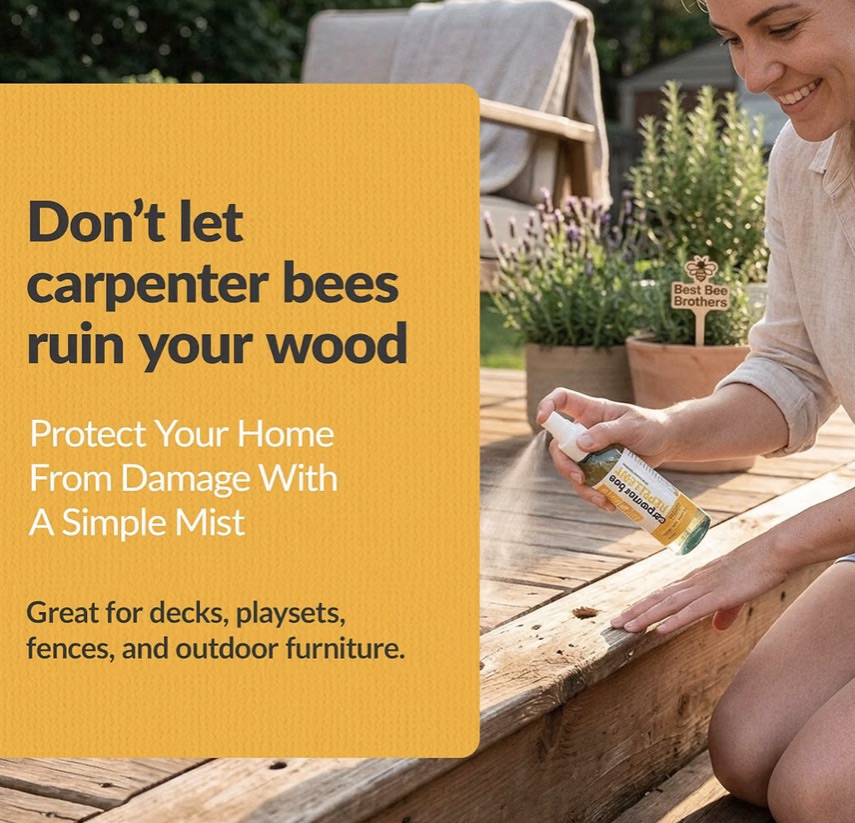
Unlike ordinary insect-killing sprays, this product is marketed as a deterrent.
Its purpose is to make treated wood less attractive to carpenter bees investigating possible nesting spots.
That fits the approach I’d prefer when the goal is preventing damage without immediately killing beneficial insects.
What’s in Best Bee Brothers Carpenter Bee Spray?
According to the manufacturer, the active ingredients are:
- Lemongrass oil, 24.7%.
- Citronella oil, 1.9%.
These are naturally derived essential oils used in the company’s carpenter bee repellent formula.
The manufacturer recommends applying the spray to appropriate outdoor wooden surfaces such as railings and siding.
It also recommends repeated applications during carpenter bee season rather than relying on one treatment for the entire summer.
How to Use the Citrus Carpenter Bee Repellent
Start by identifying the wood you’re trying to protect.
For example, maybe carpenter bees investigate the underside of your deck railing every spring.
That would be a more sensible treatment area than spraying flowers, the entire yard, or bees themselves.
Follow the product’s current packaging directions.
The manufacturer advises shaking the bottle before use because the oils can separate.
Its published instructions describe applying the spray from approximately 6 to 12 inches away from appropriate outdoor wooden surfaces, with applications repeated every few days during carpenter bee season.
Avoid contact with eyes and skin, keep the product away from children, and follow the manufacturer’s precautions regarding sensitive materials.
Even naturally derived ingredients can cause irritation or damage certain surfaces.
Does Best Bee Brothers Carpenter Bee Spray Actually Work?
Here’s where expectations matter.
The product is specifically formulated and marketed to discourage carpenter bee nesting. That makes it a more relevant choice than an ordinary skincare oil or an unrelated homemade spray.
However, I haven’t independently verified a controlled study showing how reliably this exact formula prevents nesting under real-world conditions.
I’d consider it a supplemental deterrent, not a guaranteed solution.
A spray also won’t repair damaged boards or make an occupied nesting gallery disappear.
For someone trying to discourage new nesting on vulnerable wood, it’s an option worth considering alongside more established physical prevention methods.
See the Best Bee Brothers Citrus Carpenter Bee Repellent 2-Pack on Amazon
When Would I Use It?
I’d consider this kind of product before or during the period when carpenter bees are investigating potential nesting locations.
For example, if you have a wooden porch railing that’s repeatedly attracted them, you could apply the repellent to appropriate surfaces according to the product directions while also planning a more lasting way to protect the wood.
I wouldn’t depend on repeated spraying alone for important structural components.
And I wouldn’t apply it directly to bees or occupied nesting entrances as though it were a proven relocation treatment.
Its intended role is discouraging new nesting on treated surfaces.
Painting Your Wood Is Still One of the Best Prevention Methods
While carpenter bee sprays may provide an additional deterrent, properly maintaining the wood itself remains extremely important.
Carpenter bees generally prefer unfinished, exposed, or weathered wood.
Well-maintained painted surfaces are usually less attractive.
That’s why I would prioritize painting or properly protecting vulnerable wood over relying entirely on a spray.
Don’t Forget the Underside of Wooden Boards
This is an easy mistake to make.
A homeowner may paint the visible surfaces of a porch railing but leave the underside unfinished.
Unfortunately, carpenter bees commonly begin their nesting tunnels on sheltered undersides and edges.
Inspect the entire accessible board, particularly around corners, exposed ends, and weathered areas.
Follow the coating manufacturer’s directions, and avoid disturbing occupied nests during maintenance.
Is Paint Better Than Stain?
Paint generally provides stronger deterrence than leaving wood bare.
Stain may also discourage nesting, but carpenter bees can still investigate stained wood, particularly when the finish has weathered.
Neither treatment guarantees complete protection.
If you prefer the look of natural wood, you’ll need to monitor vulnerable areas more closely.

Should You Fill Carpenter Bee Holes?
Yes, repairing unoccupied nesting holes can help prevent future reuse.
But timing matters.
Don’t immediately plug an active carpenter bee hole simply because you’ve discovered it.
An occupied tunnel may contain adult bees or developing young.
Sealing the entrance could trap the insects inside, and adults may attempt to excavate another opening.
You also risk unnecessarily killing developing bees.
When Is the Best Time to Repair Carpenter Bee Holes?
Ideally, repair them when you’re confident the gallery is unoccupied.
That can be more complicated than it sounds.
New adults may emerge later in the season, and carpenter bees can also use existing galleries for overwintering.
An old-looking hole isn’t proof that nothing is inside.
If you can’t determine whether a gallery is occupied, a pest-control professional familiar with carpenter bees may be able to help.
What Should You Use to Fill Carpenter Bee Holes?
For appropriate unoccupied holes, wooden dowels secured with exterior-grade wood glue can be one repair option.
Exterior wood filler or other suitable repair materials may also help, depending on the location and condition of the wood.
Remember that carpenter bee tunnels can extend well beyond the entrance.
Cosmetically filling a hole doesn’t necessarily repair internal structural damage.
If a board has extensive tunneling or has become weak, replacement may be more appropriate.
After repairs, maintain a suitable protective finish.
Does Almond Oil Keep Carpenter Bees Away?
Almond oil is another preventive method worth mentioning.
Penn State Extension recommends an annual spring application of almond oil to wood as a deterrent, particularly when homeowners want to maintain a natural wood appearance.
The purpose is to discourage new nesting.
However, Penn State also notes that surface treatments such as almond oil, paint, and stain aren’t effective at driving bees out of already established nests.
There’s another important detail.
Not every product sold as almond oil is chemically identical, and an ordinary sweet almond skincare oil shouldn’t automatically be treated as a tested carpenter bee repellent.
If you prefer a ready-made product marketed specifically for outdoor carpenter bee prevention, the Best Bee Brothers spray discussed above is a more directly relevant option.
Still, neither product should replace repairing and protecting vulnerable wood.

Can You Give Carpenter Bees Another Place to Nest?
If you have room on your property, this is a possibility worth considering.
Carpenter bees naturally use suitable dead wood and woody materials for nesting.
Leaving an old log or stump in a safe area away from your home may provide habitat.
Penn State Extension also discusses offering suitable untreated pine or cedar away from vulnerable wooden structures.
Will Alternative Wood Keep Them Off Your House?
Not necessarily.
Providing another nesting opportunity doesn’t guarantee a female carpenter bee will abandon an existing gallery or ignore your porch.
However, it’s a habitat-friendly step that may help reduce conflicts when combined with protecting the wood on your home.
If you have an old stump at the edge of your yard that’s not causing any problems, there’s often no reason to remove carpenter bees nesting there.
Do Carpenter Bee Traps Work?
Some carpenter bee traps are effective at catching adult bees.
However, conventional carpenter bee traps are often designed to capture and kill them.
That’s something I’d want readers to understand before purchasing one.
A trap isn’t automatically a harmless relocation device.
It also doesn’t make exposed wooden railings or trim less attractive to future carpenter bees.
If your goal is discouraging nesting without unnecessarily harming pollinators, start with wood protection and preventive deterrents rather than traps.
Should You Spray Carpenter Bees With Insecticide?
Sometimes carpenter bee activity becomes extensive enough that professional pest management may be justified.
This is particularly true when important wooden structures contain multiple active galleries or repeated nesting has created significant damage.
However, spraying every carpenter bee you see isn’t a reasonable first response.
A bee visiting flowers isn’t causing damage to your house.
A male hovering around your porch may not even be capable of stinging.
If insecticide treatment becomes necessary, use a product labeled for the pest and application site, following all directions.
A licensed professional can determine whether targeted gallery treatment is appropriate.
Avoid applying insecticides to flowering plants or other locations where beneficial pollinators are actively feeding.
Are Carpenter Bees Dangerous to People?
Carpenter bees can look intimidating, especially when they hover directly in front of your face.
But they’re generally less aggressive than their behavior suggests.
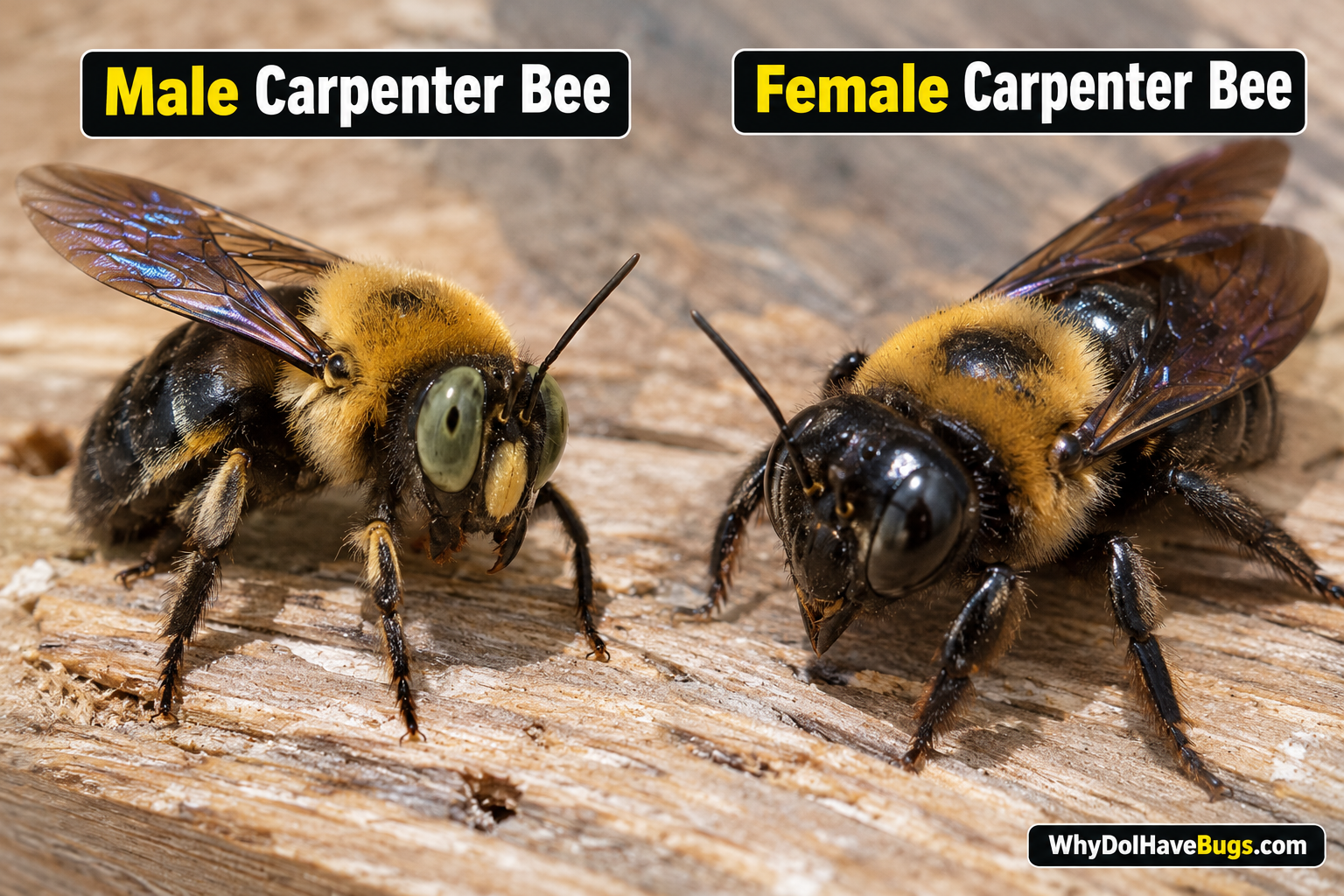
Male Carpenter Bees Cannot Sting
Male carpenter bees often patrol areas around nesting sites.
They may dart toward people or hover aggressively near a porch.
Despite their behavior, male carpenter bees don’t have stingers.
That means some of the bees acting the most intimidating are physically incapable of stinging you.
Female Carpenter Bees Can Sting
Female carpenter bees have stingers, but they generally aren’t aggressive unless handled or provoked.
Giving them space is usually enough to avoid problems.
If someone has a serious insect-sting allergy, appropriate precautions are especially important.
How to Stop Carpenter Bees From Returning Every Spring
Carpenter bees may reuse existing nesting galleries, and some adults overwinter inside wood.
That’s why homeowners sometimes notice activity around the same porch or shed year after year.
If you want to reduce repeated nesting, focus on making those wooden surfaces less attractive.
Inspect Before Spring Nesting Begins
Look for bare wood, weathered paint, cracks, and old nesting holes.
Check underneath railings and along exposed trim.
These sheltered areas are easy to overlook.
Repair Unoccupied Galleries
Once you’ve confirmed a nesting tunnel is empty, repair the wood appropriately.
If the damage is extensive, replace the affected board.
Maintain the Finish
Paint or properly finish exposed surfaces before the wood becomes heavily weathered.
Reinspect areas where protective coatings peel or wear away.
Consider a Preventive Repellent
For vulnerable outdoor wood, a purpose-made repellent may provide another preventive option.
Best Bee Brothers Citrus Carpenter Bee Repellent is formulated with lemongrass and citronella oils and is intended for outdoor wooden surfaces.
You can review the Best Bee Brothers natural-ingredient carpenter bee spray here .
Use it according to the product instructions and remember that repeated applications may be needed.
Leave Harmless Bees Alone
If the bees are simply pollinating your flowers or using suitable deadwood away from buildings, you usually don’t need to do anything.
The goal isn’t to eliminate carpenter bees from your property.
It’s to prevent damage where it matters.
Frequently Asked Questions
What is the best way to get rid of carpenter bees without killing them?
The most dependable approach is prevention. Keep vulnerable wood properly painted or protected, repair confirmed unoccupied galleries, and consider purpose-made deterrents for appropriate surfaces.
Does Best Bee Brothers Citrus Carpenter Bee Repellent kill bees?
The product is marketed as a repellent rather than an insect-killing spray. However, that doesn’t establish that direct exposure is harmless to every insect. Use it as directed on outdoor wooden surfaces rather than spraying bees.
How often should you apply carpenter bee repellent?
It depends on the product. Best Bee Brothers recommends reapplying its citrus repellent every few days during carpenter bee season. Follow the current directions on your specific package.
Is citronella or lemongrass good for carpenter bees?
These oils are used in commercial carpenter bee deterrent formulas. However, the effectiveness of a particular product depends on its formulation and use. Homemade mixtures shouldn’t be assumed to work the same way.
Can carpenter bees damage a wooden deck?
Yes. Repeated nesting can damage railings, framing, and other wooden components. A single gallery may create limited damage, but extensive tunneling and woodpecker activity can cause greater problems.
Are carpenter bees good pollinators?
Yes. Carpenter bees help pollinate many flowering plants and can perform buzz pollination, which is particularly useful for certain flowers that release pollen through vibration.
Do carpenter bees eat wood?
No. Females excavate wood to construct nesting galleries. The larvae develop using pollen and nectar provisions rather than feeding on the wooden tunnel walls.
Will carpenter bees leave if I spray their nest with repellent?
Not reliably. Preventive surface repellents aren’t established methods for removing carpenter bees already living inside nesting galleries.
Should I plug carpenter bee holes immediately?
No. First determine whether the tunnel is occupied. Sealing an active gallery can trap adult bees or developing young and may create additional problems.
Does painting wood stop carpenter bees?
A well-maintained paint finish can substantially discourage new nesting, although it isn’t guaranteed to prevent every attempt.
Can you use carpenter bee repellent on outdoor furniture?
Only if the product directions permit use on that surface. Test for finish compatibility where appropriate, and avoid applying it to areas where people or pets will have direct contact unless the instructions specifically allow that use.
Will carpenter bees come back next year?
They may. Carpenter bees can reuse existing nesting galleries, so maintaining wood finishes and properly repairing unoccupied holes is important for long-term prevention.
About the Author: At Why Do I Have Bugs, we believe protecting your home and respecting beneficial insects can go hand in hand. Our goal is to help homeowners identify pests, understand their behavior, and choose practical solutions without unnecessary harm.