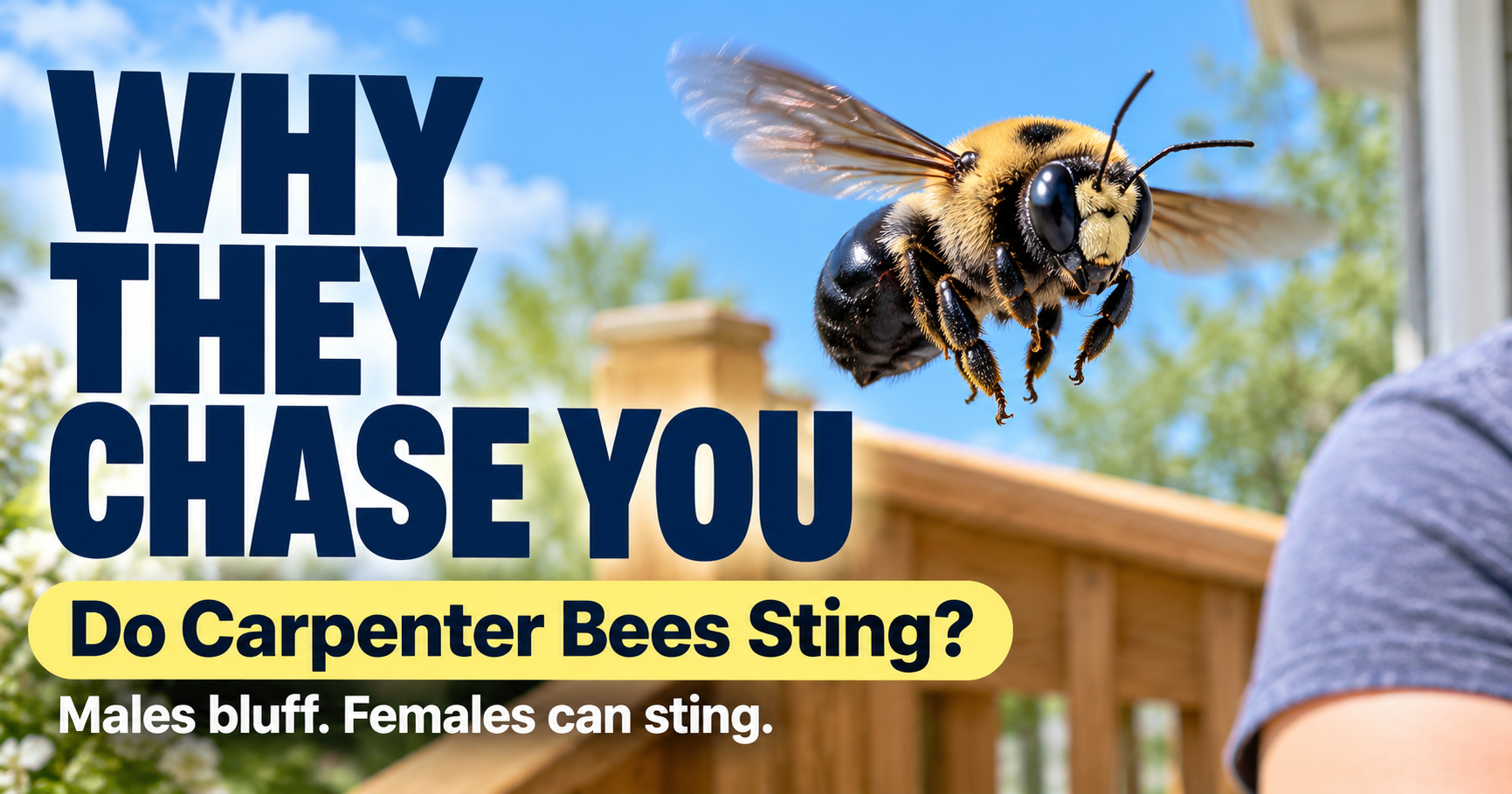
You’re sitting on the porch when a big black-and-yellow bee suddenly starts hovering a few feet in front of your face. You move to the other side, and there it is again. You swat your hand in the air, and somehow the bee seems even more interested in you.
It certainly acts like it wants to sting.
But here’s something that surprises a lot of homeowners.
Female carpenter bees can sting, but male carpenter bees cannot. And those large bees that hover aggressively around your porch are often males, which means the ones acting the toughest aren’t even equipped with stingers.
Female carpenter bees do have stingers, and a sting can be painful. However, they’re usually calm around people and rarely sting unless they’re handled, trapped, or threatened.
That doesn’t mean you should grab one to test the theory. But it does mean you can usually enjoy your porch without worrying that every carpenter bee flying past is about to attack.
Do Carpenter Bees Sting Humans?
Yes, carpenter bees can sting people, but only the females have stingers.
Unlike honey bees, which live in large colonies, carpenter bees generally nest individually or in small family groups. They aren’t usually interested in aggressively defending a large hive.
Most encounters happen because a male is patrolling his territory or a female is traveling between flowers and her nesting gallery.
Neither situation automatically puts you in danger.
Can Female Carpenter Bees Sting?
Yes. A female carpenter bee has a functional stinger connected to venom glands.
She can use it to defend herself, particularly if she’s grabbed, squeezed, or trapped against someone’s skin.
But under ordinary circumstances, female carpenter bees generally prefer going about their business.
You might see one gathering pollen from flowers, hovering near a wooden railing, or disappearing into a nesting hole.
She’s not typically looking for a confrontation.
Can Male Carpenter Bees Sting?
No. Male carpenter bees do not have stingers.
This is especially interesting because males often display the behavior people find most threatening.
They may hover directly in front of your face, dart toward you, or repeatedly investigate your movements.
Although it can feel like an attack, a male carpenter bee cannot deliver a sting.


Why Do Carpenter Bees Chase People?
Carpenter bees don’t actually have a personal problem with you.
What you’re usually seeing is territorial behavior.
During the breeding season, male carpenter bees patrol areas where females are likely to appear.
They may challenge other males, investigate moving objects, and occasionally fly toward people walking nearby.
Male Carpenter Bees Can Be Surprisingly Bold
Imagine walking across your deck while a male carpenter bee is hovering near a nesting area.
As you move into his territory, he may fly toward you.
If you move away, he might follow briefly.
This behavior is sometimes described as a bluff because the male lacks the equipment needed to sting.
It can still be intimidating when a large insect is buzzing inches from your face.
But the bee generally isn’t trying to injure you.
Will Carpenter Bees Follow You Around?
A territorial male might follow your movement for a short distance.
However, carpenter bees aren’t known for relentlessly pursuing people across a property.
Once you move away from the area he’s patrolling, he’s likely to return to his previous activity.
The best response is usually to remain calm and give the bee some space.
Avoid deliberately swatting at it or attempting to catch it.

How Can You Tell if a Carpenter Bee Can Sting?
For eastern carpenter bees (Xylocopa virginica), the face provides one of the easiest identification clues.
These are the large carpenter bees commonly found throughout much of the eastern United States, including Missouri.
Male Carpenter Bees Have Pale Faces
Male eastern carpenter bees have a noticeable pale yellowish-white marking on the front of their faces.
If you get a clear look without approaching too closely, this marking can help identify a male.
And remember, males cannot sting.
Female Carpenter Bees Have Black Faces
Female eastern carpenter bees generally have entirely black faces.
They’re responsible for excavating nesting galleries and gathering pollen and nectar for their young.
Females have stingers, but they’re usually less confrontational than males.
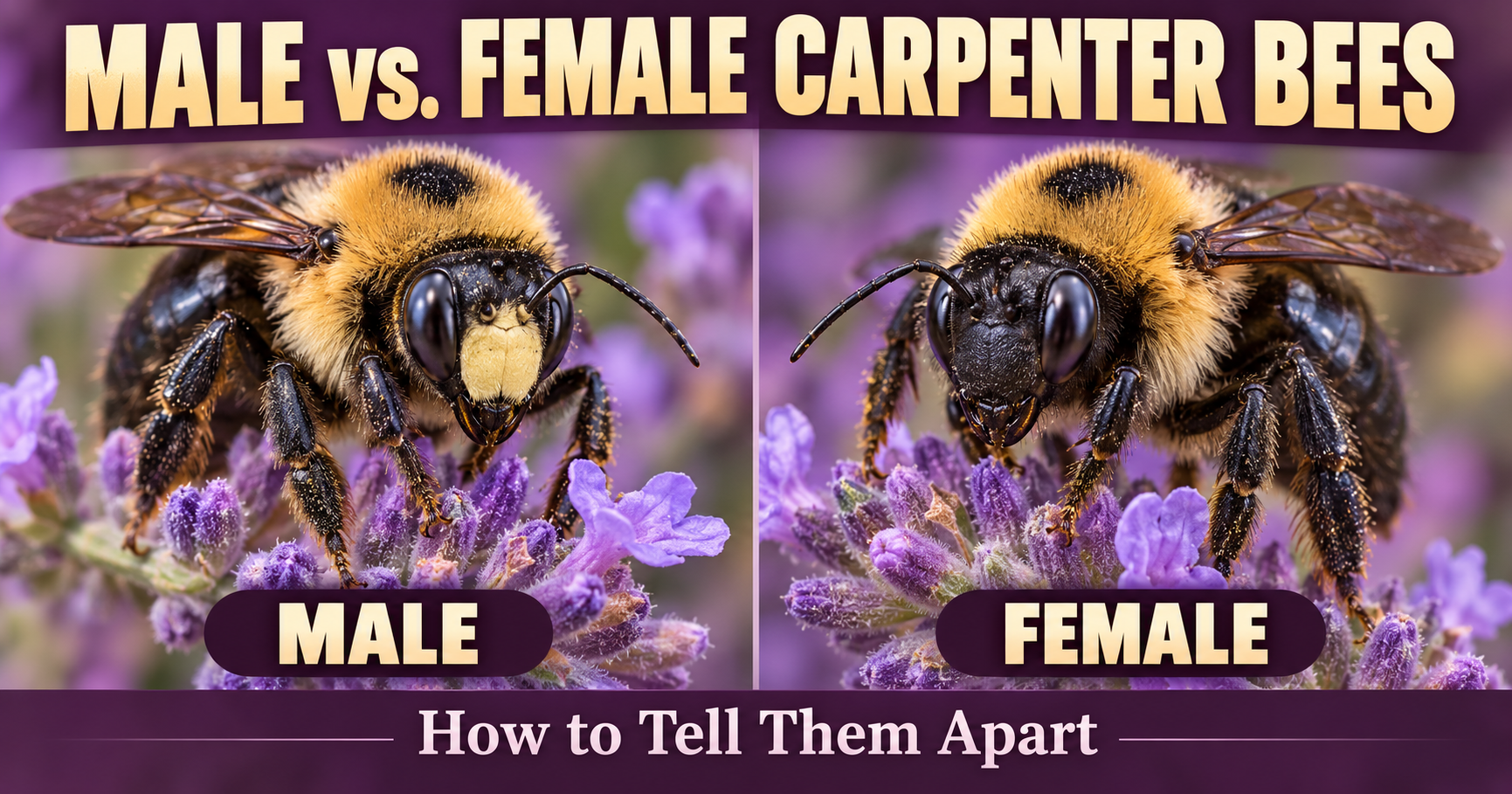
We’ve already covered the differences in appearance and behavior in our guide to identifying male and female carpenter bees.
Keep in mind that facial markings vary among carpenter bee species. This particular identification method applies to eastern carpenter bees.
What Does a Carpenter Bee Sting Feel Like?
A female carpenter bee sting can cause immediate, sharp pain.
People may describe it as a sudden burning or stinging sensation.
The affected area may become red, tender, itchy, or swollen.
How strongly someone reacts depends on individual sensitivity and the circumstances of the sting.
Are Carpenter Bee Stings Worse Than Honey Bee Stings?
There’s no dependable universal ranking that tells you exactly how painful a carpenter bee sting will feel compared with a honey bee sting.
Both can cause pain and local swelling.
Some people experience only brief discomfort, while others develop a larger localized reaction.
It’s important not to confuse the intensity of pain with the severity of an allergic reaction.
A sting that initially seems minor can still cause serious symptoms in someone with an insect-venom allergy.
Can Carpenter Bees Sting More Than Once?
Yes. Female carpenter bees can potentially sting more than once.
Unlike honey bees, which commonly leave a barbed stinger behind when stinging human skin, carpenter bees generally don’t lose their stingers during ordinary stinging.
They can therefore sting again if they remain threatened.
However, repeated stinging isn’t typical behavior during a normal encounter with a carpenter bee.


What Does a Carpenter Bee Sting Look Like?
A carpenter bee sting usually produces a localized skin reaction.
You might notice a small red area, swelling, or a raised bump at the sting site.
There may be tenderness or itching.
The appearance can resemble reactions caused by other bees or wasps.
Can You Identify a Carpenter Bee Sting From a Picture?
Not reliably.
A red bump doesn’t tell you exactly which insect caused it.
Mosquito bites, other insect stings, skin irritation, and various medical conditions can produce similar-looking marks.
If you didn’t actually see the insect sting you, don’t assume a carpenter bee was responsible just because one was flying nearby.
What to Do if a Carpenter Bee Stings You
Most uncomplicated bee stings can be managed with basic first aid, but monitoring for an allergic reaction is important.
1. Move Away From the Bee
Calmly leave the immediate area to avoid further contact.
You don’t need to panic or run through the yard because of one carpenter bee.
Simply give the insect space.
2. Wash the Sting Area
Clean the affected skin with soap and water.
This helps remove dirt and reduces the chance of contamination.
Carpenter bees usually don’t leave their stingers embedded in human skin. If you see a retained stinger, remove it promptly.
3. Apply a Cold Compress
Use a cold pack or ice wrapped in a cloth.
Apply it for approximately 10 to 15 minutes at a time to help reduce pain and swelling.
Avoid placing ice directly against bare skin.
4. Manage Pain and Itching
An over-the-counter pain reliever may help with discomfort when appropriate.
For itching, an oral antihistamine or topical treatment may be useful.
Follow medication labels and ask a healthcare professional or pharmacist if you’re uncertain whether a medicine is suitable for you or your child.
5. Watch for an Allergic Reaction
This is the most important part of responding to any bee sting.
Some people have serious allergies to insect venom.
Call 911 immediately if someone develops difficulty breathing, throat or tongue swelling, fainting, severe dizziness, or symptoms affecting multiple parts of the body after a sting.
If an epinephrine auto-injector has been prescribed, administer it promptly according to its instructions. Don’t delay emergency care while waiting to see whether symptoms improve.
Severe allergic reactions can become life-threatening quickly.


Can Carpenter Bee Stings Be Dangerous?
Yes, although serious reactions are uncommon compared with the total number of encounters people have with bees.
For most people, a single carpenter bee sting produces temporary localized pain, redness, and swelling.
However, someone with a venom allergy may experience anaphylaxis.
This is a medical emergency.
Signs of a Severe Allergic Reaction
Warning signs can include widespread hives or flushing, trouble breathing, swelling of the tongue or throat, a weak or rapid pulse, vomiting associated with other allergic symptoms, or faintness.
Don’t assume someone is safe simply because they were only stung once.
A serious reaction can happen after a single sting.
If a person has a known history of severe reactions to insect stings, they should follow their clinician’s emergency action plan.
What if the Swelling Keeps Getting Bigger?
Some people develop large local reactions that extend well beyond the original sting site.
These can be uncomfortable and may worsen during the first day or two.
A large local reaction isn’t necessarily anaphylaxis, but swelling involving the face, mouth, tongue, or throat requires immediate emergency assessment.
Seek medical advice if swelling is severe, symptoms are worsening, or you develop signs of infection such as increasing warmth, spreading redness, or fever.
Do Carpenter Bees Bite Instead of Sting?
Carpenter bees have mandibles, which are the mouthparts females use to chew tunnels into wood.
They aren’t normally used to bite people during ordinary encounters.
However, a bee that’s grabbed or handled may potentially pinch with its mandibles.
This is different from a sting.
A carpenter bee sting involves venom delivered through the female’s stinger.
A bite or pinch involves the mouthparts.
Neither is a reason to handle these bees unnecessarily.
Are Carpenter Bees More Aggressive Than Bumblebees?
Not necessarily, but their behavior can seem more intimidating.
Male carpenter bees are especially known for hovering near people and patrolling territory.
Bumblebees have different social and nesting behaviors.
Many bumblebees live in colonies and may defend their nests when disturbed.
Carpenter bees are generally solitary or have relatively simple social arrangements.
Both are valuable pollinators, and neither should be treated as inherently aggressive simply because they’re large.
If you’re watching a big bee around your porch, look at the abdomen.
Eastern carpenter bees generally have smooth, shiny, mostly black abdomens.
Bumblebees usually have fuzzier abdomens.
Correct identification can help you understand what you’re seeing.
What Should You Do if Carpenter Bees Keep Hovering Around Your Porch?
First, determine whether the bees are actually causing damage.
A male carpenter bee patrolling your porch might look threatening, but he isn’t necessarily excavating the wood.
Females are responsible for creating nesting galleries.
If you find fresh sawdust or nearly circular entrance holes, you may have active nesting nearby.
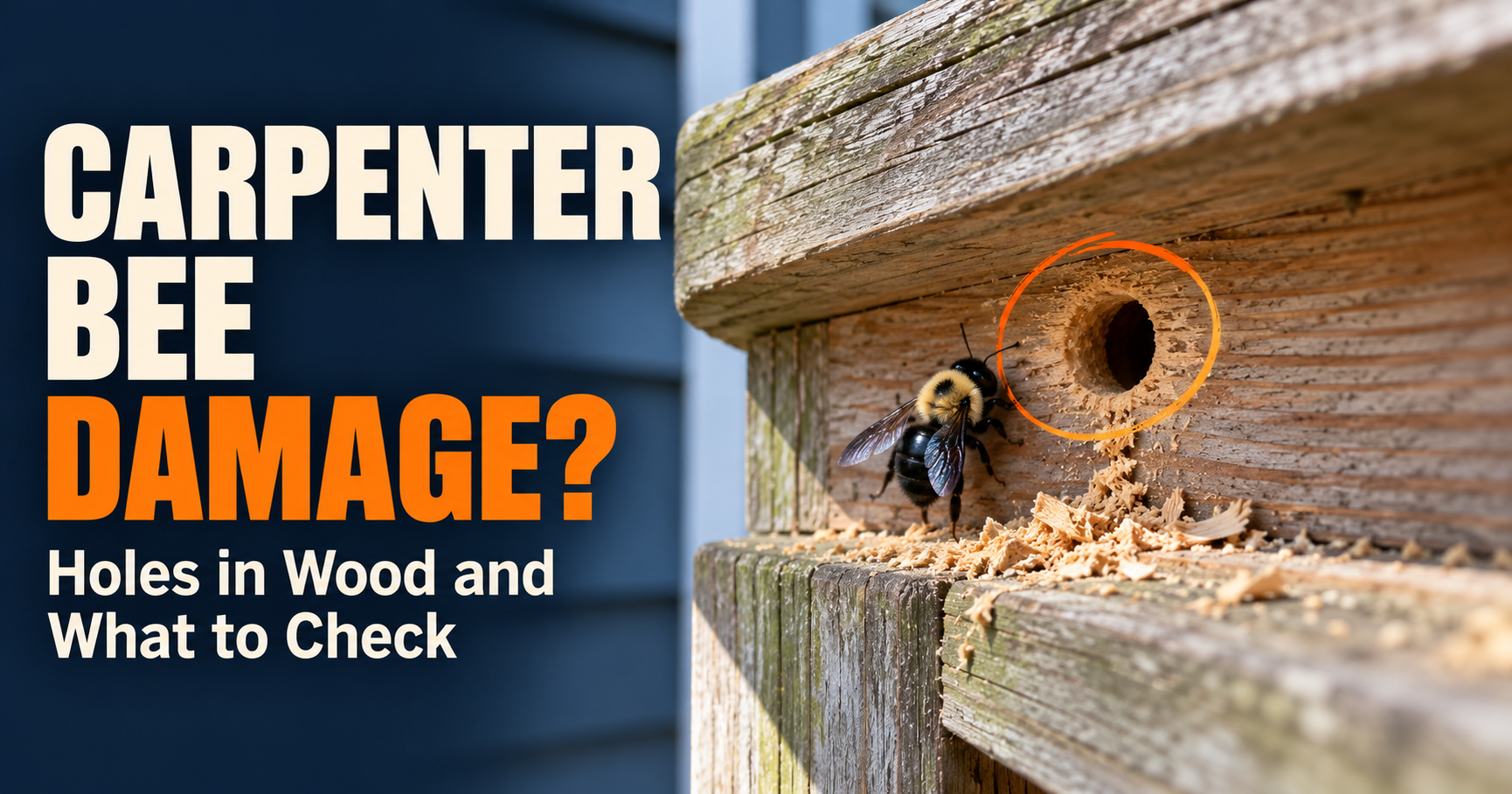
Our guide to recognizing carpenter bee holes and damage explains how to inspect the wood.
Protect the Wood Instead of Killing Every Bee
Carpenter bees are beneficial pollinators.
They help pollinate many flowering plants, including some that benefit from buzz pollination.
If a bee is simply visiting flowers or nesting in a harmless old log, there’s generally no reason to interfere.
When they’re damaging your porch or deck, focus on protecting exposed wooden surfaces.
Properly maintained painted wood is generally less attractive for nesting than bare, weathered lumber.
Can Carpenter Bee Repellent Help?
A purpose-made deterrent may be another option for appropriate outdoor wood surfaces.
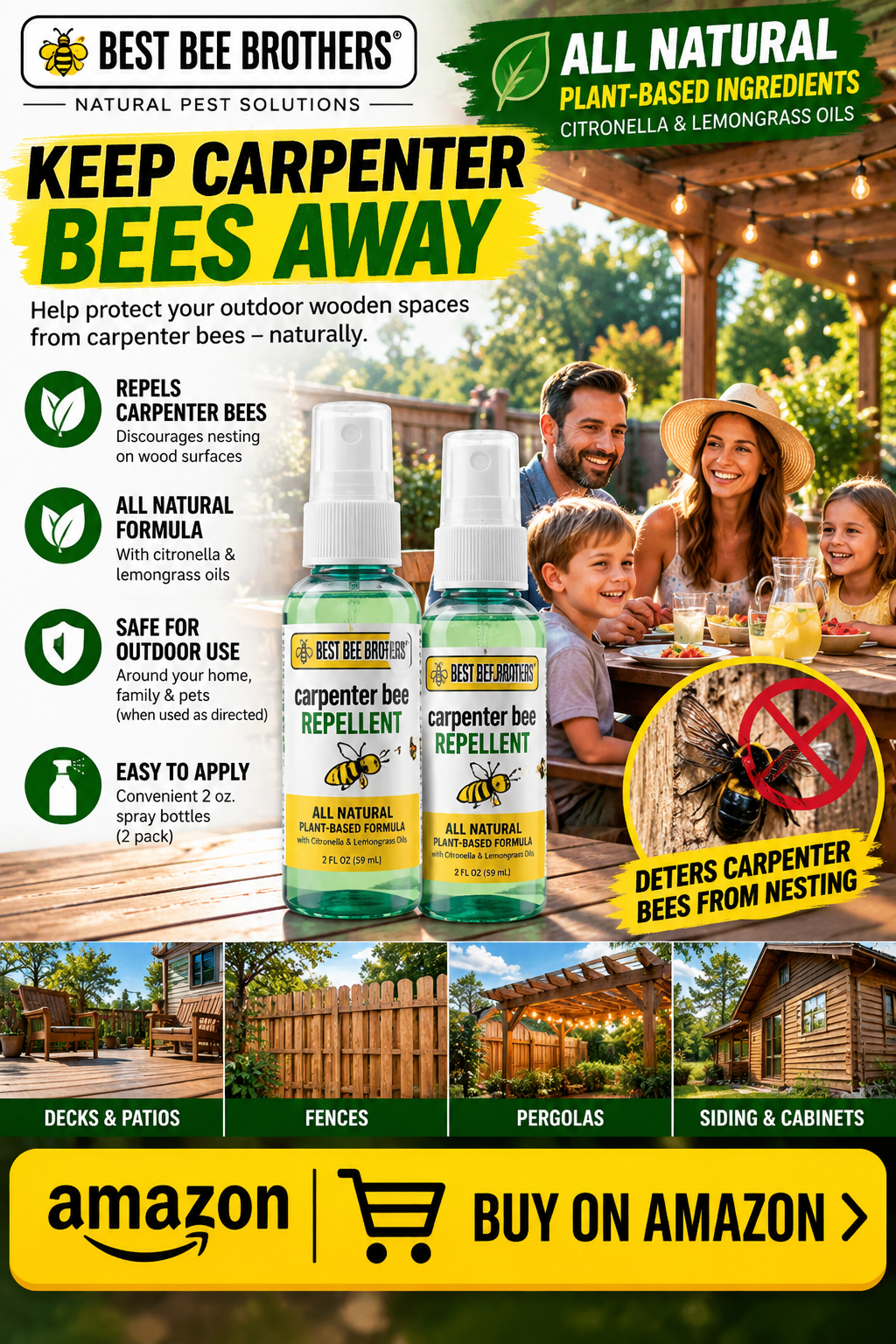
One example is Best Bee Brothers Citrus Carpenter Bee Repellent Spray on Amazon , which contains lemongrass and citronella oils and is marketed to discourage new carpenter bee nesting.
Its effectiveness hasn’t been independently established here, and it shouldn’t be relied on to remove bees from an occupied nest.
Follow the manufacturer’s instructions and avoid spraying bees directly.
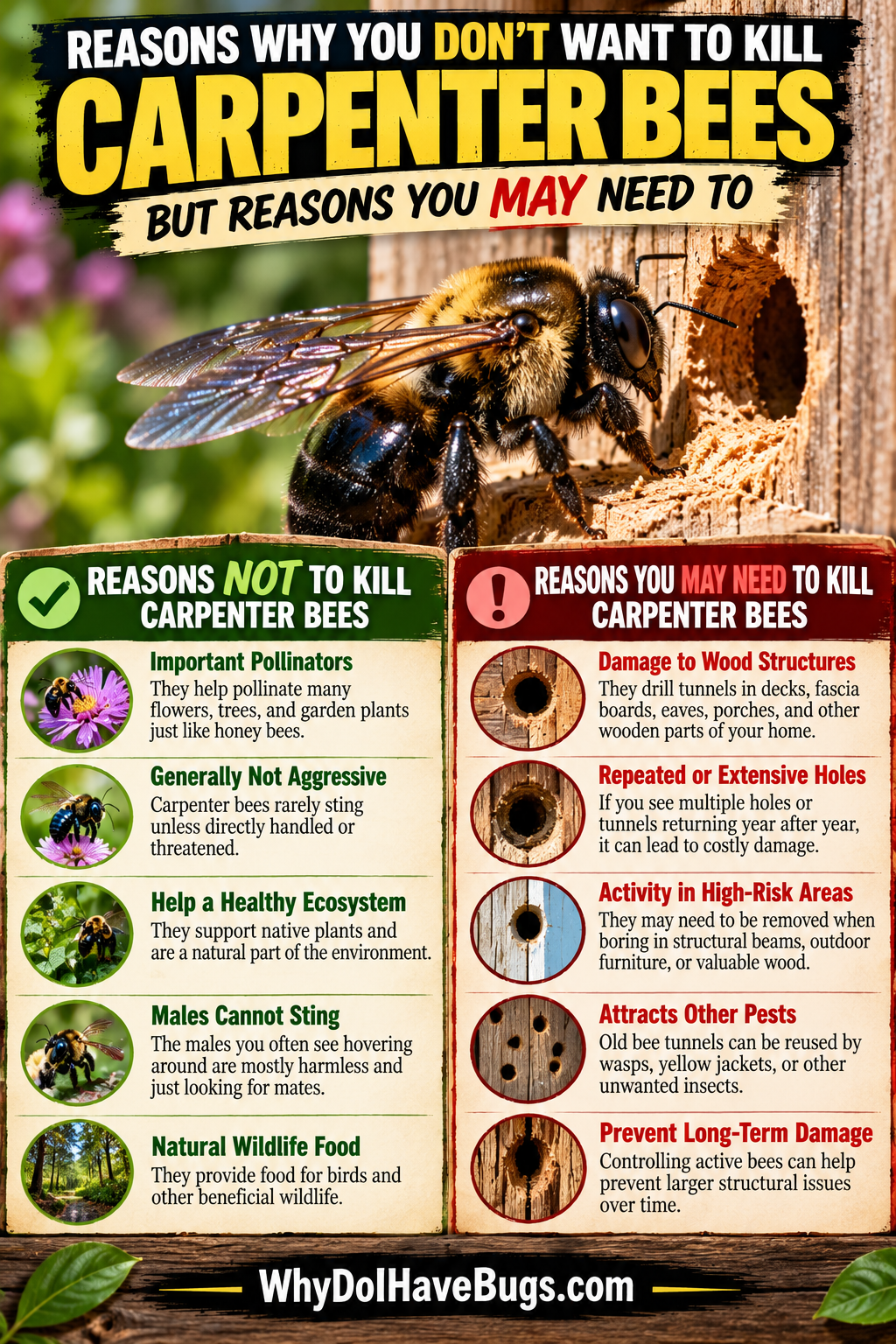
For more ways to manage nesting while protecting beneficial pollinators, see our guide to keeping carpenter bees away without killing them.
Are Carpenter Bees Safe Around Children and Pets?
Carpenter bees generally aren’t looking for trouble with people or animals.
However, young children may instinctively try to catch large insects, and pets may snap at buzzing bees.
A female carpenter bee can sting if trapped or handled.
Teach children to observe bees without grabbing, chasing, or swatting at them.
Keep pets from investigating active nesting holes or trying to catch bees.
If a child or pet is stung, monitor the reaction carefully.
For pets with facial swelling, breathing difficulties, repeated vomiting, or other severe symptoms after a suspected sting, seek emergency veterinary care.
Why It’s Better to Leave Carpenter Bees Alone When Possible
Carpenter bees are an important part of our native pollinator populations.
They visit wildflowers, garden plants, and other flowering vegetation.
Some species perform buzz pollination, helping certain flowers release pollen.
That makes them beneficial insects, even though their nesting habits can sometimes conflict with wooden structures.
A male carpenter bee hovering around your porch isn’t automatically a threat.
A female visiting your flowers isn’t trying to sting you.
And carpenter bees nesting in deadwood away from buildings can usually be left alone.
Protect important wooden structures when necessary, but don’t assume every carpenter bee needs to be eliminated.
Frequently Asked Questions
Do carpenter bees sting for no reason?
Female carpenter bees generally sting in self-defense rather than without provocation. Males may appear aggressive when patrolling territory, but they cannot sting.
Why do carpenter bees fly toward your face?
Male carpenter bees often investigate movement near their territories. They may hover or dart toward people, but they lack stingers.
How do you know if a carpenter bee is male or female?
Male eastern carpenter bees have a pale yellowish-white facial patch, while females have predominantly black faces. Other carpenter bee species may have different markings.
Can black carpenter bees sting?
Yes, if the bee is female. Many carpenter bees have predominantly black bodies, so overall body color doesn’t reliably identify stinging ability.
Do carpenter bees sting multiple times?
Female carpenter bees can potentially sting more than once because they generally retain their stingers. However, repeated stinging is uncommon when the bees are left undisturbed.
Does a carpenter bee sting hurt?
Yes. A female carpenter bee sting can cause immediate pain, redness, and swelling. The intensity and duration vary from person to person.
How long does a carpenter bee sting last?
Mild discomfort may improve within hours, while itching or localized swelling can last several days. Larger local reactions may take longer. Seek medical care for concerning or worsening symptoms.
Do carpenter bees leave their stingers in you?
Usually not. Carpenter bees generally retain their stingers after stinging. If a stinger is visibly embedded, remove it promptly.
Are carpenter bee stings poisonous?
Carpenter bees inject venom when they sting. Most reactions are localized, but venom can cause serious allergic reactions in sensitive individuals.
Can carpenter bees sting through clothes?
A female carpenter bee may be able to sting through thin or loose fabric if pressed against the skin. Clothing can reduce exposure but isn’t an absolute guarantee.
Are carpenter bees dangerous to dogs?
They’re generally not aggressive toward dogs, but a female may sting if a dog attempts to catch or bite her. Serious symptoms after a suspected sting require prompt veterinary attention.
Should you kill carpenter bees to prevent stings?
Usually not. Most carpenter bee encounters don’t result in stings, and males cannot sting at all. Preventing contact and protecting vulnerable wood are generally more reasonable first steps.
About the Author: The team at Why Do I Have Bugs helps homeowners understand insects, identify potential risks, and protect their properties while respecting the important role beneficial pollinators play in nature.