
Watching dozens of fireflies blinking across a summer field almost feels magical.
As a kid, I simply accepted that lightning bugs glowed.
I never stopped to wonder how they did it.
The truth is even more fascinating than I imagined.
Fireflies don’t carry tiny light bulbs.
They don’t absorb sunlight during the day.
And they certainly aren’t on fire.
Instead, they create one of the most efficient chemical reactions found anywhere in nature.
Scientists call this process bioluminescence, and it’s one of the reasons fireflies remain among the most remarkable insects on Earth.
The Short Answer
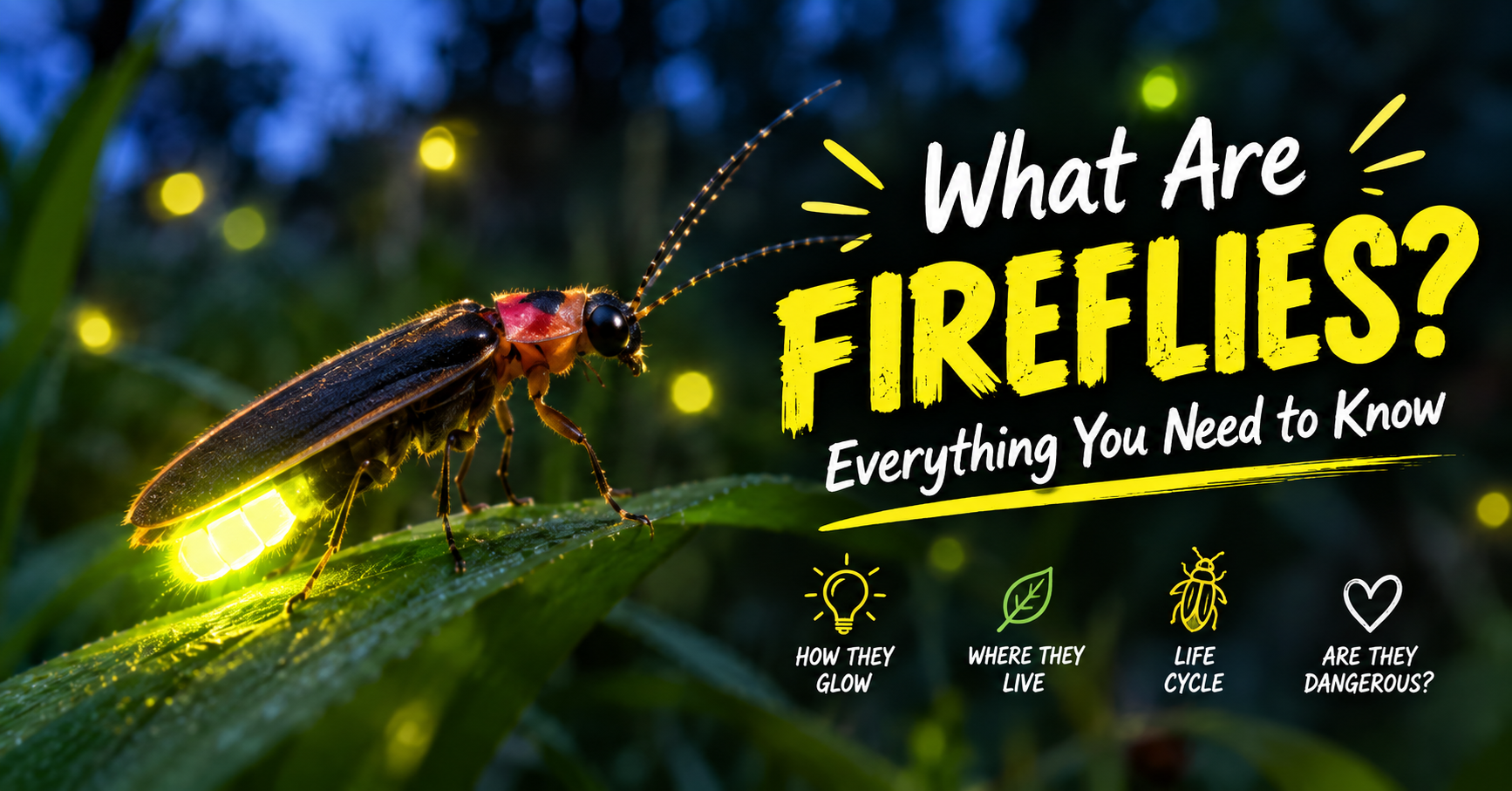
Fireflies glow because a chemical inside their bodies reacts with oxygen to produce light. For a broader overview of these insects, including their biology and behavior, see how fireflies produce light.
The reaction takes place inside specialized light-producing cells located near the end of the abdomen.
Several ingredients work together:
- A chemical called luciferin.
- An enzyme called luciferase.
- Oxygen.
- ATP (cellular energy).
- Other supporting chemicals.
When these ingredients combine, nearly all of the energy becomes visible light instead of heat. Scientists often refer to this as cold light, making it one of the most energy-efficient light-producing reactions known in nature.


Why Is It Called Bioluminescence?
Bioluminescence simply means living light.
Many organisms can produce their own light, including:
- Fireflies.
- Certain jellyfish.
- Some squid.
- Deep-sea fish.
- A few mushrooms.
- Tiny marine plankton.
Fireflies are one of the few examples most people encounter in their own backyard.
Unlike a flashlight or light bulb that produces heat as a byproduct, fireflies generate almost no wasted heat.
That’s why scientists sometimes describe their glow as one of nature’s most efficient lighting systems.
Where Does the Light Come From?

If you look closely at an adult firefly, you’ll notice that the last few segments of its abdomen are lighter in color than the rest of its body.
That’s because those segments contain specialized light organs.
Inside these organs are thousands of cells designed specifically for producing light.
The insect’s nervous system controls when oxygen reaches these cells.
By rapidly increasing or decreasing the oxygen supply, the firefly can switch its light on and off in precise patterns.
That’s why the flashes appear so controlled instead of glowing continuously.
Fireflies Aren’t Trying to Entertain Us
The flashing isn’t just beautiful.
It’s communication.
Most adult fireflies use their flashes to find mates.
Each species has its own unique flashing “language.”
Some species produce:
- A single flash every few seconds.
- Two quick flashes.
- Long glowing pulses.
- Rapid blinking sequences.
Females recognize the correct pattern and answer with a flash of their own.
If the timing is right, the male flies toward her.
This system helps prevent different species from accidentally mating with one another.


Why Do Different Fireflies Flash Differently?
This is one of my favorite things about fireflies.
If you’ve ever watched them carefully, you’ve probably noticed they don’t all blink the same way.
That’s because each species has evolved its own unique signal.
The flash pattern may differ in:
- Brightness.
- Color.
- Duration.
- Number of flashes.
- Time between flashes.
- Height above the ground.
To us, they may all look similar.
To another firefly, those differences are as recognizable as different voices are to us.
Fireflies Don’t Glow Just to Find Mates
Although courtship is the reason most people associate with firefly flashes, it’s actually not the only purpose.

Fireflies use light throughout different stages of their lives.
Warning Predators
One important function of their glow is defense.
Fireflies contain naturally occurring chemicals called lucibufagins, which make many species taste unpleasant to predators.
The flashing light serves as a warning.
It’s nature’s way of saying:
“I’m probably not worth eating.”
Birds, spiders, frogs, and other predators often learn to associate the flashing light with a bad meal and avoid them in the future. (news.illinois.edu)
Larvae Glow Too
One thing that surprised me was learning that adult fireflies aren’t the only ones capable of producing light.
Many firefly larvae glow as well.
Since larvae spend months or even years crawling through moist soil and leaf litter hunting slugs and snails, scientists believe their glow also acts as a warning to predators that they aren’t good to eat. (hort.extension.wisc.edu)

That means fireflies may spend most of their lives glowing in one form or another. The timing behind that long development is explained in how long fireflies remain alive.
Can Fireflies Control Their Light?
Yes.
In fact, they have incredible control over it.
Fireflies don’t simply glow continuously.
Instead, they carefully switch their light on and off.
Their nervous system regulates how much oxygen reaches the light-producing cells.
When oxygen enters those cells, the chemical reaction begins almost instantly.
When the oxygen supply decreases, the light shuts off.
This rapid control allows fireflies to produce the precise flash patterns that other members of their species recognize. (news.ncsu.edu)
Why Do Some Fireflies Flash Together?
One of the most breathtaking sights in nature is watching an entire hillside of fireflies blinking in perfect unison.
This behavior is called synchronous flashing.
Instead of each insect flashing independently, hundreds or even thousands coordinate their flashes.
Scientists believe synchronized flashing helps males attract females more efficiently while also making it easier for females to locate suitable mates among large groups.
Only a relatively small number of firefly species display this remarkable behavior, making it a special event wherever it occurs. (nps.gov)


Why Do Fireflies Glow More on Warm Summer Nights?
If you’ve noticed that fireflies seem especially active on warm, humid evenings, you’re not imagining things.
Several conditions encourage increased flashing activity.
These include:
- Warm temperatures.
- High humidity.
- Calm winds.
- Darkness after sunset.
- Peak breeding season.
Cool temperatures, heavy rain, or strong winds often reduce activity because fewer adults are flying and searching for mates.
That’s why some evenings seem filled with flashing lights while others have very few.
Why Don’t I See as Many Fireflies as I Used To?
This is a question I hear more every year.
Many people remember seeing hundreds of fireflies during childhood but only a handful today.
Researchers believe several factors are contributing to declines in some firefly populations.
Light Pollution
Artificial lighting can interfere with the flashing signals fireflies use to communicate.
When neighborhoods remain brightly lit throughout the night, males and females have a harder time finding one another.
Habitat Loss

Fireflies depend on moist habitats with healthy leaf litter and undisturbed soil. Those conditions can also explain why fireflies appear more often in some yards, as moist firefly-friendly yard conditions describes.
As forests, meadows, wetlands, and natural areas disappear, suitable habitat becomes harder to find.
Pesticides
Broad-spectrum insecticides don’t distinguish between pest insects and beneficial insects.
Repeated pesticide applications may reduce firefly populations by killing both larvae and adults or by reducing the prey they depend on. (xerces.org)


Can You Help More Fireflies Glow in Your Yard?
Absolutely.
If you’d like to enjoy more fireflies during the summer, there are several simple things I recommend.
- Turn off unnecessary outdoor lights after dark.
- Replace bright white bulbs with warmer-colored lighting where possible.
- Leave some leaf litter beneath trees and shrubs.
- Avoid unnecessary insecticide applications.
- Plant native vegetation.
- Maintain areas with moist soil instead of removing every natural feature.

These simple changes make your yard more attractive not only to fireflies but also to many other beneficial insects. If you want to examine a firefly or another beneficial insect briefly, responsible insect observation offers a way to do so before returning it to the yard.
Fascinating Facts About Firefly Light
The more I learn about fireflies, the more incredible they become.
Here are a few of my favorite facts.
- Firefly light is nearly 100% efficient, producing very little wasted heat compared to traditional light bulbs. (news.ncsu.edu)
- Every firefly species has its own unique flashing pattern.
- Some species don’t flash at all as adults and instead communicate using chemical signals.
- Nearly all firefly larvae can produce light, even though they live underground or beneath leaf litter.
- Scientists study firefly bioluminescence for medical research, forensic science, environmental monitoring, and biotechnology because the luciferase enzyme has many practical applications beyond nature. (nih.gov)
Frequently Asked Questions
Why do fireflies glow?
Fireflies glow through a chemical reaction called bioluminescence. Chemicals known as luciferin and luciferase react with oxygen to produce an efficient, nearly heat-free light. (hort.extension.wisc.edu)
Do all fireflies glow?
No. While most people associate fireflies with glowing, some species produce very little light as adults or rely primarily on chemical signals to find mates. (xerces.org)
Why do fireflies flash instead of glowing constantly?
Flashing allows fireflies to send specific signals to members of their own species. Different flash patterns help males and females recognize each other while conserving energy. (news.ncsu.edu)
Can baby fireflies glow?
Yes. Many firefly larvae produce light, and scientists believe it helps warn predators that they aren’t good to eat. (hort.extension.wisc.edu)
Does a firefly’s light produce heat?
Very little. Firefly bioluminescence is often called “cold light” because almost all of the energy is converted into visible light instead of heat, making it one of the most efficient natural light sources known. (news.ncsu.edu)
About the Author
Dr. Emily Carter is an ecologist specializing in insect behavior and freshwater ecosystems. She has spent years studying native insects and the ecological role they play in healthy environments. Her work focuses on translating scientific research into practical, easy-to-understand guides that help homeowners appreciate and better understand the fascinating insects living around them.