
When most people think about fireflies, they picture tiny flashing lights floating across the yard on a warm summer evening.
What they don’t realize is that the glowing adult they’re watching is actually living the shortest part of its entire life.
In fact, a firefly spends the overwhelming majority of its life hidden beneath leaves, inside moist soil, or under decaying logs where most people never notice it.
By the time that familiar flashing beetle appears in your backyard, it may already be one or two years old.
I think that’s one of the most fascinating things about fireflies.
The spectacular light show we enjoy each summer is really just the final chapter of a much longer story.
Let’s take a look at each stage of the firefly life cycle and what happens along the way.
The Short Answer
Like all beetles, fireflies undergo complete metamorphosis with four distinct life stages:
- Egg
- Larva
- Pupa
- Adult
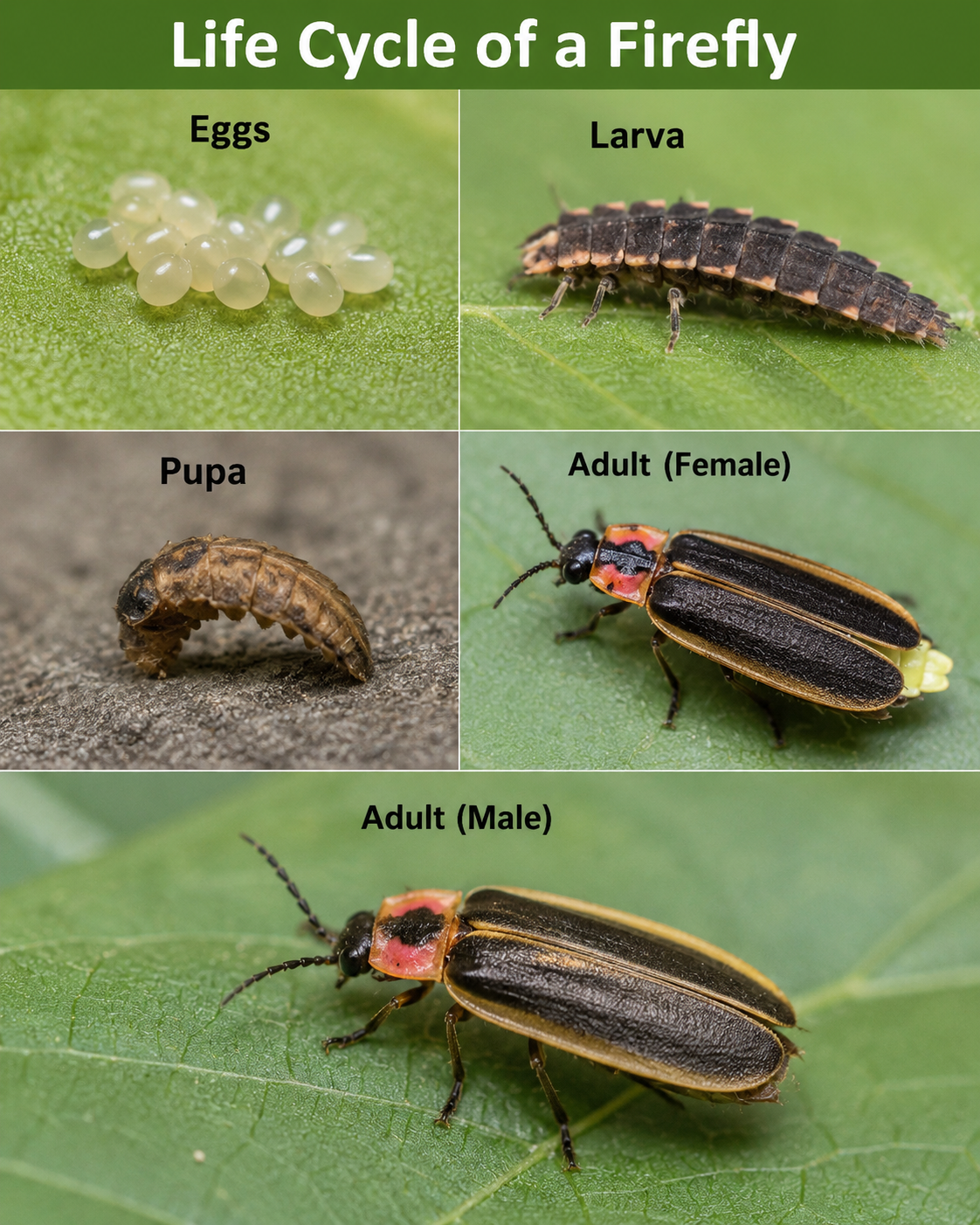
While the glowing adults usually live only a few weeks, the complete life cycle often lasts one to two years, with most of that time spent as a larva living beneath the soil or leaf litter. Some species complete the cycle faster, while others take even longer depending on climate and location. The differences between the brief adult stage and the much longer larval stage are explained in these firefly lifespan facts.

Stage One Begins With Tiny Eggs
After mating, the female firefly searches for a suitable place to lay her eggs.
She usually chooses locations that stay moist throughout the summer, such as:
- Leaf litter.
- Damp soil.
- Rotting wood.
- Moss.
- Areas beneath grasses and shrubs.
Unlike many insects that lay hundreds of eggs in exposed locations, fireflies place their eggs where they’ll remain protected from drying out.
One of the coolest facts is that the eggs of some firefly species actually glow faintly before they hatch. Scientists believe this dim light may help discourage predators or serve another protective purpose, although researchers are still studying exactly why it occurs.

Eggs Hatch Into Hungry Larvae
A few weeks after the eggs are laid, tiny larvae emerge.
This is where the real growing begins.
Firefly larvae look nothing like the glowing adults most people recognize.
Instead, they’re flattened, segmented, armored-looking insects that spend their time crawling through moist soil and leaf litter searching for food.
Many people who find one don’t even realize they’re looking at a young firefly.
In fact, I’ve seen them mistaken for beetle larvae, centipedes, and even tiny alligators because of their unusual appearance.
The Larval Stage Lasts the Longest
The larval stage is by far the longest part of a firefly’s life.
Depending on the species and climate, larvae often spend one to two years developing before becoming adults.
During that time they molt several times as they grow larger.
Unlike the adults, larvae are active predators.
They commonly feed on:
- Slugs.
- Snails.
- Earthworms.
- Soft-bodied insect larvae.
- Other small invertebrates.

That’s one of the reasons fireflies are considered beneficial insects. Long before they ever begin flashing, they’re already helping control garden pests. That helpful role is part of the homeowner case for keeping fireflies, which explains why seeing fireflies is usually a positive sign.

If you’d like to learn more about their changing diet, I explain it in greater detail in my article about what fireflies eat.
Even Firefly Larvae Can Glow
This is one of my favorite facts.
Many people assume only the flying adults produce light.
That’s not true.
Many firefly larvae are also bioluminescent.
Their glow is usually much dimmer than an adult’s flashing display, but it’s still visible under the right conditions.

Scientists believe this light serves as a warning to predators, signaling that the larvae contain defensive chemicals that make them an unpleasant meal. The broader science of firefly bioluminescence also explains why fireflies are associated with light at different stages of life.
Winter Doesn’t Stop the Life Cycle
One thing that surprised me was learning that fireflies don’t simply disappear every winter.
Instead, different species survive the cold in different life stages.
Some overwinter as:
- Eggs.
- Larvae.
- Pupae.
Most North American species spend the winter as larvae hidden beneath leaves, logs, bark, or in the soil where temperatures remain much more stable than above ground. When spring arrives, they resume feeding and growing until they’re ready for the next stage.



The Pupal Stage Is Where the Transformation Happens
After spending months or even years feeding and growing as a larva, the firefly enters the pupal stage.
This is the stage where one of nature’s most remarkable transformations takes place.
The larva stops feeding and forms a pupa, usually in a small chamber in the soil, beneath leaf litter, attached to bark, or in another protected location depending on the species. Inside the pupa, its body is completely reorganized as wings, adult legs, reproductive organs, and other adult features develop.
Although the pupa appears inactive from the outside, an incredible amount of development is taking place.
This stage typically lasts one to three weeks, although the exact timing varies among species and environmental conditions.
Finally, the Adult Firefly Emerges
When development is complete, the adult firefly emerges from the pupal case.
At first, its body is soft and pale.
Over the next several hours, the outer skeleton hardens, the wings expand, and the familiar colors begin to appear.
Soon afterward, the firefly is ready to fly.
This is the stage everyone recognizes.
Warm summer evenings suddenly fill with tiny flashes of yellow-green light as adults search for mates.
Ironically, although it’s the most recognizable stage of the life cycle, it’s also the shortest.
Most adult fireflies live only two to four weeks, and many spend nearly all of that time reproducing.


The Entire Life Cycle Can Take Years
One thing I always find fascinating is how much longer a firefly’s life really is than most people realize.
When someone sees a flashing adult, they often assume the insect recently hatched.
In reality, that firefly may have begun its life one or even two years earlier.
Here’s a general timeline.
- Eggs hatch after roughly two to four weeks.
- Larvae spend one to two years feeding and growing.
- Pupae develop for about one to three weeks.
- Adults live for only a few weeks before mating and laying eggs.
Looking at the complete picture, it’s amazing that the spectacular flashing display we enjoy each summer represents only a tiny fraction of the insect’s life.
Every Stage Depends on Healthy Habitat
One reason fireflies have become less common in some areas is that every stage of their life cycle needs suitable habitat.
Eggs need moist places where they won’t dry out.
Larvae need leaf litter, logs, and healthy soil filled with prey.
Pupae require protected places to complete their transformation.
Adults need dark summer nights where they can communicate using their flashing signals.
If any one of those stages is disrupted by habitat loss, excessive outdoor lighting, or unnecessary pesticide use, local firefly populations can decline.

Watching the Life Cycle Up Close
If you’re lucky enough to find a firefly larva or adult, it’s fascinating to observe its behavior for a few minutes before releasing it.


I use the Carson BugView 5X Magnifying Bug Catcher because it lets me safely examine insects without handling them directly. If you’re interested in learning why I recommend it, you can read my full review of the Best Catch and Release Bug Catcher.
I always recommend releasing fireflies exactly where you found them so they can continue their life cycle naturally.
Frequently Asked Questions
How many stages are in a firefly’s life cycle?
Fireflies undergo complete metamorphosis with four stages: egg, larva, pupa, and adult.
Which stage lasts the longest?
The larval stage is by far the longest, often lasting one to two years while the firefly grows and feeds beneath the soil or leaf litter.
Do firefly larvae glow?
Yes. Many firefly larvae produce a steady glow that is thought to warn predators that they are not good to eat.
How long does the pupal stage last?
For many species, the pupal stage lasts approximately one to three weeks before the adult firefly emerges.
How long do adult fireflies live?
Most adult fireflies live only two to four weeks, spending nearly all of that time finding mates and reproducing before the cycle begins again.
About the Author
Dr. Emily Carter is an ecologist specializing in native insects and freshwater ecosystems. She enjoys helping homeowners understand the incredible life cycles of beneficial insects and believes that learning how these species develop is one of the best ways to appreciate the important role they play in healthy landscapes.