
Most people think fireflies only live for a few weeks.
That’s understandable because the glowing adults seem to appear almost overnight during the summer before disappearing just as quickly.
The truth is much more interesting.
While the adult fireflies we see flashing across our yards really do have short lives, that’s only a tiny portion of their overall lifespan.
In fact, by the time an adult firefly begins glowing on a warm summer evening, it may already be one or even two years old.
That makes fireflies one of the most misunderstood insects when it comes to lifespan.
Let’s look at how long fireflies actually live and why their life is divided into such dramatically different stages.
The Short Answer
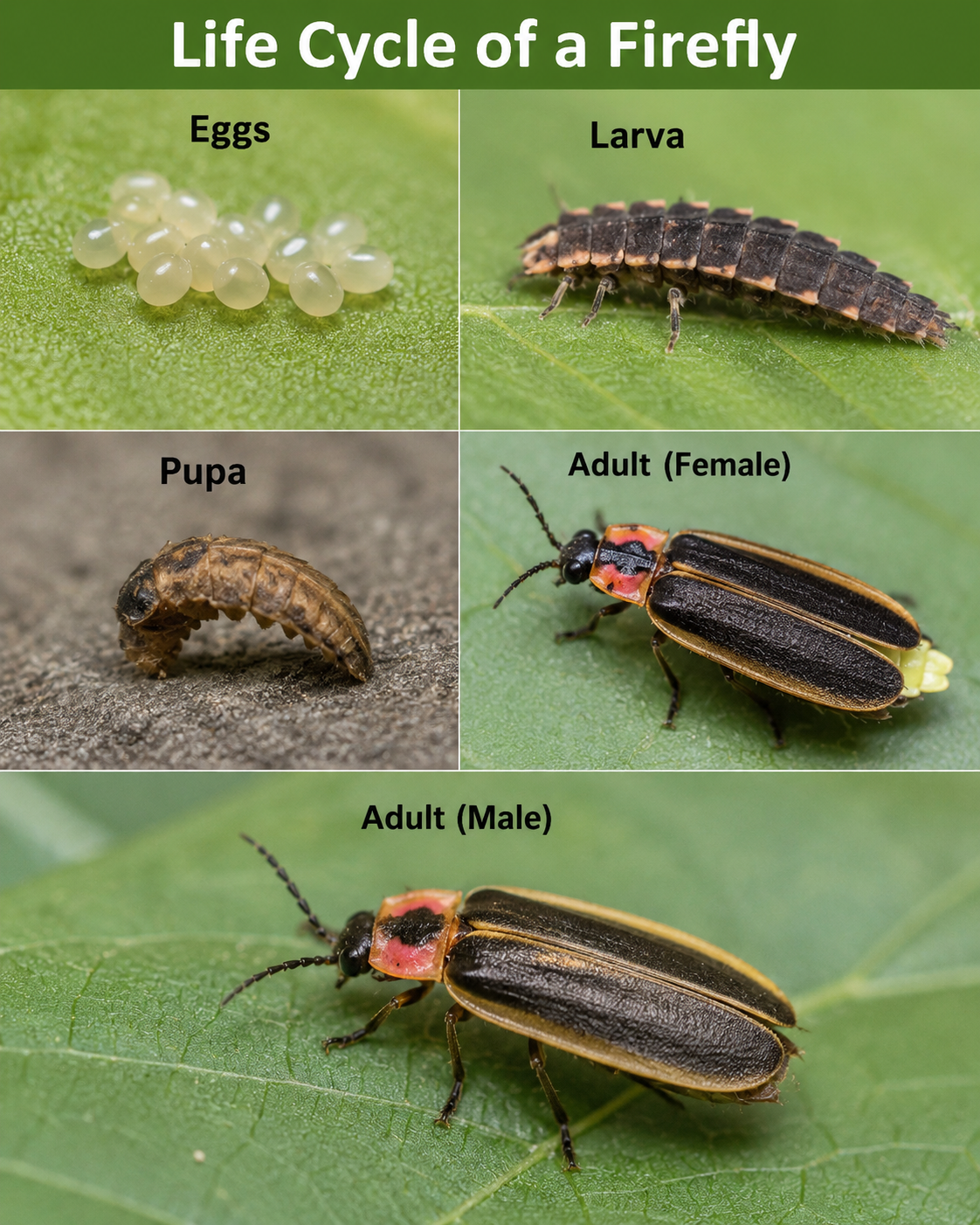
Most fireflies live one to two years from the time they hatch until they die.
However, nearly all of that time is spent as a larva hidden beneath the soil or leaf litter.

The glowing adults that everyone recognizes usually survive for only two to four weeks, with most of that time devoted to finding mates and reproducing. The chemistry behind the science behind firefly glow makes those brief flashes possible.
The Adult Stage Is Surprisingly Short
The adult stage is the one we notice.
It’s also the shortest.
Once a firefly emerges from its pupal stage, it has one primary goal.
Reproduce.
Unlike many insects that spend weeks or months feeding as adults, many firefly species either eat very little or don’t feed at all.
Instead, they rely on the energy they stored during the larval stage.
Their days are spent:
- Flying.
- Flashing to attract mates.
- Mating.
- Laying eggs.
After that, their life cycle comes to an end.
Most of Their Lives Are Spent Underground
This is the part that surprises almost everyone.
Fireflies spend the overwhelming majority of their lives hidden from view.
After hatching, the larvae live beneath:
- Leaf litter.
- Damp soil.
- Decaying logs.
- Moss.
- Woodland debris.
During this time they’re busy hunting slugs, snails, worms, and other soft-bodied invertebrates.
They’re growing constantly, molting several times before eventually becoming pupae.
Depending on the species and climate, this stage commonly lasts one to two years, although northern populations may take even longer to complete development.
Climate Can Change Their Lifespan
One reason it’s difficult to give a single answer is that not every firefly develops at the same speed.
Several factors influence how quickly they mature.
These include:
- Temperature.
- Rainfall.
- Humidity.
- Food availability.
- Species.
- Geographic location.
Fireflies living in warmer southern climates often complete their life cycle more quickly than those living farther north, where colder weather slows development.
Fireflies Spend Very Little Time Flying
When you think about it, the stage we enjoy watching is incredibly brief.

For a few weeks each summer, adult fireflies fill backyards, parks, and fields with their flashing lights. If those seasonal appearances are happening on your property, why fireflies gather in yards explains the common reasons.
Then, almost as quickly as they appeared, they’re gone.
That short adult lifespan isn’t a flaw.
It’s simply how fireflies have evolved.
By the time they emerge as adults, they’ve already spent years growing and storing energy beneath the ground.
Now their entire purpose is to:
- Find a mate.
- Reproduce.
- Lay eggs.
- Begin the next generation.
Once that job is finished, their life naturally comes to an end. (extension.okstate.edu)
Do Fireflies Die After Mating?
Eventually, yes.
Neither males nor females live very long after reaching adulthood.
Males typically spend their evenings flying and flashing while searching for females.
Females respond with species-specific flash patterns, allowing the two to find one another.
After mating, females lay their eggs in suitable habitat before eventually dying.
The next generation then begins its long journey beneath the soil. (fireflyatlas.org)


Why Do Fireflies Seem to Disappear Overnight?
One evening your yard may be filled with glowing lights.
A week or two later…
They’re gone.
That’s completely normal.
Most adult fireflies emerge around the same time, mate over a relatively short period, and then die.
Because the adults are synchronized, it often feels as though the entire population disappeared overnight.
In reality, the next generation is already developing beneath your feet as eggs and larvae.
That’s one reason I always encourage people to enjoy fireflies while they’re around.
Their annual display is beautiful, but it’s also surprisingly brief.
What Shortens a Firefly’s Lifespan?
Not every firefly reaches the end of its natural life.
Many face challenges long before then.
Some of the biggest threats include:
- Birds.
- Frogs.
- Spiders.
- Habitat loss.
- Light pollution.
- Broad-spectrum insecticides.
- Prolonged drought.
Artificial lighting is especially problematic because it interferes with the flashing signals adults use to find mates. If they can’t successfully reproduce, local populations may gradually decline over time. (xerces.org)

Can You Help Fireflies Live Longer?
You can’t extend the lifespan of an individual firefly.
That’s determined by its biology.
What you can do is improve the chances that future generations will survive.
I recommend:
- Leaving some leaf litter beneath trees and shrubs.
- Turning off unnecessary outdoor lighting during summer evenings.
- Avoiding broad-spectrum insecticides whenever possible.
- Planting native vegetation.
- Preserving moist areas of your landscape.

Those simple changes create better habitat for eggs, larvae, pupae, and adults alike. To understand why preserving that habitat matters to homeowners, read what fireflies mean for your property.

If you’re lucky enough to find a firefly and would like a closer look, I recommend briefly observing it before releasing it exactly where you found it. I use the Carson BugView 5X Magnifying Bug Catcher because it lets me safely examine insects without handling them directly. You can read why I recommend it in my review of the Best Catch and Release Bug Catcher.
The Lifespan Most People Never See
When people think about fireflies, they picture the glowing adults floating across the yard after sunset.
What they don’t see is everything that came before.
Months or even years spent hidden beneath leaves.
Hunting slugs.
Growing.
Molting.
Surviving winter.
Preparing for the moment they finally emerge.
By the time that tiny flashing beetle lights up your backyard, it’s already lived almost its entire life.
That perspective has completely changed how I view fireflies.
Instead of seeing a short-lived summer insect, I see the final stage of a remarkable journey that’s been unfolding beneath the ground for years.



Frequently Asked Questions
How long do fireflies live in total?
Most fireflies live one to two years, although some species may complete their life cycle a little faster or slower depending on climate and environmental conditions. Most of that time is spent as larvae. (fireflyatlas.org)
How long do adult fireflies live?
Adult fireflies generally live two to four weeks, spending that time finding mates and reproducing before dying naturally. (extension.okstate.edu)
Why do fireflies live so much longer as larvae?
The larval stage is when fireflies grow, molt, hunt, and store the energy they’ll need as adults. Once they emerge, their primary focus shifts to reproduction.
Do fireflies die after laying eggs?
Yes. Female fireflies lay their eggs in suitable habitat before completing their natural life cycle. The eggs hatch a few weeks later, beginning the next generation. (fireflyatlas.org)
Can fireflies survive the winter?
Yes. Most North American species survive winter as larvae hidden beneath leaf litter, logs, or in the soil, where they remain protected until warmer weather returns. (extension.okstate.edu)
About the Author
Dr. Emily Carter is an ecologist who specializes in beneficial insects and native ecosystems. She enjoys helping homeowners understand the remarkable lives of insects like fireflies and believes that appreciating their biology is one of the best ways to encourage conservation and healthy backyard habitats.