You see tiny flies hovering around your kitchen sink, so you assume they’re fruit flies. You check the bananas, throw out some old produce, and maybe set out a little apple cider vinegar.
But the flies keep showing up.
Then you notice something strange. Instead of hovering around the fruit bowl, some of them are running across your countertops in quick, jerky movements. Others seem to appear around the sink even when there’s no fruit sitting out.
You might not have fruit flies at all.
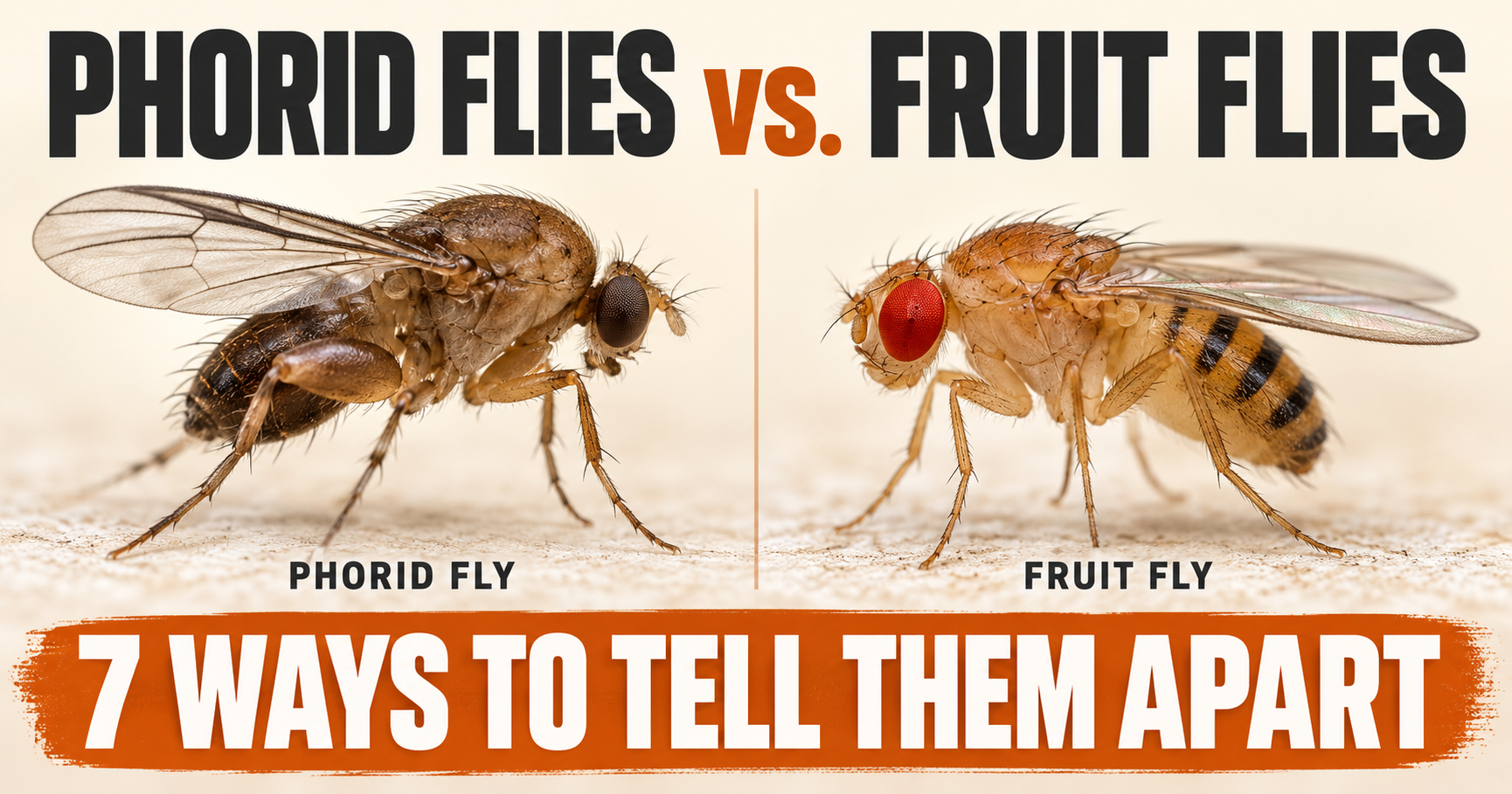
The biggest difference between phorid flies and fruit flies is their body shape and behavior. Phorid flies have a noticeably humpbacked appearance and often run across surfaces in short, rapid bursts. Common household fruit flies usually have a more evenly rounded body, and many have noticeable reddish eyes.
Both can be found in kitchens, both can develop in decaying organic material, and both are small enough to be mistaken for gnats.
Fortunately, there are several practical ways to tell them apart without needing to become an insect expert.
1. Phorid Flies Have Humpbacked Bodies
If I could examine just one physical characteristic, I’d start with the shape of the fly’s body.
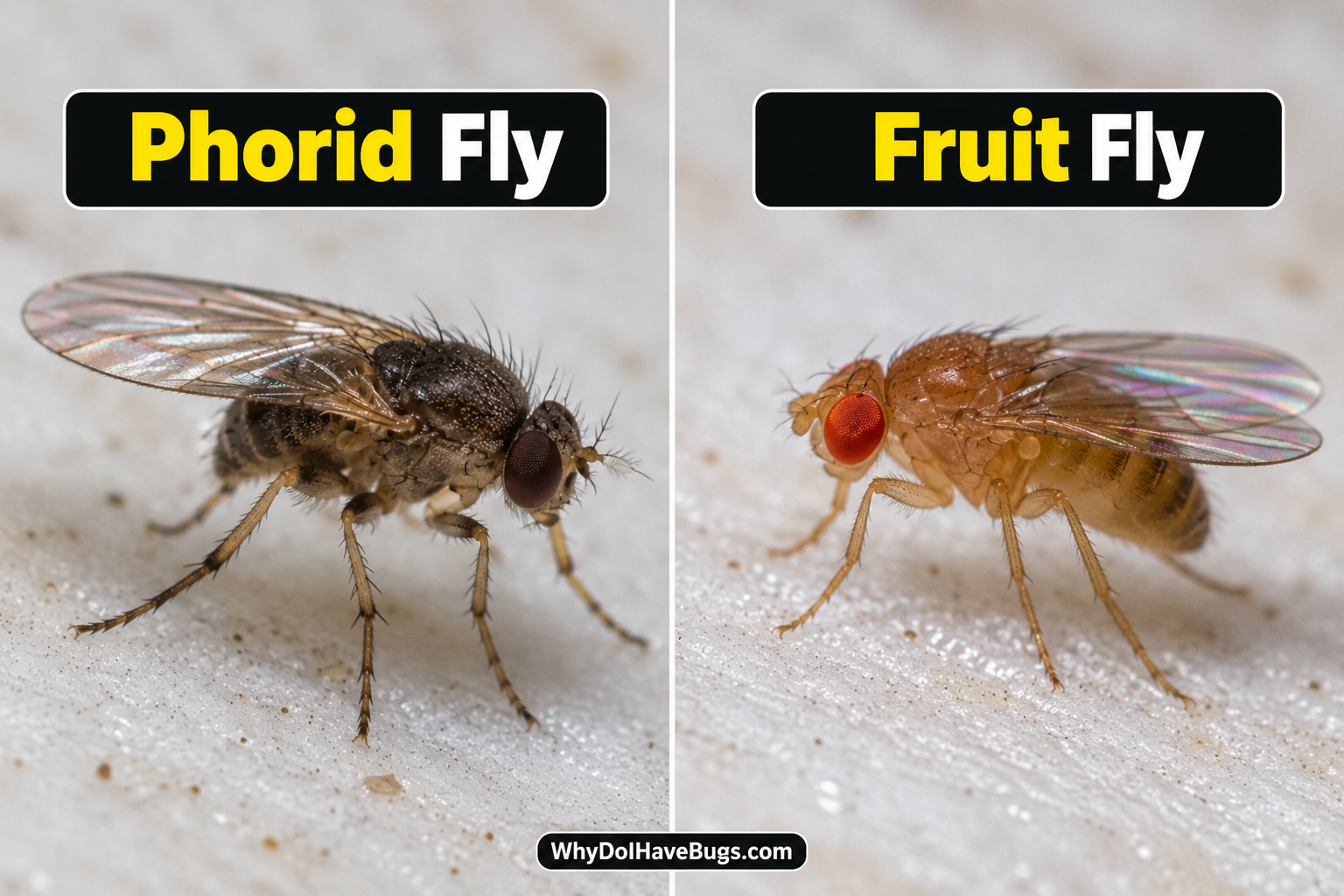
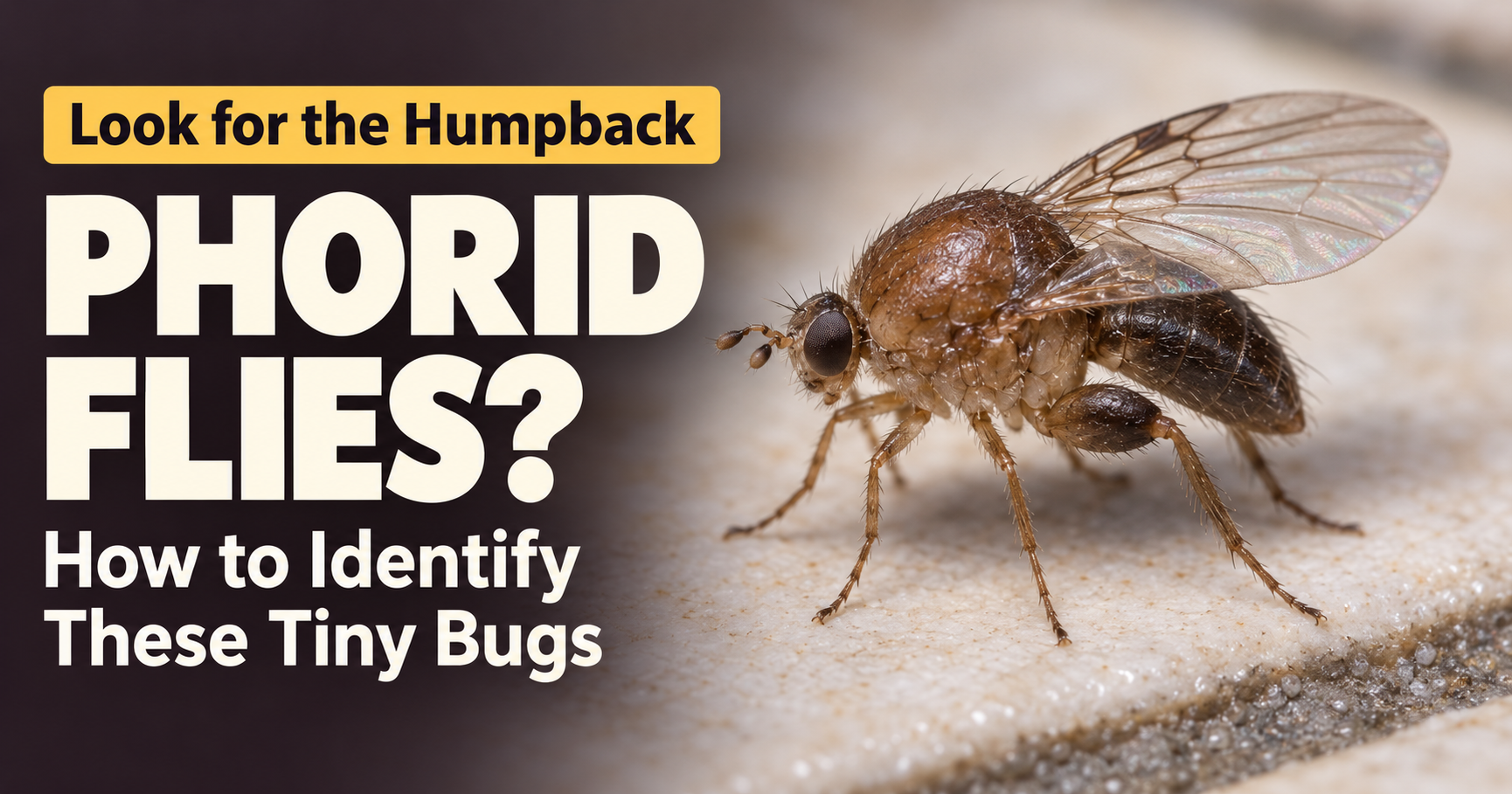
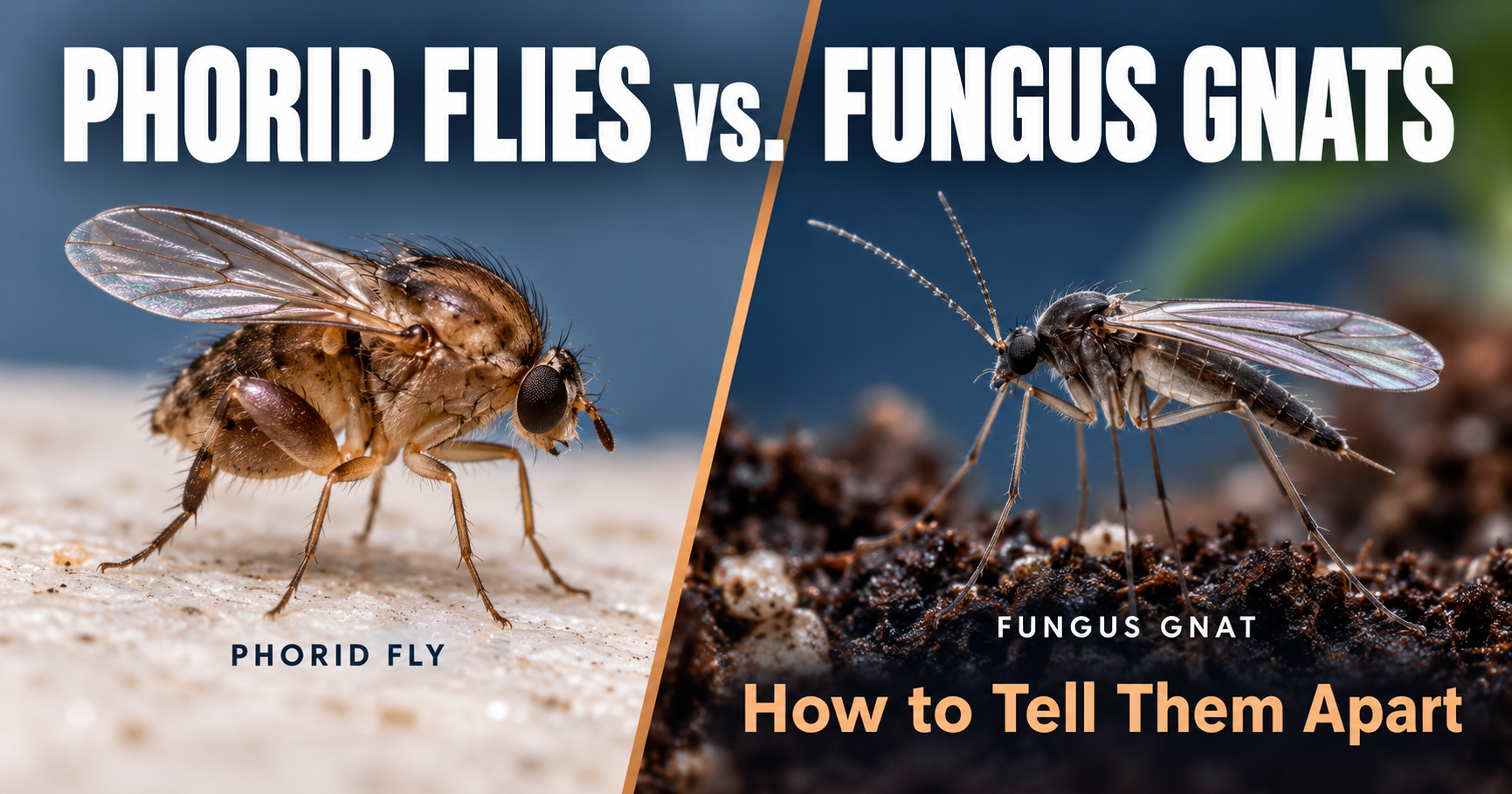
Phorid flies are commonly called humpbacked flies because their thorax arches upward behind the head.
When viewed from the side, this gives them a noticeably hunched appearance.
Their heads can look small compared with the raised thorax.
Fruit flies have a different body profile.
Common household fruit flies generally have a more rounded, compact shape without the steep hump associated with phorid flies.
What a Phorid Fly Looks Like
A typical household phorid fly has a small head, a sharply arched thorax, relatively prominent legs, and clear wings.
Its body may be light brown, dark brown, or nearly black.
The abdomen extends behind the hump, although the exact proportions vary by species.
This appearance becomes much easier to recognize in a clear side-view photograph.
Our recently published guide to what phorid flies look like and how to identify them covers their appearance in greater detail.
What a Fruit Fly Looks Like
A typical household fruit fly has a compact, somewhat rounded body.
Many are tan or yellowish-brown, with a darker abdomen.
Their heads often appear proportionally larger, especially when their eyes are prominent.
There isn’t the same steeply arched thorax that gives phorid flies their distinctive profile.
If you can capture a clear photograph from the side, comparing body shapes is one of the best places to begin.

2. Phorid Flies Run Across Surfaces in Jerky Movements
This is one of my favorite identification clues because you can sometimes spot it without a magnifying glass.
Phorid flies are also called scuttle flies.
Watch one on a countertop and you’ll understand why.
It may run a short distance, stop suddenly, turn, and dart away again.
Sometimes they appear more interested in running than flying.
Of course, phorid flies can fly perfectly well. Their running behavior is simply characteristic of many species.
Fruit flies can walk and run too, but they aren’t especially known for that rapid, stop-and-start scuttling behavior.
Instead, you may notice them flying around produce, bottles, or other attractive food sources.
Can You Identify Them Just by Watching Them Move?
Not with complete certainty.
An insect’s behavior is a clue, not a guaranteed identification.
Different species can behave differently depending on temperature, lighting, and whether they’ve been disturbed.
However, a tiny fly that repeatedly scuttles across the countertop and has a humpbacked body is a strong phorid fly candidate.

3. Fruit Flies Often Have Red Eyes, While Phorid Flies Usually Don’t
This is another useful difference, although people sometimes rely on it too heavily.
Many common household fruit flies, particularly familiar Drosophila species, have noticeable reddish eyes.
Those eyes can stand out against their yellowish-brown bodies.
Phorid flies generally have darker eyes that don’t have the same conspicuous red appearance.
Do All Fruit Flies Have Red Eyes?
No.
Fruit flies include different species, and not every individual has bright red eyes.
Eye color can vary, and certain fruit flies have darker eyes.
Lighting also affects how easily you can see them.
So while red eyes are a useful clue, they shouldn’t be your only identification method.
If the fly has a distinctly humpbacked body and dark eyes, I’d consider phorid flies.
If it has a compact tan body with conspicuous red eyes, a common fruit fly becomes more likely.

Our fruit fly identification guide explains their appearance in more detail.
4. Both Flies Are Tiny, but Their Body Shapes Differ
People sometimes assume one type must be much larger than the other.
In reality, their sizes overlap considerably.
Many common household phorid flies measure around 1/16 to 1/8 inch long.
Typical household fruit flies are also often about 1/16 to 1/8 inch long.
That means both can look like tiny moving specks when viewed from across the kitchen.
A full-grown fruit fly isn’t necessarily bigger than a phorid fly.
What About Their Wings?
Both insects have a single functional pair of wings, as flies do.
However, their wing veins differ.
Phorid flies typically have a distinctive pattern with relatively strong veins near the front edge and fewer obvious veins extending across the rest of the wing.
Fruit flies have a different arrangement of wing veins.
Those details are more useful to insect specialists or people examining a specimen with magnification.
For most homeowners, body shape and behavior will be easier to check.


5. Fruit Flies Prefer Fermenting Material, While Phorid Flies Have More Varied Breeding Sources
This difference is especially useful once you’ve confirmed which insects are present.
Fruit flies are strongly associated with fermenting fruits, vegetables, and sugary liquids.
You might find them around overripe bananas, forgotten potatoes, spilled juice, empty soda containers, or fermenting residues in recycling bins.
Phorid flies can develop in a wider range of decaying organic materials.
Depending on the species, these may include rotting plant matter, animal material, organic buildup in drains, garbage, or material associated with wastewater leaks.
Does Finding Flies Near Fruit Mean They’re Fruit Flies?
Not necessarily.
Phorid flies can also be associated with decomposing fruits and vegetables.
A piece of rotting produce may attract more than one type of small fly.
The location helps narrow down possibilities, but examining the insect itself is still important.
Does Finding Flies Near a Drain Mean They’re Phorid Flies?
Again, not necessarily.
Both groups can be associated with organic buildup in drains or nearby areas.
Drain flies, sometimes called moth flies, are another possibility entirely.
They’re the fuzzy little flies that often resemble miniature moths.
The breeding site becomes most useful after you’ve looked at the insect’s physical features.
6. Fruit Flies Often Gather Around Produce, but Phorid Flies May Appear in Unexpected Places
Think about where you’re seeing most of the insects.
Are they concentrated around bananas, tomatoes, juice bottles, or recycling containers?
That pattern often points toward fruit flies, especially when fermenting material is present.
Are they running across countertops, appearing around floor drains, or repeatedly emerging near a damp area without an obvious food source?
Phorid flies become a stronger possibility.
Common Places to Find Fruit Flies
Fruit flies often appear around produce bowls, trash cans, recycling containers, garbage disposals, and fermenting residues.
Their presence is frequently associated with food preparation or storage areas.
If you have a sudden increase in these flies, inspect for forgotten produce and spilled liquids.

Our guide explaining why fruit flies appear inside homes covers several of those common sources.
Common Places to Find Phorid Flies
Phorid flies may appear in kitchens, bathrooms, basements, garbage areas, or other locations near suitable decaying material.
Some species can develop in organic debris associated with damaged plumbing or sewage-contaminated soil.
However, finding phorid flies doesn’t automatically mean you have a broken sewer pipe.
A neglected trash container or hidden spill can sometimes explain the problem.
The key is to identify where the larvae are developing instead of assuming the most expensive possible cause.

7. Vinegar Traps Tend to Work Better for Fruit Flies Than Phorid Flies
This is where identifying the insect can save you some frustration.
Apple cider vinegar traps are commonly used against fruit flies because many species respond to odors associated with fermentation.
A simple trap may attract and capture adult fruit flies, particularly when competing food sources have been removed.
Phorid flies don’t necessarily respond to those same attractants as reliably.
Some species may be attracted to particular organic odors, but homemade vinegar traps aren’t a dependable solution for every phorid fly problem.
What if Apple Cider Vinegar Isn’t Catching Anything?
It could mean you’re dealing with a different type of fly.
It could also mean the trap isn’t attractive enough, competing food sources are present, or the flies are responding to something else nearby.
A failed vinegar trap doesn’t prove that phorid flies are present.
Still, if the insects have humpbacked bodies, run rapidly over surfaces, and ignore your fruit fly trap, it’s worth checking them more closely.
Will Fly Traps Get Rid of Either Insect?
Traps can reduce the number of adult flies.
They can also help you monitor where insects are most active.
But neither fruit flies nor phorid flies are likely to disappear permanently if suitable breeding material remains available.
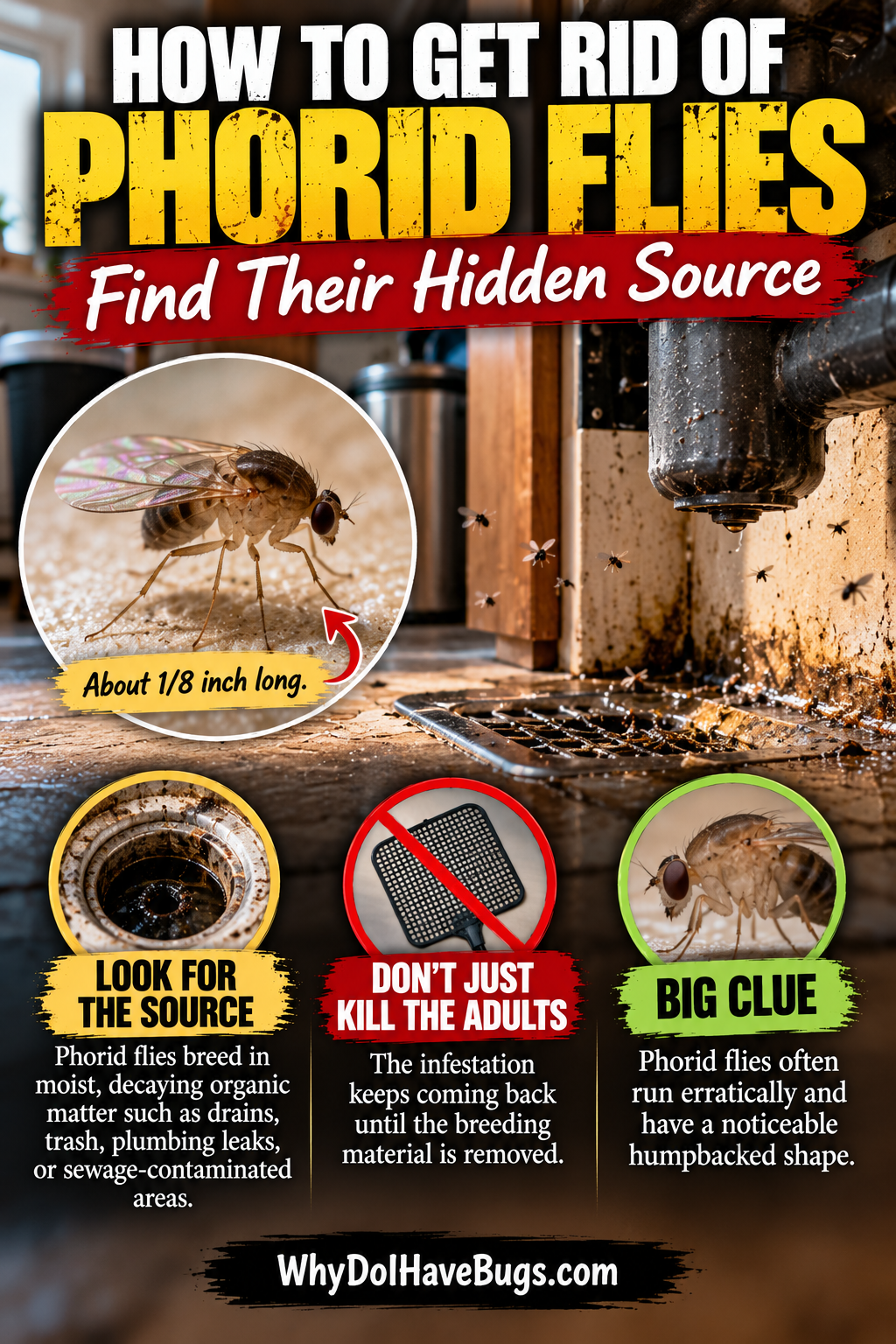
If you’ve confirmed phorid flies, our detailed guide to getting rid of phorid flies and locating their hidden breeding sourceexplains the full process.
How to Tell Which Fly You Have in Under a Minute
If you can safely get a close look at one of the insects, here’s the order I’d use.
First, Check the Body Shape
Look at the fly from the side.
A sharply humpbacked thorax points toward phorid flies.
A more evenly rounded body, particularly one with a tan abdomen and prominent eyes, may indicate a fruit fly.
Next, Watch How It Moves
Does it run rapidly across the surface, stopping and changing directions?
That’s characteristic of phorid flies.
Does it spend most of its time flying around fermenting food or liquids?
That supports a fruit fly identification, although it isn’t definitive.
Then, Check the Eyes
Bright reddish eyes suggest certain common fruit flies.
Dark eyes combined with a humpbacked profile may point toward phorid flies.
Finally, Look at the Environment
Fermenting produce and sugary liquid residue are common fruit fly sources.
A broader range of decomposing organic material may support phorid flies.
Remember that both can share some breeding environments.
The actual insect should be your primary evidence. Its location provides supporting clues, not a substitute for identification.

Can You Have Fruit Flies and Phorid Flies at the Same Time?
Yes, and this can make a small-fly problem more confusing.
A home may contain several suitable breeding environments.
For example, fruit flies could be developing around fermenting produce while phorid flies are associated with separate organic buildup elsewhere.
Finding one type doesn’t rule out the other.
If some insects look tan with prominent red eyes while others have dark, humpbacked bodies and run across surfaces, collect specimens of both.
You may discover that you’re dealing with two separate insect problems.
That doesn’t mean you should immediately start using multiple pesticides.
Identify the insects and inspect the appropriate breeding sources before choosing a treatment.
Are Phorid Flies More Dangerous Than Fruit Flies?
Neither is normally considered a biting household pest.
Both are primarily nuisances.
However, insects associated with rotting organic material can potentially transfer microorganisms between contaminated surfaces and food.
Certain phorid flies may develop in particularly unsanitary environments, including sewage-contaminated material.
That makes locating the source important.
Fruit flies can also contaminate food surfaces after visiting garbage or decomposing produce.
For either insect, basic food sanitation and source removal are more important than worrying about an occasional fly landing nearby.
What Should You Do After Identifying the Fly?
Once you know which fly you’re dealing with, your next step becomes clearer.
If They’re Fruit Flies
Inspect fermenting produce, sugary liquid residue, bottles, trash, recycling, and other potential food sources.
Remove or properly store affected material.
Clean containers and surfaces where organic residue has accumulated.
A suitable vinegar trap may help capture adults while you remove the breeding material.
If They’re Phorid Flies
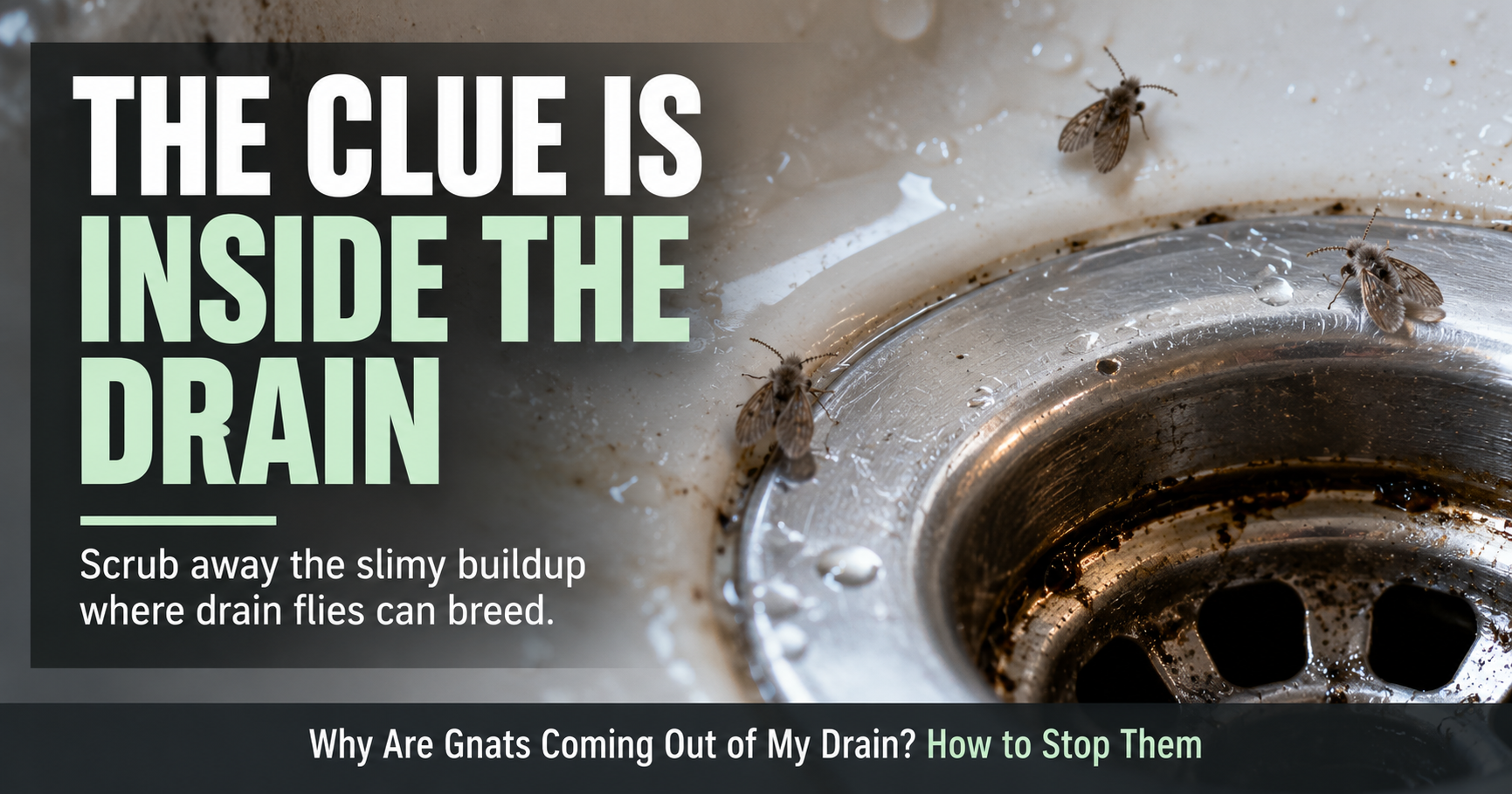
Inspect damp, decaying organic material around garbage containers, drains, and accessible plumbing areas.
Look for moisture problems and overlooked debris.
If a persistent infestation cannot be traced to an accessible source, consider getting professional help to investigate.
Large infestations associated with damaged plumbing may require repair rather than repeated insecticide applications.
In either case, finding and removing the breeding material is usually more important than choosing the strongest fly spray.
Frequently Asked Questions
Are phorid flies just another type of fruit fly?
No. Phorid flies belong to the family Phoridae, while the familiar small fruit flies associated with fermenting produce belong to the family Drosophilidae. They’re different groups of flies.
Do phorid flies have red eyes like fruit flies?
Phorid flies generally have darker eyes. Many common household fruit flies have reddish eyes, although eye color varies between species and isn’t a reliable identification method by itself.
Which is smaller, a phorid fly or a fruit fly?
Their sizes overlap. Many household phorid flies and fruit flies measure around 1/16 to 1/8 inch long, depending on the species.
Why do phorid flies run instead of flying?
Phorid flies are known for their rapid, jerky running behavior, which is why they’re called scuttle flies. They’re still capable of flying.
Can phorid flies and fruit flies breed in the same place?
Sometimes. Both may use certain types of decaying organic material, although their preferred breeding environments differ among species.
Do fruit flies come out of drains like phorid flies?
Fruit flies may breed in fermenting organic residue associated with certain drains and garbage disposals. Phorid flies can also develop in suitable drain buildup, so drain activity alone doesn’t identify the insect.
Do vinegar traps catch phorid flies?
They may attract some phorid flies under certain conditions, but vinegar traps are generally more dependable for common fruit flies. Neither type of trap eliminates a hidden breeding source.
Are phorid flies harder to get rid of than fruit flies?
They can be when their breeding source is inaccessible, such as hidden decomposing material or a plumbing-related problem. Fruit fly infestations associated with accessible produce or containers are often easier to trace.
Can phorid flies bite you?
Common household nuisance phorid flies do not normally bite people. Neither do the familiar fruit flies found around fermenting produce.
Should I call pest control if I can’t identify the flies?
If they’re appearing repeatedly and you can’t identify them or locate the source, a pest-control professional or local extension service may help. Proper identification is particularly valuable before undertaking expensive plumbing repairs or chemical treatments.
About the Author: The writers at Why Do I Have Bugs help homeowners recognize common household insects, understand why they’re appearing, and find practical ways to deal with frustrating pest problems.