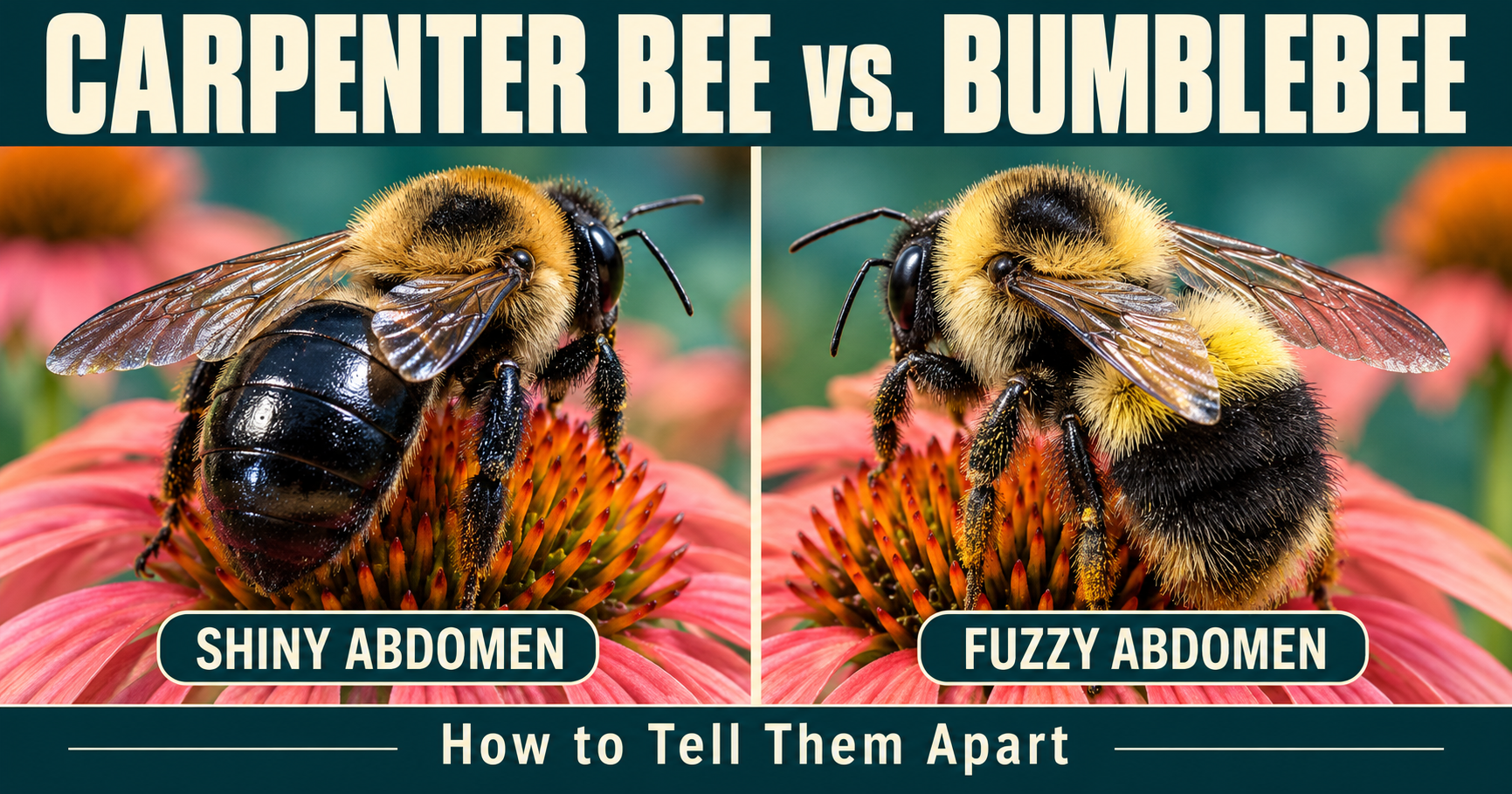
You’re outside watching a big black-and-yellow bee buzzing around the porch when you notice something interesting. One bee looks almost completely fuzzy, while another has what looks like a smooth, shiny black backside.
They might seem like the same kind of bee at first, but there’s a good chance you’re looking at a bumblebee and a carpenter bee.
These two bees are regularly mistaken for each other. They’re both large, have similar yellow-and-black coloring, and make a loud buzzing sound when they fly. Both are also important pollinators that deserve a place in our yards and gardens.
The easiest way to tell a carpenter bee from a bumblebee is to look at the abdomen, the large rear section of its body. Eastern carpenter bees have mostly smooth, shiny black abdomens, while bumblebees generally have fuzzy, hair-covered abdomens.
That’s the difference I’d look for first.
But their appearance isn’t the only thing that separates them. Their nesting habits, behavior, and family structures are quite different, too.
1. Carpenter Bees Have Shiny Abdomens, While Bumblebees Are Fuzzy
If you can safely get a good look at the bee, pay attention to its backside.
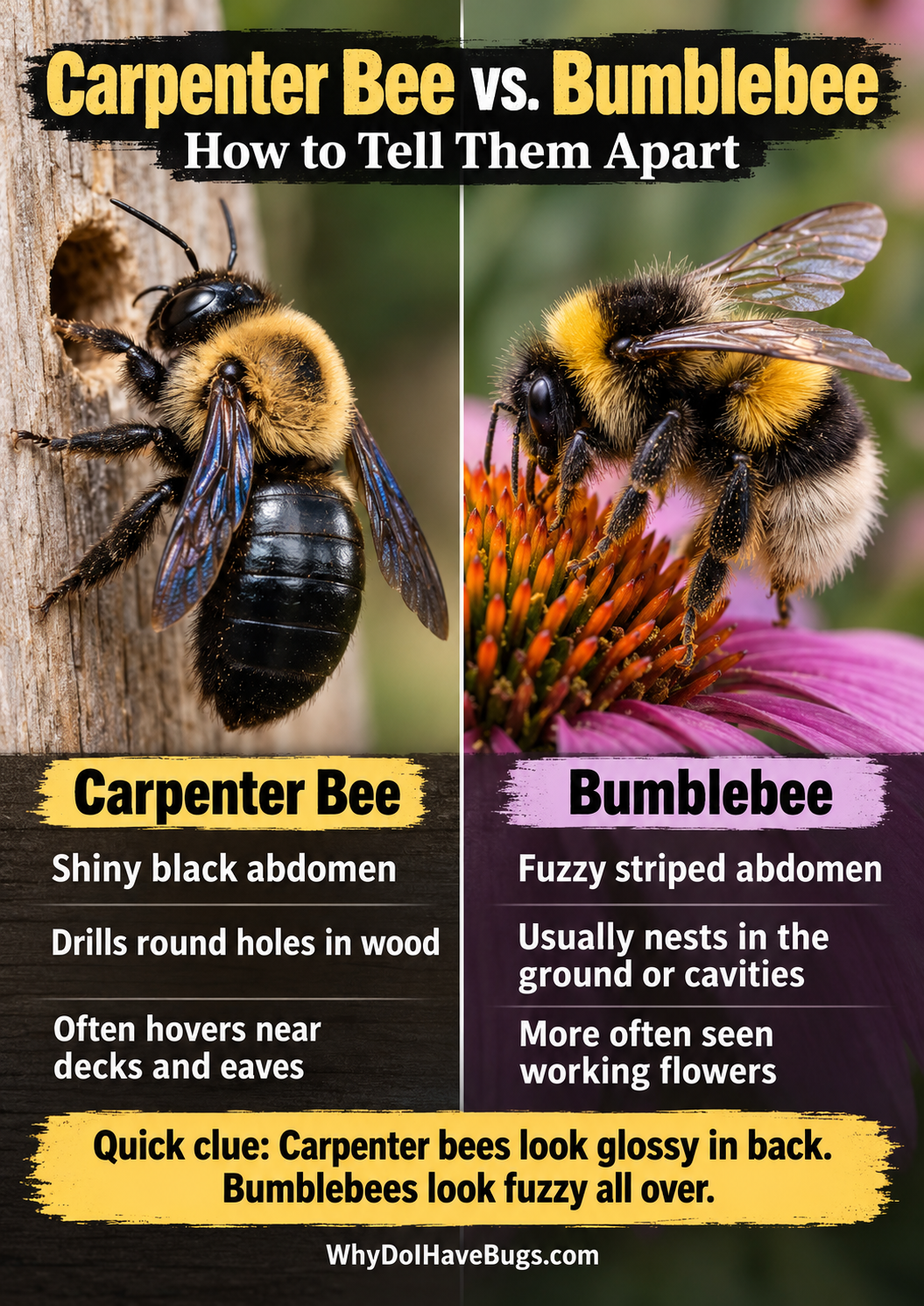
Eastern carpenter bees (Xylocopa virginica) have a mostly black, shiny upper abdomen.
It often looks smooth, almost like polished leather.
Their thorax, the middle section behind the head, is covered with yellowish hairs. This gives them that familiar black-and-yellow appearance.
Bumblebees are generally much fuzzier.
Their abdomens are covered in noticeable hairs, often with bands or patches of yellow, black, orange, white, or other colors depending on the species.
What Does a Carpenter Bee Look Like?
An eastern carpenter bee is a large, stocky insect that commonly measures around 3/4 to 1 inch long.
It has a fuzzy yellowish thorax, dark wings, and a shiny black abdomen.
Some individuals have a slightly golden appearance around the thorax.
From above, you’ll often notice how the dark abdomen contrasts with the hairy middle section.
That’s one of the strongest identification clues.
What Does a Bumblebee Look Like?
Bumblebees have thick, fuzzy bodies.
The hair continues across the abdomen rather than leaving the large, smooth-looking black surface seen on an eastern carpenter bee.
Some bumblebee species have striking yellow-and-black bands.
Others have orange or reddish markings, and some are predominantly dark.
Not every bumblebee looks exactly like the familiar yellow-and-black striped insect.
Still, the noticeably hairy abdomen is an important feature.
One caution: Carpenter bee species vary across the United States, and some have different colors or patterns. The shiny black abdomen is especially useful when comparing eastern carpenter bees with the bumblebees commonly encountered in Missouri and nearby states.



2. Carpenter Bees Drill Into Wood, but Bumblebees Usually Use Existing Cavities
This is one of their biggest behavioral differences.
Carpenter bees get their name from their nesting habits.
Female carpenter bees chew tunnels into wood using their strong mandibles.
These tunnels become nesting galleries where they lay eggs and provide food for their developing young.
Bumblebees generally don’t excavate nesting tunnels in solid wooden boards.
Instead, they commonly establish colonies in existing sheltered spaces.
Where Carpenter Bees Nest
You might find carpenter bees nesting in porch railings, deck framing, fascia boards, exposed rafters, sheds, or other wooden structures.
In nature, they can also use suitable deadwood.
Their entrance holes are often almost perfectly round and approximately half an inch across.
You may find a little pile of sawdust underneath an active hole.
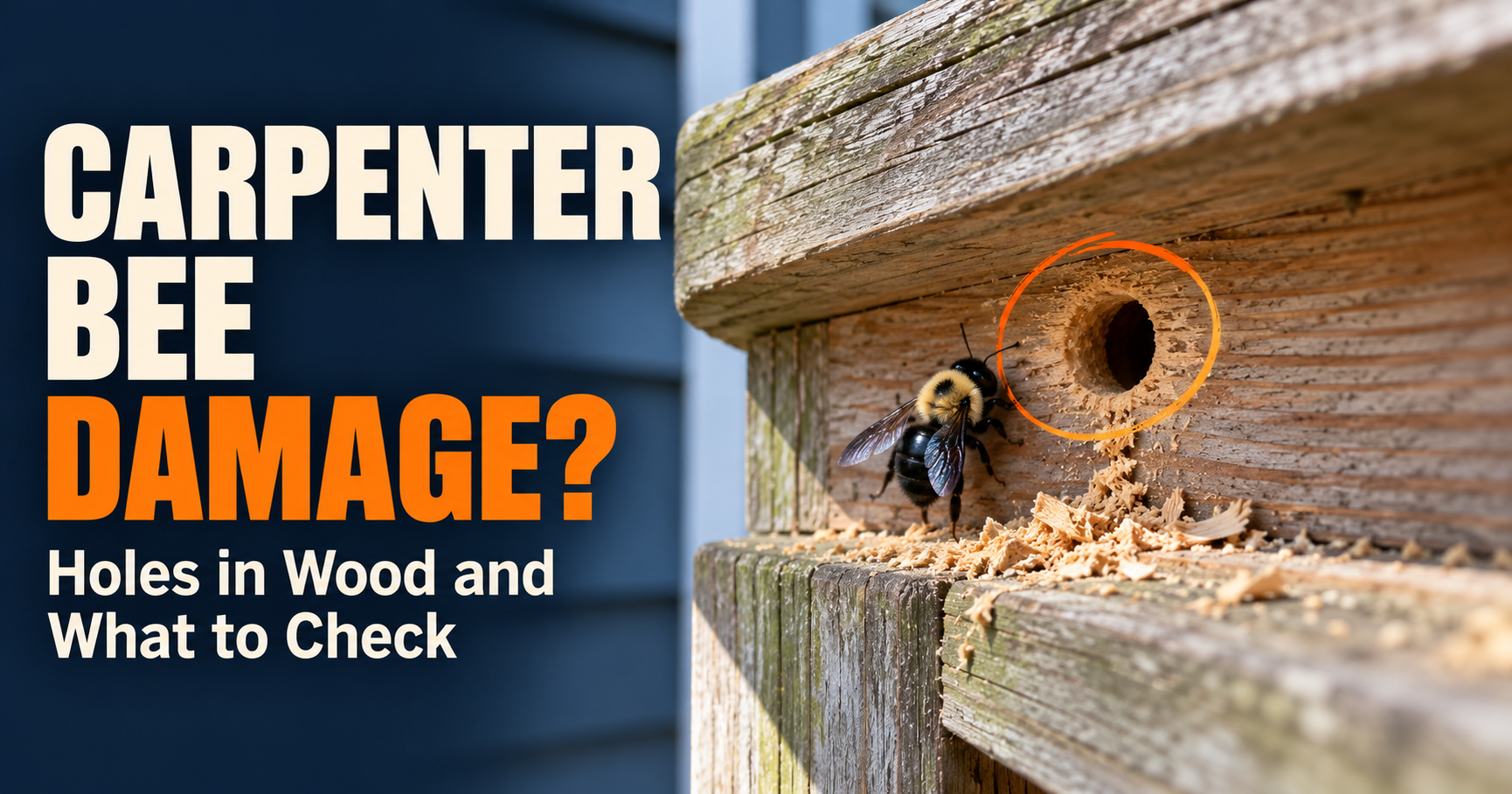
We’ve covered the details in our guide to recognizing carpenter bee holes and wood damage.
Where Bumblebees Nest
Bumblebees typically use sheltered cavities.
Depending on the species, these can include abandoned rodent burrows, spaces beneath vegetation, old animal nests, or other protected locations.
Some species nest above ground in cavities such as wall voids or birdhouses.
They don’t need to drill neat circular holes into wooden railings to raise their young.
If you’re seeing a large bee repeatedly entering a clean, round hole in solid wood, carpenter bees are more likely.
If you’re seeing numerous fuzzy bees entering an old underground animal burrow, a bumblebee colony may be responsible.


3. Bumblebees Live in Colonies, While Carpenter Bees Are Mostly Solitary
Carpenter bees and bumblebees have different social lives.
Most familiar bumblebee species live in colonies organized around a queen.
Carpenter bees have much simpler social arrangements.
How Bumblebee Colonies Work
In spring, a mated bumblebee queen begins establishing a nest.
She collects food and raises the first group of workers.
As the colony grows, workers help gather food and care for developing bees.
Depending on the species and conditions, a colony may eventually contain dozens or hundreds of individuals.
Later in the season, the colony produces new queens and males.
Most bumblebee colonies are annual, meaning the old colony generally dies out while newly mated queens survive to begin the next generation.
How Carpenter Bee Nests Work
Eastern carpenter bees are primarily solitary or weakly social.
A female generally excavates or reuses a nesting gallery and provisions individual chambers with pollen and nectar.
Sometimes related bees share or reuse nesting areas.
However, they don’t form the same large worker-based colonies as bumblebees.
You might see several carpenter bees around one porch, but that doesn’t automatically mean there’s a giant colony hidden inside the boards.
They may be using separate nesting galleries or patrolling nearby areas.
4. Carpenter Bees Often Hover Around People More Than Bumblebees
This is one of the more noticeable differences when you’re spending time outside.
Male carpenter bees are known for territorial hovering.
They patrol areas where females may appear, sometimes flying toward people or other moving objects.
A male may hover directly in front of your face, dart away, and return again.
It can feel surprisingly aggressive.
Why Carpenter Bees Chase People
Male carpenter bees often investigate movement within their territories.
They’re looking for females and competing with other males.
The strange part is that males don’t have stingers.
That means the carpenter bee acting the most intimidating around your porch might be completely incapable of stinging you.
Female carpenter bees can sting, but they’re generally less confrontational.
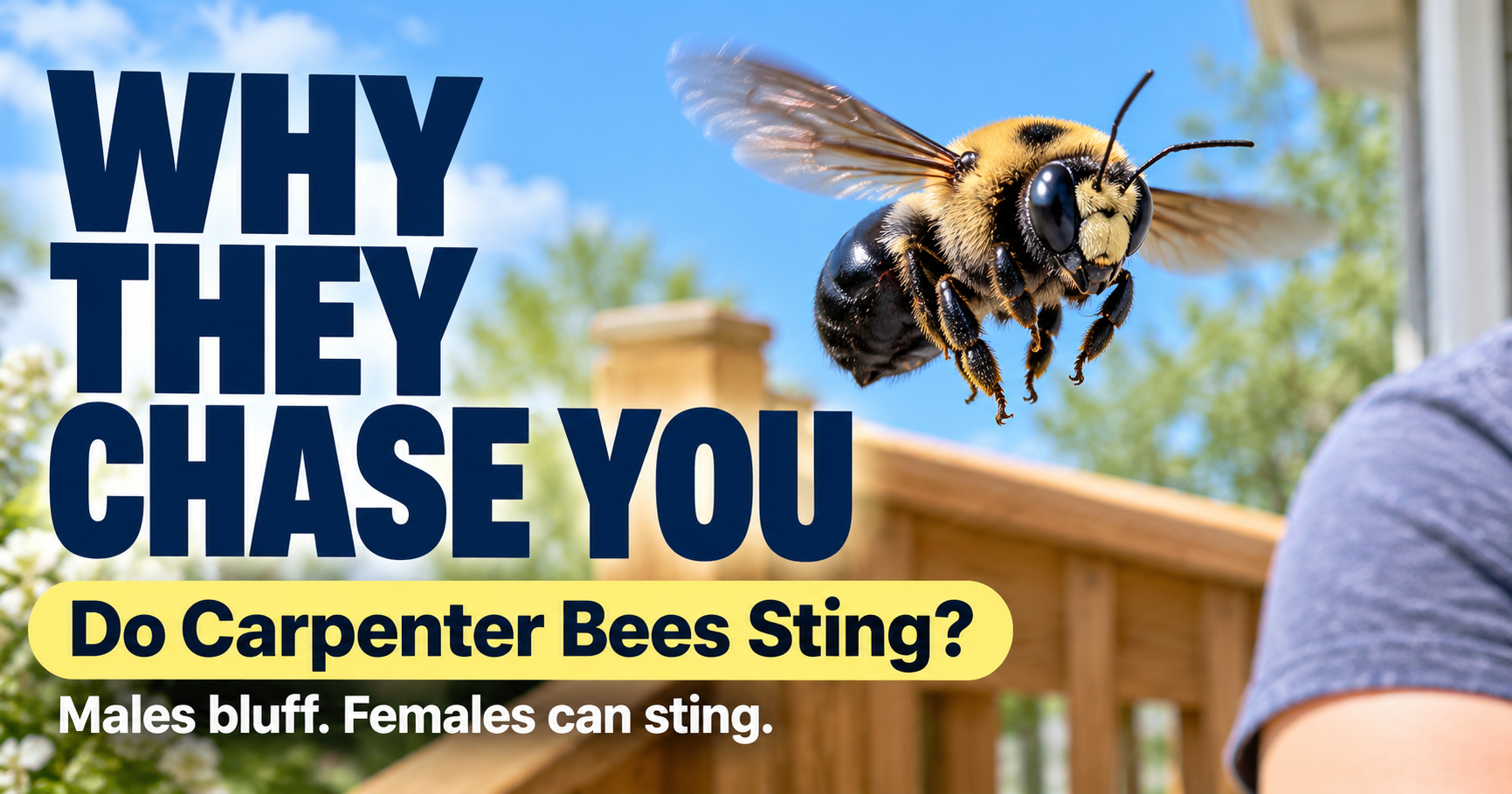
Our article on why carpenter bees chase people and when they can sting explains this behavior in more detail.
Do Bumblebees Chase People?
Bumblebees generally spend much of their time visiting flowers and gathering food.
They aren’t usually interested in people who are simply walking nearby.
However, bumblebees can defend their nests when disturbed.
Workers and queens have stingers, and approaching or disturbing a colony can result in defensive behavior.
It’s best to give any bee nest some space, whether you’re dealing with bumblebees or carpenter bees.


5. Carpenter Bees and Bumblebees Can Be Similar in Size
You may have heard that carpenter bees are always bigger than bumblebees.
That’s not a dependable identification method.
Eastern carpenter bees are large bees, commonly around 3/4 to 1 inch long.
Bumblebee sizes vary considerably depending on the species and whether you’re looking at a queen, worker, or male.
A bumblebee queen can be quite large.
Workers from the same colony may be noticeably smaller.
Which Bee Is Bigger?
Sometimes a carpenter bee will be larger than the bumblebee beside it.
Other times, a large bumblebee queen can rival or exceed the carpenter bee in size.
That’s why I’d rely on the abdomen rather than trying to estimate which insect looks bigger.
A smooth, glossy black abdomen points toward an eastern carpenter bee.
A fuzzy abdomen, particularly one with distinct colored hair bands, points toward a bumblebee.
6. Both Are Important Pollinators
This is something worth emphasizing because both bees are beneficial.
Carpenter bees and bumblebees visit flowers for nectar and pollen.
In the process, they help pollinate a wide variety of plants.
Both can also perform buzz pollination.
What Is Buzz Pollination?
Some plants hold their pollen inside structures that don’t release it easily.
Certain bees can vibrate their flight muscles while gripping a flower.
Those vibrations shake pollen loose.
Carpenter bees and bumblebees are particularly well known for this ability.
Plants such as tomatoes and eggplants benefit from buzz pollination.
Both groups also contribute to pollination of various wildflowers and native plants.
Are Bumblebees Better Pollinators Than Carpenter Bees?
There isn’t one simple answer for every plant.
Different bees vary in their body size, flower preferences, behavior, and effectiveness at transferring pollen.
Bumblebees are especially valuable pollinators of many crops and wildflowers.
Carpenter bees also contribute to pollination, although some species occasionally obtain nectar by making openings near the base of flowers rather than passing through their normal pollinating structures.
Neither group should be dismissed as unimportant.
If you’re seeing either bee visiting flowers in your garden, it’s probably doing something useful.


7. Carpenter Bees Can Damage Wood, but Bumblebees Usually Don’t
This is where homeowners may have a legitimate reason to manage carpenter bee activity.
Female carpenter bees excavate nesting galleries inside wood.
One nest may cause relatively minor damage.
However, repeated nesting over several years can create multiple tunnels in the same wooden structure.
Woodpeckers may also enlarge holes while searching for carpenter bee larvae.
Over time, that can damage railings, trim, or other wooden components.
Bumblebees don’t normally create this kind of damage.
They usually use existing cavities rather than tunneling into sound lumber.
Should You Remove Carpenter Bees From Your Porch?
Not automatically.
If carpenter bees are visiting flowers or nesting in harmless deadwood, leaving them alone is generally best.
They’re native pollinators, and there’s no reason to eliminate them simply because they’re present.
But if females are repeatedly excavating important structural wood, taking preventive measures makes sense.
Painting exposed wood, protecting vulnerable surfaces, and repairing confirmed unoccupied galleries can help reduce damage.
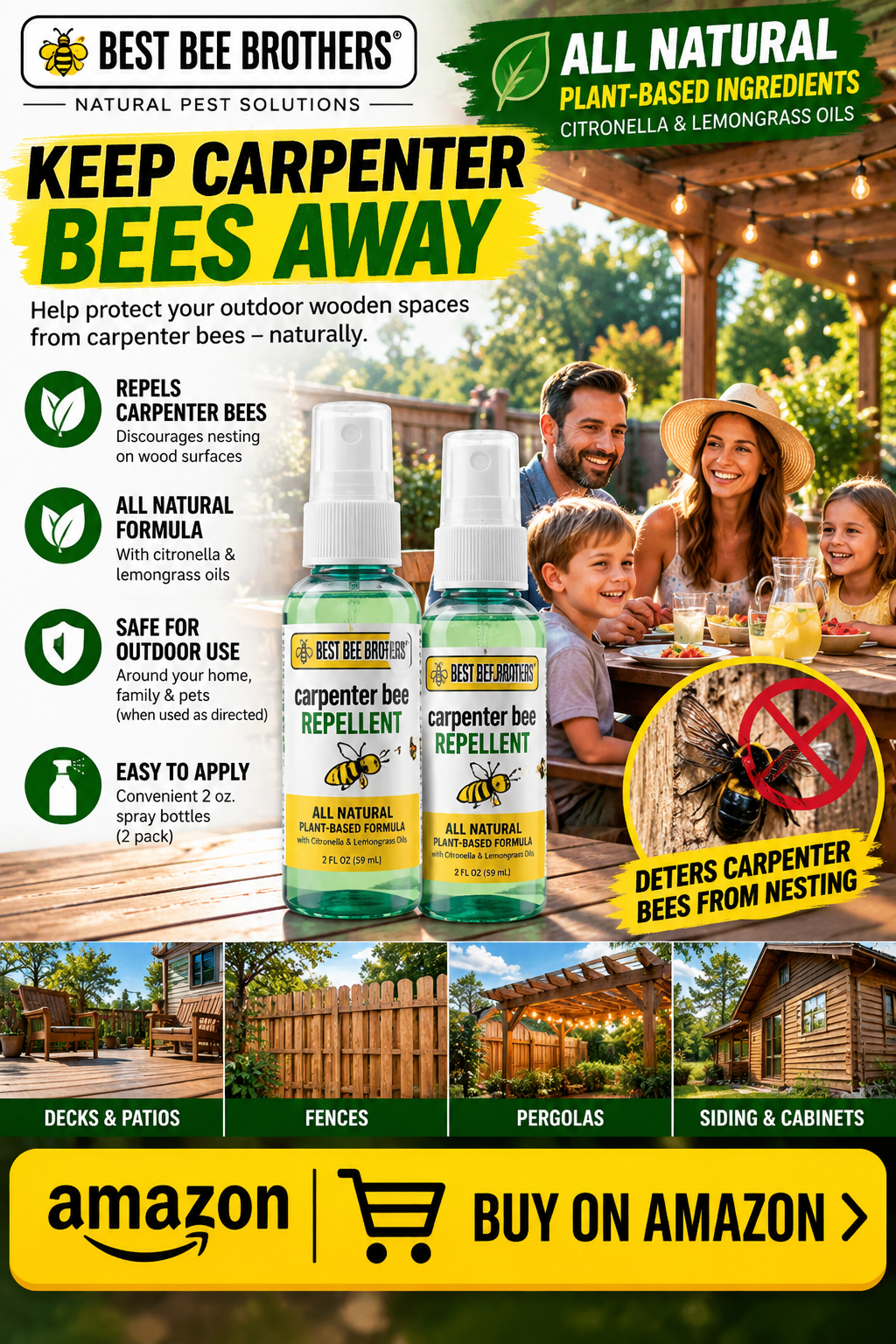
Some homeowners also consider products such as Best Bee Brothers Citrus Carpenter Bee Repellent Spray , which is marketed to discourage new nesting on outdoor wooden surfaces.
Its effectiveness hasn’t been independently established here, so I’d treat it as a supplemental deterrent rather than a guaranteed fix.
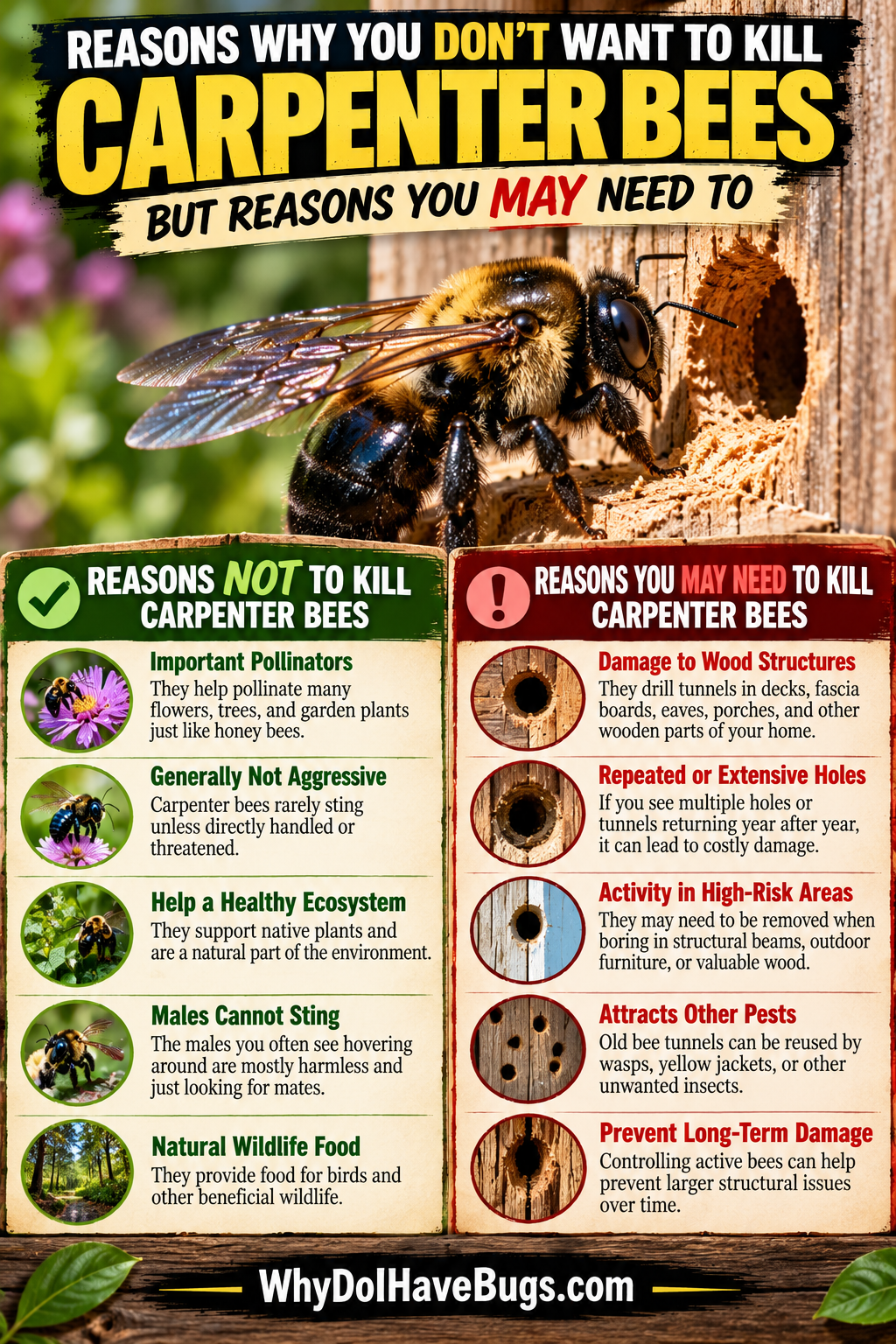
Our guide to protecting your home from carpenter bees without killing them explains the full approach.
Should You Remove a Bumblebee Nest?
If a bumblebee colony is in a harmless location, leaving it alone is usually the best option.
Bumblebee colonies are often seasonal, and many naturally decline toward the end of the growing season.
If a colony is located where children, pets, or people with serious sting allergies are likely to disturb it, professional advice may be appropriate.
Don’t seal an active bumblebee nest entrance or attempt to move the colony yourself.
How to Tell a Carpenter Bee From a Bumblebee in Your Yard
If you’re watching a large bee and trying to determine what you’ve found, here’s the order I’d check.
Look at the Abdomen First
This is the most useful visible difference for eastern carpenter bees.
Does the bee have a large, shiny black abdomen?
That suggests an eastern carpenter bee.
Is the abdomen fuzzy, with noticeable hairs or colored bands?
That suggests a bumblebee.
Watch Where It’s Flying
A large bee repeatedly hovering around wooden railings or investigating round holes may be a carpenter bee.
A fuzzy bee flying back and forth between flowers may be a bumblebee, although carpenter bees visit flowers too.
Behavior can help, but it isn’t enough by itself.
Check the Nesting Location
A clean, round hole excavated in a wooden board strongly suggests carpenter bee activity.
Multiple fuzzy bees entering an existing underground cavity are more consistent with a bumblebee colony.
However, other insects can also nest in soil or wood, so proper identification still matters.
Take a Photograph if You’re Unsure
A close-up photograph can reveal the abdomen, body hairs, and other useful characteristics.
Try to capture the insect from above or slightly behind without disturbing it.
Avoid handling bees or approaching an active nest just to get a better picture.
A good photo is usually much safer and more helpful than trying to catch one.

Frequently Asked Questions
What is the easiest way to tell a carpenter bee from a bumblebee?
Look at the abdomen. Eastern carpenter bees have mostly smooth, shiny black abdomens, while bumblebees have noticeably fuzzy abdomens.
Are carpenter bees and bumblebees related?
Yes. Both belong to the bee family Apidae, but carpenter bees belong to the genus Xylocopa, while bumblebees belong to the genus Bombus.
Which is bigger, a carpenter bee or a bumblebee?
Their sizes overlap. Large bumblebee queens may be as big as or bigger than eastern carpenter bees, so size alone isn’t reliable.
Do carpenter bees have fuzzy bodies?
Yes, but not uniformly. Eastern carpenter bees have fuzzy thoraxes and mostly smooth, shiny black abdomens.
Are bumblebees completely fuzzy?
Bumblebees generally have densely hairy bodies, including their abdomens. The amount and color of hair vary among species and individuals.
Do bumblebees drill holes in wood?
Bumblebees don’t normally excavate nesting galleries in sound wood. They typically use existing cavities, including underground spaces and other sheltered locations.
Are carpenter bees more aggressive than bumblebees?
Male carpenter bees can appear more aggressive because they hover and patrol territories. However, they cannot sting. Bumblebees may defend their colonies if disturbed.
Can both carpenter bees and bumblebees sting?
Female carpenter bees can sting, while males cannot. Bumblebee queens and workers can sting, while male bumblebees cannot.
Which bee is better for your garden?
Both can benefit your garden. Carpenter bees and bumblebees pollinate various flowering plants, and both can perform buzz pollination.
Why are big black bees hovering around my wooden porch?
They may be eastern carpenter bees, especially if they have glossy black abdomens and are patrolling around exposed wooden surfaces. Check for round nesting holes, but don’t assume every hovering bee is damaging wood.
Do carpenter bees live in colonies like bumblebees?
No. Eastern carpenter bees are primarily solitary or weakly social, while bumblebees form organized colonies with queens and workers.
Should I kill carpenter bees or bumblebees around my home?
Usually not. Both provide important pollination benefits. Leave harmless nests alone when possible and use targeted, preventive measures when nesting creates a genuine safety or property concern.
About the Author: The team at Why Do I Have Bugs helps homeowners recognize insects, understand their behavior, and find practical ways to protect their property while respecting beneficial wildlife.