
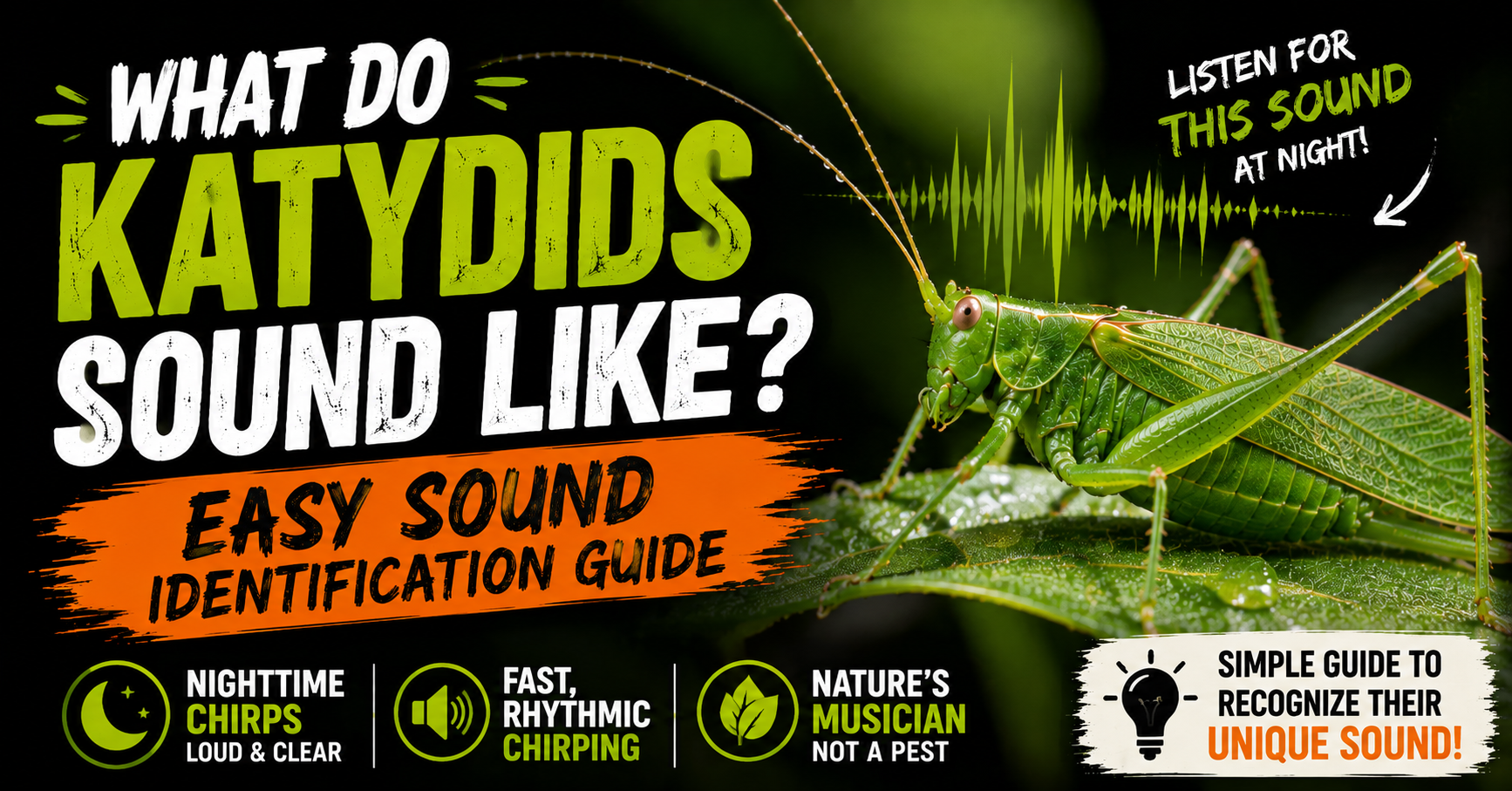
You’re sitting outside on a warm summer evening when you hear it.
A loud, rhythmic call echoes from the trees.
It seems to repeat over and over again, almost like someone is calling from high above.
Many people assume they’re hearing crickets.
Others think it’s a cicada.
In many parts of North America, though, that familiar nighttime sound actually belongs to a katydid.
Katydids are among the loudest insects you’ll hear after dark. Their calls are produced almost entirely by males trying to attract females, and on warm late-summer nights, dozens of males calling together can fill an entire neighborhood with sound.
The Short Answer
Katydids produce loud, repetitive nighttime calls that many people describe as sounding like:
- “Katy did!”
- “Katy didn’t!”
- A harsh rasping chirp.
- A rhythmic buzzing.
- Short repeated phrases.
The exact sound depends on the species, but most katydids call during the evening and throughout the night rather than during the day.
Why Are They Called Katydids?
This is actually one of my favorite insect stories.
Long before modern field guides existed, people tried describing insect sounds using familiar words.
The common true katydid’s call reminded many listeners of someone saying:
“Katy did… Katy didn’t.”
Whether you hear those exact words or not, that’s how the insect earned its common name.
Today, it’s still one of the easiest ways to remember what you’re hearing on a summer night.


Why Do Katydids Make So Much Noise?
The simple answer is:
They’re looking for a mate.
Male katydids call to attract nearby females.
The louder and more consistent the call, the better the chance of being noticed.
If you’ve ever heard dozens of katydids singing from nearby trees at once, you’re actually listening to many males competing for attention at the same time.
How Do Katydids Make Their Sound?
Unlike people, birds, or frogs, katydids don’t have vocal cords.
Instead, they produce sound through a process called stridulation.
The male rubs specialized areas of his front wings together.
One wing contains a tiny file-like ridge while the other acts like a scraper.
As they’re rubbed together, the wings vibrate and create the loud calls you hear during summer nights. The wings themselves also help amplify the sound like a natural speaker.


Why Are Katydids So Loud?
Considering how small they are, katydids can be surprisingly loud.
Several factors help explain why.
First, the insects are often calling from high in trees where the sound carries well.
Second, dozens or even hundreds of males may be calling at once.
Finally, their wing structure is designed to amplify the sound so females can hear it from much farther away.
On quiet summer nights, their chorus can sometimes be heard from hundreds of feet away.
Why Do They Mostly Sing at Night?
Katydids are primarily nocturnal.
They spend much of the daytime resting quietly among leaves where their remarkable camouflage keeps them hidden from birds and other predators.
As evening temperatures begin to cool, they become much more active.
That’s when males begin calling almost continuously in search of mates.
This is one of the easiest ways to distinguish them from cicadas, which are famous for calling during the heat of the day instead.



Why Do Some Nights Sound Louder Than Others?
If you’ve ever thought the katydids were unusually loud one evening and nearly silent the next, you’re not imagining it.
Their activity depends on several factors, including:
- Warm evening temperatures.
- Humidity.
- The number of adult males in the area.
- The stage of the breeding season.
- Calm weather that allows sound to travel farther.
Late summer often produces the loudest choruses because that’s when the greatest number of adult katydids are active at the same time.
Do Female Katydids Make Noise?
For most species, it’s the males doing nearly all of the calling.
The purpose of the sound is simple.
They’re trying to attract females.
Females are generally much quieter and spend more time listening than calling.
Once a female locates a male with a suitable song, the two eventually find one another for mating. That’s why a warm summer evening can sound like an insect concert, with dozens of males calling at once while females remain mostly silent.



How Can You Tell a Katydid From a Cricket by Sound?
This is one of the most common questions homeowners ask.
Both insects are active after dark.
Both create sound by rubbing their wings together.
But their songs have very different personalities.
Crickets usually produce:
- Smooth, steady chirps.
- A more musical rhythm.
- Even spacing between chirps.
Katydids often produce:
- Louder, raspier calls.
- Buzzing or rattling sounds.
- Short repeated phrases.
- Less musical rhythms.
If you’ve ever thought, “That sounds harsher than a cricket,” there’s a good chance you were hearing a katydid instead.
How Can You Tell a Katydid From a Cicada?
Katydids and cicadas are probably confused more than any other two noisy insects.
Fortunately, one clue usually solves the mystery almost immediately.
Listen to the time of day.
Cicadas are famous for calling during hot afternoons and into dusk.
Katydids usually don’t begin their chorus until evening and remain active throughout the night.
The sound itself is different too.
Cicadas often produce a long, continuous buzzing or droning sound that rises and falls in volume.
Katydids usually make shorter, rhythmic phrases or harsh rasping calls that repeat over and over.
If the loud insect chorus starts after dark, katydids are often the better guess.



Can You Identify Different Katydid Species by Sound?
Sometimes.
North America is home to many different katydid species, and each has its own unique calling pattern.
Some make slow, deliberate phrases.
Others produce rapid clicking sounds.
Some create harsh rasps, while others sound surprisingly similar to crickets.
Experienced naturalists can often identify a species by listening alone, much like birdwatchers identify birds by their songs.
For most homeowners, though, simply recognizing that the sound belongs to a katydid is more than enough.
Why Do Katydids Sometimes Stop Singing?
Have you ever walked toward a tree where a katydid was calling only for the sound to suddenly stop?
That’s normal behavior.
Katydids are constantly watching and listening for predators.
If they sense movement, vibration, or another possible threat, they’ll often stop calling immediately to avoid giving away their location.
After a few minutes, if everything seems safe again, the chorus usually resumes.
Why You Usually Hear Them Before You See Them
One of the fascinating things about katydids is how well they stay hidden.

Their bright green bodies and leaf-shaped wings allow them to disappear among tree leaves almost perfectly. Those features are central to this green, leaf-like appearance.
Many species spend their lives high in the tree canopy, making them nearly impossible to spot from the ground.
That’s why most people become familiar with katydids through their sounds long before they ever see one.
Even if dozens are calling overhead, finding a single insect can take patience and a sharp eye.
My Advice
If you hear loud insect calls on warm summer nights, take a moment to listen before assuming they’re crickets or cicadas.
Katydids have some of the most recognizable nighttime songs in North America, and once you learn their rhythm, you’ll start recognizing them almost everywhere.
For me, their calls have become one of the sounds that truly signals late summer has arrived.