You’ve probably seen a big carpenter bee hovering around your porch, flying toward anyone who gets too close. Then, a few minutes later, another carpenter bee quietly slips into a hole in the railing without paying you much attention.
Believe it or not, you may have just watched a male and female carpenter bee behaving exactly the way they’re supposed to.
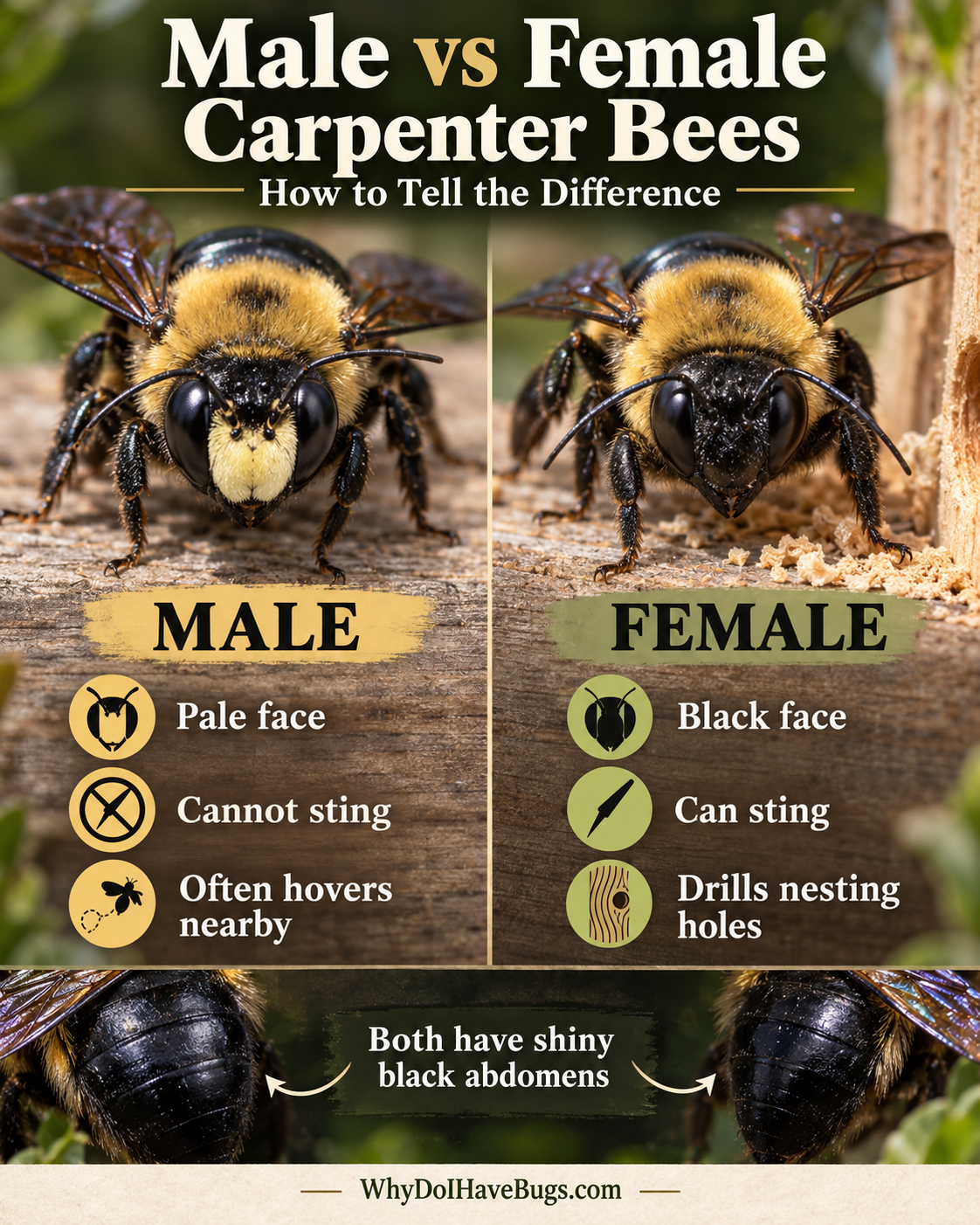
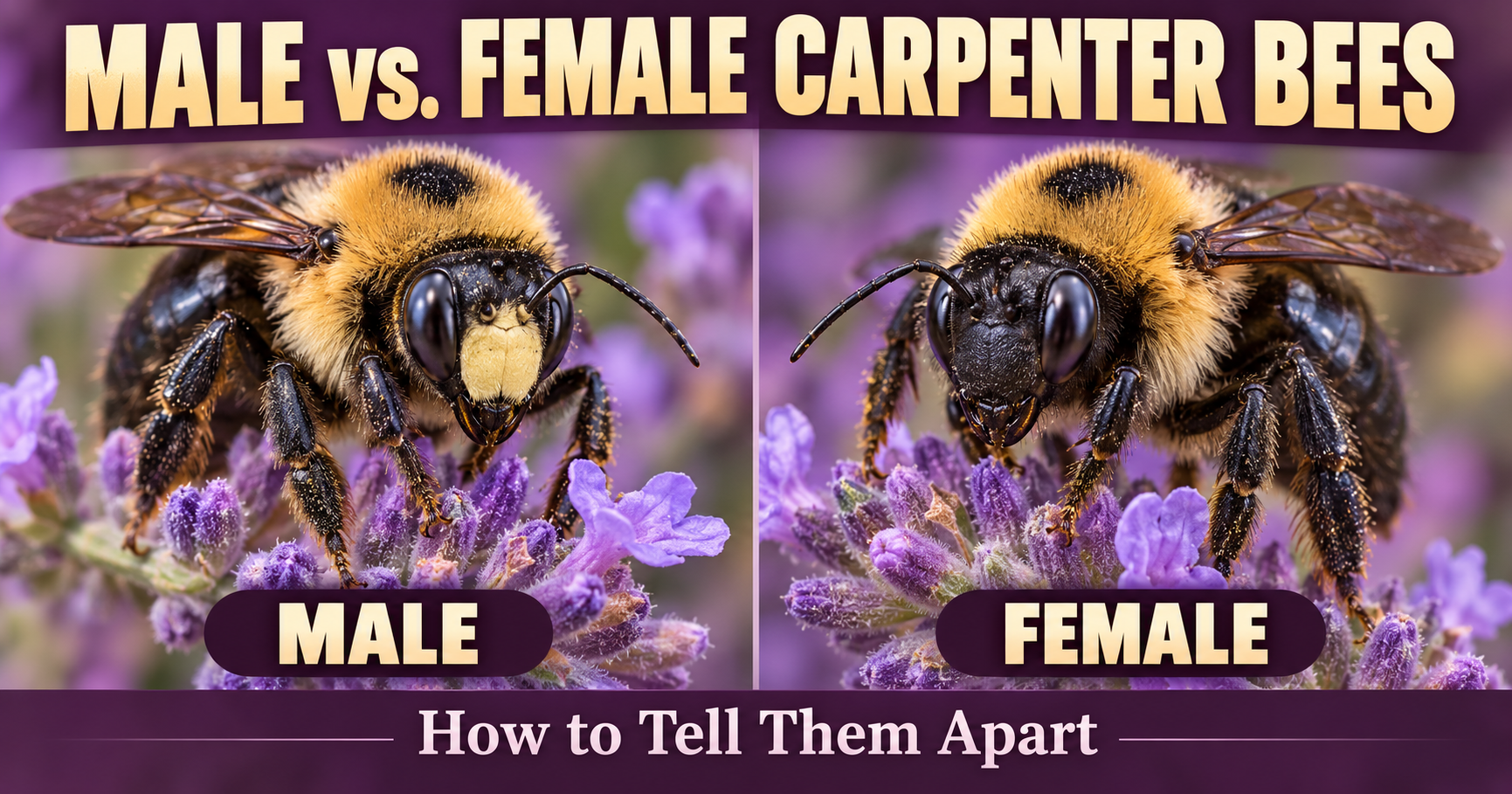
Male and female eastern carpenter bees look remarkably similar, but there’s one easy difference: males have a pale yellowish-white patch on their faces, while females have entirely black faces.
Their behavior is different, too. Males spend much of their time hovering, patrolling, and looking for females. Females are the ones doing the woodworking, excavating nesting tunnels, collecting pollen, and preparing chambers for their young.
If you’ve ever wondered which carpenter bee is buzzing around your head and which one is drilling into your porch, here’s how to tell them apart.
Male vs. Female Carpenter Bees: The Easiest Way to Tell
The face is usually the best place to look.
For the eastern carpenter bee (Xylocopa virginica), which is common throughout much of the eastern United States, the differences are surprisingly noticeable in a good close-up photograph.
Male Carpenter Bees Have White or Yellowish Faces
Look closely at the front of a male eastern carpenter bee’s head.
You’ll notice a pale patch between the eyes.
Depending on the lighting, this marking may appear white, cream-colored, or yellowish.
It can almost look like somebody painted a little spot on the bee’s face.
This pale marking is one of the most useful ways to identify a male eastern carpenter bee without handling it.
Female Carpenter Bees Have Black Faces
Female eastern carpenter bees lack that pale facial patch.
Their faces are predominantly black, including the area between the eyes where males have the lighter marking.
They also have strong mandibles used to chew tunnels into wood.
In a close-up comparison, the difference between the pale-faced male and black-faced female is often quite clear.
One important detail: This identification trick applies specifically to eastern carpenter bees. Other carpenter bee species can have different facial markings, so don’t assume it works for every carpenter bee in North America.
Do Male and Female Carpenter Bees Have Different Bodies?
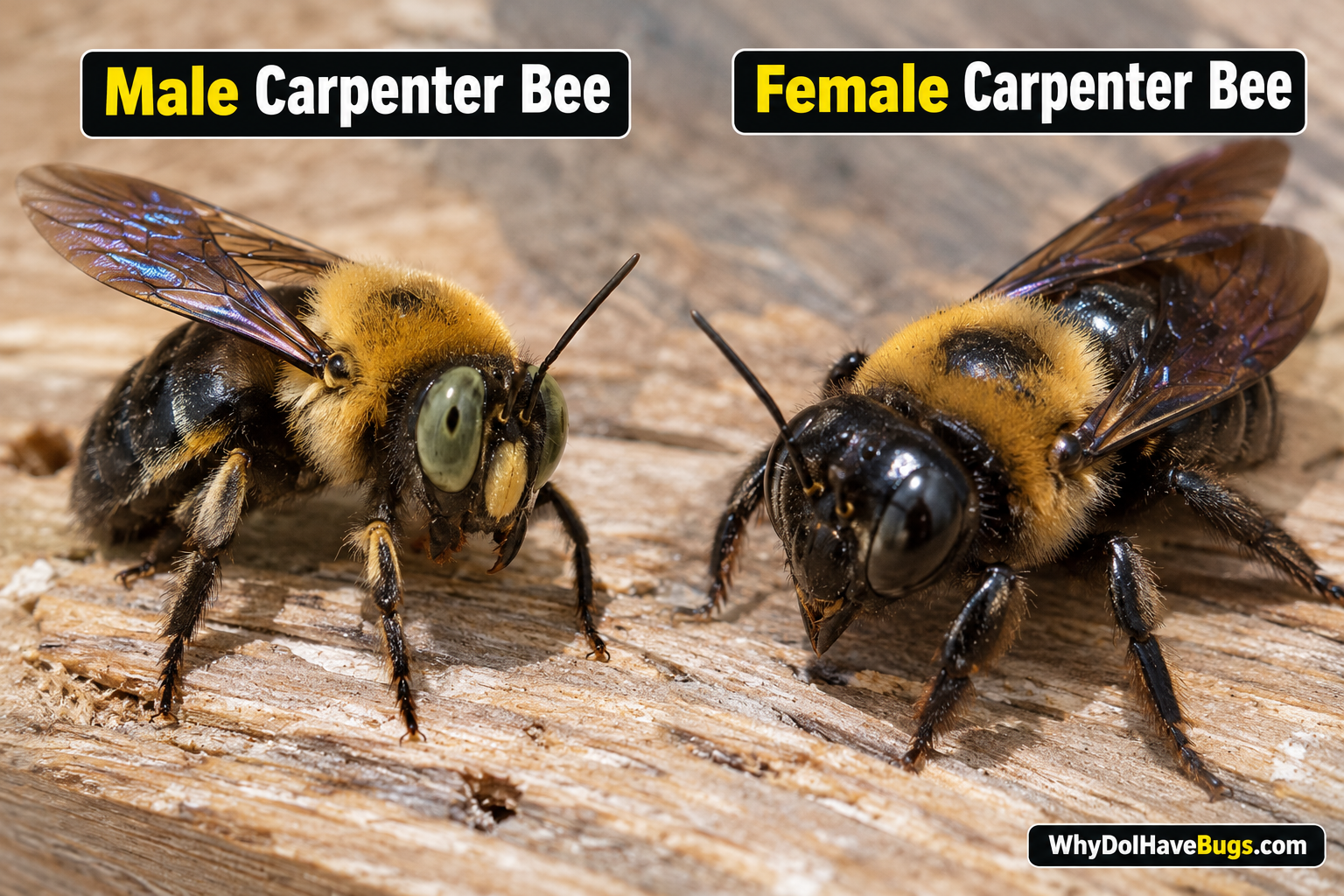
Both sexes have the large, stocky appearance most people associate with carpenter bees.
Eastern carpenter bees commonly measure approximately 3/4 to 1 inch long.
Their thoraxes are covered in yellowish hairs, while the upper surfaces of their abdomens are mostly black, smooth, and shiny.
That glossy abdomen is also one of the easiest ways to distinguish eastern carpenter bees from many bumblebees.
Are Female Carpenter Bees Bigger Than Males?
Not necessarily.
Male and female eastern carpenter bees overlap considerably in size, so judging sex by body length isn’t particularly reliable.
You may notice individual bees that look slightly larger or stockier than others, but that doesn’t automatically tell you whether they’re male or female.
The facial marking is a much better clue.
Do Female Carpenter Bees Look More Black?
From the front, females can appear darker because their faces lack the male’s pale marking.
However, both sexes have dark abdomens and similarly colored thoraxes.
A bee that looks darker overall isn’t necessarily female.
Lighting, posture, and the condition of the bee’s body hairs can affect its appearance.


Why Do Male Carpenter Bees Hover in Your Face?
This is one of the most entertaining, and sometimes intimidating, differences between the sexes.
Male carpenter bees often establish territories around nesting areas.
They patrol those spaces while searching for females and trying to discourage competing males.
Unfortunately, they don’t always distinguish between another bee and a person walking onto the porch.
A male may hover directly in front of your face, dart toward you, retreat, and then come back again.
It can feel like he’s deliberately trying to chase you away.
In a sense, he is defending his territory, but there’s an important catch.
Male Carpenter Bees Cannot Sting
Despite their bold behavior, male carpenter bees do not have stingers.
They may fly toward people and appear aggressive, but they cannot sting you.
That doesn’t mean you should grab or deliberately provoke them.
It simply means the hovering behavior is usually more frightening than dangerous.
If you can safely see a pale patch on the face of a carpenter bee that’s hovering around your porch, there’s a good chance you’re watching a territorial male eastern carpenter bee.
Why Don’t Female Carpenter Bees Chase People as Much?
Female carpenter bees are generally occupied with different responsibilities.
They’re responsible for excavating nests, gathering pollen and nectar, and provisioning their offspring.
They can defend themselves when threatened, but they usually aren’t the ones repeatedly patrolling an area and challenging everything that moves.
If you see a carpenter bee quietly entering a wooden nesting tunnel, it may be a female working on her nest.
Which Carpenter Bee Drills Holes in Wood?
Female carpenter bees are responsible for excavating nesting galleries.
This is one of the biggest behavioral differences between males and females.
The female uses her powerful mandibles to chew an entrance into suitable wood.
She then creates a tunnel that generally continues along the grain.
Inside, she prepares individual brood chambers for her developing young.
Do Male Carpenter Bees Drill Holes?
No. Male eastern carpenter bees don’t excavate nesting galleries the way females do.
They may use existing galleries for shelter, but the construction work is done by females.
That means the bee you see hovering around the porch isn’t necessarily the one creating those perfectly round holes.
In fact, the male may spend much of his time patrolling while a female works inside the wood.
How Can You Tell if a Female Is Building a Nest?
Look for repeated entry into the same wooden opening.
Fresh sawdust beneath a hole can also indicate excavation.
However, watching a carpenter bee enter a gallery doesn’t prove it’s actively drilling. Bees can reuse existing nesting tunnels.
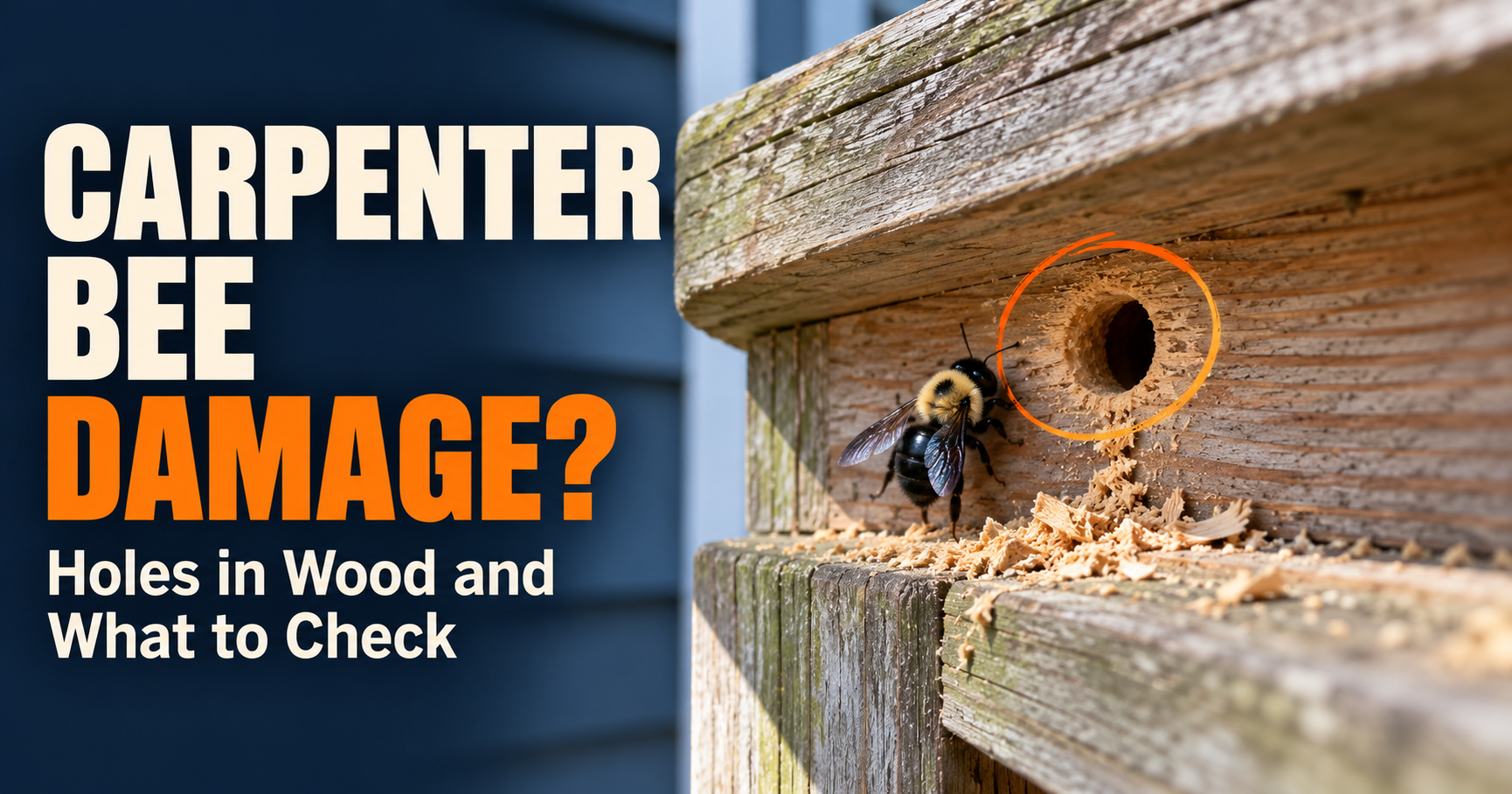
Our guide to identifying carpenter bee holes and recognizing real damage explains what to look for.
Do Female Carpenter Bees Sting?
Yes. Female carpenter bees have functional stingers.
However, they’re generally not aggressive toward people.
A female is more likely to sting if she’s handled, trapped, squeezed, or seriously threatened.
Simply walking past a female carpenter bee visiting flowers usually isn’t a reason to worry.
The distinction is easy to remember:
Males are often the ones acting intimidating, but females are the ones physically capable of stinging.
This is one reason understanding their behavior can make people more comfortable around carpenter bees.
You don’t need to swat at every large bee that flies near your porch.
Give it space and allow it to continue doing what it’s doing.
What Does a Female Carpenter Bee Do All Day?
Female carpenter bees do most of the work associated with raising the next generation.
Once a female has mated, she locates a suitable nesting site.
That may involve reusing an existing wooden gallery or excavating a new one.
After preparing the tunnel, she creates brood chambers where her young will develop.
Collecting Pollen and Nectar
Female carpenter bees visit flowers to gather pollen and nectar.
They use these materials to create food provisions for their developing larvae.
Each egg is placed in a chamber containing an appropriate food supply.
The female separates chambers within the gallery using partitions made from chewed wood material.
Raising the Next Generation
The young develop inside their individual chambers.
Unlike honey bees, eastern carpenter bees don’t live in large colonies with a queen and thousands of workers.
Their nesting behavior is primarily solitary, although related individuals can share or reuse nesting areas, and social interactions do occur.
Each nesting female plays a major role in provisioning her own offspring.
Are Female Carpenter Bees Good Pollinators?
Absolutely.
As females travel between flowers collecting pollen and nectar, they contribute to pollination.
Carpenter bees can also perform buzz pollination, vibrating flowers to help release pollen.
This makes them valuable visitors to certain garden plants and native flowers.
It’s worth remembering that the bee excavating your porch is also capable of providing real ecological benefits.
That doesn’t mean you have to allow structural damage. It simply means prevention and nonlethal management deserve consideration.

What Do Male Carpenter Bees Do?
Male carpenter bees have a very different role.
Their primary reproductive responsibility is finding and mating with females.
During spring, males may spend considerable time patrolling suitable territories.
They often choose areas around wooden nesting sites or places where females are likely to appear.
Males Defend Territories
A male may hover repeatedly in the same general area.
He might investigate another insect, chase a rival male, or approach a person walking nearby.
These behaviors help explain why a carpenter bee can seem unusually interested in you.
He’s not trying to eat your food or drink your blood.
He’s responding to movement in an area he’s patrolling.
Male Carpenter Bees Visit Flowers Too
Males also feed on nectar.
They can visit flowering plants and contribute to pollination as they move between flowers.
Although females perform the nesting and provisioning work, both sexes can be involved in visiting flowers.
Can Male and Female Carpenter Bees Live in the Same Hole?
Yes.
Eastern carpenter bee nesting galleries can be used by more than one individual at different times.
Males and females may share nesting areas, and new adults can remain associated with their natal galleries after emerging.
Carpenter bees may also overwinter inside existing wooden tunnels.
That’s why you shouldn’t assume a hole is empty simply because you haven’t seen a female actively working on it.
If you find carpenter bee holes in your deck or porch, don’t immediately seal them while insects may still be inside.
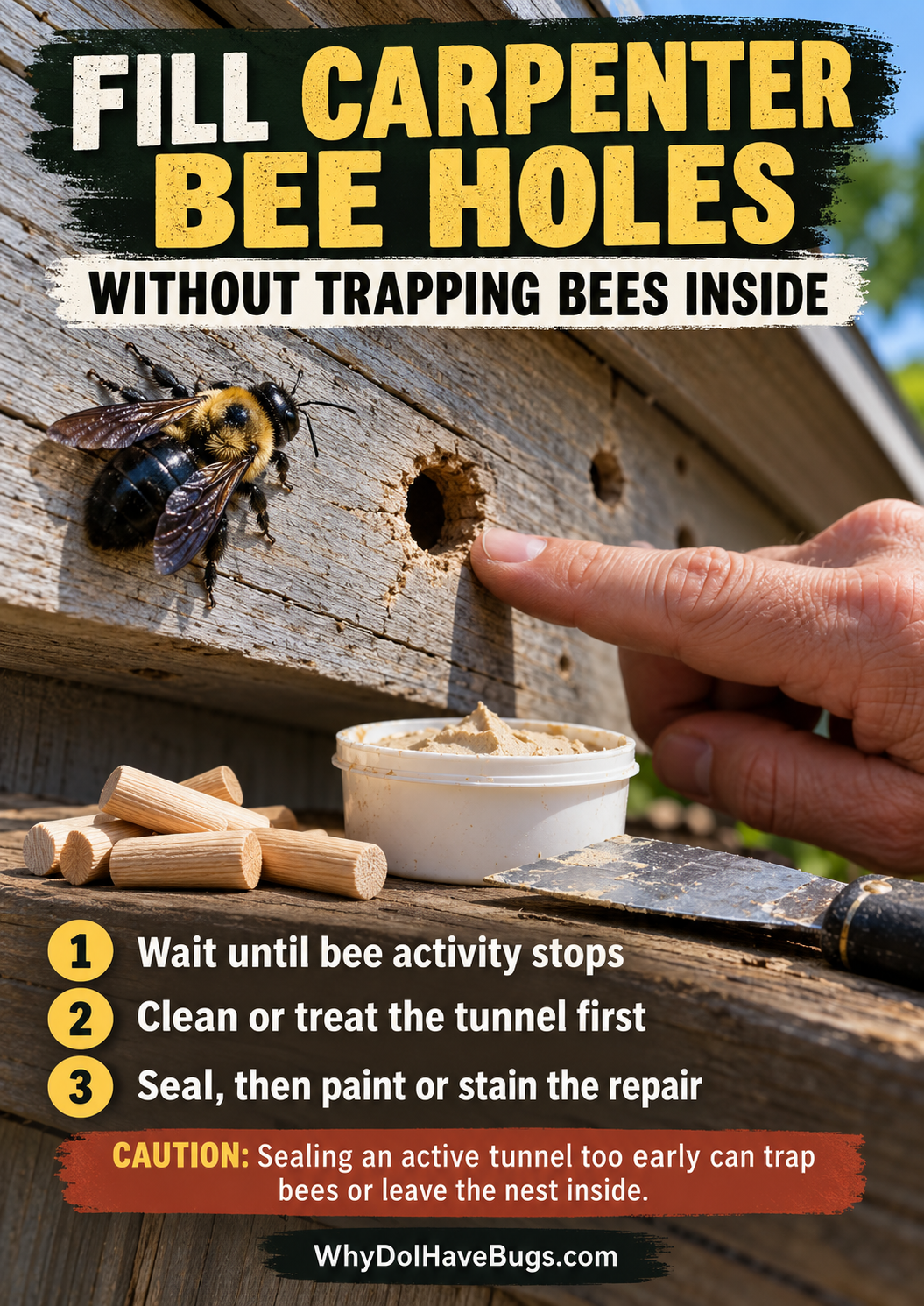
Our article explaining how to fill carpenter bee holes without trapping bees covers why occupancy matters before making repairs.
Can You Tell a Male or Female Carpenter Bee From a Picture?
Often, yes, especially when the photograph clearly shows the face of an eastern carpenter bee.
A front-facing picture can reveal the pale facial patch characteristic of males.
A female’s face will appear predominantly black.
The Best Angle for Identifying Carpenter Bee Sex
Try to capture the bee from the front or slightly above and in front.
You want the area between the eyes to be visible.
A side-view photograph may show the bee’s body shape but not enough facial detail to determine its sex.
Avoid handling a live bee just to take a picture.
If you already have a good comparison image, placing male and female eastern carpenter bees side by side makes the distinction especially easy for readers.
What if the Bee Has a Yellow Face but Doesn’t Look Like a Carpenter Bee?
Not every bee with pale facial markings is a carpenter bee.
Other bee species can also have light-colored markings on their heads.
First, confirm that you’re looking at a carpenter bee.
For eastern carpenter bees, the combination of a large body, yellow-haired thorax, glossy dark abdomen, and the appropriate facial pattern is useful.
If the identification remains uncertain, a local extension office or insect identification specialist may be able to help.
Why Knowing the Difference Can Help You Protect Your Porch
Understanding male and female behavior can prevent unnecessary pest-control decisions.
If you see a large bee hovering around your deck, it may simply be a male patrolling for females.
He isn’t necessarily drilling into your wood.
If you see fresh sawdust and a female repeatedly entering a hole, you may have an active nesting gallery.
In that situation, protecting the wood becomes more relevant.
Preventing Damage Without Killing Carpenter Bees
Carpenter bees are valuable pollinators, and a bee visiting flowers shouldn’t automatically be considered a pest.
When possible, focus on keeping important wooden structures less attractive for nesting.
Properly painted wood is generally less appealing than unfinished or weathered lumber.
For vulnerable outdoor surfaces, some homeowners also consider purpose-made deterrents.

One example is Best Bee Brothers Citrus Carpenter Bee Repellent Spray , which contains lemongrass and citronella oils and is marketed to discourage new nesting on outdoor wooden surfaces.
The effectiveness of this particular product hasn’t been independently verified here, so it shouldn’t replace maintaining and protecting the wood.
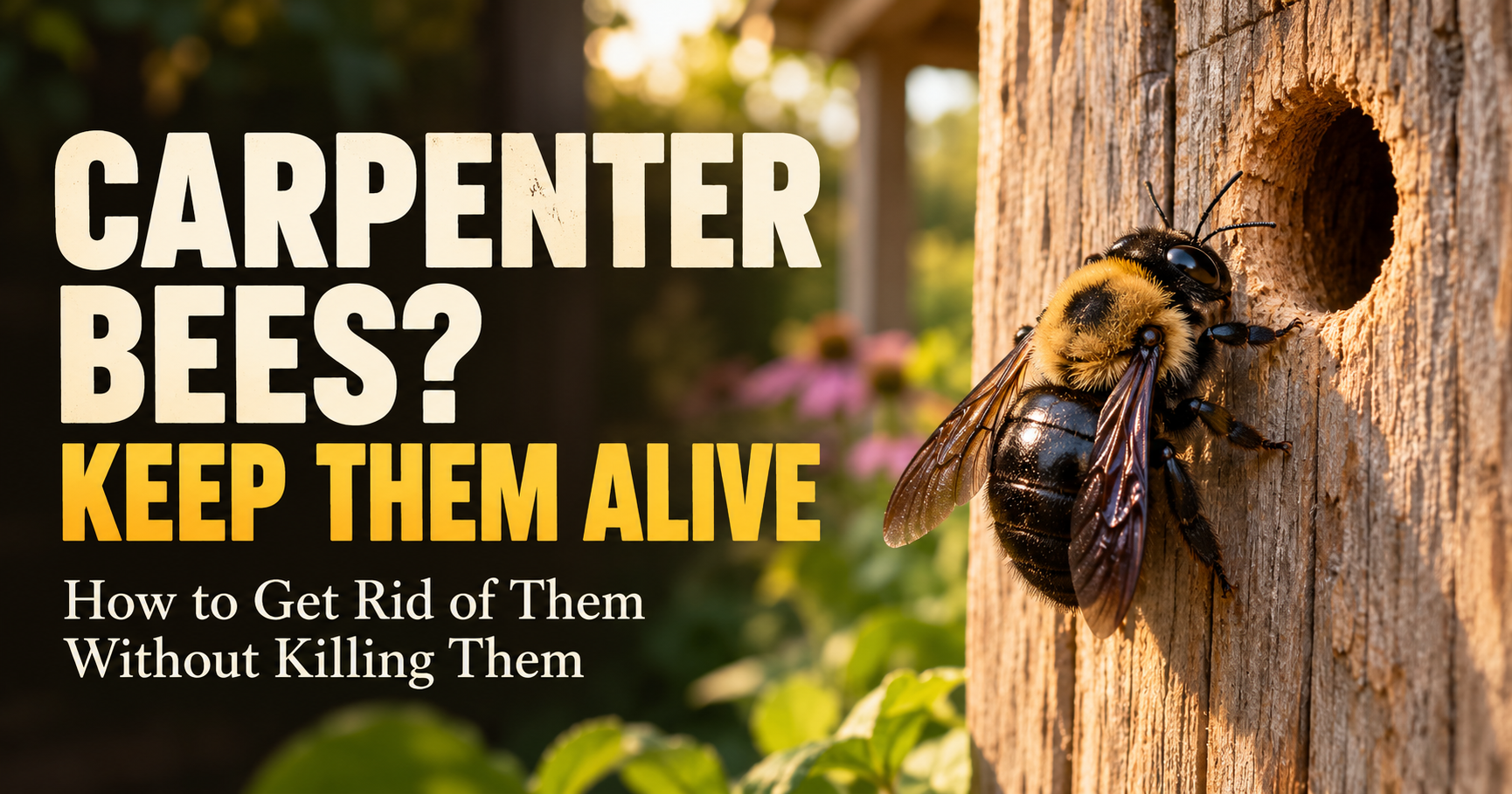
Our complete guide to discouraging carpenter bees without killing them explains the different prevention options and when intervention makes sense.
Frequently Asked Questions
How do you tell if a carpenter bee is male or female?
For eastern carpenter bees, males have a noticeable pale yellowish-white patch on their faces. Females have entirely black faces. This is generally a more reliable clue than size or overall body color.
Are male carpenter bees bigger than females?
Their sizes overlap considerably. Some physical differences exist, but size alone isn’t a dependable way to determine the sex of an eastern carpenter bee.
Why do male carpenter bees have white faces?
The pale facial patch is a natural sex-related physical characteristic of male eastern carpenter bees. It’s useful for identification, although its precise evolutionary function shouldn’t be assumed from appearance alone.
Do female carpenter bees have yellow faces?
Female eastern carpenter bees normally have black faces without the distinct pale facial marking found on males. Other carpenter bee species can have different markings.
Which carpenter bee is more aggressive?
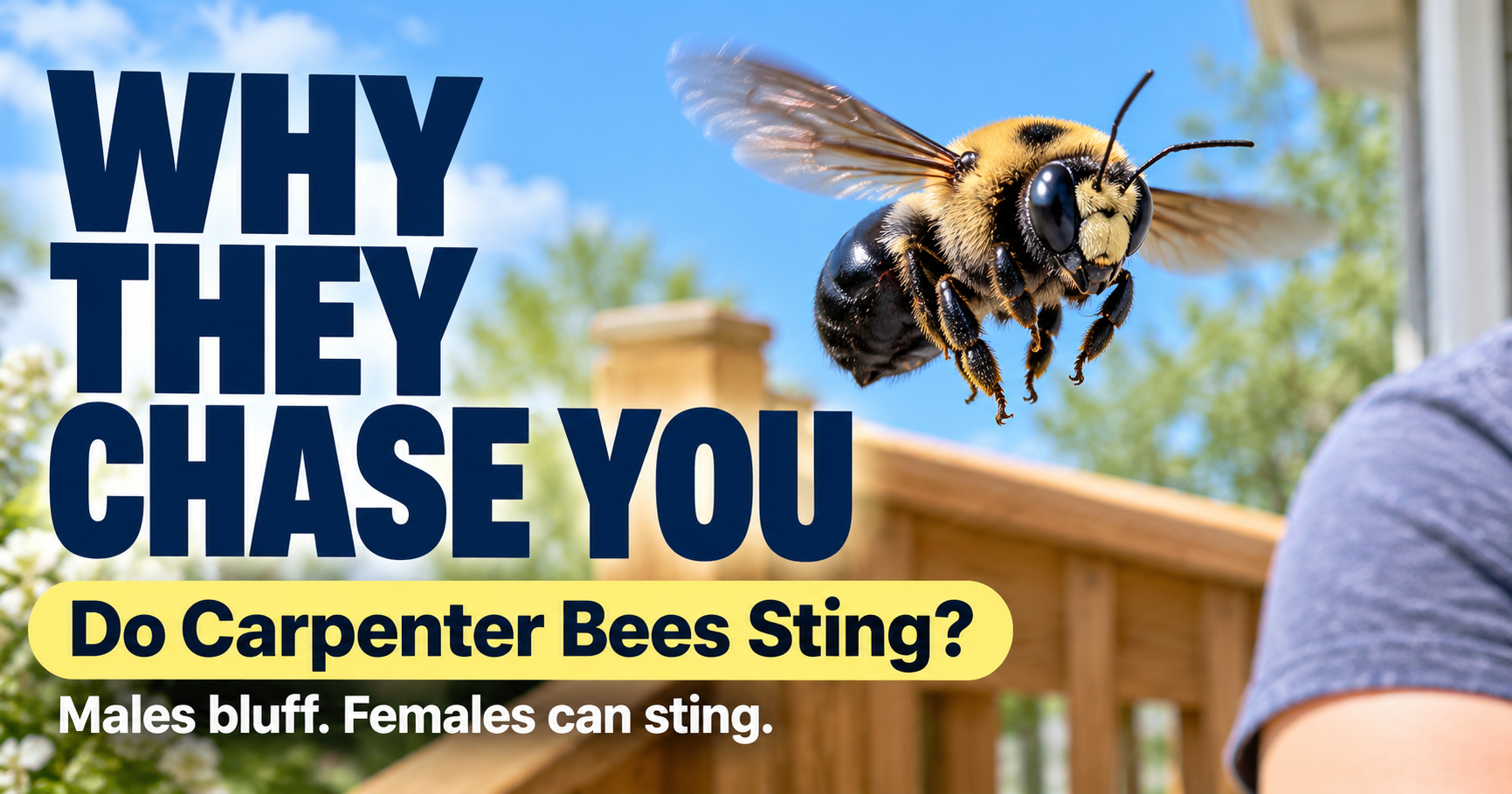
Male eastern carpenter bees often behave more territorially, hovering around people and chasing moving objects. However, they cannot sting. Females can sting but generally avoid confrontation.
Do male carpenter bees make nests?
No. Female carpenter bees excavate and provision the nesting galleries. Males may use existing tunnels for shelter.
Can a male carpenter bee bite?
Male carpenter bees have mandibles and could potentially pinch if handled, but they aren’t known for biting people during ordinary encounters. They cannot sting.
Do male and female carpenter bees both pollinate flowers?
Yes. Both sexes visit flowers, although females also collect pollen to provision their offspring. Carpenter bees are important pollinators, including for plants that benefit from buzz pollination.
Why does a carpenter bee keep hovering in front of me?
A territorial male may be investigating movement near his patrol area. If it’s a male eastern carpenter bee with a pale facial patch, it cannot sting. Give it space rather than swatting at it.
Are male and female carpenter bees different colors?
They have broadly similar body colors. The most noticeable difference in eastern carpenter bees is the pale facial patch on males compared with the black face of females.
Do female carpenter bees stay inside their nests?
Females enter their nesting galleries to excavate chambers and provision eggs, but they also leave to gather pollen and nectar. Their activity varies with the season and nesting stage.
About the Author: The writers at Why Do I Have Bugs help homeowners identify insects, understand their behavior, and find practical ways to protect their property while respecting the important role beneficial species play in nature.