You notice a tiny black fly crawling across the soil in one of your houseplants. A little later, another one is running across the kitchen counter. They look almost identical from a distance, but are they actually the same insect? If the insect is neither a fungus gnat nor a phorid fly, tracking down a fruit fly source offers a useful way to investigate the kitchen source.
Two possibilities are fungus gnats and phorid flies.
Both are tiny, dark-colored flies that show up inside American homes. Both can be found around moisture and decaying organic material. And both can become frustrating when you can’t figure out where they’re coming from.
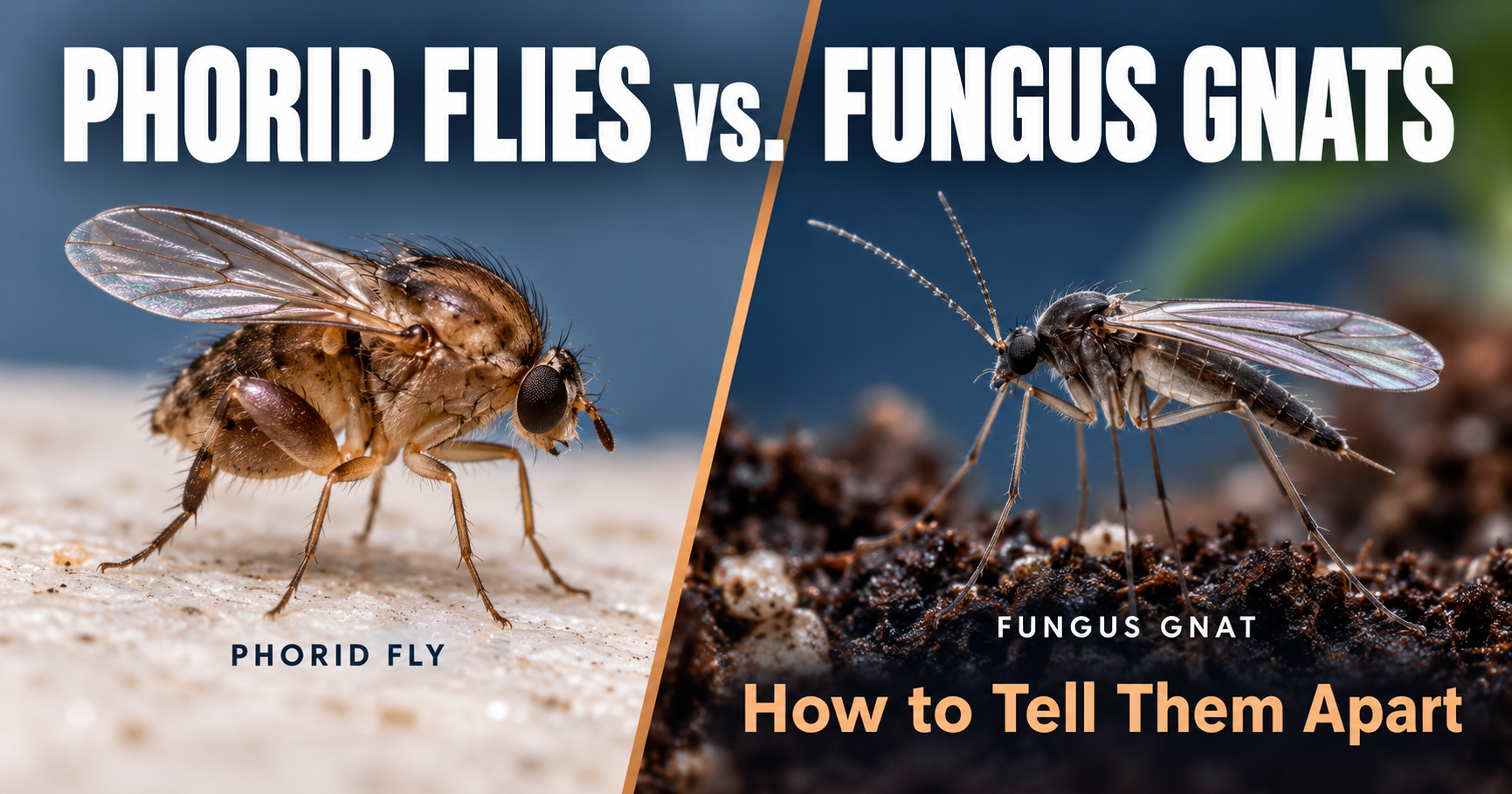
The easiest way to tell phorid flies from fungus gnats is to compare their body shapes. Fungus gnats look like miniature mosquitoes, with slender bodies, long legs, and noticeably long antennae. Phorid flies have shorter antennae, a more compact body, and a distinctive humpbacked appearance. Once you have a likely identification, compare their body shapes explains how to address the infestation.
There’s another clue that’s especially useful. Phorid flies often run across surfaces in quick, jerky movements, while fungus gnats are commonly found resting or crawling around damp potting soil.
Let’s look at how to recognize each one and what their presence might be telling you about your home.
Phorid Flies vs. Fungus Gnats: The Biggest Difference
If you’ve managed to catch one of these tiny insects, take a close look at its body from the side.
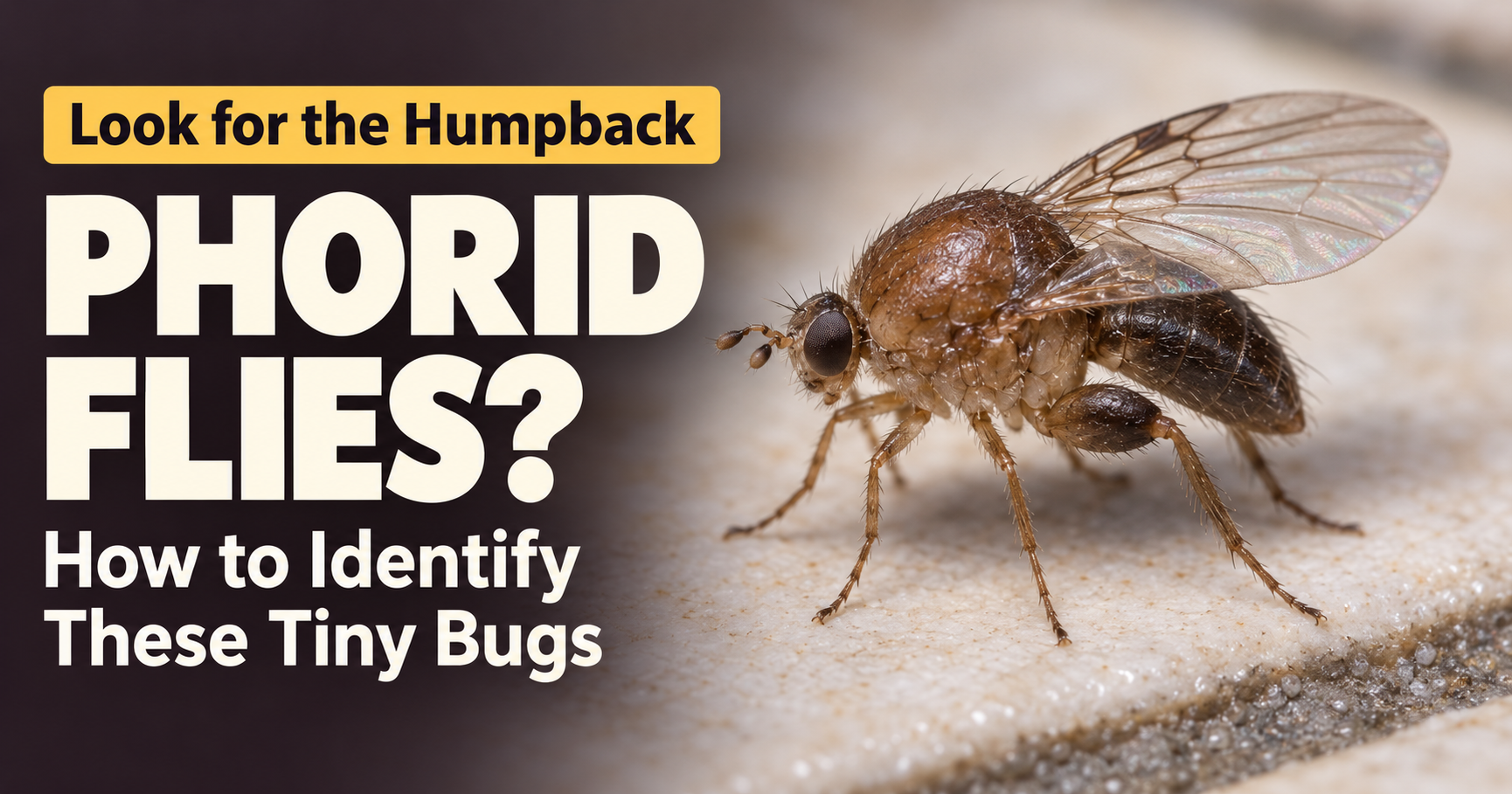
A phorid fly looks somewhat stocky for its size. Its thorax, the section directly behind its head, curves upward into a noticeable hump.
The legs can be fairly prominent, particularly the hind legs, but the body doesn’t have the delicate, mosquito-like appearance of a fungus gnat.
Fungus gnats are different.
They generally have long, slender legs, a narrow body, and antennae that are noticeably longer than those of phorid flies.
Many of the fungus gnats found in homes belong to the family Sciaridae, commonly called dark-winged fungus gnats.
If you can see the insect clearly, those long antennae are one of the best ways to separate them from phorid flies.
Quick Differences to Look For
- Body shape: Phorid flies have a noticeably humped thorax, while fungus gnats look slender and mosquito-like.
- Antennae: Phorid flies have short antennae. Fungus gnats have longer, segmented antennae.
- Movement: Phorid flies are famous for running in fast, jerky bursts. Fungus gnats may also run, but often remain around potting soil.
- Wings: Phorid flies have distinctive heavy veins toward the front edge of their wings. Many common dark-winged fungus gnats have a Y-shaped wing vein.
- Breeding sources: Phorid flies use various kinds of decomposing organic matter. Fungus gnats are especially associated with damp soil and potting mixes.
You don’t need to identify every tiny detail to narrow things down.
Usually, body shape, antennae, and where you keep finding the insects provide a good starting point.



What Do Phorid Flies Look Like?
Phorid flies belong to the family Phoridae.
They’re also called scuttle flies or humpbacked flies.
Many household species are approximately 1/16 to 1/8 inch long, although the size varies.
Their bodies can be tan, brown, dark brown, or nearly black.
The most recognizable feature is that raised thorax.
When viewed from the side, the insect almost looks hunched over, with its small head positioned lower than the highest part of its back.
Their Legs and Wings Are Different Too
Phorid flies often have relatively prominent hind legs.
Their wings also have a distinctive vein pattern.
Several heavier veins are concentrated toward the front edge, with thinner veins extending across the rest of the wing.
You probably won’t see those details without magnification.
But if you have a sharp close-up photograph, an insect identification specialist can use the wing pattern to help confirm what you’ve found.
We’ve already covered these physical features in greater detail in our guide to identifying phorid flies.
Why Do Phorid Flies Run So Much?
This is one of the strangest things about them.
A phorid fly may run quickly across a countertop, stop abruptly, turn around, and run in another direction.
It can almost look like it’s searching for something.
That behavior is why they’re called scuttle flies.
They can fly, of course, but rapid running is a characteristic behavior of many species.
If you’re watching a tiny dark fly repeatedly dart across your sink or countertop, phorid flies should be on your list of possibilities.


What Do Fungus Gnats Look Like?
Fungus gnats have a noticeably different appearance when you can examine them closely.
They’re small, dark-colored flies with long legs and long antennae.
Most common household fungus gnats are around 1/16 to 1/8 inch long, although some species are larger.
Their bodies look delicate and narrow, almost like miniature mosquitoes.
Unlike phorid flies, they don’t have the same exaggerated humpbacked shape.
Look Closely at the Antennae
The antennae are especially useful for identification.
Dark-winged fungus gnats have long, segmented antennae that can extend noticeably beyond the head.
Phorid flies have much shorter antennae.
If you’re looking at a small fly and can clearly see long, thin antennae extending forward from its head, fungus gnats become a stronger possibility.
What About Their Wings?
Many common dark-winged fungus gnats have a distinctive Y-shaped vein pattern on their wings.
This can be a useful identification detail under magnification.
Their wings are generally clear to grayish.
However, not every household fly you find around plants will have an obvious wing pattern you can see with a phone camera.

For additional identification details, see our fungus gnat appearance guide.
Why Are Tiny Flies Around My Houseplants?
If the insects are concentrated around your plants, fungus gnats are one of the first possibilities to investigate.
Adult fungus gnats commonly lay eggs in moist potting soil containing suitable organic material.
Their larvae develop in the soil, feeding primarily on fungi and decomposing plant matter. Some also feed on delicate plant roots.
That’s why fungus gnat problems often become noticeable when houseplants are watered too frequently.
The soil stays damp, fungi develop, and the environment becomes suitable for the larvae.
Does That Mean Every Fly Around a Plant Is a Fungus Gnat?
No.
Phorid flies can also be associated with moist organic matter, including certain potting mixes containing decomposing material.
A fly hovering around a plant doesn’t automatically identify itself as a fungus gnat.
You still need to examine its body.
If it’s slender, mosquito-like, and has long antennae, fungus gnats are more likely.
If it has a humpbacked body and frequently scuttles across surfaces, consider phorid flies.
How to Check Whether Your Plant Has Fungus Gnats
Start by looking closely at the soil.
Is it constantly damp?
Does the pot drain properly?
Are tiny adult flies resting on the soil surface or appearing when you disturb the plant?
You can place a yellow sticky trap near the soil to help monitor adult activity.
A small slice of raw potato placed cut-side down on the soil can also help detect fungus gnat larvae. After a few days, examine its underside for small, pale larvae with dark heads.
This is a monitoring method, not a complete treatment.
If you find larvae, photograph them or have them identified rather than assuming all small fly larvae are fungus gnats.


Why Are Tiny Flies Running Around My Kitchen Sink?
Now imagine a different situation.
Your houseplants look fine, but you’re finding tiny dark flies running across the kitchen countertop.
Some appear near the sink, and others gather around the windows.
You don’t notice many insects near your plants.
That pattern makes phorid flies worth investigating.
Certain phorid fly species can develop in moist, decaying organic material associated with drains, garbage, and other hidden sources.
However, seeing one near a sink doesn’t prove that it’s coming from the plumbing.
Adult flies can travel away from their breeding location.
The insect may have developed in a trash container, organic buildup beneath an appliance, or somewhere else entirely.
Could Fungus Gnats Be Around the Kitchen Sink Too?
Absolutely.
Adult fungus gnats can wander away from their plants.
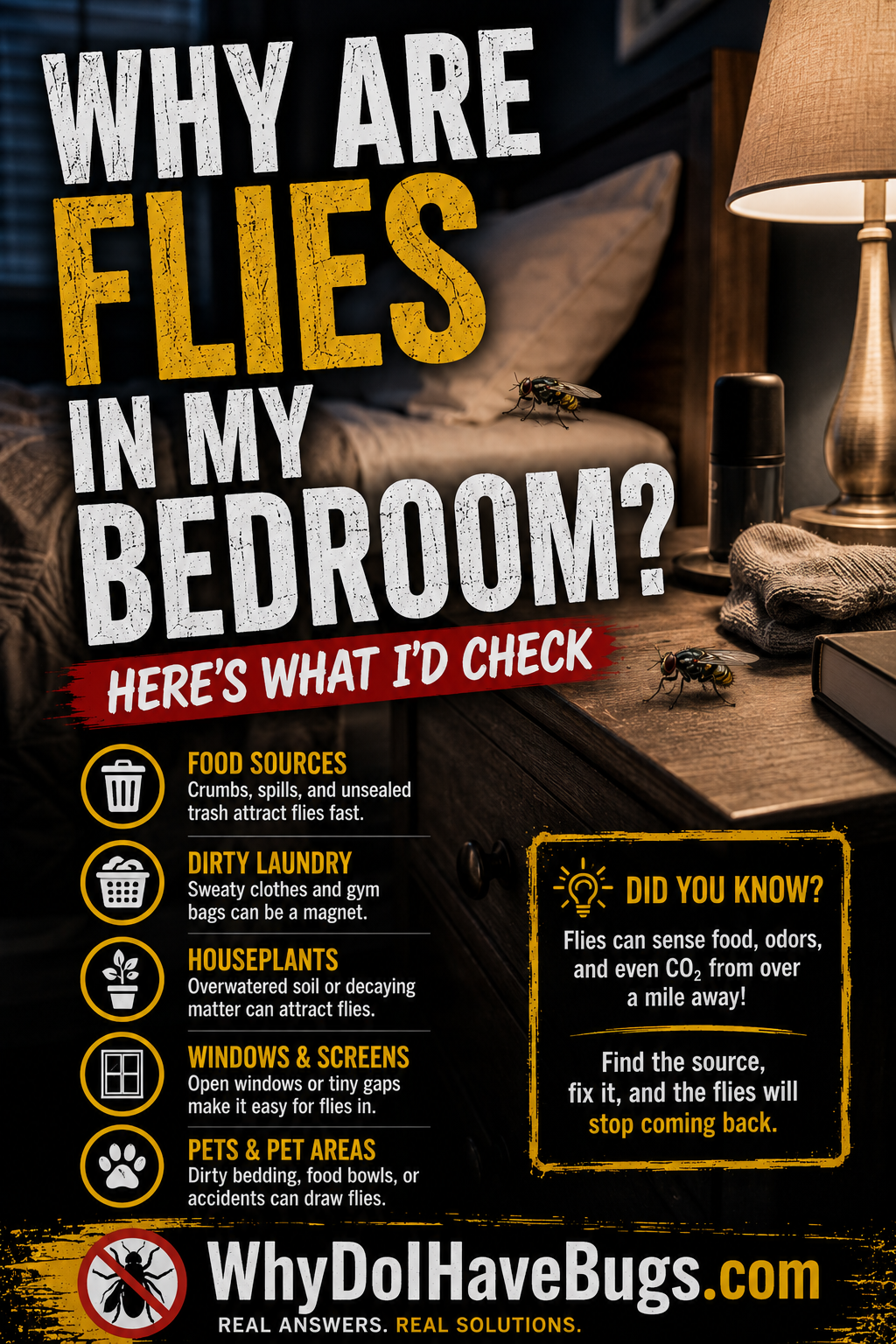
They’re also attracted to light and may gather near windows, lamps, and other illuminated areas. If that light-seeking behavior is most noticeable where you sleep, flies gathering near bedroom windows explains what to check before assuming the bedroom is the source.
If you have potted plants in the kitchen, fungus gnats could easily end up near the sink.
This is why the body shape matters more than the location alone.
Phorid Fly Larvae vs. Fungus Gnat Larvae
The adult insects are different, but their young also have useful identification features.
Both insects undergo complete metamorphosis, developing through egg, larval, pupal, and adult stages.
Neither starts life looking like a miniature adult fly.
Fungus Gnat Larvae
Fungus gnat larvae are slender, pale, legless insects that often have translucent or whitish bodies.
One of their most noticeable features is a small, shiny black head capsule.
They’re commonly found in moist potting media where they feed on fungi and organic matter.
Depending on the species, they may also feed on plant roots.
Phorid Fly Larvae
Phorid fly larvae are small, pale, legless, maggot-like insects.
Their precise appearance varies among species, and they’re often difficult to identify without magnification.
They develop in suitable decomposing organic material.
You might find them in wet garbage, decaying food residue, or other organic matter supporting the adults.
Can You Tell the Larvae Apart Easily?
Sometimes, but not always.
The distinct dark head capsule of common fungus gnat larvae can be helpful.
Phorid fly larvae generally have a more typical maggot-like appearance without the same obvious black head.
However, several other fly larvae can look similar.
If the breeding source matters, don’t rely solely on the appearance of one pale larva.

Which Fly Is More Likely to Damage Houseplants?
Fungus gnats are the more important concern when it comes to plant roots.
Their larvae primarily feed on fungi and decaying organic matter, but some also feed on root hairs and tender roots.
Severe infestations can harm seedlings and young plants, especially when the soil stays consistently wet.
You might notice poor growth or wilting in heavily affected plants.
However, overwatering, root disease, and poor drainage are often more common causes of those symptoms.
Phorid flies aren’t generally considered major houseplant root pests.
Some species can develop in decaying material associated with pots, but the presence of phorid flies doesn’t automatically mean plant roots are being eaten.
Do Phorid Flies and Fungus Gnats Bite?
Neither is normally a biting household pest.
The common fungus gnats found around houseplants do not feed on human blood.
Household nuisance phorid flies also don’t normally bite people.
If you’re noticing itchy skin or unexplained marks, don’t automatically blame either insect just because you found tiny flies in your home.
Many other insects and non-insect causes can produce skin irritation.
Proper identification is more reliable than trying to determine the insect from a skin reaction.


Which Is Harder to Get Rid Of?
That depends more on the breeding source than the insect’s name.
Fungus Gnats Are Often Easier to Trace
When fungus gnats are developing in houseplants, the source is frequently accessible.
You can inspect the potting soil, adjust watering practices, and remove accumulated plant debris.
If necessary, a biological control product containing Bacillus thuringiensis israelensis (Bti) may help control fungus gnat larvae when labeled for that use.
The most important step is correcting overly wet conditions.
Phorid Flies Can Have Hidden Sources
Phorid flies may be more frustrating when their larvae are developing in an inaccessible location.
A forgotten spill behind an appliance can be difficult to notice.
Organic buildup inside a drain may require cleaning.
Occasionally, persistent populations are associated with wastewater leaks or sewage-contaminated material.
In those situations, the problem may require professional investigation rather than another fly trap.
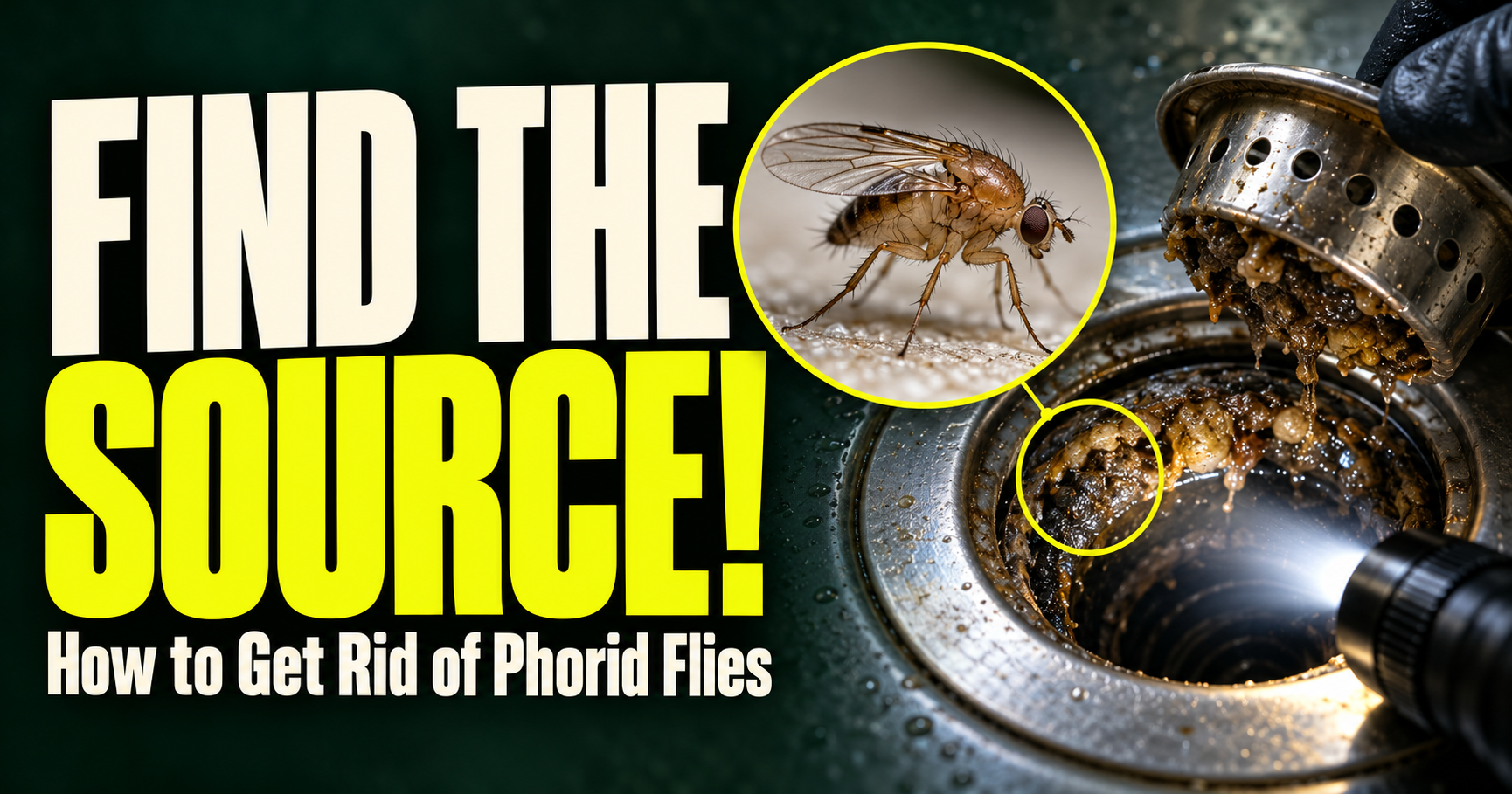
Our step-by-step phorid fly removal guide explains how to investigate those possible breeding sites.
How to Tell Which Tiny Fly You Have
If you’re standing in your kitchen or beside your houseplants trying to figure out what you’ve found, here’s how I’d narrow it down.
First, Look at the Body Shape
Does the insect have a raised, humpbacked thorax?
That points toward a phorid fly.
Does it have a thin, delicate body resembling a miniature mosquito?
That points toward a fungus gnat.
Next, Check the Antennae
Long, slender antennae are characteristic of fungus gnats.
Short antennae are characteristic of phorid flies.
This is particularly useful when the body shape isn’t obvious.
Watch Where It Spends Its Time
Fungus gnats frequently rest or crawl on potting soil, foliage, and nearby surfaces.
Phorid flies can appear around a wide range of moist, decaying materials and often scuttle across countertops or other surfaces.
Remember that both can move away from their breeding sources.
Finally, Investigate the Possible Breeding Area
If the soil remains wet and small flies keep appearing around a plant, inspect for fungus gnat activity.
If flies are repeatedly appearing around trash, damp organic debris, or plumbing areas, look more closely for phorid flies.
When in doubt, collect a specimen and compare it with reliable insect identification photographs.

Can You Have Both Phorid Flies and Fungus Gnats at the Same Time?
Yes.
There’s nothing preventing both insects from appearing in the same house.
You might have fungus gnats developing in overwatered houseplants while phorid flies are associated with decaying material elsewhere.
This can make the problem confusing because you may find several tiny flies with slightly different appearances.
If some flies look slender and mosquito-like while others have rounded, humpbacked bodies, consider the possibility of two species.
Don’t assume that one treatment will necessarily eliminate both.
Correct identification helps you locate the appropriate source for each insect.
Frequently Asked Questions
Are phorid flies the same as fungus gnats?
No. They’re different groups of flies. Phorid flies belong to the family Phoridae, while many common household fungus gnats belong to the family Sciaridae.
Are phorid flies bigger than fungus gnats?
Not necessarily. Their sizes overlap considerably, and many household species measure around 1/16 to 1/8 inch long.
Which one looks like a tiny mosquito?
Fungus gnats generally look more like miniature mosquitoes because of their slender bodies, long legs, and long antennae.
Which tiny fly runs across countertops?
Phorid flies are especially well known for rapid, jerky running movements, which is why they’re called scuttle flies. Fungus gnats can also run on surfaces, so behavior alone isn’t definitive.
Can phorid flies live in potting soil?
Yes. Some phorid fly species can develop in moist potting media containing suitable decaying organic material. However, fungus gnats are more commonly associated with houseplant soil.
Can fungus gnats come from drains?
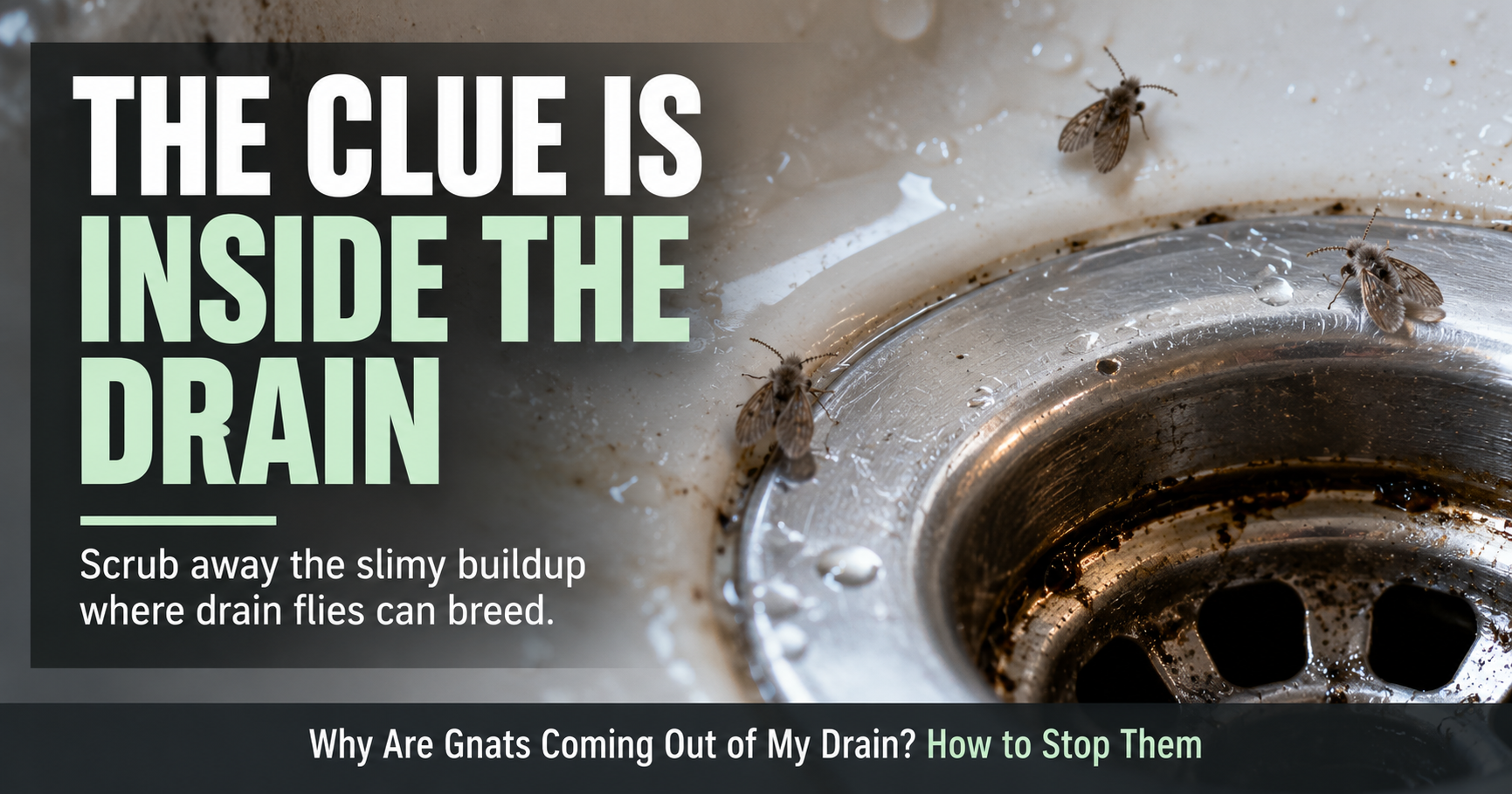
Some fungus gnats may develop in moist organic material associated with certain drainage areas, but houseplant potting soil is a much more familiar source. Finding small flies at a drain doesn’t establish their identity.
Do yellow sticky traps catch both flies?

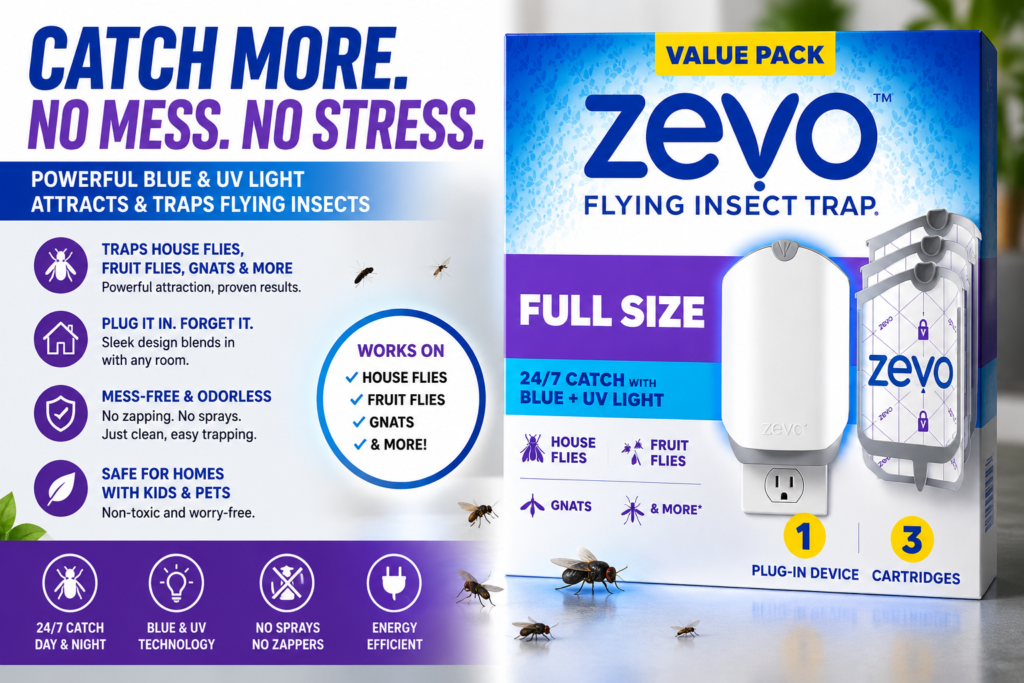
They may capture adults of both groups. Yellow sticky traps are commonly used for monitoring fungus gnats. However, trapping adults doesn’t remove the breeding material supporting either insect. For a powered approach to catching those adults, compare these indoor trap options before deciding what fits the room.
Can fungus gnats damage plants?
Yes. Large populations of fungus gnat larvae can damage delicate roots, especially on seedlings and young plants. Adult fungus gnats don’t feed on plant roots.
Are phorid flies a sign of a sewer problem?
Not necessarily. Some phorid fly infestations are associated with wastewater leaks, but many develop in more ordinary decaying materials. A few flies aren’t proof of damaged plumbing.
What’s the most reliable way to identify them?
Examine a clear close-up photograph or specimen. The humpbacked thorax and short antennae of phorid flies differ from the slender body and long antennae of fungus gnats. Wing-vein patterns can provide additional confirmation.
About the Author: The team at Why Do I Have Bugs helps homeowners identify common household insects, understand what’s attracting them, and find practical ways to deal with frustrating pest problems.