
If you’ve found a small, brown, hairy larva crawling across your floor, you’re not alone.
It’s one of the most confusing household pests to identify.
In fact, I originally believed the larvae in my own home belonged to carpet beetles.
It wasn’t until I found and photographed the adult beetles that I realized I was actually dealing with larder beetles instead. Once you find an adult, adult larder beetle identification can help confirm whether the larvae belong to the same species.
That experience taught me just how similar these two insects can appear at first glance.
The good news is that once you know which features matter, telling them apart becomes much easier.
Why These Two Larvae Are Confused So Often
There’s a good reason homeowners mix them up.
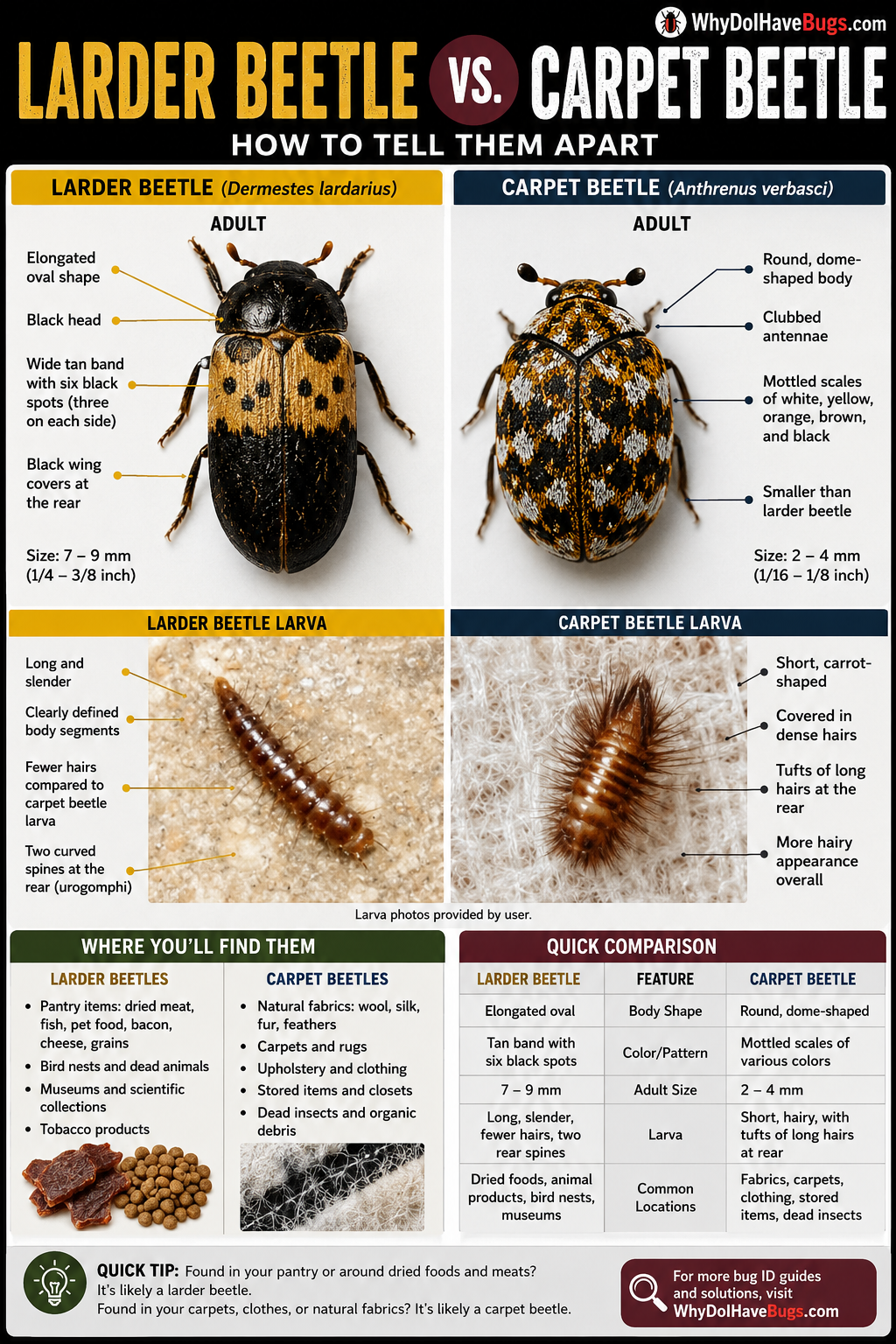
Larder beetles and carpet beetles belong to the same beetle family, Dermestidae.
Because they’re closely related, both larvae have several things in common.
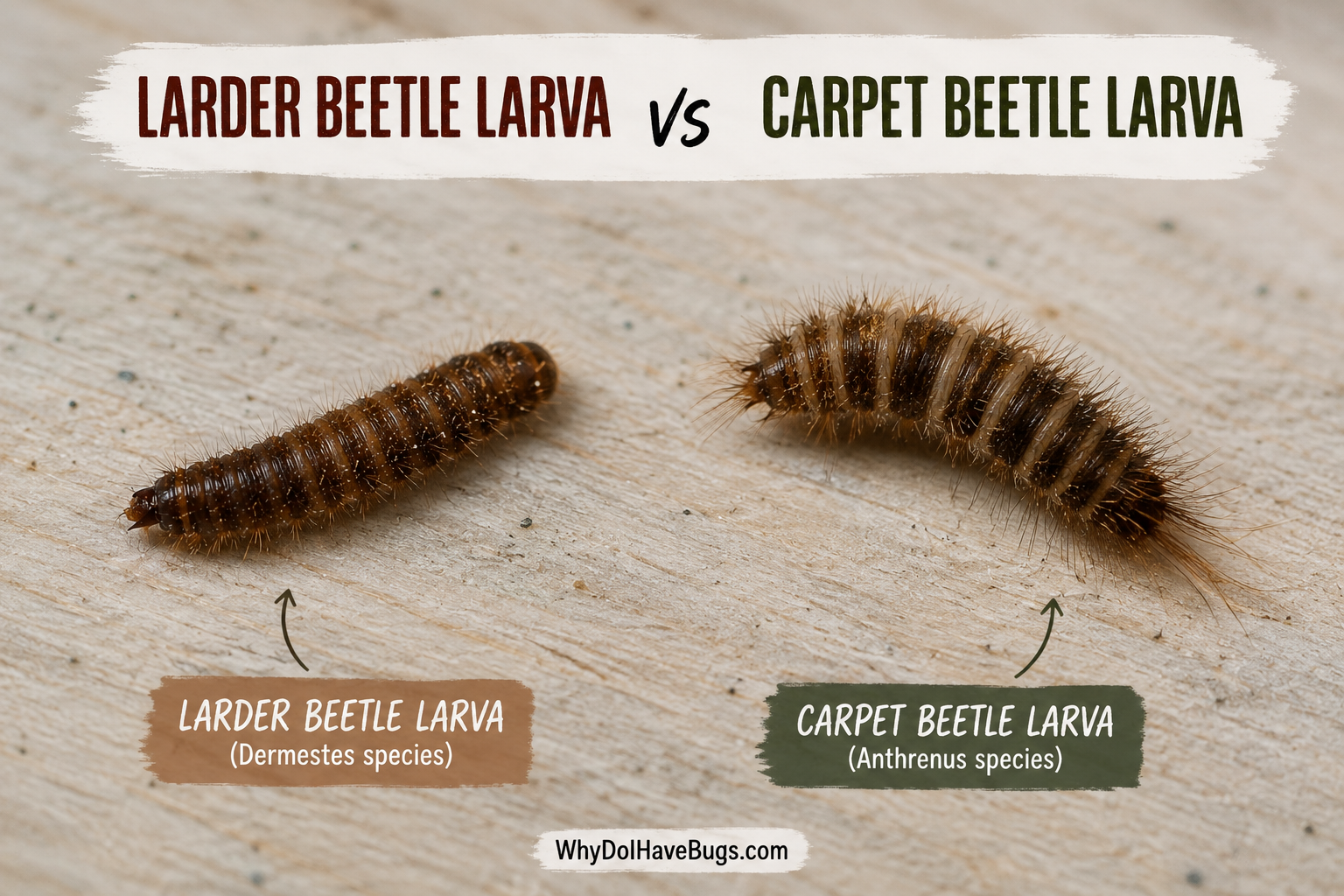
They both:
- Have elongated bodies.
- Are covered with stiff hairs.
- Feed on animal-based materials.
- Hide in dark, undisturbed places.
- Wander before pupating.
If you only glance at one for a second, it’s easy to think they’re exactly the same insect.
That’s why I never rely on just one feature.
Instead, I compare several characteristics before deciding what I’m looking at.


Larder Beetle Larvae Are Usually Larger
The first thing I usually notice is the overall size.
A mature larder beetle larva commonly reaches about 1/2 inch long.
Many carpet beetle larvae are noticeably smaller, although the exact size depends on the species.
Size alone isn’t enough to identify them.
Young larder beetle larvae can easily be mistaken for mature carpet beetle larvae.
Still, whenever I find a fairly large, hairy larva, larder beetles immediately move higher on my list of possibilities.


Body Shape Gives Me My Next Clue
Once I look past the size, I study the overall body shape.
Larder beetle larvae usually appear:
- Longer.
- Thicker.
- More cylindrical.
- Slightly tapered toward the rear.
Carpet beetle larvae often look shorter and more carrot-shaped or oval depending on the species.
Neither description is perfect because several carpet beetle species exist.
That’s why I continue checking additional characteristics instead of stopping here.
Both Are Hairy, but They Don’t Wear Their Hair the Same Way
One of the biggest reasons these insects get confused is because both are covered with hairs.
However, those hairs aren’t arranged exactly the same way.
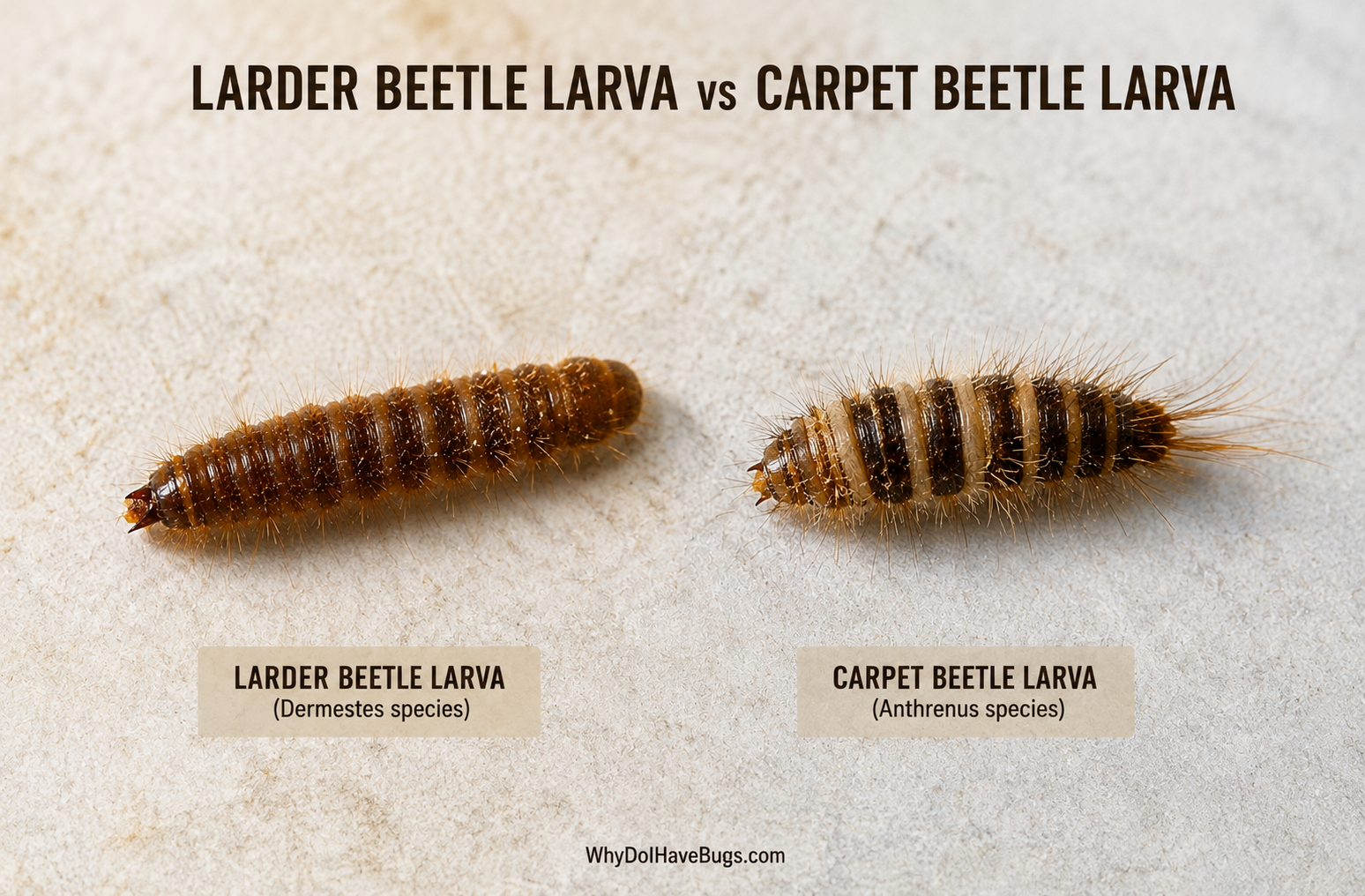
Larder beetle larvae tend to have a more evenly bristled appearance across the body.
Many carpet beetle larvae, especially varied carpet beetles, have obvious tufts or brush-like bundles of hairs near the rear end that stand out much more clearly.
When I see those brushy rear tufts, carpet beetles immediately become much more likely.



The Tail Is the Fastest Way I Tell Them Apart
If someone asked me for the single best identification feature, this would be it.
Larder beetle larvae have two hardened curved spines projecting from the last body segment.
These structures are called urogomphi.
Once you know they’re there, they’re surprisingly easy to recognize with a close look or a good photograph.
Carpet beetle larvae don’t have those curved tail spines.
Instead, many species have tufts or brushes of long hairs extending from the rear.
For me, this is the feature that settles the debate more often than anything else.
The Biggest Difference Is What They’re Eating
One of the easiest ways I narrow down an identification is by looking beyond the larva itself.
I look at what it’s feeding on.
That often tells me more than its appearance.
Larder beetle larvae strongly prefer materials rich in animal protein.
The most common food sources I investigate include:
- Dry dog food.
- Dry cat food.
- Pet treats.
- Dead insects.
- Dead rodents.
- Bird nests.
- Feathers.
- Fur.
- Leather.
- Animal hides.
- Taxidermy.

If you’ve found a larva near any of those materials, it immediately makes me think of larder beetles. I explain these food sources in much more detail in my guide on what larder beetles eat because understanding their diet often leads directly to the source of the infestation. Larder beetles are particularly associated with dried animal products, stored pet food, and dead insects.
Carpet beetle larvae, on the other hand, are much more likely to feed on:
- Wool rugs.
- Wool clothing.
- Blankets.
- Upholstered furniture.
- Feathers.
- Silk.
- Hair.
- Lint mixed with animal fibers.

Although the two species overlap in some of the materials they’ll eat, carpet beetles are far more commonly associated with damage to natural fabrics inside the home. Because natural fabrics can attract developing larvae, carpet beetle egg-laying locations are especially worth checking in closets, storage areas, and upholstered furniture.

Where You’re Most Likely to Find Each One
The location where I discover the larva is another huge clue.
When I’m dealing with larder beetle larvae, I usually begin searching places like:
- Garages.
- Basements.
- Utility rooms.
- Pet food storage areas.
- Around bird nests.
- Near evidence of rodents.
- Attics containing dead overwintering insects.
When I’m dealing with carpet beetle larvae, I spend much more time checking:
- Closets.
- Under beds.
- Under furniture.
- Along baseboards.
- Inside stored clothing.
- Blanket chests.
- Linen closets.
Neither insect always follows these rules, but the locations are often different enough that they help point me in the right direction.
Which One Causes More Damage?
This depends entirely on what they’re feeding on.
Carpet beetle larvae are usually the bigger concern if you own:
- Wool rugs.
- Expensive clothing.
- Antique textiles.
- Upholstered furniture containing natural fibers.
- Blankets made from wool.
Larder beetle larvae become a much bigger problem if you have:
- Stored pet food.
- Hunting trophies.
- Taxidermy.
- Animal feed.
- Bird nests attached to the house.
- Hidden rodent activity.
Neither insect is necessarily “worse.”
They’re simply damaging different things.


Which One Is Easier to Get Rid Of?
People often expect one insect to be much easier than the other.
In my experience, they’re actually very similar.
Neither one disappears simply because you spray the adults.
Both require you to locate the food source first.
Once I know what the larvae are feeding on, the rest of the job becomes much easier.

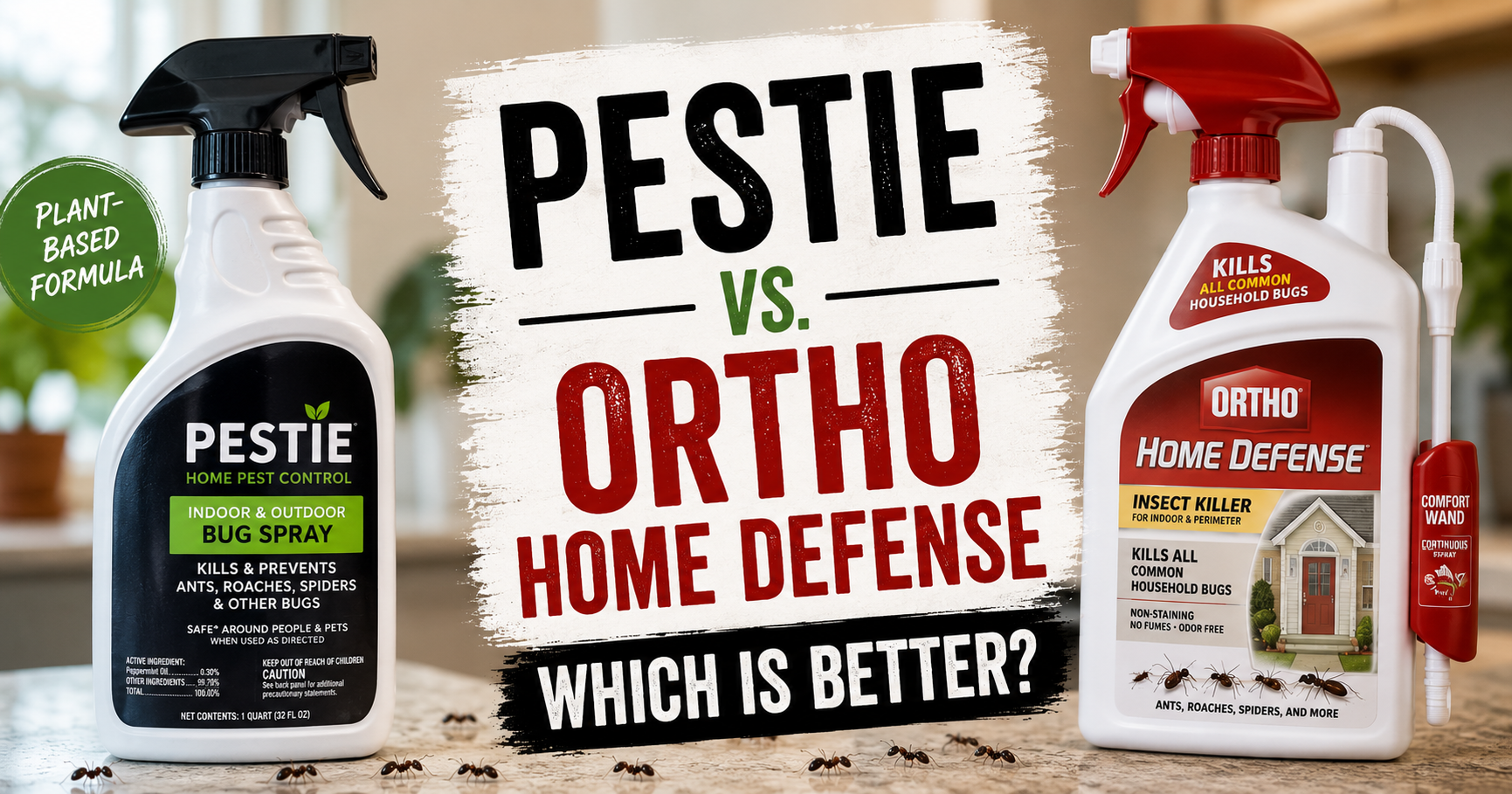
After removing the source, thoroughly vacuuming the surrounding area, and cleaning away shed skins and debris, I usually treat cracks, crevices, and other beetle travel routes with Ortho Home Defense Insect Killer for Indoor & Perimeter² to help eliminate wandering larvae and newly emerged adults before they spread into other parts of the home.
My Quick Identification Checklist
Whenever I’m trying to identify one of these larvae, I mentally run through the same checklist every time.
If I notice:
- A relatively large hairy larva.
- Two curved spines projecting from the tail.
- A nearby source of animal protein.
- Pet food, dead insects, or rodent activity.
…I strongly suspect a larder beetle larva.
If instead I see:
- A smaller, carrot-shaped larva.
- Prominent brush-like tufts of hairs near the rear.
- Wool fabrics, clothing, rugs, or stored blankets nearby.
…I’m much more likely to suspect a carpet beetle larva.

Why I Originally Misidentified Mine
I’ll admit it.
When I first started finding hairy larvae around my home, I immediately assumed I had carpet beetles.
That’s what most websites talked about.
It wasn’t until I found and photographed the adult beetles that I realized I was actually looking at larder beetles.
Looking back, there were clues the entire time.
The adults had the distinctive pale band across their backs.
The larvae were larger than I expected.
And the food sources I eventually investigated matched larder beetles much better than carpet beetles.
That’s exactly why I encourage homeowners not to rely on a single photo they find online.
Compare the size.
Compare the tail.
Compare where you found the larva.
And compare what it’s likely feeding on.
Putting all of those clues together is much more reliable than trying to identify it from color alone.
Frequently Asked Questions
Are larder beetle larvae bigger than carpet beetle larvae?
Usually, yes. Mature larder beetle larvae commonly reach about 1/2 inch long, while many carpet beetle larvae remain noticeably smaller depending on the species.
What’s the fastest way to tell them apart?
The quickest feature I look for is the tail. Larder beetle larvae have a pair of curved tail spines called urogomphi, while carpet beetle larvae have hairy tufts instead of those hardened spines.
Do both larvae damage homes?

Yes, but in different ways. Carpet beetle larvae are better known for damaging natural fabrics, while larder beetle larvae are more commonly associated with pet food, animal products, dead insects, and other protein-rich materials. That distinction is especially useful when investigating carpet damage beneath furniture, where hidden larvae can damage natural fibers over time.
Can both species live in the same house?
Absolutely. Since they often use different food sources, it’s possible for both carpet beetles and larder beetles to be present in the same home at the same time, especially if suitable conditions exist for each species.
About the Author
Mark Sullivan has spent years researching household beetles and helping homeowners correctly identify hidden infestations. After initially mistaking larder beetle larvae for carpet beetle larvae in his own home, he learned firsthand how subtle the differences can be and now focuses on practical, experience-based identification guides that help readers confidently tell similar pests apart. WhyDoIHaveBugs.com