
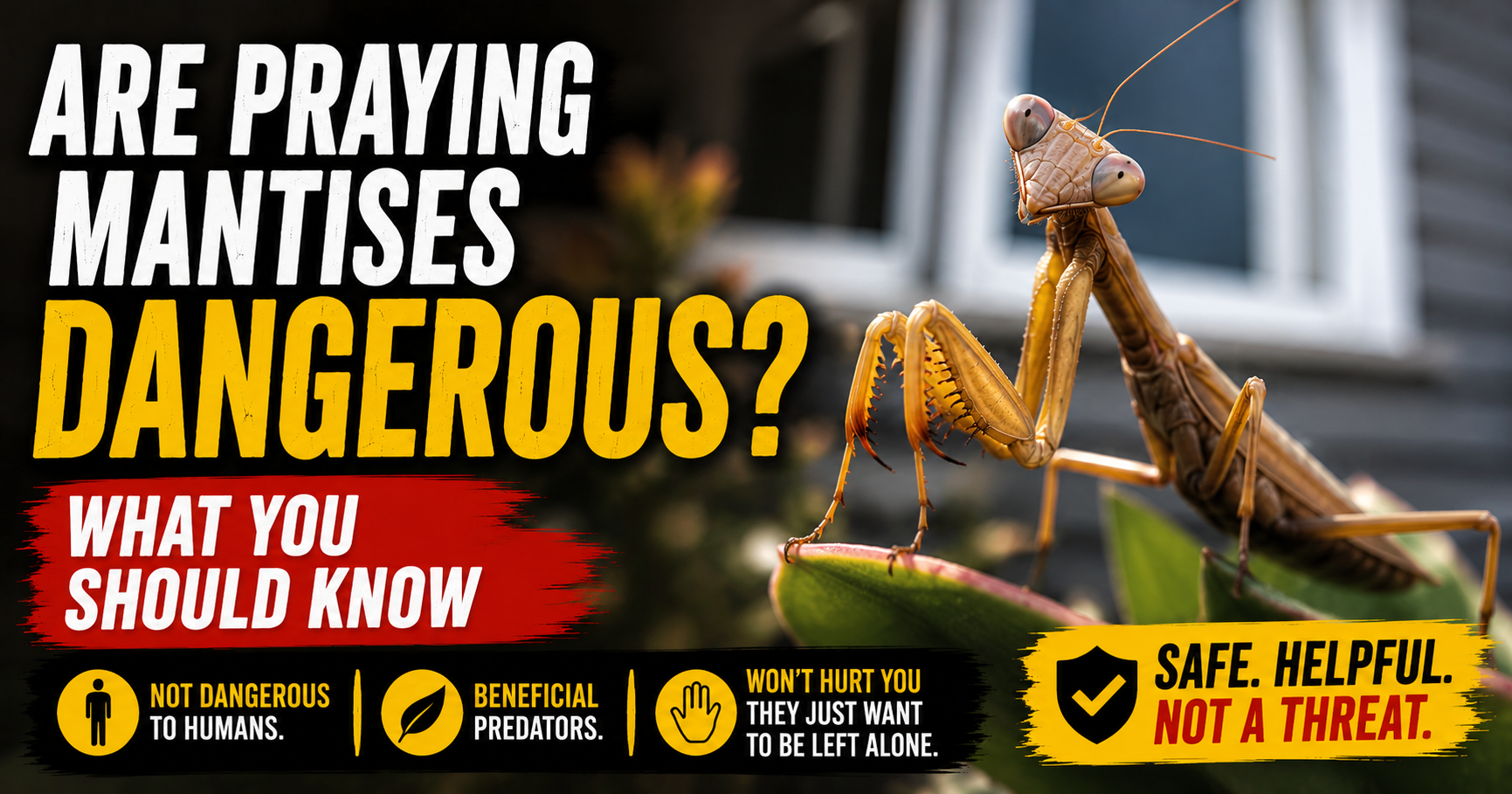
Praying mantises are not considered dangerous to people. They are not venomous, do not have stingers, and do not normally attack or chase humans. A large mantis can pinch with its spiny front legs or give a defensive nip if it is grabbed, but serious injuries are extremely unlikely.
Their large eyes, rotating heads, rapid strikes, and folded front legs make them look like miniature predators because that is exactly what they are. The important difference is that their hunting equipment is designed for insects and other small prey, not people.
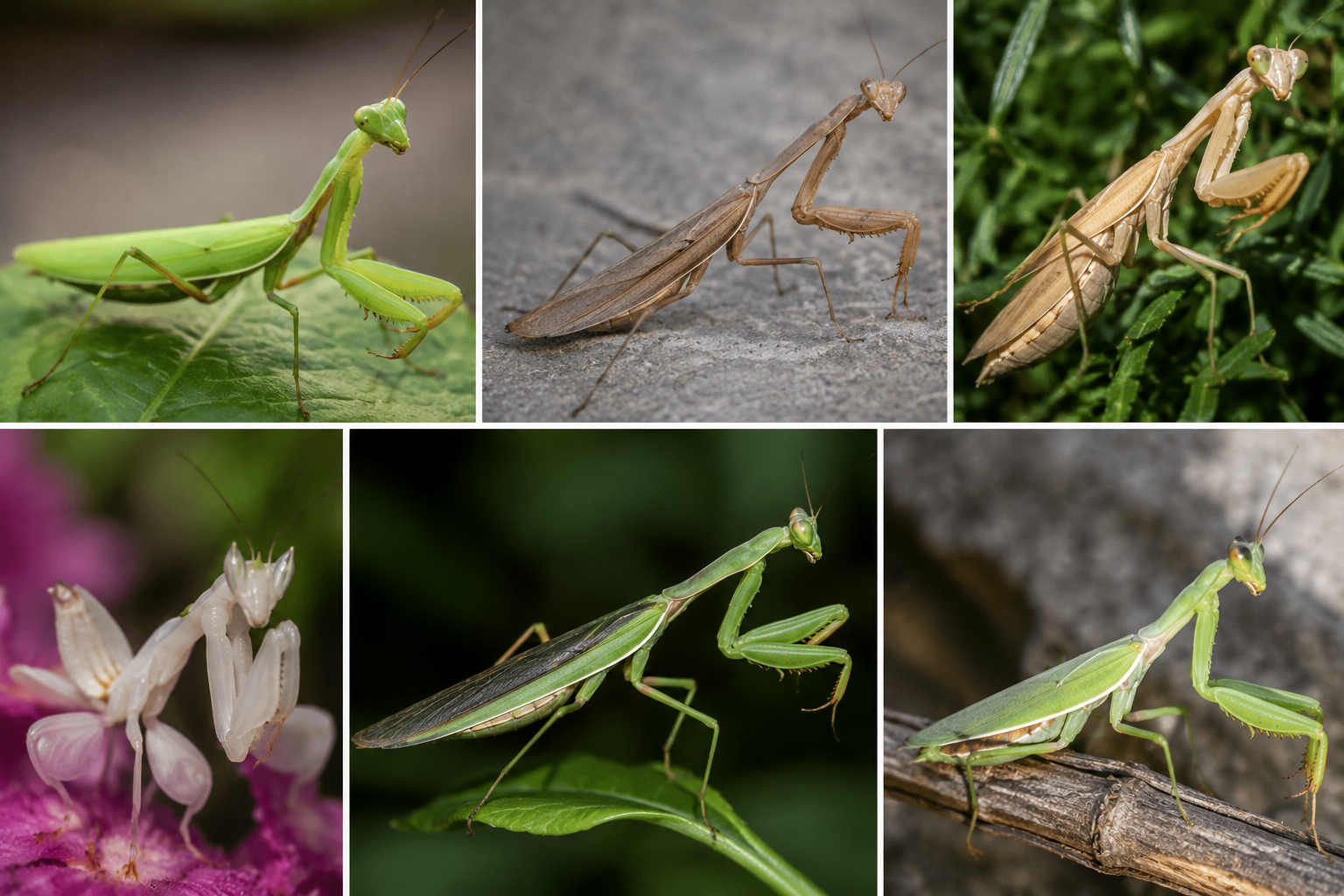
If you find a praying mantis on your porch, siding, tree, or garden plant, you can safely observe it without needing to spray or kill it.
Why Praying Mantises Look So Dangerous
A praying mantis has several features that can make it appear threatening.
Its front legs are lined with sharp spines. Its triangular head can turn and follow your movements. Its large eyes seem to stare directly at you, and it may suddenly raise its body when you get close.
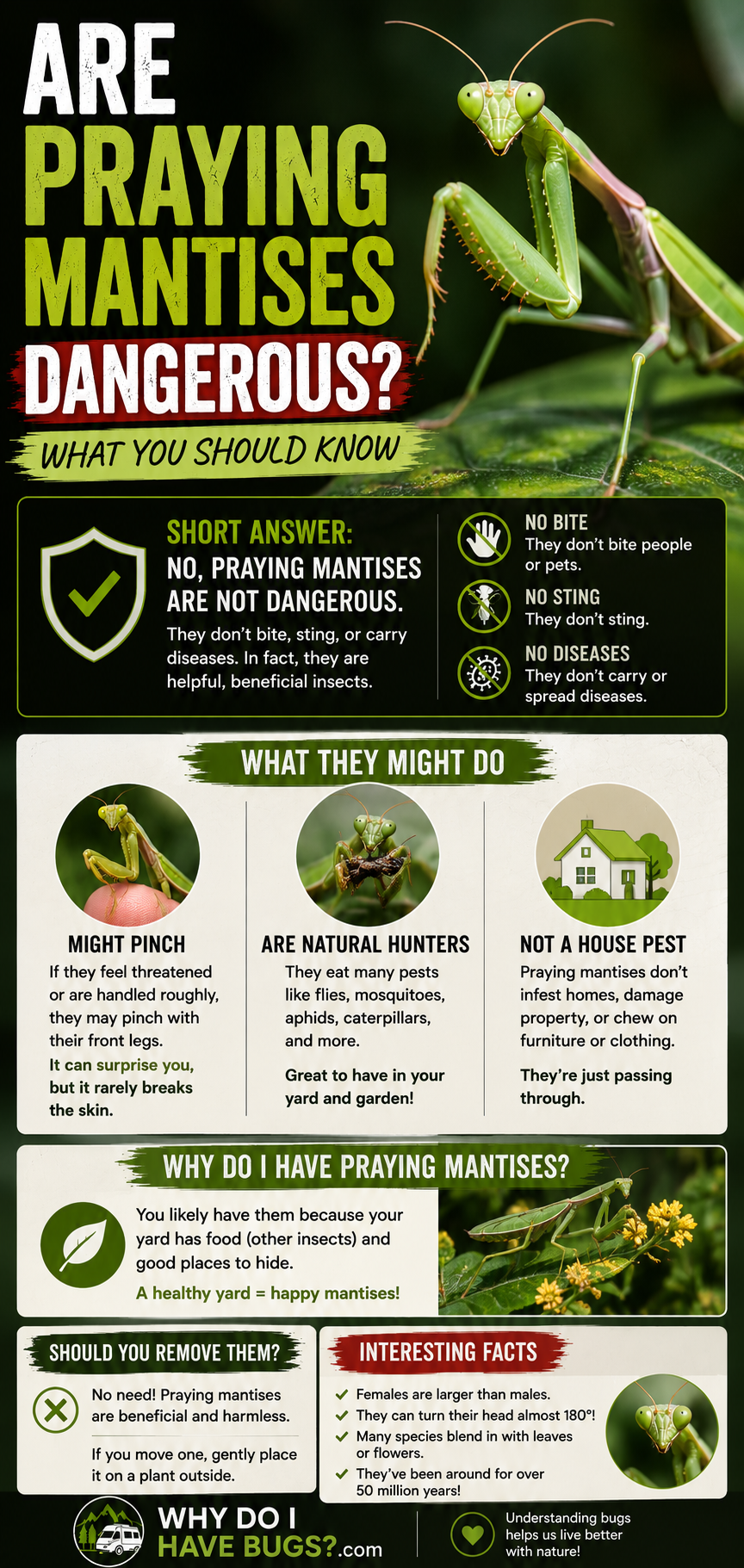
A frightened mantis may also:
- Raise its front legs
- Spread its wings
- Expose colorful markings
- Open its mouth
- Rock from side to side
- Strike toward an approaching object
- Make itself appear larger
This defensive display is intended to frighten predators. The mantis would rather convince you to back away than become trapped in a fight with an animal thousands of times its size.
Although the display can be startling, it does not mean the insect is preparing to pursue you.



Are Praying Mantises Aggressive Toward People?
Praying mantises are not naturally aggressive toward people. They are solitary predators interested in catching insects and avoiding larger animals that might eat them.
A mantis may turn its head toward you because its vision is highly sensitive to movement. When you approach, you become the largest moving object in its surroundings.
That attention can feel like aggression, especially when the insect follows you with its eyes. In reality, it is trying to decide whether you are a threat.
Most mantises respond to people by:
- Remaining motionless
- Walking farther into vegetation
- Flying away
- Dropping from their perch
- Raising their legs defensively
- Spreading their wings as a warning
A mantis does not stalk people, jump at faces, or attack without being disturbed. Nearly every unpleasant interaction begins when someone grabs, restrains, pokes, or corners the insect.


Can a Praying Mantis Bite You?
A praying mantis has chewing mouthparts and is physically capable of giving a defensive bite. However, bites are unusual because people are not prey and mantises generally prefer to escape.
The greatest chance of being bitten occurs when someone:
- Holds the mantis tightly
- Places a finger near its mouth
- Tries to pull it from a surface
- Handles it roughly
- Prevents it from moving away
- Mistakes its warning display for friendly behavior
A bite from a praying mantis is generally described as a pinch or nip. A particularly large mantis might break the skin, but the injury is not venomous and is rarely medically significant.
The simplest way to avoid being bitten is to observe the mantis without grabbing it.
Are Praying Mantises Venomous?
Praying mantises are not venomous. They do not inject venom through their mouthparts, front legs, or any other part of their bodies.
They capture prey using speed and physical force. The spines on their front legs hold the prey in place while the mantis uses its chewing mouthparts to eat.
This differs from animals such as spiders, scorpions, wasps, and certain centipedes that use venom to subdue prey or defend themselves.
A mantis bite may cause a small cut or localized soreness, but there is no mantis venom entering the wound.



Are Praying Mantises Poisonous?
Praying mantises are not generally considered poisonous to touch.
Poisonous and venomous do not mean the same thing. A venomous animal injects a toxin through a bite or sting. A poisonous animal causes harm when it is eaten or touched.
A praying mantis does not produce a dangerous skin toxin, and simply touching one is not expected to poison you.
I would still wash my hands after handling any outdoor insect. Mantises spend time on plants, soil, bark, siding, and other surfaces that may carry dirt, pesticides, or microorganisms.
The safer choice is usually to move the insect with a container rather than handling it directly.
Can the Spiny Front Legs Hurt You?
The front legs of a praying mantis are built to grab and restrain prey. Rows of stiff spines close around an insect and prevent it from escaping.
A large mantis may use those legs defensively if it is restrained. The spines can feel sharp and may leave a small scratch or mark on sensitive skin.
This is more accurately described as a pinch or scratch than a sting. The legs do not inject venom.
The risk increases when someone allows a large mantis to wrap both front legs around a finger. Even then, most injuries are minor.
You can avoid the spines by letting the mantis walk onto a branch, cup, or piece of cardboard rather than placing your fingers directly in front of it.



Can a Praying Mantis Sting You?
No. Praying mantises do not have stingers.
The pointed structures people notice are usually:
- Spines on the front legs
- Wing edges
- The tip of the abdomen
- A female’s egg-laying structures
None of these functions like a bee or wasp stinger.
A mantis may quickly strike with its front legs when threatened, which can look similar to a stinging motion. However, it is attempting to grab, push away, or frighten the threat.
What Happens If a Praying Mantis Bites You?
Most praying mantis bites cause little more than brief pain, a small pinch, or minor skin irritation.
If the skin is not broken, no special treatment is usually necessary. If there is a small cut, basic wound care is appropriate:
- Wash the area with soap and water
- Remove any visible dirt
- Apply a clean bandage if needed
- Watch for increasing redness or swelling
- Avoid repeatedly touching the wound
Seek medical advice if you experience severe pain, spreading redness, significant swelling, drainage, breathing difficulty, or another unusual reaction. Those symptoms would be unexpected from a mantis bite and deserve professional evaluation.
People with serious allergies or weakened immune systems should be especially cautious with any wound that breaks the skin, regardless of what caused it.


Can a Praying Mantis Make You Sick?
Praying mantises are not known as important carriers of human disease. They do not feed on blood, live on people, or regularly move between animal waste and human food.
That makes them very different from mosquitoes, ticks, fleas, roaches, and certain flies.
The more realistic concern after rough handling would be ordinary contamination of a small scratch or cut. Washing the area with soap and water reduces that risk.
There is no reason to seek medical treatment simply because a mantis touched or walked across your skin.
Are Praying Mantises Dangerous to Children?
Praying mantises are not considered dangerous to children, but children should observe them without squeezing or grabbing them.
A child may be tempted to pick one up because the insect looks unusual and appears calm. The mantis may remain still until it feels trapped, then suddenly raise its legs or strike defensively.
A large mantis could pinch delicate skin, and a child might drop or crush the insect after being startled.
I would teach children to:
- Watch the mantis from a comfortable distance
- Avoid placing fingers near its mouth
- Never squeeze its body
- Allow an adult to move it if necessary
- Keep their face away from a defensive insect
- Wash their hands after touching outdoor animals
The mantis is far more likely to be injured by a child than the child is to be seriously injured by the mantis.
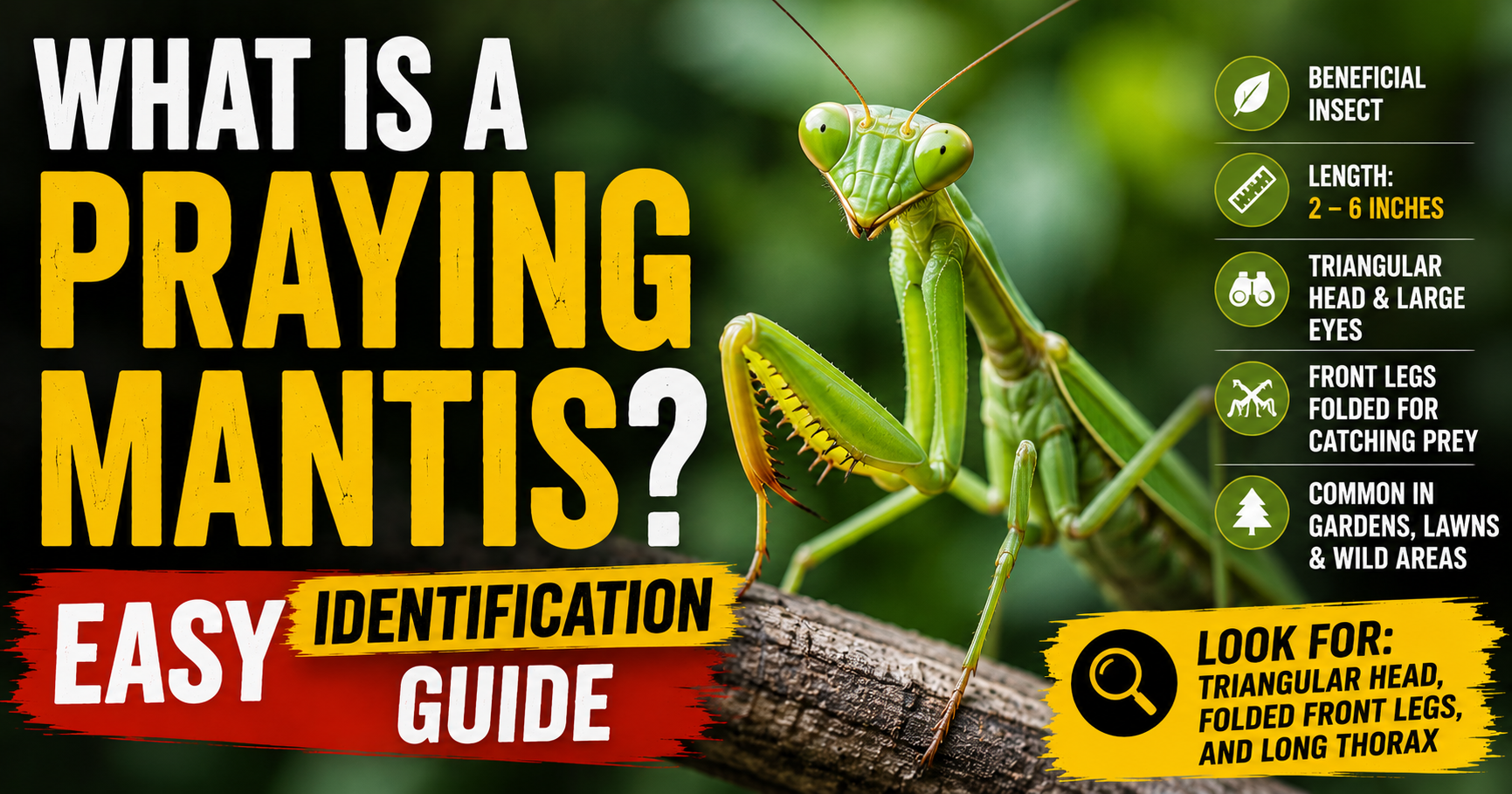
If your child is frightened because of the insect’s size, this praying mantis identification guide explains its unusual body parts and what they are actually used for.
Are Praying Mantises Dangerous to Babies?
A praying mantis is not likely to approach or attack a baby. It has no reason to seek human contact.
As with any insect, I would not leave one crawling near an infant. A baby could grab or place the insect in their mouth, and the mantis could defend itself.
If one enters the house, capture it with a container and release it outside. There is no need to spray the room or treat the home afterward.
Are Praying Mantises Dangerous to Dogs?
Praying mantises are not normally dangerous to dogs. They are not venomous and cannot sting.
A curious dog may sniff, paw at, lick, or attempt to eat the insect. The mantis may raise its wings and front legs or pinch defensively.
A small scratch around the nose or mouth is possible, but a serious injury would be unusual. Eating the mantis could cause temporary drooling, gagging, vomiting, or stomach irritation simply because the dog swallowed an insect.
Contact your veterinarian if your dog develops persistent vomiting, facial swelling, trouble breathing, unusual weakness, or other concerning symptoms after interacting with any unknown animal.
When possible, move the mantis to nearby vegetation before a dog discovers it.
Are Praying Mantises Dangerous to Cats?
Praying mantises are unlikely to seriously hurt a cat. Cats are much larger, faster, and physically stronger than any mantis.
The more likely outcome is that the cat injures or kills the insect. A mantis may strike at the cat’s nose or paw, but it does not have venom or a stinger.
A cat that eats one may experience mild digestive irritation, although many cats eat insects without obvious problems.
The eyes are the area I would be most cautious about. Any frightened animal with spiny legs could potentially scratch a sensitive eye if a cat presses its face close. Separating the animals prevents injury to both.
Are Praying Mantises Dangerous to Chickens?
Praying mantises are not generally dangerous to full-grown chickens. A chicken is more likely to eat the mantis than be injured by it.
Very large mantises are capable predators, but a normal adult chicken is far beyond the size of their usual prey.
Small chicks should still be protected from unnecessary contact with large insects. Even when an insect is not poisonous, a chick can choke or experience digestive problems after swallowing something too large.
In a typical yard or chicken run, a mantis is not a major poultry concern.
Can Praying Mantises Hurt Hummingbirds?
Large praying mantises have occasionally been documented capturing hummingbirds, particularly when a mantis waits near a hummingbird feeder.
These encounters are real but uncommon. They do not mean every mantis near a house is a threat to birds.
The greatest concern involves a very large mantis positioned directly on or beside a feeder. From that location, it may be able to grab a hummingbird that approaches to drink.
If you find a large mantis waiting on a hummingbird feeder, move it to vegetation well away from the feeder. There is no need to kill it solely because it was nearby.
Check feeders regularly during late summer and early fall, when adult mantises are largest and most noticeable.
Are Praying Mantises Dangerous to Other Insects?
Yes, praying mantises are extremely dangerous to insects and other small prey. Their calm appearance hides a highly effective ambush predator.
They may eat:
- Flies
- Moths
- Crickets
- Grasshoppers
- Beetles
- Caterpillars
- Roaches
- Spiders
- Bees
- Butterflies
- Other praying mantises
A mantis does not understand which insects people label as pests or beneficial. It captures whatever manageable animal comes within reach.
That is why a praying mantis can be useful in a garden without being a perfect biological-control solution.
Will a Praying Mantis Attack Another Praying Mantis?
Praying mantises may attack and eat members of their own species.
Cannibalism can occur when:
- Young mantises hatch together
- Several mantises share a confined area
- Food is scarce
- A smaller mantis approaches a larger one
- A female encounters a male during mating
The famous image of a female eating a male during or after mating is based on real behavior, but it does not happen during every mating encounter.
Mantises are solitary hunters. They do not form cooperative groups, defend one another, or recognize another mantis as a friend.
Why Does a Praying Mantis Raise Its Arms at You?
A mantis raises its front legs to make itself look larger and prepare to defend itself.
This posture may be accompanied by:
- Spread wings
- A raised body
- Side-to-side rocking
- An open mouth
- Sudden forward strikes
- Visible color patches
The message is simple: you are too close.
Back away and give the insect room. Once it no longer feels cornered, it will usually lower its legs or move away.
Trying to touch it during this display increases the chance of a pinch or bite.
Why Does a Praying Mantis Stare at You?
A praying mantis relies heavily on vision. Its large compound eyes detect movement, while its mobile head allows it to track an object without repositioning its entire body.
When you walk closer, the mantis may turn its head and continue watching. This can make the encounter feel strangely personal.
It is not hypnotizing you, preparing to attack, or identifying you as food. It is monitoring a possible threat.
If it remains calm, you can observe or photograph it without getting close enough to trigger a defensive display.
Can a Praying Mantis Jump on You?
A praying mantis can jump or fly, but it does not normally launch itself at people as an attack.
One may land on you accidentally if:
- It takes flight near a porch light
- It jumps from disturbed vegetation
- You walk through tall plants
- It mistakes your clothing for a landing surface
- Wind alters its flight
Remain still and allow it to walk onto a branch or container. Swatting at it may cause the mantis to cling more tightly or respond defensively.
Can Praying Mantises Fly at Your Face?
An adult mantis can fly near a person, particularly around exterior lights where both mantises and prey insects are active.
A mantis flying toward your face is unlikely to be attacking. It may be:
- Flying toward a light behind you
- Searching for a landing surface
- Escaping another animal
- Disoriented
- Pursuing a flying insect
Males tend to fly more readily than heavy adult females. Nighttime flights become more noticeable during late summer and fall.
If mantises and other insects repeatedly gather near an entryway, reducing unnecessary exterior lighting may help.
Is It Safe to Pick Up a Praying Mantis?
It is possible to handle a praying mantis safely, but direct handling is usually unnecessary.
A calm mantis may voluntarily walk onto an open hand. The risk increases when someone grabs it from above or squeezes around its abdomen.
If you need to move one, I prefer using:
- A clear cup
- A small container
- A stiff piece of paper
- A sturdy branch
- A garden glove
Place the object in front of the mantis and allow it to step onto the surface. Move slowly and avoid touching the wings.
The body, legs, and wings of a mantis can be damaged much more easily than a person can be injured.
How to Move a Praying Mantis Safely
If a mantis is sitting in a doorway, inside your house, or somewhere pets can reach it, relocate it without restraining its body.
Place a cup or container over the insect. Slide a piece of paper or thin cardboard beneath the opening, then carry the covered container outside.
Release it onto:
- A sturdy shrub
- A low tree branch
- Tall grass
- A garden plant
- Dense vegetation
Do not throw it into the air. Heavy females may not fly well, and young mantises cannot fly at all.
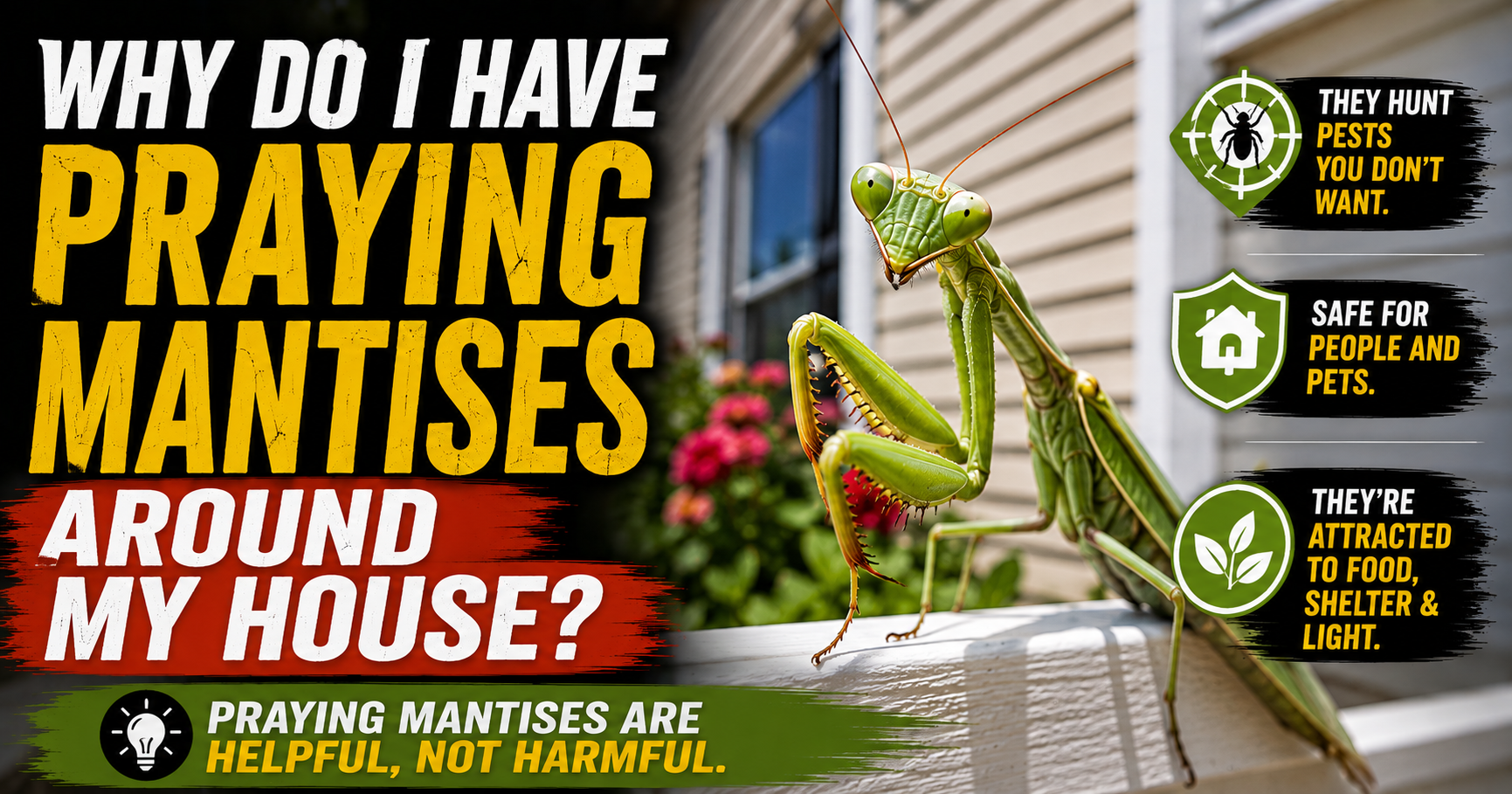
If you are finding mantises repeatedly near doors, windows, or porch lights, my guide explaining why praying mantises gather around houses covers the insects, vegetation, lighting, and shelter that bring them close.
Should You Kill a Praying Mantis?
There is usually no reason to kill an individual praying mantis simply because it is near your house.
It does not:
- Damage wood
- Eat plants
- Infest walls
- Spread through bedrooms
- Contaminate food
- Feed on people
- Reproduce indoors under normal conditions
The native Carolina mantis is an important part of the local ecosystem. Chinese and European mantises are nonnative, and some people selectively remove them because they may compete with native species.
The challenge is identifying the species correctly. Green and brown coloring occurs in both native and nonnative mantises, so color alone is not enough.
If you are unsure, photograph the head, wings, entire body, inner front legs, and any nearby egg case before deciding what to do.
Do You Need Pest Control for Praying Mantises?
Professional pest control is almost never necessary for praying mantises.
An adult found indoors is normally an accidental visitor. Numerous tiny mantises usually came from an egg case attached to a plant, branch, wreath, Christmas tree, or another object brought inside.
Spraying the house will not solve a hidden mantis infestation because praying mantises do not establish that type of infestation.
Basic steps are normally enough:
- Capture and release adults
- Inspect outdoor plants before bringing them inside
- Check branches and decorations for egg cases
- Repair damaged screens
- Keep doors closed
- Reduce unnecessary exterior lighting
- Move mantises away from busy doorways
Pesticides create a greater risk to pollinators and other harmless insects than the mantis creates for your household.
Are Praying Mantises Safe to Leave in the Garden?
A praying mantis can usually be left alone in a garden.
It may eat caterpillars, beetles, flies, grasshoppers, and other insects that damage plants. However, it may also capture bees, butterflies, and other beneficial insects.
I would not rely on mantises as the primary solution to a garden pest problem, and I would not purchase nonnative egg cases to release.
An established mantis outdoors is best viewed as one predator within a much larger ecosystem. Its presence does not guarantee that every insect it catches is harmful or helpful.
When Should You Be Cautious?
Extra caution makes sense when:
- A mantis is displaying defensively
- A small child is trying to grab it
- A dog or cat is attempting to eat it
- The insect is near someone’s face
- A large mantis is positioned on a hummingbird feeder
- Someone has a serious fear of insects
- The mantis is inside a vehicle or machinery
- It is sitting in a busy doorway
In these situations, relocation is generally better than spraying or crushing the insect.
Give it a way to step onto a container or branch, then move it to suitable vegetation.
How Dangerous Is a Praying Mantis Really?
For the average person, a praying mantis presents very little danger.
Its appearance and hunting behavior are dramatic, but its actual risks are limited:
- It can pinch with spiny front legs.
- It may bite if roughly restrained.
- A bite could leave a small cut.
- A frightened mantis may startle someone by flying.
- Very large individuals can prey on animals larger than insects.
It cannot sting, inject venom, poison you by touch, or establish a dangerous household infestation.
Respecting the insect’s space is usually all that is required. If you do not grab it, the mantis has little reason or opportunity to hurt you.
Frequently Asked Questions
Can a praying mantis kill a human?
No. A praying mantis cannot kill a human. Even the largest species are far too small to cause that type of injury.
Will a praying mantis bite me?
A mantis might bite defensively if you hold or restrain it, but bites are uncommon. It does not seek people out or view them as prey.
Does a praying mantis have venom?
No. Praying mantises do not produce or inject venom.
Can a praying mantis sting?
No. A praying mantis does not have a stinger. Its front legs have sharp spines that can pinch or scratch.
Is it safe to touch a praying mantis?
Brief, gentle contact is unlikely to be dangerous, but direct handling is unnecessary. Allow it to walk onto a branch or use a container to move it.
Are praying mantises poisonous to dogs?
Praying mantises are not generally considered poisonous to dogs. Eating one may still cause temporary drooling, vomiting, or digestive irritation.
Can a praying mantis hurt a cat?
Serious injury is unlikely. A mantis may strike defensively if a cat paws at it, but the cat poses a greater danger to the mantis.
Are praying mantises dangerous to children?
No, but children should not squeeze or grab them. A large mantis may pinch or nip when it feels trapped.
What should I do if a praying mantis is in my house?
Cover it with a container, slide cardboard underneath, and release it onto sturdy vegetation outside.
Why does a praying mantis act like it wants to fight?
Raising its legs and spreading its wings are defensive warnings. The mantis wants the perceived threat to move away.
Should I be afraid of a praying mantis?
No. You can safely observe a praying mantis without touching it. It is interested in small prey, not people.
Caleb Warren is a longtime gardener and backyard insect researcher who writes practical identification guides for WhyDoIHaveBugs.com, helping homeowners understand the insects they find before deciding whether any action is needed.