
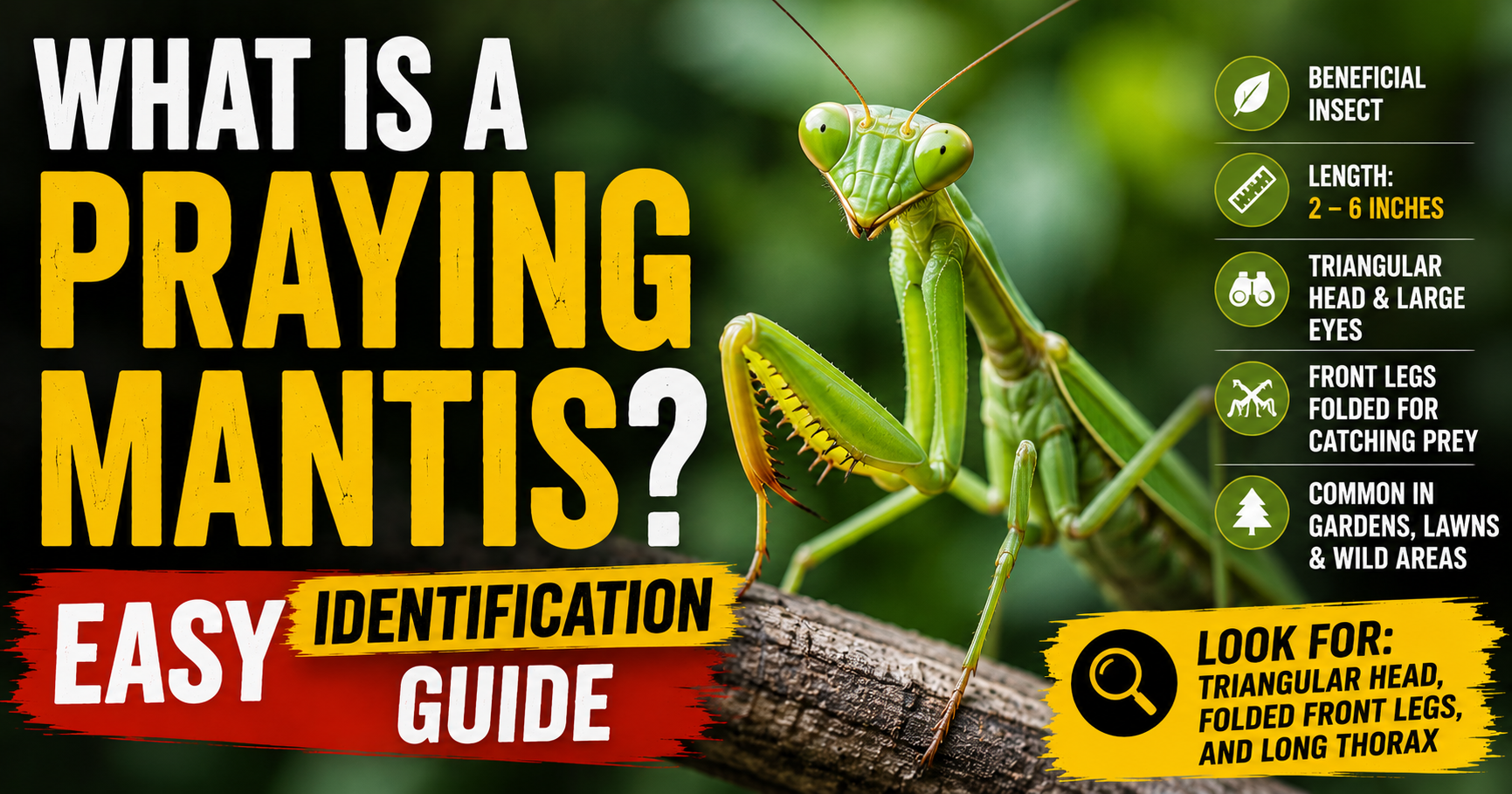
A praying mantis is a large predatory insect recognized by its triangular head, long body, and powerful front legs that fold together as though it is praying. Despite its intimidating appearance, a praying mantis is not a household pest and is generally harmless to people.
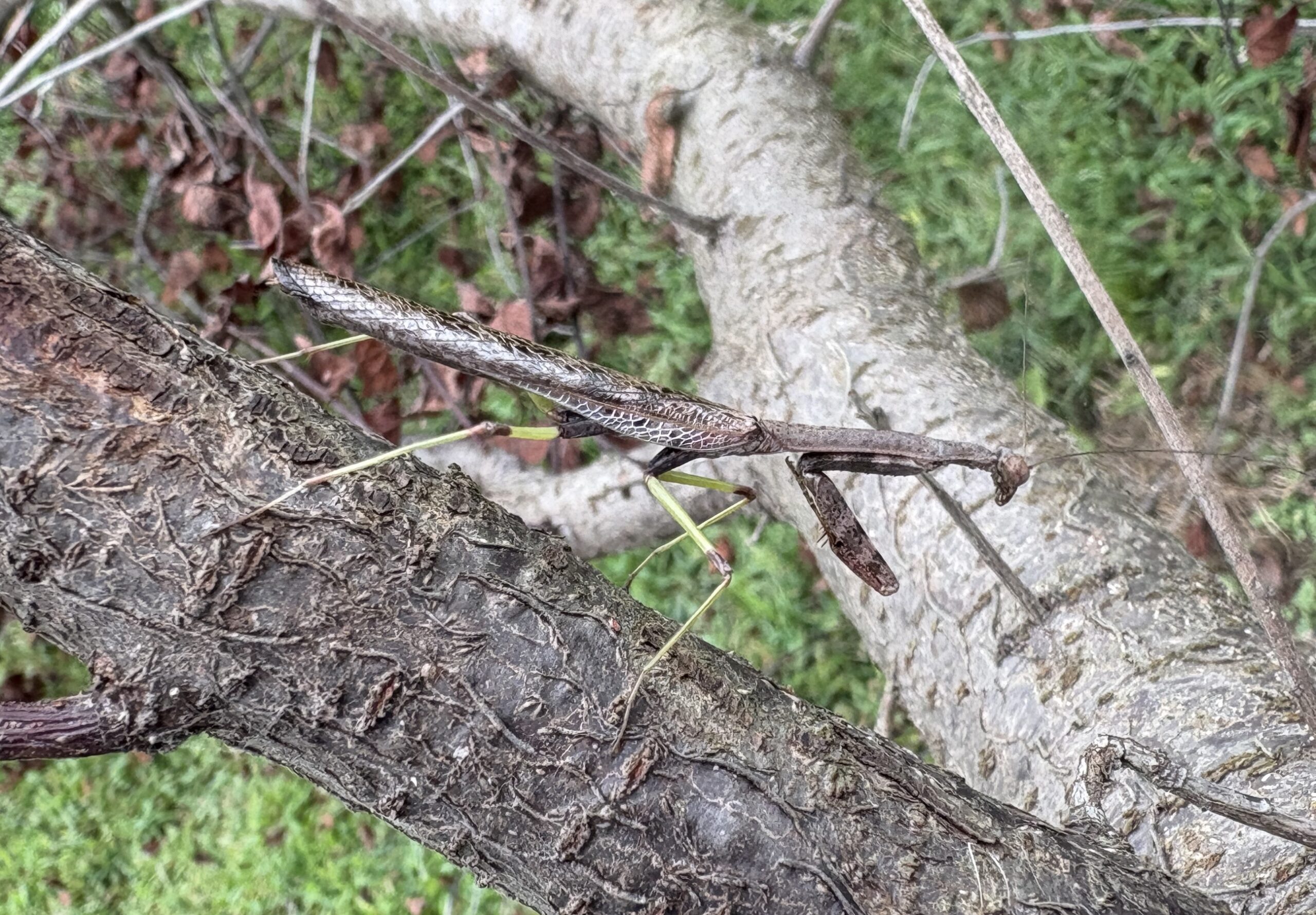
I recently found the large brown mantis shown in this guide clinging to a tree on our Missouri property. Its long body blended into the bark so well that it would have been easy to walk right past it. Based on its size, long wings, brown coloring, and narrow green markings, I believe it was most likely a Chinese mantis.
That discovery is a good example of why identifying a praying mantis is not always as simple as looking for a bright green insect. Praying mantises can be green, brown, tan, gray, or mottled, and several different species may live in the same part of the country.
What Does a Praying Mantis Look Like?
A praying mantis has one of the most recognizable body shapes in the insect world. It has a long body, a mobile triangular head, two large compound eyes, and a pair of enlarged front legs designed to capture prey.
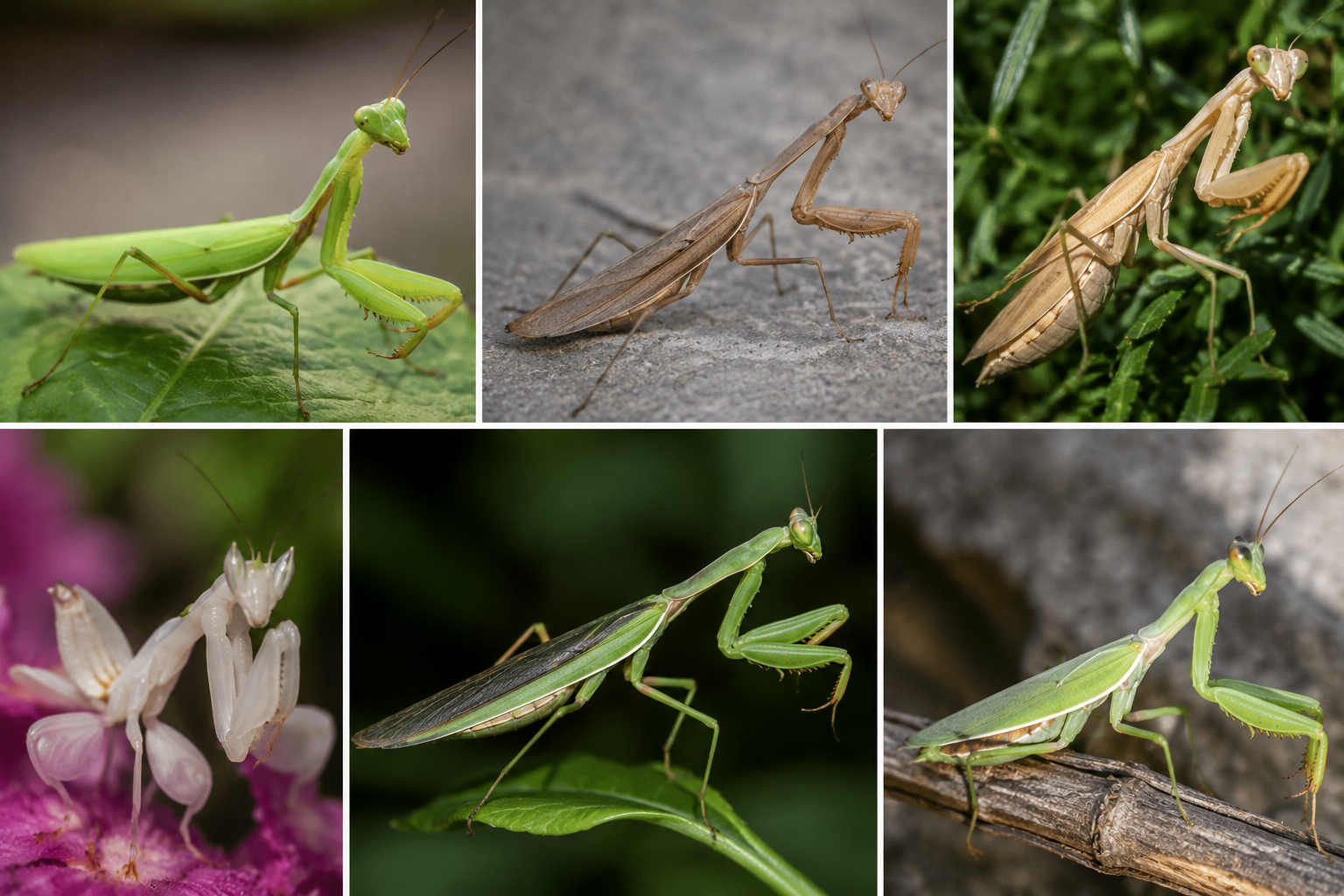
The easiest identifying features include:
- A triangular head
- Large eyes positioned near the upper corners of the head
- A long, narrow section behind the head that resembles a neck
- Powerful front legs held in a folded position
- Sharp spines along the front legs
- Four thinner legs used for walking and climbing
- A long abdomen that may be covered by wings
- Green, brown, tan, gray, or mottled coloring
The folded front legs are where the insect gets its familiar name. When it is waiting for prey, the position can look like a person holding their hands together in prayer.
Those front legs are not ordinary walking legs. They are raptorial legs built to reach forward quickly, close around another insect, and hold it against rows of sharp spines.



The Praying Mantis I Found in Missouri
The mantis I photographed was resting vertically against a tree. Its body was primarily brown, while parts of its legs and the edges of its wings showed green coloring.
It was a fairly large insect with wings extending along almost the entire abdomen. Those characteristics point toward a Chinese mantis, one of the three praying mantis species commonly encountered in Missouri.

The insect also showed exactly how effective mantis camouflage can be. From a distance, its brown wings looked like part of the bark or a narrow dead branch. The green sections of its legs blended into the grass and surrounding vegetation.
I cannot confirm the exact species from these photographs alone because the face and several important markings are partly obscured. However, its overall size, coloring, body proportions, and full-length wings make a Chinese mantis the most likely identification.

Is Praying Mantis the Correct Name?
People commonly call these insects praying mantises, but the word “mantid” is also used.
A mantid is any insect belonging to the order Mantodea. The word mantis can refer to a particular genus within that order, but in everyday American usage, “praying mantis” has become the familiar name for the entire group.
Both of these phrases are commonly understood:
- Praying mantis
- Praying mantid
The plural form can be either mantises or mantids. For a homeowner simply trying to identify the insect in front of them, praying mantis is perfectly acceptable.
How Big Is a Praying Mantis?
Adult praying mantises found in the United States are commonly between two and five inches long. Their exact size depends on the species, sex, age, and available food.
The native Carolina mantis is usually around two to two and a quarter inches long. European mantises generally reach approximately two to three inches. The much larger Chinese mantis can exceed four inches and occasionally approach five inches.
Females are normally heavier and larger than males. A mature female may have a noticeably broad abdomen, especially when she is carrying eggs near the end of summer.
The insect’s long legs and narrow body can make it appear even larger than its actual body measurement. When a mantis raises its front legs or opens its wings defensively, it may look surprisingly imposing.


What Colors Can a Praying Mantis Be?
Praying mantises are not always green. Depending on the species and individual insect, they may be:
- Bright green
- Pale green
- Light brown
- Dark brown
- Tan
- Gray
- Mottled with several colors
Color alone is not enough to identify the species. Chinese, Carolina, and European mantises can all display some variation of green or brown.
Their coloring provides camouflage rather than decoration. A green mantis can disappear among leaves and stems, while a brown or gray mantis blends into tree bark, dead vegetation, and dried plants.
The brown mantis I photographed almost disappeared against the tree despite being several inches long. Its unusual coloring only became obvious after I moved closer.
Why Does a Praying Mantis Have a Triangular Head?
The triangular head gives a praying mantis a broad field of view while keeping its mouth positioned below its large eyes.
Unlike most insects, a mantis can turn its head from side to side. It can watch movement without shifting its entire body and revealing its position to prey.
The two large compound eyes help detect movement and judge distance. A mantis also has three much smaller simple eyes positioned between the larger eyes, although these are difficult to see without a close photograph.
You may notice a dark spot inside each large eye that appears to follow you. This is not a movable pupil like the one in a human eye. It is an optical effect created by the structure of the compound eye. The parts facing you appear dark from your viewing angle.
Even though it is an optical effect, the mantis may genuinely be watching your movement. Vision is extremely important to an ambush predator that must judge exactly when another insect is within striking distance.


Why Are Its Front Legs Folded?
A praying mantis holds its front legs folded because that position keeps them ready to strike.
Each front leg has rows of spines that work together like a closing trap. When prey comes close enough, the mantis extends its legs rapidly, grabs the insect, and folds the legs back toward its mouth.
The strike can happen so quickly that it is difficult to follow with the human eye. Once captured, the prey is held between the spines while the mantis begins eating.
A mantis may also raise or spread its front legs when it feels threatened. This defensive display is intended to make the insect look larger and warn a predator to stay away.
What Does a Praying Mantis Eat?
Praying mantises eat other animals rather than leaves or plants. They are ambush predators that capture whatever suitable prey moves within reach.
Their diet can include:
- Flies
- Moths
- Crickets
- Grasshoppers
- Beetles
- Caterpillars
- Roaches
- Spiders
- Bees
- Butterflies
- Other praying mantises
Large mantises may occasionally capture small frogs, lizards, or hummingbirds, but those events are rare. Insects and other arthropods make up the normal diet.
A mantis does not distinguish between an insect people consider harmful and one they consider beneficial. It may eat a garden pest, but it can also capture a bee, butterfly, or another useful predator.



How Does a Praying Mantis Hunt?
A praying mantis usually hunts by waiting rather than chasing.
It selects a location where insects are likely to pass, such as a flowering plant, leafy shrub, garden, meadow, or outdoor light. It remains nearly motionless and relies on camouflage to avoid being noticed.
When prey approaches, the mantis may slowly sway or creep closer. Once the target is within range, it strikes with its front legs and begins feeding.
The swaying motion sometimes looks like the insect is rocking in the wind. This may help it resemble moving vegetation and make its approach less noticeable.
A praying mantis can remain still for a surprisingly long time. That patience is one reason people sometimes discover one only after looking closely at a plant or branch.
Are Praying Mantises Good Bugs?
Praying mantises can eat insects that damage garden plants, but calling them completely beneficial oversimplifies their role.
They may capture caterpillars, flies, grasshoppers, roaches, and other insects people do not want. However, mantises are general predators. They also eat bees, butterflies, native insects, spiders, and sometimes other mantises.
I would consider a praying mantis part of the natural backyard food web rather than a dependable pest-control service. One mantis will eat some unwanted insects, but it will not patrol the garden and eliminate a particular pest population.
Finding one outdoors is normally a reason to observe it, not spray it. Broad insecticide treatments may kill the mantis along with pollinators and many other insects that were not causing a problem.



Is a Praying Mantis Dangerous?
A praying mantis looks much more dangerous than it actually is. It does not have venom, a stinger, or any interest in attacking people.
Its spiny front legs and rapid movements are designed for capturing much smaller prey. When approached, most mantises remain still, walk away, fly, or display their wings defensively.
A large mantis could pinch or bite if it were trapped in someone’s hand, but this would be a defensive reaction. Praying mantises do not seek people out or feed on blood.
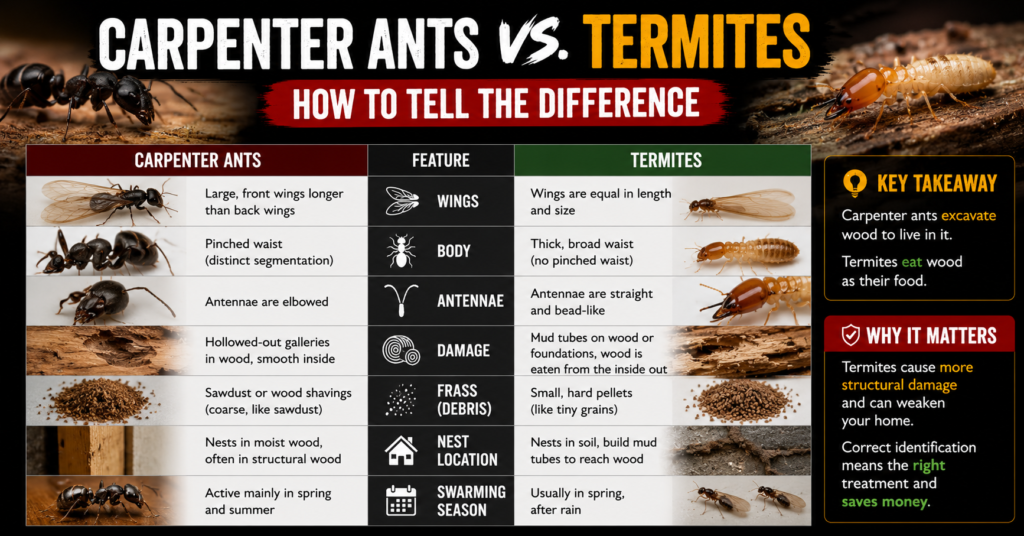
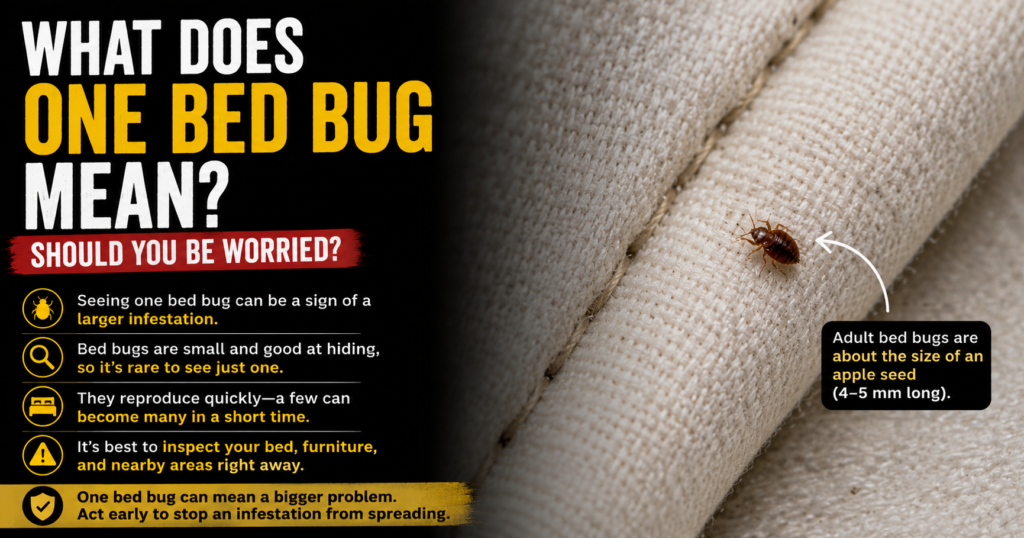
They are also not known to spread household diseases or infest buildings. Finding one near your house does not create the kind of concern associated with roaches, bed bugs, fleas, or ticks.
Can a Praying Mantis Fly?
Adult praying mantises have wings, but their flying ability varies considerably.
Males are usually lighter and more willing to fly. They may travel at night while looking for females and can be attracted to porch lights or other bright exterior lighting.
Females are generally heavier, particularly when carrying eggs. Some adult females can fly short distances, while others rarely fly or are nearly flightless.
Species also matter. A female Carolina mantis has relatively short wings that do not reach the end of her abdomen. Chinese mantises have longer wings that normally cover the abdomen, although large females may still be reluctant fliers.
Young praying mantises cannot fly because their wings are not fully developed. Wings become functional after the final molt into adulthood.
How Can You Tell a Baby Praying Mantis From an Adult?
A baby praying mantis is called a nymph. It resembles a miniature adult but does not have fully developed wings.
Young nymphs have:
- A triangular head
- Folded, spiny front legs
- A long body
- Six legs
- No functional adult wings
- A smaller and sometimes upward-curved abdomen
As the nymph grows, it sheds its exoskeleton several times. Small wing pads eventually become visible, but the insect cannot fly until it completes its final molt.

A newly hatched mantis can be extremely small and may feed on tiny insects, including fruit flies and aphids. Larger nymphs gradually begin capturing bigger prey.
What Is the Difference Between a Praying Mantis and a Walking Stick?
Praying mantises and walking sticks both have long, narrow bodies that blend into vegetation, but they are very different insects.
A praying mantis has a triangular head and enlarged spiny front legs that fold in front of its body. It is a predator that eats other insects.
A walking stick has a much smaller head and six relatively similar legs used for walking. Its body resembles a twig, and it feeds on plant material.
The front legs provide the easiest identification clue. If the insect has muscular, folded grabbing legs lined with spines, it is a mantis rather than a walking stick.
What Is the Difference Between a Praying Mantis and a Katydid?
A katydid may be green and leaf-shaped, but it does not have the mantis’s enlarged grasping front legs or highly mobile triangular head.
Katydids usually have extremely long threadlike antennae and powerful hind legs built for jumping. Their wings often resemble leaves, and many species are known for their nighttime calls.

A praying mantis uses its front legs to capture prey and usually waits silently for food. If the insect you found has long antennae, jumping legs, and leaf-like wings, this guide to identifying a katydid may be more helpful.
What Types of Praying Mantises Are Found in Missouri?
Missouri has three commonly encountered praying mantis species.
Carolina Mantis
The Carolina mantis is native to the United States. It is generally between two and two and a quarter inches long and may be pale green, tan, gray, brown, or mottled.
Adult females have wings that extend only partway down the abdomen. Their shorter wings and smaller size can help distinguish them from the much larger Chinese mantis.
Chinese Mantis
The Chinese mantis is a large nonnative species that has been established in North America since the late 1800s. It can grow more than four inches long and may be green, tan, brown, or a combination of these colors.
Brown individuals commonly have a green or pale stripe along the edges of the front wings. The wings usually cover the full abdomen.
This is the species I believe I photographed on our tree, although a clear view of the face and additional measurements would be needed for complete confidence.
European Mantis
The European mantis is another introduced species. It normally measures between two and three inches and may be green, cream, tan, or brown.
The best identifying mark is a dark circular spot on the inside of each front leg near where it joins the body. The spot may have a white center, giving it a bull’s-eye appearance.
Are Chinese Praying Mantises Invasive?
The Chinese mantis is nonnative and has been established in North America for well over a century. It was introduced accidentally and was later deliberately distributed in hopes that it would control crop and garden pests.
Whether people call it invasive can depend on the definition being used. It is certainly introduced and widespread. There is also concern that large Chinese mantises may compete with or eat smaller native Carolina mantises.
Buying Chinese mantis egg cases and releasing them into a garden is not something I would recommend. They do not selectively target pests, and releasing more nonnative predators does not guarantee meaningful garden protection.
Finding an established Chinese mantis outdoors presents a more complicated decision. Some people remove them to protect native mantises, while others leave individual insects alone. Accurate species identification matters before deciding what to do.
Where Do Praying Mantises Live?
Praying mantises prefer areas with vegetation and plenty of insects to hunt.
They are commonly found in:
- Gardens
- Tall grass
- Meadows
- Pastures
- Shrubs
- Flower beds
- Woodland edges
- Overgrown fence rows
- Agricultural fields
- Trees near open areas
They may also appear on decks, siding, window screens, garages, and porches. Exterior lights attract moths and other insects, creating convenient hunting opportunities for mantises.
A praying mantis found near a house is usually there because the surrounding habitat provides food and shelter. It is not trying to enter the home and start an infestation.
Where Do Praying Mantises Go at Night?
Some praying mantises remain active after sunset, while others stay concealed among vegetation.
Adult males may fly at night while searching for females. Porch lights and other exterior lights can attract them, either directly or because insects gathering around the light provide abundant prey.
A mantis may spend the night on a branch, plant stem, flower, wall, or screen. Its location may change as it follows food or searches for a mate.
What Does a Praying Mantis Egg Case Look Like?
A praying mantis lays eggs inside a protective structure called an ootheca. The female produces a foamy material around the eggs that hardens into a tough case.
The finished egg case may look like:
- A tan foam blob
- A hardened piece of insulation
- A small toasted marshmallow
- A narrow ridged mass
- A brown growth attached to a twig
Egg cases are commonly attached to branches, bark, plant stems, fences, outdoor equipment, and other protected surfaces.
The shape can help identify the species. Chinese mantis egg cases are generally rounded and bulky. Carolina mantis egg cases are narrower, flatter, and more elongated.
The eggs remain protected through winter and hatch when warmer weather returns.
What Is the Praying Mantis Life Cycle?
A praying mantis develops through three main stages:
- Egg
- Nymph
- Adult
It does not have a caterpillar-like larval stage or a pupa. A newly hatched nymph already resembles a tiny wingless mantis.
The eggs overwinter inside the ootheca. Nymphs emerge during spring and begin feeding on small insects. They molt repeatedly throughout spring and summer, becoming larger after each molt.
The final molt produces a winged adult. Adults mate and females create new egg cases during late summer or fall. In colder parts of the United States, freezing weather kills most adults while the protected eggs survive until the following spring.
Most praying mantises complete this cycle within approximately one year.
Why Do Female Praying Mantises Eat the Male?
Female praying mantises sometimes eat males during or after mating, but this does not happen every time.
Mantises are naturally cannibalistic predators. A hungry female may view the smaller male as food, especially if he approaches carelessly or the two insects are confined together.
Sexual cannibalism has often been observed in captivity, where the male has fewer opportunities to escape. It occurs in nature too, but it is not an unavoidable ending to every mantis mating.
Eating the male provides the female with nutrients that can contribute to egg production. From the mantis’s perspective, another mantis is both a potential mate and a potential meal.
What Should You Do If You Find a Praying Mantis?
If the mantis is outdoors and not in danger, you can usually leave it alone.
It is not damaging the tree, shrub, siding, or outdoor furniture where you found it. A mantis resting on a plant is normally waiting for prey or using the vegetation as camouflage.
If one enters your house, place a container over it and carefully slide a piece of stiff paper underneath. Carry the covered container outside and release the mantis onto a shrub or other sturdy vegetation.
Avoid grabbing it around the abdomen or wings. Its body can be injured easily, and restraining it increases the chance of a defensive pinch or bite.
Does Finding One Praying Mantis Mean There Are More?
Finding one adult does not mean you have a praying mantis infestation.
Mantises are generally solitary predators. They may share the same favorable habitat, but they do not create indoor colonies or travel together as adults.
An egg case is different because it can contain dozens or even hundreds of young mantises. Many may emerge in the same area, but the nymphs quickly disperse. Those that remain crowded together may eat one another.
Several mantises in a garden usually indicate that the habitat provides vegetation and prey. It does not mean your home requires pest treatment.
Why a Praying Mantis Is Easy to Miss
Praying mantises survive by remaining unnoticed. Their narrow bodies resemble stems, while their green, brown, or gray coloring matches living plants, dry vegetation, and tree bark.
The praying mantis I found was large enough that it should have been obvious. Even so, its brown wings blended almost perfectly into the tree, and its green legs disappeared against the yard behind it.
That camouflage serves two purposes. It helps the mantis avoid birds and other predators while allowing it to remain hidden from the insects it hunts.
Once you recognize the triangular head, folded front legs, and long body, identifying a praying mantis becomes much easier. Determining the exact species can require a closer look at size, wings, facial markings, front-leg markings, and sometimes the shape of a nearby egg case.
Frequently Asked Questions
Is a praying mantis a bug or an insect?
A praying mantis is an insect. It has six legs, three main body sections, antennae, and an exoskeleton. People commonly call all insects bugs, although mantises are not classified as true bugs in the scientific order Hemiptera.
Is a brown praying mantis still a praying mantis?
Yes. Praying mantises can be brown, tan, gray, green, or mottled. Brown coloring helps them blend into tree bark, dead vegetation, and dried plants.
Can a praying mantis turn its head all the way around?
A praying mantis can turn its head approximately 180 degrees, giving it an unusually wide viewing range for an insect. It cannot rotate its head completely around.
Does a praying mantis have teeth?
A praying mantis has chewing mouthparts rather than teeth like a person or mammal. These mouthparts allow it to eat captured insects.
Will a praying mantis chase a person?
No. A praying mantis does not hunt or chase people. It may turn its head to watch you, raise its front legs defensively, or attempt to move away.
Can a praying mantis hurt a dog or cat?
A praying mantis is unlikely to hurt a dog or cat. A large mantis may defend itself if an animal mouths or paws at it, but it is not venomous and does not have a stinger.
Should I kill a praying mantis near my house?
Usually not. A praying mantis outdoors is not infesting or damaging your house. If identification confirms a nonnative Chinese or European mantis, some people choose to remove it to protect native mantis species, but accurate identification should come first.
What time of year are praying mantises most noticeable?
Adults are most noticeable during late summer and early fall after they have reached full size. Egg cases remain visible throughout winter, and tiny nymphs begin appearing after the eggs hatch in spring.
How long does a praying mantis live?
Most praying mantises live for approximately one year. Eggs survive winter, nymphs hatch in spring, adults mature during summer, and the next generation of eggs is deposited before cold weather kills the adults.
Caleb Warren is a longtime gardener and backyard insect researcher who writes practical identification guides for WhyDoIHaveBugs.com, helping homeowners understand the insects they find before deciding whether any action is needed.