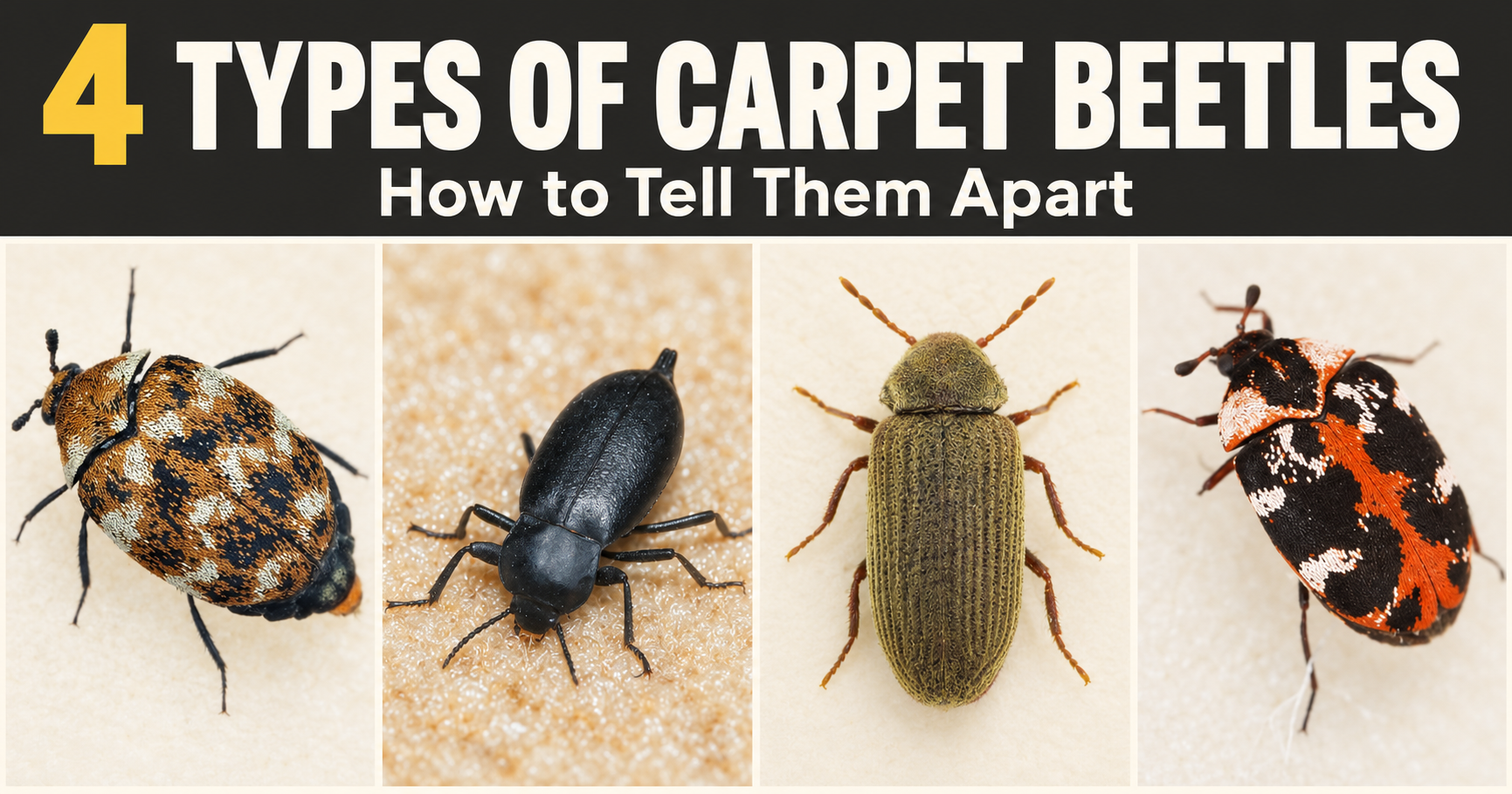
If you’ve been searching for pictures of carpet beetles, you might have noticed something confusing. Some are tiny, round insects covered in white and brown spots. Others are solid black, more oval-shaped, and look almost like completely different bugs.
That’s because there isn’t just one type of carpet beetle. Several species commonly show up in American homes, and their colors, markings, sizes, and even larvae can look surprisingly different.
Four of the most important types to recognize are the varied carpet beetle, black carpet beetle, furniture carpet beetle, and common carpet beetle.
All four belong to the dermestid beetle family, and their larvae can damage certain natural materials around your house. But you don’t need to be an entomologist to spot some of their most noticeable differences.
Let’s compare them so you have a better idea of which carpet beetle you’re actually finding.
Are There Different Types of Carpet Beetles?
Yes. There are numerous carpet beetle species, but four are especially important household pests in the United States.
The main types you’ll encounter in American pest identification guides are:
- Varied carpet beetle: A tiny, rounded beetle with mottled white, brown, and yellowish markings.
- Black carpet beetle: A darker, somewhat elongated beetle that usually lacks the colorful spotted pattern.
- Furniture carpet beetle: A rounded beetle with an irregular pattern of white, yellowish, orange, and dark scales.
- Common carpet beetle: A small, patterned beetle that can have distinctive pale and reddish-orange markings.
Their names can be misleading.
For example, furniture carpet beetles don’t live exclusively in furniture, and black carpet beetles aren’t always completely black.
Likewise, varied carpet beetles don’t necessarily have the same pattern throughout their adult lives.
These details matter when you’re trying to identify a small insect you found on a windowsill or near your carpet.
1. Varied Carpet Beetle: The Tiny Spotted One
Scientific name: Anthrenus verbasci
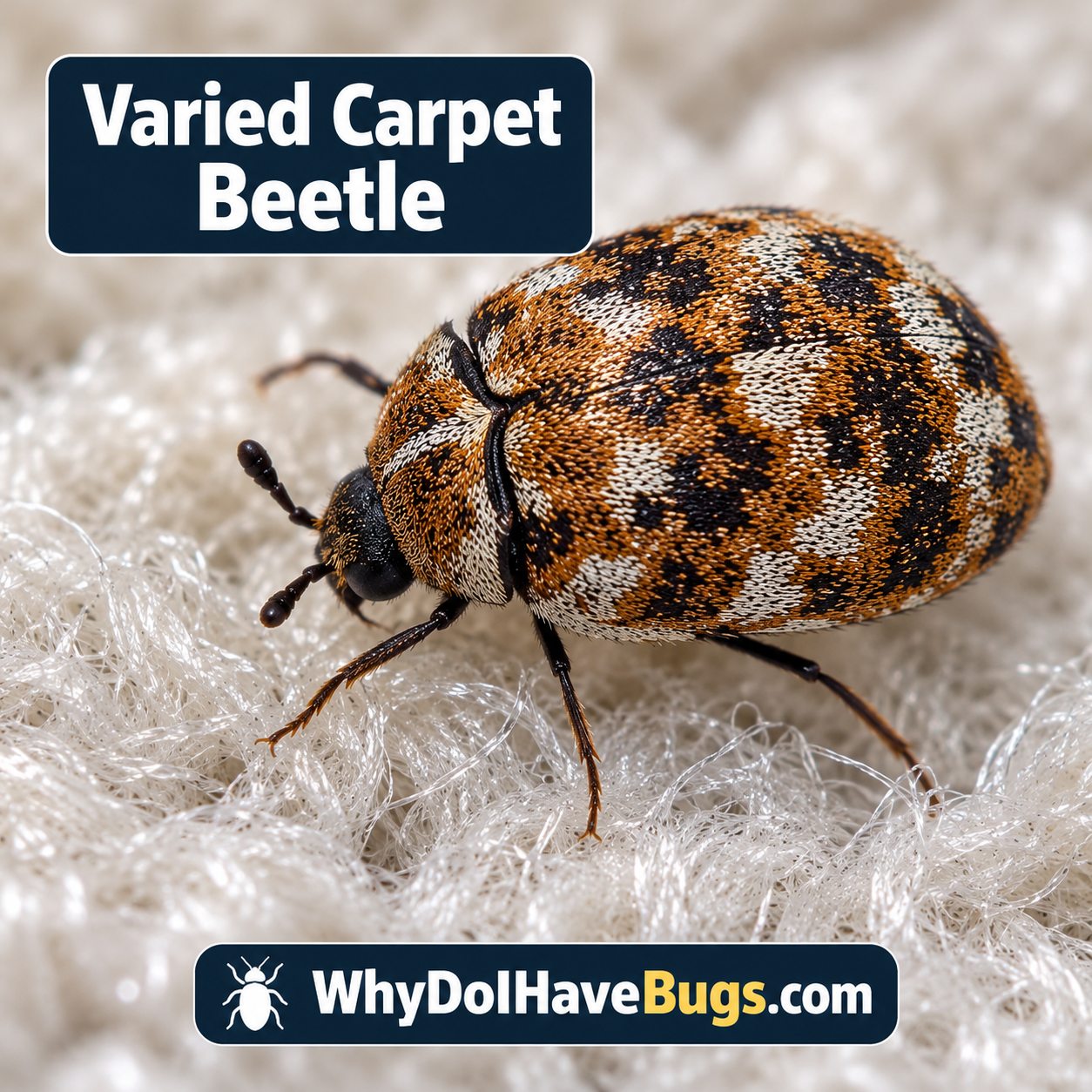
The varied carpet beetle is one of the most recognizable carpet beetles because of its unusual coloring.
Adults are very small, commonly around 1/10 inch long, with a rounded, convex body.
Instead of having one solid color, they appear mottled.
Their wing covers are decorated with tiny scales in shades of white, brown, dark yellow, and black.
From a distance, the combination can make the beetle look grayish, speckled, or even slightly checkered.
How to Recognize a Varied Carpet Beetle
I’d look for a small, rounded body with irregular light and dark patches.
The markings generally don’t form perfectly symmetrical spots like those on a ladybug.
Instead, they create a scattered, uneven pattern across the beetle’s back.
You may find adults crawling along windowsills in spring or early summer.

They’re capable of flying and may gather around windows because they’re attracted to light. Their window-seeking behavior is easier to understand after seeing why carpet beetles fly.
One interesting detail is that the colored scales can wear off as the beetles age.
An older varied carpet beetle may look much darker than a freshly emerged adult.
That means a carpet beetle that looks mostly brown or black could still be a varied carpet beetle.
What Do Varied Carpet Beetle Larvae Look Like?
The larvae look nothing like the colorful adults.
They’re brownish, hairy insects with alternating lighter and darker bands across their bodies.
Their shape is often broader toward the rear and narrower toward the head.
They also have distinctive bristly tufts near the back of their bodies.
Those hairs are especially noticeable under magnification.
Varied carpet beetle larvae may feed on wool, fur, feathers, dead insects, hair, and other suitable animal-based materials.
They’re also associated with old bird nests and similar sources of animal debris.
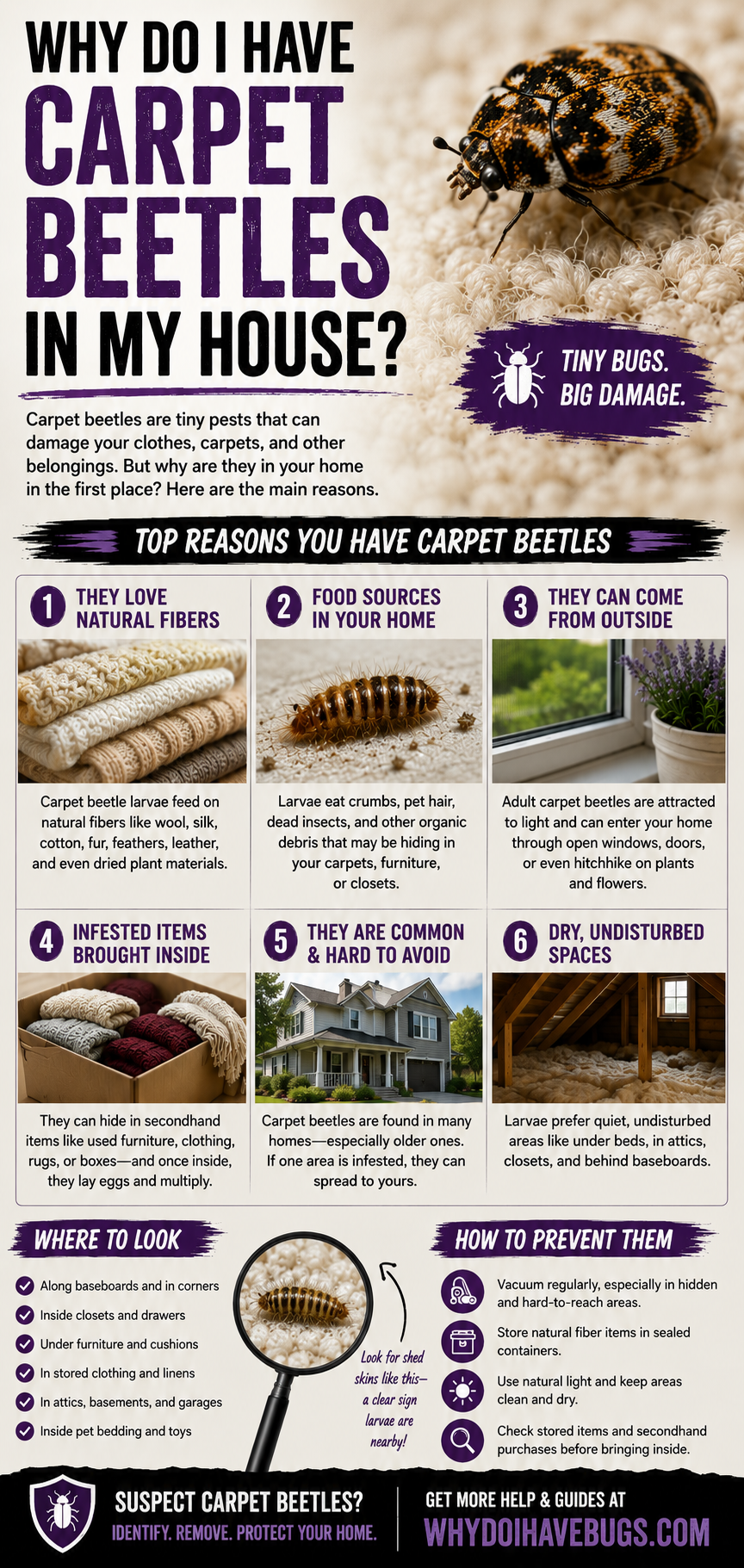
If you’re finding these larvae but no adult insects, our article about why carpet beetle larvae hide in unexpected places can help you narrow down where they’re developing.
2. Black Carpet Beetle: The Solid Black or Dark Brown One
Scientific name: Attagenus unicolor
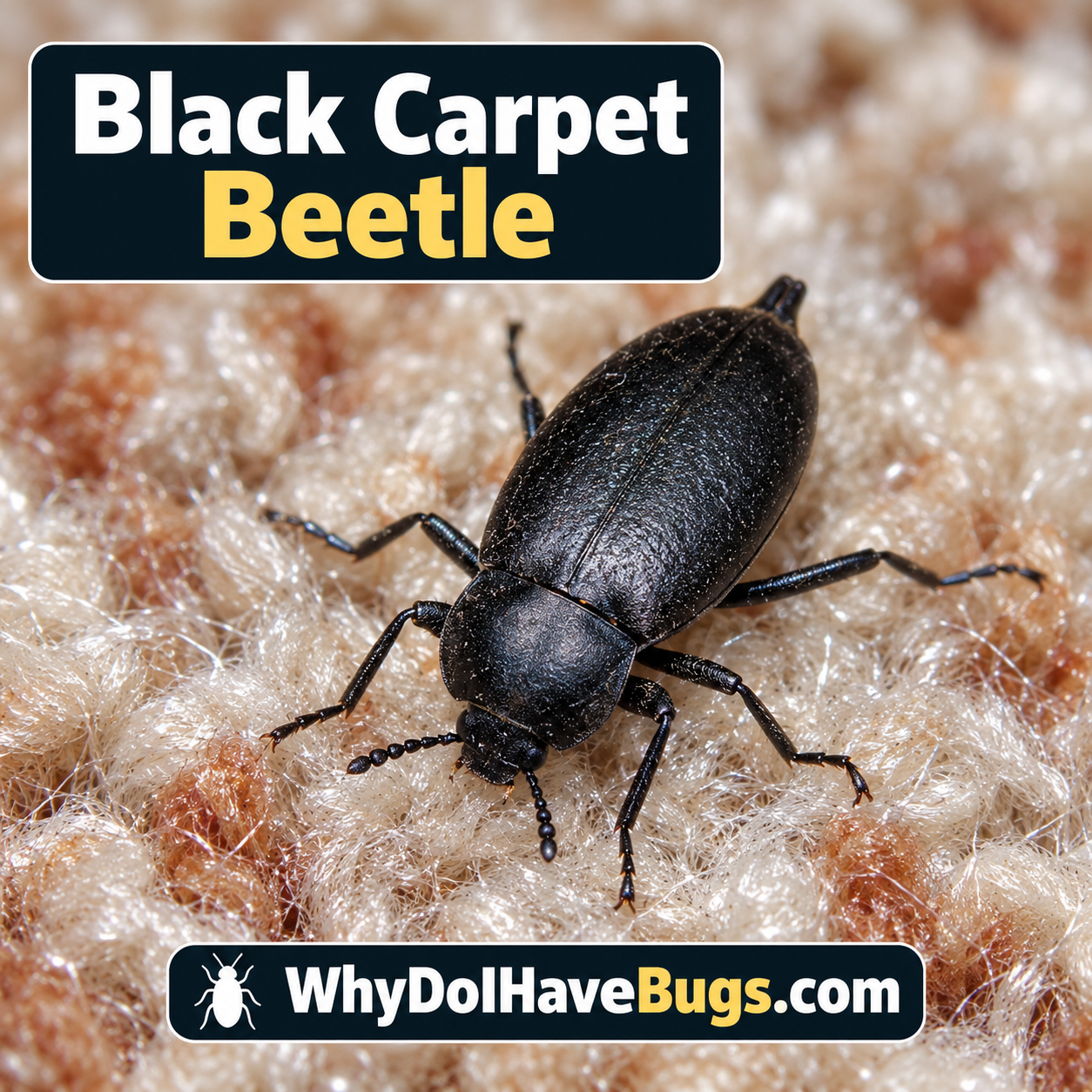
Black carpet beetles look noticeably different from the varied type.
Instead of having a very rounded body covered in colorful scales, adults are generally more elongated and oval.
They commonly measure about 1/8 to 3/16 inch long.
Their bodies are dark brown to black, sometimes with a slightly shiny appearance.
Their legs may appear brownish.
If you find a small, dark beetle wandering near your baseboards, there’s a chance it could be a black carpet beetle.
However, plenty of unrelated household beetles look similar, so color alone isn’t enough to identify one.
How to Recognize a Black Carpet Beetle
The easiest visible differences are its relatively elongated body and uniform dark coloring.
It generally doesn’t have the obvious mottled white and yellow patches of a varied carpet beetle.
Some adults appear nearly jet black, while others are dark brown.
A close-up view can reveal the beetle’s oval shape, wing covers, antennae, and brownish legs.
Black Carpet Beetle Larvae Look Different Too
Black carpet beetle larvae are often described as carrot-shaped.
They have elongated bodies that become narrower toward the rear.
Their coloring ranges from golden brown to very dark brown.
One of their most recognizable features is a long brush-like tuft of hairs at the end of the body.
Although they have body hairs, they don’t necessarily look as densely fuzzy or strongly banded as varied carpet beetle larvae.
Fully developed black carpet beetle larvae may reach around 1/2 inch long, making them considerably larger than the adults.
These larvae can feed on animal-based materials such as wool, fur, feathers, and dead insects.
They may also infest certain stored foods, including grain products.
This is why a black carpet beetle infestation isn’t necessarily limited to your living room carpet.
3. Furniture Carpet Beetle: The Round Beetle With Yellowish Markings
Scientific name: Anthrenus flavipes
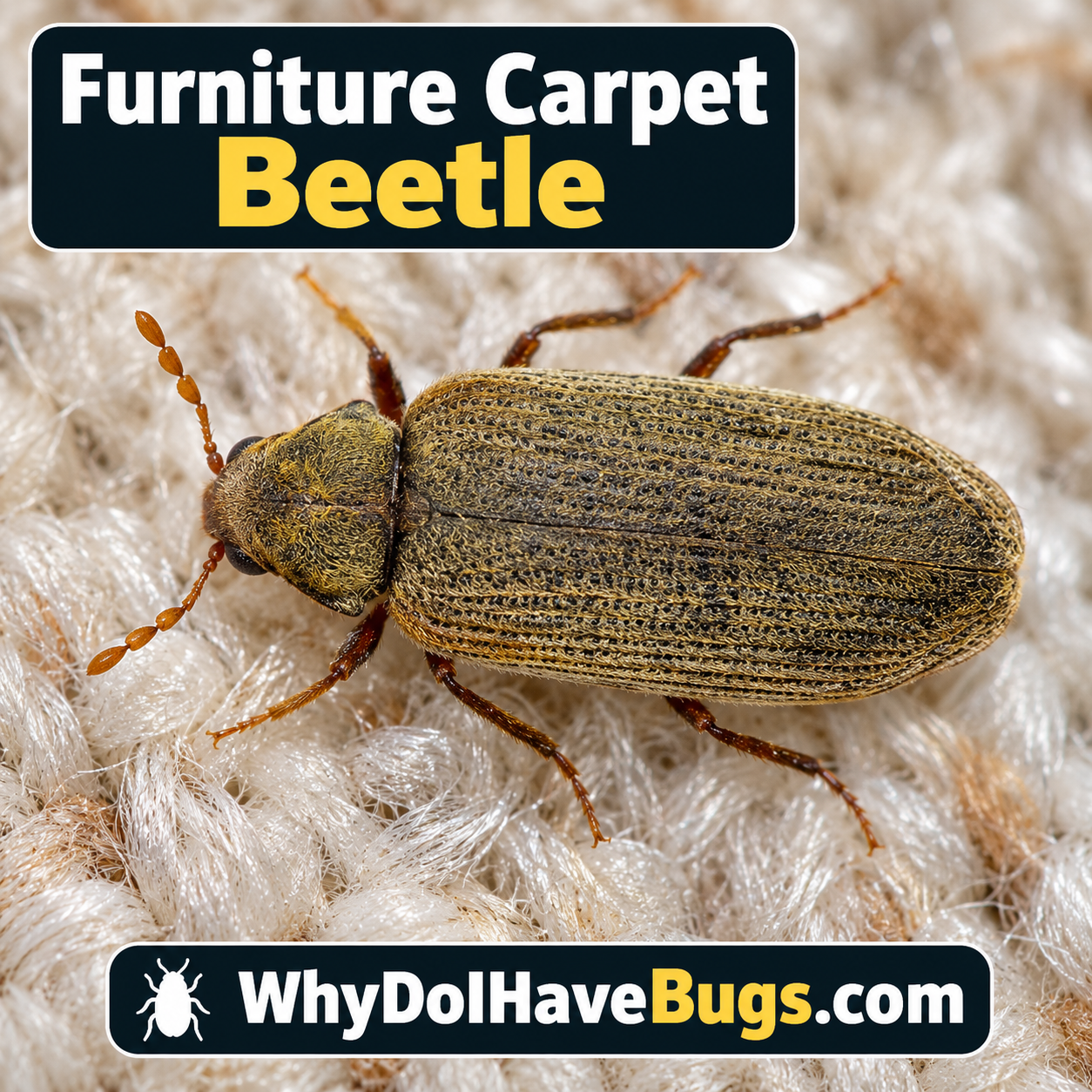
Furniture carpet beetles are another patterned species.
At first glance, they can look similar to varied carpet beetles.
Both are tiny, rounded insects with contrasting markings.
However, furniture carpet beetles are generally somewhat larger and rounder than varied carpet beetles when viewed from above.
Their coloring typically combines white, dark yellow or orange, and black scales.
These colors create irregular mottled patterns across the wing covers.
The underside of an adult furniture carpet beetle is covered in pale scales.
How to Recognize a Furniture Carpet Beetle
The adult’s shape and arrangement of scales are useful clues.
Furniture carpet beetles tend to be noticeably rounded, and their pattern may include orange-yellow scales mixed with black and white markings.
However, there’s a complication.
Like varied carpet beetles, they can lose some of their colored scales as they age.
An older furniture carpet beetle may appear much darker than expected.
A solid-looking black beetle isn’t automatically a black carpet beetle.
For reliable species identification, an expert may need to examine the insect under magnification.
What Do Furniture Carpet Beetle Larvae Look Like?
Young furniture carpet beetle larvae can be pale when they first hatch.
As they develop, they become darker, often taking on a reddish-brown or chestnut-brown appearance.
Their body shape is an especially interesting difference.
Furniture carpet beetle larvae are generally broader near the head and narrower toward the rear.
Varied carpet beetle larvae show the opposite tendency, being broader toward the rear.
The larvae can damage many of the same animal-based materials as other carpet beetles.
This includes woolen fabrics, certain upholstery materials, fur, feathers, and similar items.
Despite the name, finding a furniture carpet beetle doesn’t automatically mean the beetle is eating your couch.
The larvae may be developing in another nearby food source.
4. Common Carpet Beetle: The One With Reddish-Orange Markings
Scientific name: Anthrenus scrophulariae
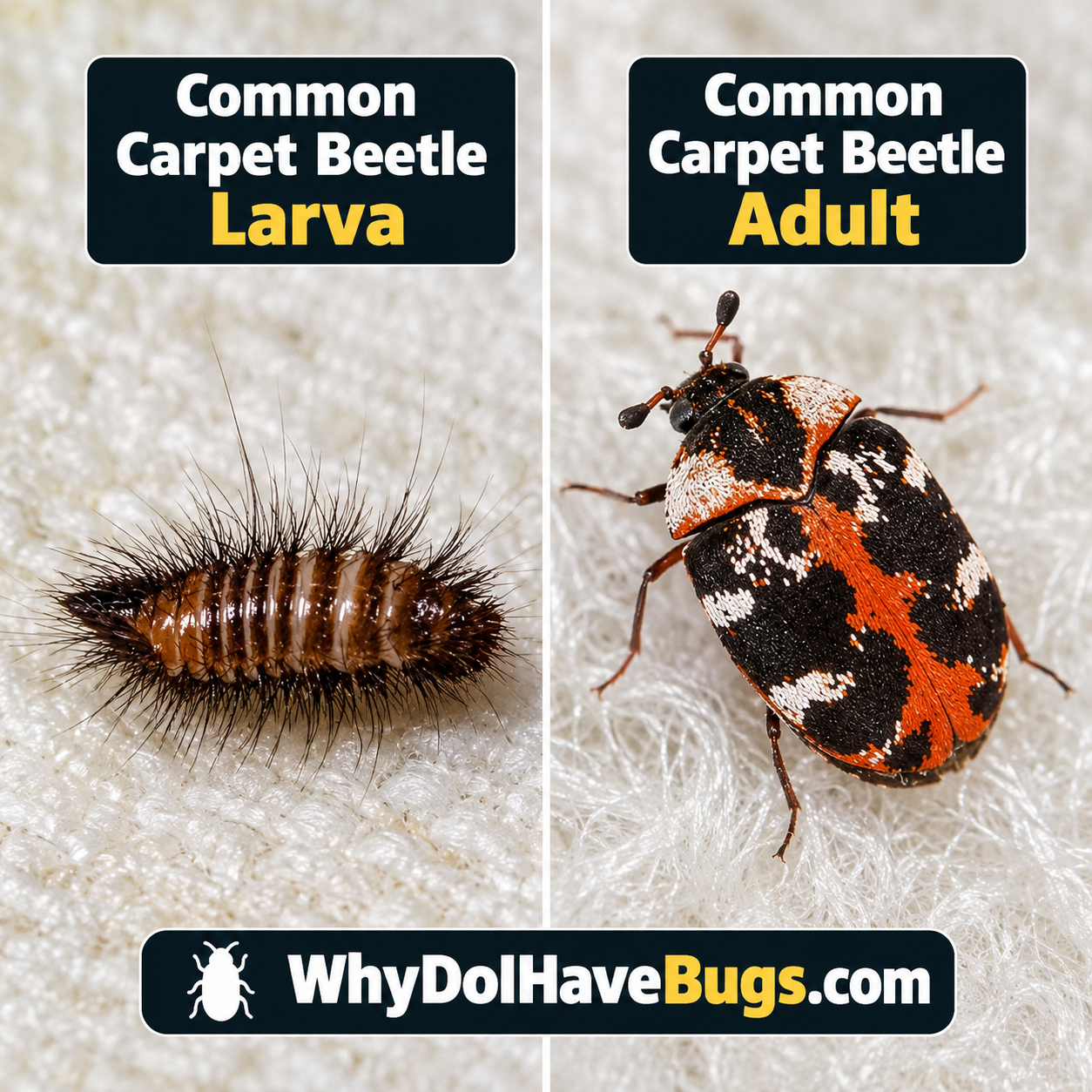
The common carpet beetle is another small, rounded species.
Its name may sound generic, but its appearance can be quite distinctive.
Adult common carpet beetles often have dark bodies with pale scales and reddish-orange or orange-red markings.
The arrangement of these scales can create contrasting bands or patches.
Some individuals have especially noticeable orange-red scales near the middle of the back.
Depending on the viewing angle and condition of the insect, the colors can be subtle or quite striking.
How to Recognize a Common Carpet Beetle
Look for a very small, rounded beetle with dark coloring and patches or bands of pale and reddish-orange scales.
It may resemble a varied carpet beetle at first.
The exact scale pattern can help distinguish the species, although this can be difficult without a magnifying lens.
Wear and age can also change how strongly the colors appear.
This is why I wouldn’t identify a carpet beetle species solely from a blurry phone picture.
What Do Common Carpet Beetle Larvae Look Like?
Common carpet beetle larvae are brownish, hairy, and generally similar to those of other Anthrenus species.
They have bristles and a banded appearance, but the fine differences between species can be difficult to distinguish without close examination.
If you’ve found a hairy larva in your carpet or closet, identifying it as a carpet beetle larva may be easier than determining the exact species.
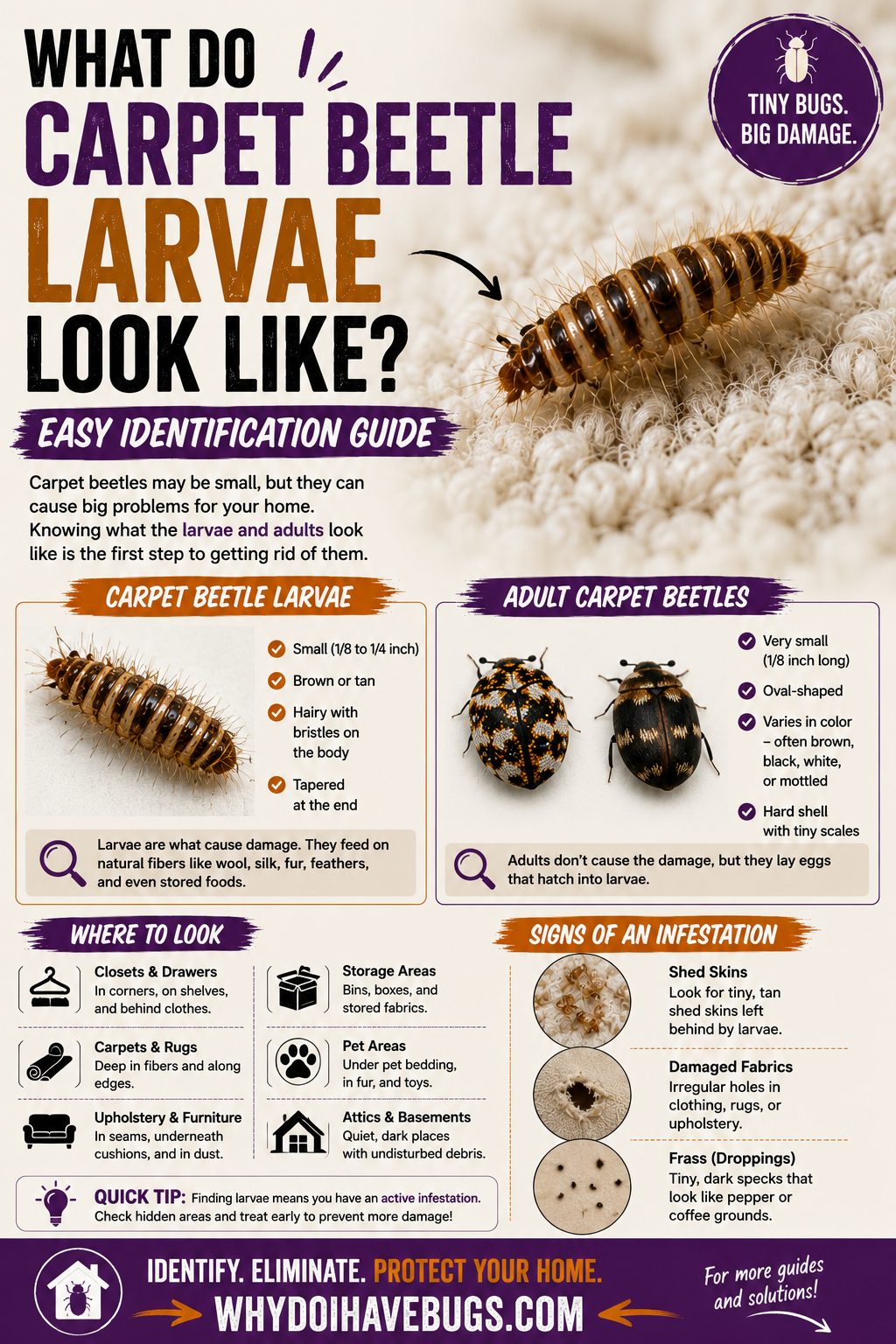
Our separate guide to what carpet beetle larvae look like provides more detail on recognizing larvae rather than adult beetles.
Which Carpet Beetle Has White and Brown Spots?
If you’re finding a tiny round beetle with white, brown, and yellowish spots, the varied carpet beetle is one of the first species to consider.
However, furniture carpet beetles and common carpet beetles can also have patterned wing covers.
The exact arrangement of the markings matters.
Varied carpet beetles have irregularly distributed scales that can create a scattered, speckled appearance.
Furniture carpet beetles often feature yellowish or orange scales mixed with white and dark markings.
Common carpet beetles may show more obvious reddish-orange markings.
These differences can be difficult to see with the naked eye because the beetles are so small.
A magnified photograph is much more useful than trying to judge the colors from across the room.



Why Do Some Carpet Beetles Look Completely Black?
There are two important explanations.
First, you may actually have black carpet beetles.
Adults of this species normally have dark brown to black bodies without the colorful mottling associated with several other carpet beetle species.
Second, an older patterned carpet beetle may have lost its colored scales.
The scales give varied and furniture carpet beetles much of their distinctive appearance.
When enough of those scales wear away, the beetle can look darker and less recognizable.
That’s why the absence of colorful spots doesn’t prove you’ve found a black carpet beetle.
Look at the insect’s body shape, size, remaining scales, and other characteristics.
If species-level identification matters, an extension entomologist or another qualified insect identification service may be able to examine a specimen.
Are Baby Carpet Beetles Different Colors?
Yes, but it’s helpful to understand the carpet beetle life cycle.
Carpet beetles go through complete metamorphosis, which means they develop through egg, larva, pupa, and adult stages.
The larvae don’t simply look like smaller adult beetles.
Instead, they’re elongated and often hairy.
Different species have larvae with different body shapes, colors, and arrangements of bristles.
Varied carpet beetle larvae are usually noticeably banded and bristly.
Black carpet beetle larvae are more elongated and have a distinctive brush-like tuft at the rear.
Furniture carpet beetle larvae become darker as they develop and have a different body shape from varied carpet beetle larvae.
The species differences are often easier to recognize with magnification than by comparing their general brown coloring.
If you find a tiny brown insect crawling around your baseboard, it may be a larva rather than an adult.


Do All Carpet Beetles Damage Carpets?
No. Not every carpet beetle you find has been feeding on carpeting.
In fact, the name can give people the wrong impression.
Most of the damage associated with carpet beetles comes from their larvae feeding on suitable materials.
These may include wool, feathers, fur, animal hair, dead insects, and certain natural-fiber products.
Some species, particularly black carpet beetles, can also damage or contaminate stored grain products.
Clean synthetic carpeting generally isn’t a preferred food source, although accumulated animal hair and debris within it can support larvae.
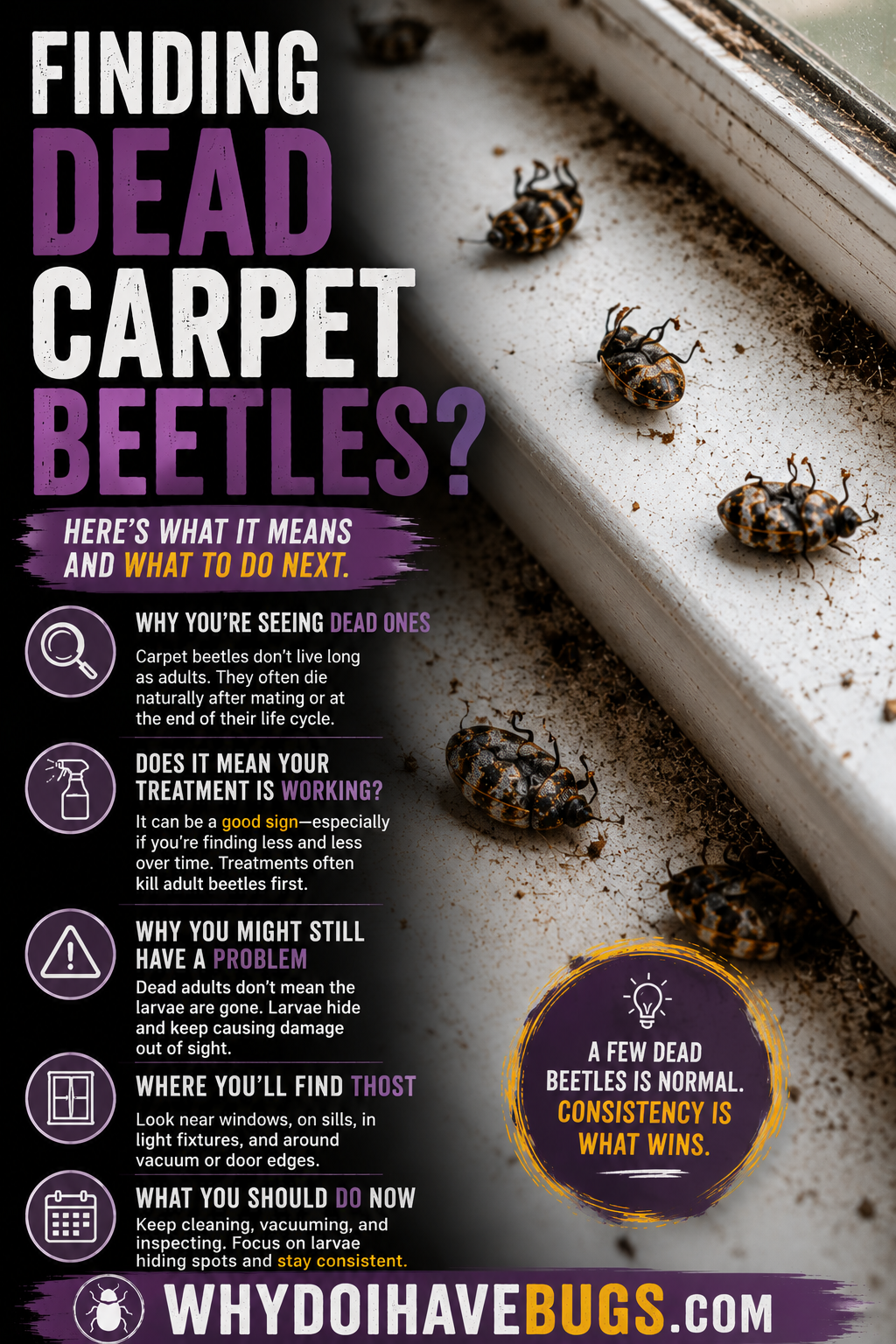
Adult carpet beetles usually don’t cause the fabric damage that makes these insects household pests. Their presence can still be worth interpreting alongside the location and frequency of dead adults, as Adult carpet beetles explains.
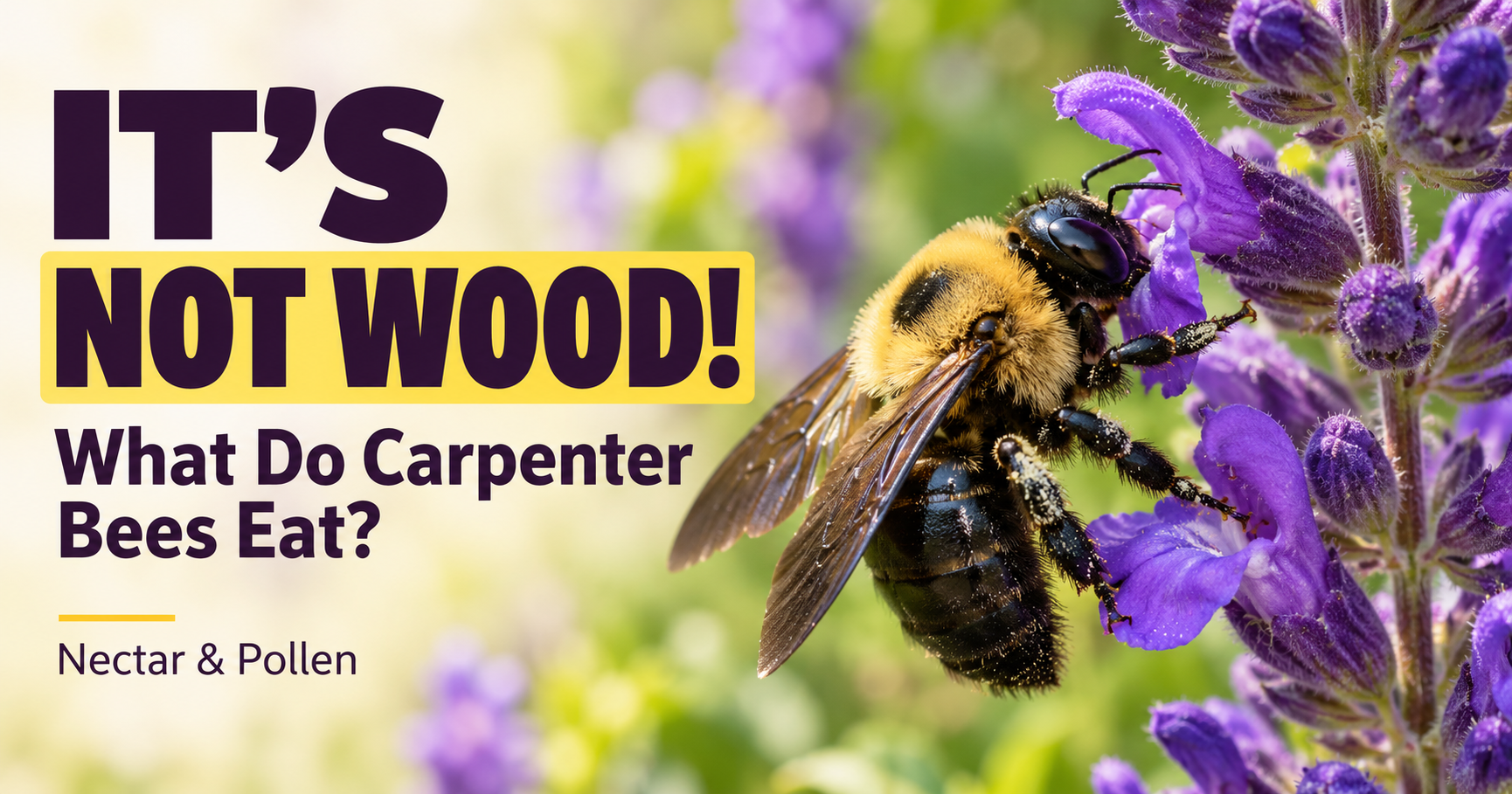
Many adults feed outdoors on pollen and nectar.
So if you’re finding several adult beetles around your window, that doesn’t necessarily mean they’re eating the carpet underneath it.

Our article about why carpet beetles show up around windows explains that situation in more detail.
Does the Type of Carpet Beetle Change How You Get Rid of It?
Usually, the overall approach is similar.
You want to locate the materials supporting the larvae, remove infested items when appropriate, and clean the areas where insects are developing.
However, identifying the species can offer clues about where to look.
For example, black carpet beetles may be associated with certain stored foods in addition to animal-based materials.
Varied carpet beetles may originate from materials such as old bird nests, dead insects, wool, and other suitable sources.
If you’re finding larvae near stored clothing, inspect vulnerable fabrics and nearby debris.
If the insects are concentrated in a pantry or food storage area, look for contaminated stored products and make sure you’ve identified the beetle correctly.
Thorough vacuuming is useful for removing larvae, shed skins, and accumulated debris.
Wash or clean affected fabrics according to their care labels.
Avoid spraying random areas of the house without finding the source.

For more detailed treatment instructions, our complete guide to getting rid of carpet beetles explains the cleanup and prevention process.
How Can You Tell Which Type of Carpet Beetle You Have?
If you’ve found a small beetle and want to narrow it down, start with the most obvious physical characteristics.
Look at the Overall Body Shape
Is the beetle nearly round or more elongated?
Varied, furniture, and common carpet beetles generally have rounded bodies.
Black carpet beetles are typically more elongated and oval.
This doesn’t identify the species by itself, but it’s a useful starting point.
Check Whether the Body Has Colored Scales
A beetle with mottled white, brown, yellow, or orange scales may belong to one of the patterned carpet beetle species.
A uniform dark beetle could be a black carpet beetle, although worn scales can make other species appear darker.
Use a magnifying glass or close-up photograph.
Examine Any Larvae You’ve Found
Larvae can offer valuable identification clues.
Look at whether the body is broad near the front or rear, whether it has obvious bands, and whether long hairs extend from the tail end.
Avoid touching the larvae unnecessarily because their bristles can irritate sensitive skin.
Save a Specimen if You’re Unsure
If you can’t identify the insect from its appearance, collect it in a small sealed container.
You can also take close-up photographs showing the top, side, and overall size.
A cooperative extension office or professional insect identification service may be able to help determine the species.
That’s especially useful if you suspect an infestation but aren’t sure whether the insect is actually a carpet beetle.
Frequently Asked Questions
How many types of carpet beetles are there?
There are numerous carpet beetle species, but four commonly discussed household pest species in the United States are the varied, black, furniture, and common carpet beetles.
What is the most common carpet beetle?
It depends on your location. Varied carpet beetles are commonly encountered in many areas, including Missouri, while black carpet beetles are also widespread household pests.
Are all carpet beetles black?
No. Some species have colorful patterns consisting of white, brown, yellowish, or reddish-orange scales. Others are predominantly dark brown or black.
What type of carpet beetle has white spots?
The varied carpet beetle is a common possibility, although furniture and common carpet beetles can also have pale markings. The shape and pattern of the scales help with identification.
What type of carpet beetle is completely black?
The black carpet beetle is one possibility. However, older patterned carpet beetles can lose their colored scales and appear mostly black or brown.
Are black carpet beetles worse than varied carpet beetles?
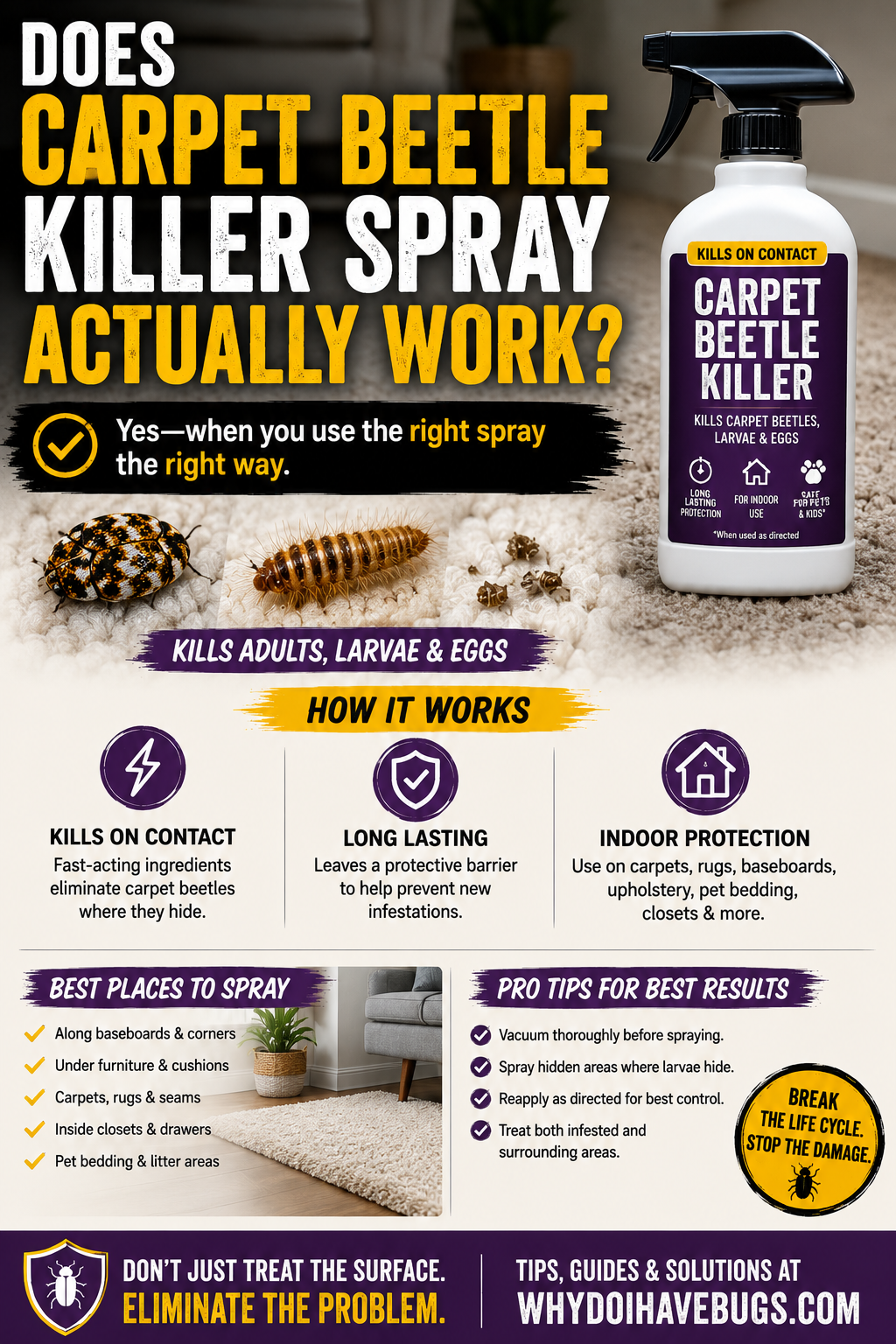
Both can damage susceptible materials. Black carpet beetle larvae may also infest certain stored grain products. The seriousness of an infestation depends more on its size, food sources, and location than the species name alone. Once the species and infestation conditions are clearer, readers can consider how carpet beetle killer spray fits into treatment.
Do different types of carpet beetles have different larvae?
Yes. Black carpet beetle larvae are typically elongated with a distinctive tail tuft, while varied and furniture carpet beetle larvae have different body shapes and arrangements of bristles.
Can you have more than one type of carpet beetle in your home?
Yes. Different species can occur in the same building, particularly when suitable food sources and entry points are available. Finding beetles with different appearances doesn’t automatically mean they’re different life stages of one species.
Can carpet beetles change color?
Adult carpet beetles don’t normally change into a completely different species color pattern as they age. However, patterned species can lose their colored scales, making them appear darker. Larvae can also darken as they develop.
Can you identify carpet beetles without a microscope?
Often, you can recognize an insect as a carpet beetle using a magnifying glass or close-up photograph. Identifying the exact species may be more difficult, especially when its scales are worn or the specimen is damaged.
About the Author: The writers at Why Do I Have Bugs help homeowners identify common insects, understand their behavior, and find practical ways to handle unwanted pests around the house.